The AI-Native Marketing Team: Doing More With Fewer People
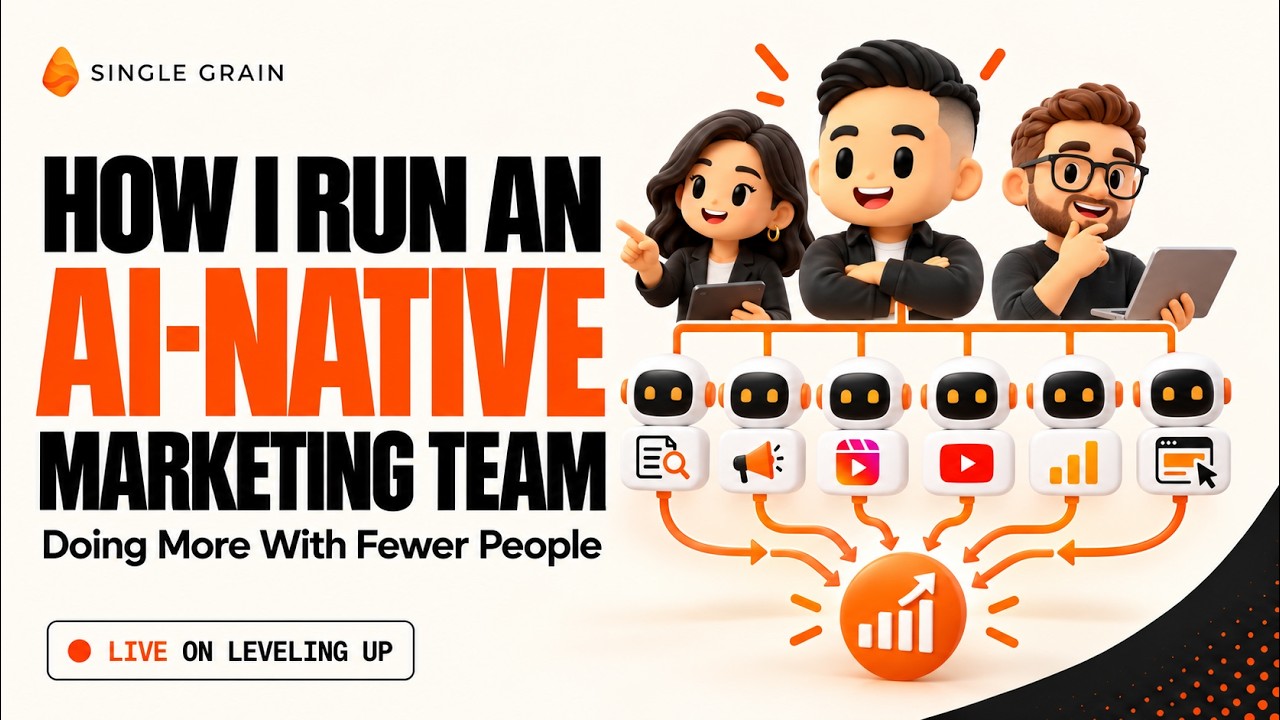
In this webinar, Eric Siu explains how the top 1% of marketers operate as forward‑deployed "agent managers" who build, hand‑off, and continuously improve AI agents (bots) to amplify their teams. He showcases the GrokBot Teams integration in Slack for AEO/SEO tasks, demonstrates how bots generate content ideas, audit GEO gaps, and produce high‑scoring drafts, then hands them to team members for refinement. Siu stresses the importance of specialization, judgment, and prioritization, arguing that AI should handle repetitive work while humans focus on high‑leverage decisions, recruitment, and creative judgment. He discusses hiring at Single Grain, the use of classification APIs (Jev, OpenAI Decisions), talent outreach automation, AI budgeting (average spend per employee), and ROI measurement (pipeline generation, output volume, time saved). Throughout, he emphasizes continuous learning via X, testing LLMs, and maintaining a high talent bar. The session ends with a Q&A covering tool choices, context management, team training, and AI budget allocation.
Chapters
How really how to become a forward-deployed marketer. And this is how the top 1% of marketers work today. And so I'm gonna wait for a couple people to come in. And while we wait, go ahead and type in where you're coming in from right now and we'll go ahead and get started. So I've been covering this recently. Like I have some videos coming out on the YouTube channel and talking about how the top 1% of founders work, right? And also the top 1% of marketers. But I wanna go a little deeper for this one. And then talk about how if you work in this way, the world is really your oyster and you can do much more than you ever imagined, right? Because I do believe that we're moving into a world now where our job is to actually be agent managers. And for whatever reason, because of human inertia, people still continue to want to work the same way. And what I will also say to you too is if you're already working in this way, we are hiring right now. So if you go to singlegrain.com/careers, We are hiring, right? Again, singlegrain.com/careers. So while we wait for some people to come in here, so we have, let's see, we have public chat over here. We have Jay coming in from the UK. We have Hector coming in from Santa Barbara. We have Tom coming in from Ontario, Canada. We've got Tampa Bay, right? We got a founder from Cyprus. Amazing. We got Bogotá, Colombia. Amazing. Terrell's coming in from Irvine. Okay. Not far away from where I am. Thank you, Max, for sharing that. We got Argentina. We got people coming from everywhere. That's awesome. So who's the guest? Put name and description. I'm the guest. Okay. I'm the guest. All right, cool. So I'm going to get us started here and I'm going to share a couple of things. Like GrokBot has a new— I'm going to show you the optimized way of playing with GrokBot, right? And this is going to— the meta is, guys, overall that we all need to become agent managers. As marketers, if we're not agent managers, we are now failures. That's how I see it, right? And most people are going to disagree with me, but I'm just like, me as an agent manager versus me without having agents, I would just roll over me without. And I was just thinking about this yesterday. I was like, how much stronger am I today versus a year ago? Because keep in mind, it hasn't even been a year yet, guys, when Opus 4 or 5 came out. Opus 4 or 5 came out in, let's say, November, but Things really started to take off last week of December 2025. We're not even there yet. And I'm like, how much stronger am I really? I just know that I would just run circles around the version of me without all these superpowers. So let me just cover the new new here because we like the new stuff. So let me cover the new stuff. And so I think we all know what GrokBot is, but let me just re-explain. GrokBot to me is becoming more and more interesting because Grokbot Teams has the ability for your team to collaborate with them inside of Slack. And then you can also share your bots with your team members, right? And you can monitor the usage that way. And then Elon today has even just said that with Grokbot, you can connect it to almost any of the other models except for OpenAI because they're enemies of OpenAI, right? But you can connect in your Claude, for example, if you have a Claude API token. And then there's other things that you can add into that. They're really trying to just drive a lot more usage from their harness. I think they probably have The best harness out there. Okay. So what I'm going to do right now, those of you that are, it doesn't matter if you're familiar or unfamiliar with GrokBot, I'm going to show you my Slack channel in terms of how I'm trying to work with it from an AEO SEO standpoint and how I'm already starting to try to hand off my bots. Okay. So some of you that have been watching these webinars for the last few weeks or so, you have seen that I have been making these bots. I've been tweaking these bots. But if you're doing that and you're just managing all that by yourself, you're not going to be able to drive true leverage. You need other people on your team to be able to do so because You might be able to get it to 70, 80% there, but it's truly the people that are on your team that are in the trenches. They're going to have a lot more context than you have and they're going to be able to tweak it to make it even better. Let me share my screen over here. This is our Slack channel. This is our Slack channel. Then you can see in this Slack channel, we're just testing this right now. We have these different agents inside this channel. Doodoo over here is my ChatGPT dot. It has a lot of context from how I Build things and it uses Astra. So when I needed to do heavier thinking inside of Slack, I have it do that. Okay. Now, Team GEO Audit. What does this do exactly? So this finds the SEO, GEO citation gaps and it writes fixed briefs. And then so we can basically attack competitor gaps when it comes to AEO or GEO, whatever you want to call it. Then we have the Team AEO SEO Bot, which I'll cover in a second. And then we have the Team SEO AEO Measurement. Okay. I had these sitting privately as bots inside of my GrokBot, but now I've introduced them inside of Slack. We are now, even though GrokBot graciously hooked up all these accounts, now we're just paying for them all. It's so good to the fact that our team, there's an uproar yesterday when GrokBot, basically they had some issues with it. That means that they have product market fit here because people are really mad when it's not around. What I would say is this, when you look at this channel, what it's really doing here is from an AEO SEO standpoint is it's looking at content that I'm putting out from an external content standpoint or internal content standpoint. And then it's mapping out what we should perhaps be drafting to the blog from an AEO SEO standpoint. Okay? So a headline here might be OpenAI Dots versus Grokbot versus Muse, which agent should you buy? Or B2B content formats ranked S to D tier, why case studies beat short form for leads. And how to stop AI ads from burning $100K before anyone checks. Or lead sources ranked S to D tier for B2B referrals and emails to win. So I'm familiar with all of these because I covered these in various short form pieces of content or even like my podcast on Marketing School or my leveling up videos. So what happened over here is Jev, Jev is a classifier. It's an API that you can use where it can basically classify things very quickly for cheaper. It can classify things very quickly as well. It basically looked at our evaluation for, hey, what should be considered clear? So it suggested 12 ideas initially and Jeff only passed 7 based on the criteria that we have. And then you can see over here, it's like, oh hey, we actually, here's the tape where we were talking about this. Could be from Granola Notes, could be from YouTube, could be from YouTube over here. And then it also shows the closest tape, basically meaning have we published this piece of content already? So my point of showing you this is that this is nice, but it's too much for you to manage, especially if you're a marketing leader or if you run the company. You can manage this. Sure, you can create all these bots, but if you have to be the one that's spinning all these plates all the time, you cannot work on the high leverage things that only you can do. Maybe you're getting a deal done. Maybe you're recruiting someone. Those are only things that you can do. If someone else is not doing their job ultimately, well then You let them go, right? So, well, if the bot isn't doing its job, then you let it go, right? But if the bot is doing its job and you have someone that you can hand it off to, well, then you promote those people, right? That's ultimately what you want. So me getting it in here has been unlocked now because I talked to the team this morning. I said, hey, I kind of set the marching orders for this and you can see a lot's going on in here and we have to continue to tweak the channel, right? So Haley in here is like, hey, what do you want to have by the end of the week? And do you want published content or mainly polished content? She's like, I would like to prioritize this. Isaac's already working with this in different ways now. Until today, we haven't had this, or actually yesterday we hadn't unlocked this. Now let me show you a point of value over here where I got my value. Okay? So it's like, okay, hey, these posts over here look like they're good to publish. Okay? Programmatic SEO and AI Search Visibility Playbook for B2B SaaS. That's not bad. JEV versus your SDR queue. How we cut 60,000 leads to 2,000 ICP fits. Before outreach. Okay. That's not bad. So these titles are getting better. But the problem is if I'm spinning like 20 different plates at the same time, I can only allocate so much focus, right? But if I have one area of focus, I can power that up a lot more. But if I have like 5 or 10 or 15 areas of focus where I have to keep managing different areas, I can't get things done. That's why in your company right now, if people can't get things done, then you have to do their job ultimately, right? Which is not a good thing. Yeah. And even if they don't know how to do their job and you hand them a bot like this, they still won't know how to do their job, right? So you still probably have to let them go, which you don't want to do. So this is why I say the top 1% of marketers, they work like this. They build leverage, they build bots, they hand off the bots, and then they move on to other areas because 99% of people are not going to build bots as of today's recording. Okay? Because keep in mind, it hasn't even been a year yet. So what did I do in this case? Look, there's 50 replies in this thread. So I said, hey, you know what? I was like, okay, okay. I was like, Haley, can you review these over here? Give me your thoughts. Okay. I was like, hey, does this one look pretty good? And you know what she says? Hey, to be honest, this looks very AI. It doesn't look that good. And I was like, okay, well that's good feedback because I'm not going to have the same level of detail or care that she has when it comes to, let's say, editing a piece of content. All right. So then it's like, I'm like, okay, hey, can you take that feedback and tell me what you would actually intake? So see the link above. Here you don't see me getting offended. Here I see this as being able to collaborate with my team on this bot allows us to make idea babies and these idea babies are much better than just one person's idea. I'm not going to pretend that I have all the answers. And a 1%er marketer doesn't have all the answers. So she says all these things over here and she's like, okay, based on the feedback that she gave, here's what I would actually lock from an eval standpoint. So that's the definition of success. So what she said was like, hey, the title must pay a promise. Stats must already be named. They must be hyperlinked. We need to have an anti-robot voice cap. And then she asked me today on a call, she's like, are you willing to let it talk in first person? I'm like, yeah, I'm fine with that. She's like, can we do this? Can we do this? Can we do this? I'm like, yeah, we should do it, right? Because I'm not that close to the work. And so what happened over here, I was like, you know what? Let's have it compete. I said, hey, show me the before and after HTMLs of these files. Okay. And I'll show you guys in a second. And tell me what we would codify from this set. And so, okay. He's like, okay, Team SEO AEO bot starts working again. And it's like, okay, well, the before version is a 58 out of 100, which is an F. Now the after version is an 86 out of 100. Haley's comments impact are 84 out of 100. It's systemic for this set. Undefined tools, fake anonymized reviews, title promise drift, tip pile mismatch, robotic voice, weak Yoast score. All right, so let's take a look at this. I've just— this is my first time looking at this, by the way. Okay, so this is the before version. Let's take a look at this. You know what? It's not designed well, so that makes it harder to look at. So let's see what this looks like. Okay, we're just going to look at the intro here. We're just going to look at the text. Okay, so here's the before text. Okay, so before text, quick overview. This playbook is for growth and creative ops who want AI video ads without turning every render into a hero project. The job is running Sea Dance videos into Meta ads as a manager agent job, clear inputs, clear outputs, review gates, and a kill switch. The mechanism is a pipeline that generates variants, packages the AI, right? I'll always say it's AI. You could just read that right now. Let's look at this one over here. So quick overview. On the 11,000 Ads in 1 Month episode, Cody Schneider and Eric Siu walked through an AI marketer workflow that can push creative volume into thousands. The punchline is not raw volume. It is, okay, This still reads like AI, but what's happening now is the team is getting in here and they're like, oh hey, we actually have some anti-robot, anti-slop skills over here that we can use. And I think we could make this a lot better. So she gave her feedback. That was just one round, but your team has probably put together skills or they have other things inside of a GitHub repo that they can insert into this bot and make it even better. And so I think this opener's a little better and it looks like it starts with the embed over here. And then it kind of just goes more, right? And so I would trust because our team already works with clients on this stuff that they're going to do a better job than I will. So your job as a 1% marketer is you're constantly looking at the bottlenecks, right? And then you're improving your bots because let's say you're deep in one area such as paid media, you would know all the things to do to make the best paid media bots out there. Okay. So your job is, let's say you're specialized in one area, go make the best bots out there and then release them to your team. And then maybe other team members can then participate and then you all can make the bots better because I truly believe again that we're all just supposed to be bot managers. That's just part of our job descriptions now. So that's how that works. This should give you guys some ideas on how this goes. But literally we have one right now for our internal paid media team. So how we're running media, how we're thinking about collaborating on the landing pages, the different offers, how MetaMuse can actually launch The ads, MetaMuse can actually draft the ads. It can actually find the ad creative based on Instagram organics that have performed, organic reels that have performed well for you. And then it can add a call to action at the end of it, right? So it can handle a lot of that work. And so the way you guys should be working now is probably the majority of your day, you're probably just living in the harness. You're probably not trying to log into a lot of these user interfaces as much. So whether you're using Claude or whether you're using ChatGPT, You're just logging into those and ChatGPT Dot is really good. The voice mode is really good too. And literally you're just dictating to your phone the whole time. In fact, yesterday I had to at least spend like 30 to 45 minutes just talking to my Dot. But top 1% of marketers, they know how to build these bots, but they also know how to share the wealth. They're always constantly learning. They're hanging out on X all the time. Probably 80+% of their work is done by AI. And the reason why I say they're hanging out on X all the time is because they're surfing the edge. They're constantly trying to learn. And so by the way, when you recruit people and you talk to them, oh yeah, I don't spend a lot of time on X. I just focus on doing. What a lazy response, right? It's like, so you think you know more than everybody? So you got to be tough. A top 1% marketer also, assuming you're a marketing leader, You're also responsible for recruiting amazing people. And so one of your jobs as a top 1% marketer is to have the talent bar unreasonably high. Because if you don't, you're going to ultimately allow a bunch of bozos in. The other piece is if you don't hold that talent bar high with your current talent right now and you allow people to drift, if you allow people that might've been doing well in the past, but then they're not doing so well in the future and you let the standards dip, ultimately that's your responsibility. And that takes you out of being a top 1% marketer. Because the top 1% of marketers are always trying to get better, right? They have that bias to action. And they can't help themselves but to want to learn. They're insanely adaptable and they're insanely curious. So that's how this looks like GrokBot inside of your Slack and your team can interact with it. The other thing that I've done here too is I said, hey, you know what? I don't want Isaac to be able to talk to this bot yet. I want him to sit and watch for a little bit. Hailey, I'm going to give her the managerial access where she can make changes to this. Because if you move this into a channel and everyone can make changes to it immediately, It just becomes like this Frankenstein thing. So you probably just want to have one person on it initially, and then you can start to roll it out to other people inside of the channel. And that's how you expand this stuff. And by the way, you want to continue to clean this up too, because I can't read all this stuff. I'm just like, what is all this stuff? And so I think I had said to it, hey, I need you to give me tables where I can actually read this stuff. Otherwise, I don't understand what I need to approve or what I need to disapprove. And so your team can not only help you fix the functionality with these bots, but they can also help you continue to upgrade the user experience inside of this bot. So this is what it is. And initially, look, I couldn't read this over here. I was like, hey man, I can't read this. Can you make it into a table? I still can't read this table over here. And then I'm like, can you just make it into MD file? Boom, now I can read this. And then I'm like, okay, we need to continue to tweak the reporting. Again, if you're a top 1% marketer, you know how to tweak these things. You know how to play with these things. And the way my team looks at this, the team that's hanging out in here messing around with this right now, is that we're basically patching this all the time. Because that's like, guys, we have ClickFlow. I get it. But this should be ClickFlow. ClickFlow is our SEO AEO product. There's a lot that it helps with from a tracking standpoint, from a share of voice standpoint. You can see your decaying content. That's all helpful. But The way I see it now is that we're all builders so that we can keep patching what we're doing. We can keep patching our software all the time. And it's not a job that's just for software engineers. So I'll leave it at that. And then I'll check out— Jay says, true, but if you spend too much time on X, you might spend all your time chasing hype and not focus on output. Well, yeah, but you should be spending at least a couple hours a week learning and then implementing things that actually move the needle. So Jay actually brings up a good point here. So a lot of people, because you can build anything, they start to build everything, right? And then they act like they're doing something with it. And so a top 1% marketer knows that whatever it is that they're building relates to their top priority and they are driving revenue or they're driving, let's say they're driving pipeline, they're driving revenue, or they're driving more traffic, right? Ideally it's something that's more tied to revenue or pipeline. So if you could do that, you behave more like a top 1% marketer because A bottom 50% marketer is going to constantly be saying, well, look, I did this. I estimated that I saved this amount of time over here. My estimated money savings is this over here. And they just start to say all this stuff and you start to get confused by what they're saying. And they start to try to show off the slop that they build. A top 1% marketer is always thinking about how do I make sure that what I'm building shows my good judgment and shows that I've actually thought this through and shows that whatever I'm trying to present, I'm not just presenting the AI-generated piece of content. I'm not just throwing a slop grenade over to the next person that I haven't reviewed, that I actually can't put— I can't back completely with all the words that let's say a Claude design has put together. So top 1% marketers, that's how they behave. They have that bias to action. They know that throwing a slop grenade is rude. And that's what it is. So let's see. I can't read all of this. An artifact of Slack that hasn't changed in years. Too bad. I don't know if it's too bad because now if you have the bots in here and you say, hey, I want these in a table and I want the report to be like this. I want you to show me a cohort retention chart. And by the way, a top 1% marketer understands these things. How do you read a cohort chart? How do you read a P&L? How do you read, how do you understand, how do you understand how to optimize for growth rates, right? Or net revenue retention, I should say, right? How do you optimize for usage? How do you look at where the funnel drop-offs are, right? And then you can ask the bots to make those reports for you so you're getting them. And a top 1% marketer, they know how to cull, meaning that they know how to cut things, right? So for all these new bots that you build, you're gonna be cutting a lot more, I believe, in the very near future. than you are creating because a lot of stuff that you make could become outdated very quickly. And by the way, these models are always leapfrogging each other, right? These harnesses are always leapfrogging each other. But I do believe right now, I think GrokBot is amazing. I think if you're a top 1% marketer using something like a GrokBot, don't get me wrong, I still love Hermes. I just don't use it that much anymore. It's probably more of my strategic brain, my individual brain. I'm going to show you how I've been messing with Muse as well because we had a meeting earlier this morning with Muse. I will probably show you a little bit around. So we got Grokbot, we covered Muse. And those of you that haven't been watching this, I'll show you some of the other critical bots that I have. So Grokbot, Muse, Instinct is interesting, but that's more of a personal thing. And then I think, okay, I feel like I'm missing something. There's Grokbot, there's Hermes. Oh, Dot, right? Dot is amazing. So let's maybe pop over to Dot for a second. Okay. So when I manage Dot, so let me give you a good example over here. Let me go over to— let's go here. Okay, great. So this is interesting, right? Because this is like a list of some of our clients. I'm not going to go into complete details here. But some of our clients over here, one person was asking yesterday, it's like, hey, what is the angle for the clients where they can use Carrot? Because Carrot is our LinkedIn account-based marketing software that will allow you to personalize LinkedIn ads at scale and personalize landing pages too. And so what it did was I gave it a list of these clients and it's like, it actually figured out an angle for all these clients. Because one of these clients in here, they're in the cleaning space, right? They build a lot of cleaning products. And it's like, well, the angle for this one is like, maybe they target Other distributors or other manufacturers and they approach it with more of a B2B angle. I'm like, that's not bad. I will say that this is good because it uses Astra. And if you're paying for ChatGPT right now, it doesn't charge you for additional usage by using this bot. I just go to town on this bot and I basically just use it as my primary chief of staff bot. And then there's a little call button inside of ChatGPT where you can just keep talking to it. And I would say that it's the voice mode for this thing has gotten better and better. I also like just inserting it into random channels. And we have one channel where it shows all the people that are joining on our email list. And obviously you can just set some type of enrichment on your own and just connect this with their email API key. But all that to say is it'll show me all the people that are opting into our email list that are ICP fit or M&A fit, because we're looking at potentially acquiring more agencies now, probably around 15 to 80 people or so. Wow. That's the range that we're looking in. Then also, so we talked about M&A, we talked about ICP fit and also recruiting as well. Then you can use something like a Jev or now OpenAI just came out with Decisions API, which is open beta and it can classify these things very quickly for very cheap. To me, being able to insert this into any channel I want and also collaborate with my Grok bots and also we have an open channel where people can ask any questions. I can insert this in there. And sometimes when I see people ask a question, I can have this add more context around it, but it only responds to me. So it's secure for me, right? I think OpenAI is getting to a point now where it can have your Dots, right? So this Dot over here can collaborate with other people's Dots on the team, and you're going to be able to make multiple ones. So I think this agentic game's going to just continue to explode. And so again, as a top 1% marketer, you have to be hanging out on X. So you can understand when the new stuff is coming out like this and understand the leverage points. Because the moment JEV came out, I was like, I got to test this out. And I was like, oh damn, I immediately started to apply to all these different use cases. So you have to continually remind yourself as a top 1% marketer of your number one priority. And so, because if you don't, you're going to try to do everything in the world. So what is your number one priority all the time? What's that one KPI you're being held accountable to? And even if your boss comes to you and they say, oh, I want you to work on X, Y, and Z, you should just push back and say, well, I'm happy to work on that, but I'm focused on A, B, and C right now. Do you want me to rejigger my priorities? Because we only have so much time in the day. So all that to say is use OpenAI Dots. You want to be using Grok Bots, but not just Grok Bots, but Team Grok Bots too. And maybe I'll share another channel with you. Let me just share another one. So let's do, let's see, the talent one. Should we do the sales one? Yeah, let's do the talent one. So, okay, here's the talent one right now. So for example, it's saying, okay, these people we should reach out to, these people we shouldn't reach out to or whatever. I'm comfortable showing this. This is fine. But from a talent operating system, by the way, if you're a top 1% marketer, guess what? If you want to show even more value, you can't just say, oh, my job's not— my job is only SEO today. No, no, no. It doesn't work like that. Your job is you can actually manage— your bots can manage your paid media for you, right? Your bots can manage recruiting for you. Your bots can manage your YouTube thumbnails for you. It can manage the posting to YouTube, your bots can manage the editing for you. And literally that's what my YouTube bot does now, right? And so why can't it manage talent for you? So if you're saying, hey, you don't have enough talent, why don't you just say, hey company, I'll build a talent bot for you and, or we'll use your talent bots and we'll continue to upgrade them. Because for us right now, by the way, we're hiring more SEO people. So if you're an AI-pilled SEO person, go to singlegrain.com/careers, or you can just email even just DM me on X or Instagram. We're hiring more paid media people as well. We're hiring more if you're super creative, like ad creative, we're hiring more. If you're super creative on the organic social media side, we're hiring. Or if it's a role that's not even open right now, if you're so good at this stuff and you work like this, we want to hire you. That's just how it works. So anyway, all that to say for this one is like, okay, I checked 40 interested people across JuiceBox, X, and Team Taylor. And these 13 people are shortlisted. Okay, great. All I really care about from a recruiting standpoint is it's just a lot of sifting. Okay? The way recruiting used to work is that you would have humans blast a bunch of people. Okay? And a bunch of people would respond. The human wouldn't be able to triage because there's just too many people responding. Okay? And then the human would have to one by one check. It doesn't need to be like that anymore. You know what you can do now? You have And this could be for any outreach, could be for sales outreach, can be for marketing partnership outreach, can be for talent outreach, which is what I'm showing you right now. But what if you said you had very specific criteria for who you're trying to work with? So you might say, okay, excuse me. Let's say you want to hire people who have at least 2 promotions at 2 different companies and they have an average 3-year tenure. So that's people that have been in the workforce, maybe mid-senior level people. Okay, well, if you want to hire those people, guess what? You use Jev or you use Decisions API from OpenAI, which just came out that can classify those people for very cheap and it's very accurate. If you're not on X, you probably still wouldn't know this today. You probably still wouldn't have tested it yet. That's why you got to be on top of it. That's what a top 1% marketer— okay, great. Now it reaches out to people. All these people respond to you. Hundreds, thousands of people respond to you. What do you do? Are you going to review it? No. Even if you say you're going to review it, you're still not going to review it because you just don't have the time to do it. Okay, so what do you do? So then you send these 6 questions to people. What percent of time are you spending on— how many hours are you spending on X per week right now? If it's less than 3 hours, you're out of our process at least, right? How many— what percent of your work is done by AI today? If you are an engineer, 95% plus is expected to be AI. If less than that, you're out. Okay, well, If you're a non-engineer, how much time are you spending on building stuff or how much of your tactical work is done by AI today? Less than 70%. Honestly, it should be less than 80%. You're out. Okay? So if you know how to set the standards, the definition of what success is, like a pre-eval gate and a post-eval gate, then you will have people that are shortlisted for you. It doesn't matter if they're applying and it doesn't matter if it's people that you're outreaching to because they all end up at the same point of the process. of the funnel, right? You just might have different starting points for the funnel. But I look at all this as just a funnel. And if you have a classifier that can do this for you at scale and it's charging like a fraction of a cent to save you all this time, then why the hell would you not do it, right? But also, how the hell could you understand this stuff if you aren't hanging out on X and you aren't trying this stuff? You have no chance, right? How can you compete with the version of you that is doing this stuff? How do you compete, right? I don't understand. And at the same time, we have these people that work on the team that are somewhere in high school, somewhere in college right now that are running circles around the people that have quote unquote experience. You cannot be someone that just has the experience. 'Cause let me give you an example here, right? So I'm working on a new article here and let me just share this with you. So let me, I'm gonna come back to the, actually I showed you the talent thing already. So let me just move over here and you guys can start to drop questions in. Because I'll start to answer questions. But if you guys take a look at this, right? So what am I working on right now? Literally, I'm talking about the cognitive wealth gap. Screw the wealth gap. There's this cognitive wealth gap that's happening right now, okay? So again, yesterday I was just thinking to myself, I'm like, I'm just getting— the reason why I'm pushing people so hard right now, whether it's at my company or pushing you all to learn, is I'm like, I think it's becoming unfair how much stronger I'm becoming. And I want people to feel the same thing too, but human inertia is a very real thing. And so this came out earlier this year, but there's this whole idea around this 2x2. Let's just focus on this 2x2 over here. Maybe I'll make this a little bigger. Okay. So this is me doing it. I think I did this in February. I was recording Marketing School. I was in Florida here, right? So this 2x2, this shows that people who do not have good judgment, and do not use AI are dead weight. But people who do not have good judgment who use AI, these are slop cannons. Okay? And then also people who have good judgment who do not use AI are steady hands. But eventually if they keep doing this, they will become dead weight. Okay? Right? So you're left in a scenario where it's like you need to use AI and you have to have good judgment. Guess what, Jev? If you help classify things at scale, if you can Codify that judgment will allow you to scale good judgment, okay? In some cases. And then you have turbo brains, right? Use AI and good judgment. And so where does good judgment come from? Well, experience working, right? Good judgment also comes from using this stuff. Good judgment also comes from having good habits, having good learning habits, right? Having good health habits, which is a completely different topic, right? But if you have those things, then you should be able to continue to be a turbo brain. I will say to you, That there are many— there's a study done by Bain right now. It's like only 6% of people in the enterprise right now are finding value from AI. Well, yeah, no shit, right? Because 94% of people are most people because they behave like most people, but you are not most people. You are here to learn, right? You're here to get better. And I'm here to get better every single day. I'm not going to pretend like I know all the answers. I certainly don't. In fact, I feel like I'm behind every day on this stuff, right? Which that's another thing, a top 1% marketer, Might be working hard on this every day, but I would say that you probably should feel like you're behind because the frontier labs for sure are probably 3 to 6 months ahead of you. That's just what it is because they get to use the latest stuff. I think there's another graph where Andreessen Horowitz called this out recently where it's like, oh, only 2% of people and the consumers are paying for AI right now. So we're still in the very early innings. Again, human inertia is a very real thing. But the reason I'm showing you all of this stuff right now to work like this is because I want you to behave like a top 1% marketer. And I'm also doing this training because we want to hire you if you behave like this already, right? We want to hire more 4-deployed marketers. And 4-deployed marketers for us are people that work on their— they work on marketing, they're deep in one area, right? You might be deep on SEO or paid media or copywriting or creative, whatever it is exactly. But then you understand the disciplines at a high level, right? So you're broadened. at the T and then the I of the T, that's where you are deep. Now, a forward-deployed marketer also works directly with the customers too. So they can figure out based on whatever solution they build for the customer, what can they take from that and put into the scaffolding that they have, the foundation that they have for their workflows. So we are actively hiring more forward-deployed marketers. So that's that. By the way, this X article that I'm showing you right now, I dictated this. This image, I'm like, oh, the image sucks. You use the single brain aperture design. Okay, boom, we have this. I'm going to mess with this a little more. This is probably my second pass, but it's not bad. There's some images in here. Oh, by the way, it'll chop up some of— I didn't ask it to pull from this specific video and these moments from the video. But it found these videos, right? And so this one has 2,000 words. Now, guess what? Ideally, a top 1% marketer is not going to just publish this. Ideally, the top 1% marketer will take a look at this and be like, okay, I'm going to edit this. Maybe this is 70% there, but this is where I apply my human magic, my taste, and my judgment to this to make it a top 1% post. Because right now, if you just post this right now, you're not a top 1% marketer. You are actually firing more slop. Into the universe because you thought this was good enough. You thought that just because you took a transcript from somebody else and you use an AI skill, that it's good enough. It is not good enough, right? In fact, from what I've seen so far, even I have all these YouTube thumbnail skills and all that, right? In fact, I'll just show you right now. If you don't ask— oh, look, I'm live right now. But if you don't add your judgment to this stuff, it's not going to perform that well. So I'll give you an example here. This one I posted, I kind of just let the AI do its own thing. So JEV doesn't work unless you use it this way. So 687 views, right? This, the AI SEO Playbook for 2027. I kind of just let it copy packaging from recently that I did earlier in the year on the AI SEO Playbook for 2026. Now this one over here, I spent a little more time on. This one over here, I spent a little more time on. This one I'm actually sad that it didn't do that well because I actually, I was like, the JEV maxing for work, show the muscle characters. I'm surprised that one didn't do that well, but the click-through rate was still 6%. All I'm saying, guys, is that whenever I spent more time crafting the actual thumbnail or the creative itself, or whether it's like a written post or not, it's done a lot better. Whenever I've just used an X long-form article skill and I just published it, it hasn't done that well. It's when I add my taste and judgment, especially for the first You know, like the hook, right? And the first opening 30 seconds for a YouTube video. When I work on that, the video becomes a lot better. When I don't work on it, the video doesn't do that well, right? So that element is really important for a top 1% marketer. And again, if you're not trying to be top 1%, well, you'd probably leave this webinar right now, right? But top 1% marketer, they actually will put the tender loving care before and after. a piece goes out. All right. So let me see what else I can show real quick before we start to get to some questions. Samuel, I see some good questions. Johnny Alvarez over here, customer support, right? Okay, great. So let me do this. So I'm going to give you all some ideas here. So let me kill my screen share for a moment. So there's this gal named Lauren Tan who works for SpaceX and she has a video on how she did 2,000 pull requests. And I would recommend that you guys all look at that for YouTube. So literally, and Max, you can type this in, but just go to YouTube and type in 2,000 PR Lauren Tan. That's L-A-U-R-E-N T-A-N. And so she talks about that process. I'm like, okay, well, I'm not an engineer. Also, I don't want to listen to this. So you know what I do? Because everyone's talking about it on X already. I just hit the share button. I copy the link and I bring it to my GrokBot chief of staff. And I said, how high leverage is this for us? 1 through 100. It's like, this would be very high leverage. Then, so I build it out. I use my Codex to build it out. And so Codex builds it out and basically we call it the I think it's Trusted Completer. That's what it's called. And so it's basically continuing to advance work because Lauren's argument is that when you have agents working, the only issue, the only reason you have to go back and forth with it is because you don't trust it that much. So she created this thing where that allows her to ship 2,000 pull requests. And that's a lot. Usually you're lucky if you even get a few out per month. So she's just shipping a lot more. code into production. And so this is stuff that's actually out there in the wild now. Now, how does this apply to us as top 1% marketers? Well, you can look at what people are doing in other areas because we're all shipping stuff now and think about how can I apply this to myself? And then how can I pass this to my team? Because this skill is now in our team repo and anybody can call on it. And it's a passive skill that's always just trying to advance work. And so are we at RSI yet with recursive self-improvement? No, right? Oh, also, how does Eric know what RSI is? It's because I read this stuff, right? You have to keep reading this stuff because anything you do, anything that seems to fit from an engineering standpoint now that can speed up just day-to-day work will affect you as a marketer. So that's one thing that I would do. Now, the other thing I would say is with a GrokBot, for example, or any of these agents, you can't overload it with too much context, meaning that you can't have 20 tabs of computer use running where it's controlling your computer, right? Because what happens is it's going to eat up memory on that computer, whether it's like a GrokBot computer or your personal computer, right? You can't do that. There's a couple other lessons over there, but guess what? You don't learn that stuff without testing. So you can't expect everything to do everything for you. You're going to have to figure out how you can continue to upgrade things. And then what happens is you can decide if you want to buy your own infrastructure, your own kind of local infrastructure, right? So I interviewed someone recently for an SEO job. And he spent $40,000 of his own money on Loco infrastructure. I'm like, why'd you do it? He's like, well, this stuff is moving so quickly. I'm not serious if I don't spend money on this. So I'm not telling you to spend 40 grand, but I'm just telling you that you have to be a voracious learner. And then what you could do is similar to the Lauren Tan thing is just look for what other people are talking about on X. If you find a workflow that can really upgrade, let's say your sales workflows or your marketing workflows, Whatever it is exactly, just copy the link and then dump it into whatever harness you're using and saying, hey, can we actually use this? What will we plug this into? What will we upgrade? Or is this a waste of time? And that way you can just keep moving things forward. But that's how I've been doing this. I'm just constantly tweaking, constantly tweaking, tweaking, tweaking. Things are getting better and better and better over time. And I'm also shutting things down too as I go. So yeah, she is the lead dev on GrokBot and yeah, she is amazing. So you should check out her stuff. So we talked about Muse a little bit, but I don't really have a lot to show you there. My only thing, my comment to you, those of you that are maybe newer to watching this, is that if you're using Meta Muse, try to use it on your organic bookmarks, your organic social, and then it can do quick analysis there, especially if you plug in the JEV API there. And you can see all the influential people that follow you as well. And you can figure out who you want to partner up with from a sales standpoint. You can do that. You can also do it to connect it with your Meta ads, connect it with your Meta API and have it spin up Draft ads for you and yeah, do that. So you can manage your meta from an organic standpoint and a paid standpoint. And you can also figure out from a partnership standpoint too. And the thing I just gave you, scanning all your followers to figure out who's influential and who you can partner up with, who's ICP fit, who should we recruit, who should you do an M&A deal with? You can do that for X, you can do that for LinkedIn. That's assuming that you have a followership there, right? Or you can even run it on your competitors too. to see what's happening there and you can reach out to those people. So there's that. Now talking about Jev, what can you do with it now? All the people who engage with your competitors' ads, oh, guess what? Maybe you can reach out to them because you can classify all those people now and you can put them into like an outbound sequence and reach out to those people. All those people who engage with you on X or LinkedIn that seem to be ICP fit or recruit fit or M&A fit, you can classify all those people now. The people who have engaged at least 3 times in the last 30 days, maybe they're higher priority. The people maybe one time, maybe not so much. But the whole idea here is that we can do a lot more, which means our TAM in terms of what we can, the types of customers we can serve in our business, their businesses, they're getting bigger. But also what we can do, our capabilities as individual people, we can do more now. And what I would encourage you to do is after you finish watching this, go get the link from this and just say, hey, you know what? Take the transcript. Go to YouTube to transcript.com, okay? Or you can just plug this video in. Sometimes the harness will just watch the video and just say, hey, Eric said a lot of things, but what's the one thing we should do from this webinar? What's just the one thing that's highest leverage as it relates to what we're trying to accomplish? Because your harness knows what your goals are. It has a memory as it relates to you. It has your context. And so that's how I do a lot of these things right now, right? If I hear an interesting conversation, I'll try to screenshot. Maybe if it's like I'm reading something, maybe I'll just screenshot it. Or maybe if I heard a snippet of a conversation, maybe I'll try to just send that snippet over to my harness and then we'll try to figure out how to Skillify it. But there's so many ideas out there today and I'm just like, instead of me being on X and just bookmarking stuff, now we can just do stuff that seems to be relevant. But I would say more than ever now, prioritization is top one. A top 1% marketer is world-class at prioritization. They don't get distracted easily. All right, cool. So we're going to start to pull up some questions. But by the way, if you guys want help with AI implementation too, that is what we do. You can pull up, Max, you can pull up the single grain QR code. So AI marketing implementation, you can go there and also AI implementation as well. Token optimization, setting up a gateway for you, all these things. That is what the team does. And we'll leave that up for another 10, 9, 8, 7, 6, 5, 4, 3, 2, and 1. All right, let's get to some questions here and we'll start with Johnny Alvarez here. Okay, so let's get his question up. Let's do 20 seconds. There we go. So Johnny says, you said you weren't using Hermes anymore and GrokBot. Why is that? My Hermes project manager agent can read, write to our team in iMessage, Slack, email. Then we have an SDR connected through iMessage who can do outbound. You think I should move those to Grokbot even though the PM agent's working well and getting stronger over time? No, I think if it's working well for you, you should keep using it. I don't think you should just pull it out. My thing is Hermes has been a— it has all my context and it's a really good strategist. And also, by the way, when you use Hermes, you actually save a lot more on your OpenAI tokens or your Claude tokens, just an FYI. Because their harness optimizes for it. So just keep that in mind. So I still love Hermes and I use it in different areas. But I found that GrokBot, when it comes to the routines, when it comes to just getting things done from a reliability standpoint, has been solid. It's just been easier to use and it's been more secure. Because here's what I'll say too, because you're paying You're paying SpaceX for this. They're going to pay a lot more attention to security and all this other stuff. And then when Hermes goes down or there's issues with Hermes, you usually have to troubleshoot that with your team, has to troubleshoot that for you. GrokBot, you just say, hey, support, can you just fix this? And so I think there's some value in that. So I still keep Hermes. It's good, but GrokBot has become number one for me and it's become number one for a lot of other people. I love the fact that you can share templates and I love the fact that Teams is pretty helpful as well. Again, Hermes is great. GrokBot I think is just more reliable right now and Muse is good for its own purposes. I think ChatGPT, the dots are, they have their own use cases as well. For me, it's just using more intellectual firepower with that harness and being able to voice chat with it and get things done that way. Anyway, I hope that helps. All right, let's pick another one here. Max, you can pick one. Okay. Jay asks, how are you managing context if you load all those skills? Do you silo them somehow? Yeah, so Jay, with the Groq bots, they seem to be able to take on a lot more. That being said, I wouldn't try to load too much context or too many skills onto one bot. So I would say GrokBot is the first time where I've probably made a lot more, just like I've separated responsibilities with the skills. And so for AEO measurement, I have one bot for that. For the content production piece, I have a bot for that. For talent outreach, we have a bot for that. We have for all inbound applications, we have a bot for that. For our agentic recruiter, we have a bot for that. And so I try to not to throw too much on it because what I've learned from Hermes and OpenClaw over time is when you load it with too many things, it just starts to not work and then you have to repair it and you have to reset it. And that's probably the biggest pain in the butt. I'm going to answer this Samuel question over here. And then Max, you can pick the next question. So how do you train your team on AI and incentivize them to use it? AI, you said, can be a huge leverage, but in some cases can become a distraction. What I've learned from this, Samuel, Is the top 1% of people already behave like the top 1% of people. You cannot train the top, someone who's like top 50% to become top 1%. You can't just magically train someone to want to work hard. You can't magically train someone who want to become magically curious, right? And I've said this a couple times already, but you have to find people who are innately curious already, who have already gone through that personal growth journey. And I do believe that's a personal growth thing. I believe that most people are most people, Because they haven't gone through that personal growth journey and they instead like to point fingers. So what I would say is we did, Samuel, to answer your question directly though, we do do hackathons, we do do AI office hours. We do have these daily standups now every day where we're actually focused specifically on these pods and just solving problems there. But also at the same time, if people aren't willing to meet us in the middle, we're not going to— if they can't meet us in the middle, then we're not going to extend that bridge. Because it's just not fair to the organization. It's just not fair to other people. So that's what it is. All right, Max, next one. Okay. So is there a certain rule of thumb that you use on what platform to use? Oh, wait, huh? Each LLM is getting better, but I've been using Claude connected to my Mac Mini for the longest time. Okay. So what I would say, Joseph, is you ultimately have to test. All these people, they're coming out with new— there's, oh, new model's out. It crushes these benchmarks and they beat everyone else. You see this happening all the time. I've just found that GPT-6 Astra has been really solid. That being said, Claude 5.5 has actually gotten really good as well. So you have to constantly test because here's the thing, after I think 4.6, 4.8 Claude came out, and then Fable was too expensive, it became the cool thing to just not use Claude. Most people switched over to Codex and I was using Codex myself. Then GPT-6 Astra came out. I'm like, Mo, this is really good. Then 5.5 came out. I was like, oh, this is actually pretty good too. I think your mileage may vary. You got to test because I would also say this, when it comes to design, Claude is actually really good for that. But also keep in mind too, when you're paying for a Claude subscription, there's a study done on this where it's like the subsidies you get from that one is like $8,000. But when you're paying for OpenAI's subscription, the subsidy is more like $14,000. Now that being said, they just changed their plans last week. But how do I know this? Guess what, guys? I was just reading X, right? The more you hang out on X, the more nerdy stuff you do there, the better you're going to get at this stuff. All right, next one, Max. Okay, so let's talk AI budget. How do you build an AI budget? Do you empower all your team members with GrokBot, ChatGPT, Claude, all of them? Okay, great. Everyone has Claude. Everyone now has GrokBot. In fact, everyone complained yesterday when there was no GrokBot. When we had an issue with GrokBot yesterday, there was an uproar. Some people on the team have ChatGPT. They've requested it. ChatGPT Images 2.5 is really good. I would say this, when I look at the median AI spend per employee for a company, it's more like, for tech firms, it's more like $16. I think ours is more like, I want to say $250 to $300. So that's at least 15 times more, if not 18, 19 times more. Now some people have API usage as well. Some people will go higher, but At least we try to set some type of a beginning threshold for everyone. That's how I think about it. And by the way, this study came from Ramp. That's where they got the $16 median. That's where I think it came from. All right, next one, Max. How are you connecting your DOT accounts, ad accounts to DOT safely as there's a lot of noise people getting— So I wouldn't even worry about the MetaMask bands. the API, the Meta API key, and you're not just running hundreds of thousands or tons of calls per minute, you're going to be fine, right? If you're running it for your own use cases, you're going to be fine. That being said, I haven't connected dots to my Meta ads. I would be more comfortable because Meta Muse, they own all this stuff, right? I'll be comfortable connecting it to whatever they build because they're incentivized to make it work for most people. By the way, let me just pull this up real quick. So if you guys see this ramp, $16 median AI spend. So median company actually spends $11 to $12 per employee per month. Top 10% of companies, $611 per employee per month. And then the top 1% of companies, AI build firms are $7,400 to $7,500 per month. So I think for some of the people on our team, it's actually a couple thousand dollars per month, I would say. And then some people are up here, but I would say the majority of people are maybe Maybe it's, I mean, like I just said, $250, $300 or so. And I think that cost is going to continue to get higher. I actually haven't factored in how things are going to look from a local compute standpoint if we're going to buy local or cloud compute. So something to keep in mind, but small businesses tend to have higher median spend, like $20 per month compared to median $8 and large companies $2 or $3 or so. So anyway, food for thought. All right, next one, Max. We'll do 2 more. Okay. So Karen Soto asks, how do you measure ROI on AI? What metrics show the clearest gain? Time saved, cost per lead, output volume? Okay. So for me, I care about if we're generating more pipeline. So let's just look at us for a second. Okay? So earlier this week, we got like a— There's actually a handful of mid-market to enterprise companies that reached out recently. And I happened to be on the call because this guy wanted to talk about Single Brain, right? So my CTO and I got on the call along with our sales guy. And I was like, hey, by the way, Max, I think I told you someone came through Beehive, right? I was like, hey, it said you came through our email list, Beehive. Where did you actually come through? He's like, oh, I was watching one of your YouTube videos. Right. And then somebody else was watching one of the YouTube videos and she was like, hey, How do we actually work with you? And then we look into it. It's like, oh, this company just raised $100 million recently. Okay. So it's like, okay, well then if we're driving pipeline from this, that's pretty damn good. But not only that, I showed you guys my YouTube channel. I'm no longer blocked there. So I actually feel more incentivized to create more content. I'm no longer blocked and I'm no longer frustrated. And I was only frustrated because I was blocked in terms of getting things out there. So That job of editing a video, outlining the thumbnails and the headlines for YouTube, fixing the first 30 seconds of retention for editing, and then publishing it, that was a job of 3 or 4 people before. And because it was 3 or 4 people, you add more human complexities to it. It would just take 1 to 2 weeks to get a video out, which disincentivized me because there's a lot of new things that are happening with AI that I couldn't get out there. And I'm just like, Frankly, I'm just like, why can't we do— what's stopping us? So now what's happening, Karen, because I'm unblocked there, I'm able to crank out more videos. Well, because I'm able to crank out more videos and I'm having more fun doing it, the videos perform better. So instead of averaging 500 or 1,000 views per video, now the average is more like, let's just call it 10,000, maybe 12,000 views per video. And it drives leads too, because I can record— I'll record a video and I was like, I'll say, hey, make sure you tighten it up. And then I can record a unique ad for each of them. And I'll say, hey, I want you to put an ad at 35% and 70% in the video. And it just does it, right? There's nobody complaining, Eric, I can't do it. Sir, it's this. Sir, it's that. Sir, it's this. And then all of a sudden, they're like, it just, it just, all that stuff is just noise, right? It just gets things done. Okay, so ultimately, how do I measure it? Let me answer your question directly. Are we generating more pipeline? That's number one. Okay. Number 2, are we actually able to ship more outputs that ultimately drive more outcomes? That's what I look at. Because even with our talent workflow, it's shortlisting people faster. So it's actually decreasing our time to fill and it's increasing the quality of the talent that we bring in now, which frankly was never possible before. And when I show recruits, like talent recruits on how we do it, oh my God, that's so amazing. I wish we could do that. I'm like, why aren't you guys doing this right now? Why can't you do it? And then I just get blank stares. And so a top 1% marketer will not accept people. It is unacceptable if you want to work with top 1% people to accept having those people join your company. Other companies can take it, but if you want to work at a top 1% level, then you have to hold other people to that bar. And that's how we measure success when it comes to AI. All right, last question. Go for it, Max. Yeah. Okay. So Johnny, thank you for listening to the podcast and consuming my content. So when I say hanging out on X, you just got to be looking for— what will happen is eventually your algorithm will be tuned to the latest on AI, right? And so I might just use a search feature and be like, just latest AI news or latest on AI and marketing. Follow, I think Riley Brown publishes good stuff. Andrew Warner has good stuff. I think following Lauren Tan, her name's I think Potato or something like that. That's L-A-U-R-E-N T-A-N. And then what will happen is as you continue to read these things, as you continue to dwell on these articles or on these posts, what's going to happen is your algorithm is going to switch into that. And so you don't even need to worry about who to follow specifically after the first week or 2. And then you're spending at least 3 weeks, probably, sorry, not 3 weeks, at least 3 hours a week Probably at least 6 to 7 hours. In fact, let me pull up my screen time. I know I spend a lot more time on desktop because my phone blocks me from it, but I'm just trying to see how long I'm spending per week on X. So if I look at my phone here, okay, so if I look at last week, GrokBot on my phone is like 5 hours. ChatGPT is like 4 hours and then X is like 4 hours, but then that's not even including all the time I spend on my desktop. So if you combine the two, it's probably way more than that. So that's just how it is. So that's what I would say. And honestly, if you feel like you're reading gibberish right now on X, it's okay because eventually you'll pick it up and eventually you'll figure out how to apply it to your own stuff. And I would also recommend, someone here mentioned Matt Pocock. Oh, it's not Matt Pocock. Matt Pocock. It's Matt Van Horn. So Matt Van Horn has a last 30 days skill. So if you search /last30days on Google, you should be able to find that skill on GitHub and use that. And so you can just say, hey, what happened in the last 30 days around AI and marketing? What happened in the last 30 days around AI and my niche? And then it'll just basically look at the last 30 days on Reddit, on X, and all these things, and you can learn a lot faster, right? And then again, that's— how did I learn about the last 30 days skill? It's by hanging out on X. So anyway. Guys, I hope you enjoyed this. I hope you found some learnings from this. This is always very, very fast. And yeah, we'll not be doing this next week, but we'll catch you the following week and we'll just continue these weekly webinars. And there's a survey coming up after this as well, right after we finish this. So please fill out the survey. It's going to help us make this better. And you can actually fill in your topic ideas. You can give me feedback on how I talk so fast and you can't understand, and we'll figure that out too. So anyway, I hope you guys
More from Eric



Even Beverly Hills Can’t Escape These Grocery Prices #shorts #business #inflation