THE HARSH TRUTH: Will the Economy Get Better in 2024? | Ep. 2593
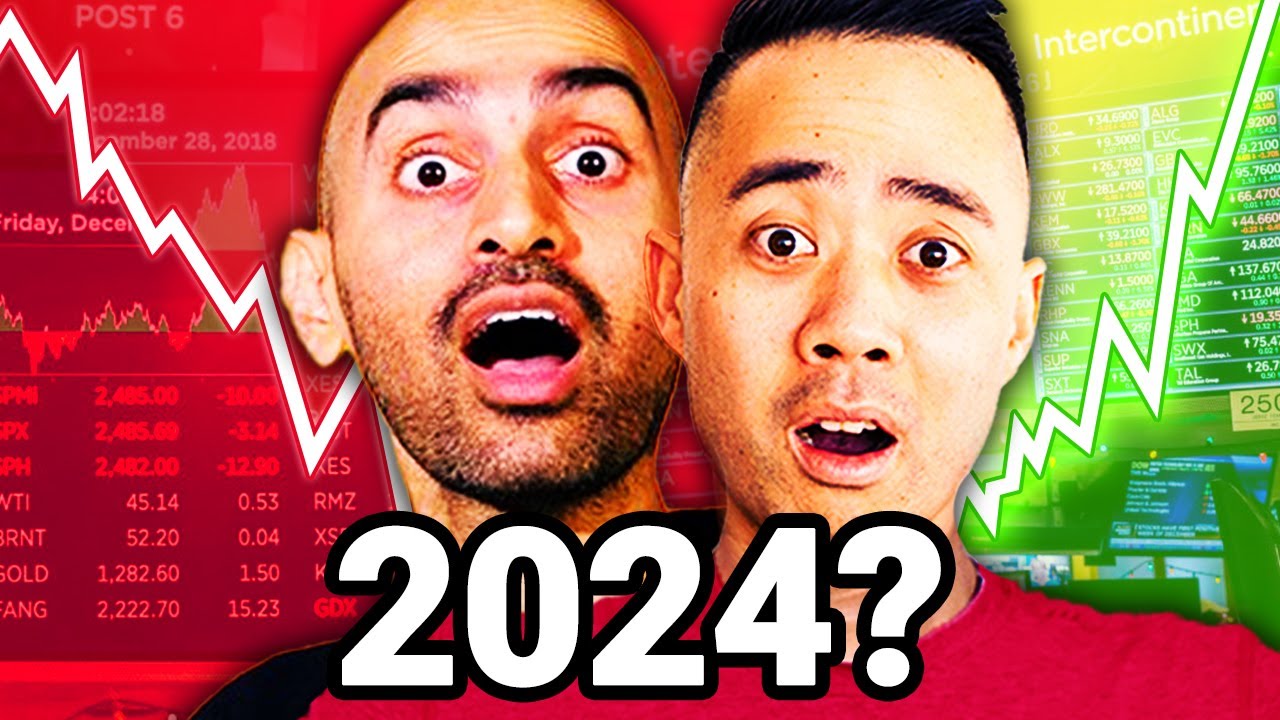
Eric Siu and Neil Patel break down what 2024 holds for the economy. They dig into interest rates, Howard Marks' theory on market shifts, and why small business bankruptcies are climbing. The takeaway: marketing budgets are shrinking, but M&A opportunities are opening up for those with cash.
Chapters
So will the economy get better next year? We're going to talk about it from a business standpoint and a marketing standpoint as well. So let me give you some highlights before we start.
Sure. And keep in mind before Eric gets started, marketing typically in bad markets is the first thing to get cut from businesses. And it typically is also the first thing that gets added when things start looking really good.
So small business, SMB bankruptcies are at an all-time high since I believe 2000 or 2001. And that's a lot. I mean, that's 22, 23 years or so. So that's one negative signal. The second one is a lot of people aren't trying to change jobs right now. So on the—
No one's quitting.
Yeah. Nobody wants to quit right now, right? Everyone wants security.
2 years ago, everyone wanted to quit.
Yeah. Everyone wanted to quit. You get like, you know, 2x your salary. You get the craziest benefits in the world. And now it's like, oh, as long as I have a job, I'm happy, right? Let me see if there's another headline. Oh, here's another headline. Did you watch? You know who Howard Marks is from Oaktree?
Yeah.
Okay.
So he's a really rich billionaire.
Yeah. Oh, okay. Yes, he's a really rich billionaire, but he specializes— he was one of the guys that specialized in buying distressed debt. So he has a firm called Oaktree Capital, and there's a 24-minute talk, and he talks about how there's a sea change. And so most of us don't know this, like in this— you're born what, '85? I was born in '86, right? So in the '80s, the interest rates were like 20%, right? Because we're trying to bring inflation down. So we actually don't know what that feels like. We don't know what high, really high interest rates feels like. What I'm trying to get at here is that we've lived in an environment of really low interest rates for a long time.
And then people using high debt.
Yep.
You know, 50 years ago, people weren't printing money and using debt like they are right now.
Point is, like, you know, when you have really low interest rates, it creates bad behaviors, right? You're trying to stimulate. We've been stimulating for too long. And so what Howard Marks has said is like, Look, people that have been searching for— people used to just invest in equities, which are stocks, right? He's like, you can now find equity-like returns, which is like 7 to 8% a year in the S&P 500.
Dude, you get 5% just keeping your money in a savings account at a bank now.
So his argument now is like, with fixed income assets, or like, you know, credit instruments, like buying someone's debt, or like lending out money, or whatever it is, like, you can get like 11, you know, 10, 11%. In some crazy cases. And so what he's saying is there's a sea change now and he's only seen 3 in his life. This will be the 3rd sea change where interest rates will go back up and we're going to see different types of investing mentalities or styles.
What were the other 2 sea changes?
I don't know. I don't think we're— Yeah, I don't know. Here, you talk while I find it.
All right. So Eric and I aren't economists and we're not trying to give you advice on what you should do, just to make that clear. But we own a marketing agency. We have a lot of friends who own marketing agencies as well. So we see a lot of data and trends on ad spending and what people are doing and companies are doing. Right now we're seeing, A, a lot of companies pull back. 4 or 5 months ago, we started seeing more companies talk about doing more with their marketing. Almost all of us agency owners did not see the pull-through in which those companies acted on what they wanted to do, more so they were just interested. So we were seeing pipeline building in which companies were interested in spending more on marketing, but we didn't actually see the conversion of those companies wanting to spend more. Just because they say it, you have to actually see if they're going to spend more. And that didn't happen. We're still seeing a massive slowdown. We're not seeing companies all rush back to spend more on marketing. And we don't really, you know, the recovery takes a while. It's not like just that happens overnight. But again, I mentioned this earlier in the podcast, marketing is typically one of the first things that businesses cut. It's one of the first things that they add back. They're not really adding it back yet. Yeah, and we're far away from— when I mean far away, we're not talking about 3 months or 6 months. It's going to be a much longer cycle.
So I got 3 sea changes here. Are you ready?
Yeah.
So number 1, the transition from the Nifty 50 era to the Great Moderation. Do you even know what the Nifty 50 is?
I do not.
Exactly right. So it's kind of like, um, You know, right now we have the Magnificent 7. You know what that is, right?
It's stocks, yes. Yeah, yeah, yeah.
So Nifty 50 is like the top 50 companies.
I was just wondering, the moment you said Magnificent 7, I'm thinking about something else because of my dad.
Oh, Magnificent whatever, or 6. OK, so in the early 1970s— and by the way, again, as Neil said, we're not—
And by the way, the Magnificent 7 has been pulling up the market quite a bit.
They've been doing exceptionally well. They are the market. So yeah. Look, again, we're not economists, but I think it's really important to understand this. I don't care if you're a marketer, like just a marketer, you should understand this stuff, right? So in the early 1970s, the stock market was dominated by a handful of large blue-chip companies known as the Nifty 50. These companies were seen as safe investments with guaranteed growth. However, the Nifty 50 era came to an end in the late 1970s, and the market shifted to a more volatile and cyclical period. This sea change ushered in the Great Moderation, a period of relatively low inflation and interest rates That lasted for several decades. So, by the way, like, this stuff, it does— sometimes it's not just for a year or two. It's like we're talking 10, 20, 30 years or so. So, so that's the first part.
Do you want me to continue? Yes, keep going.
Okay. The second one is the rise of passive investing and the global financial crisis. So in the early 2000s— so we've seen this— the rise of passive investing and the global financial crisis led to a period of low returns and high volatility in the stock market. Passive investing such as index funds became increasingly popular as investors sought a way to track the market without having to pick individual stocks. However, the global financial crisis of 2008 showed that even passive investors could suffer significant losses. Now the third one is now. So the third sea change, which is what we're living in now, which you all should understand— sorry for the ice machine— um, the end of easy money and the rise of inflation. So Marks believes, Howard Marks, believes that we are currently in the midst of a 3rd sea change, which is characterized by the end of easy money and the rise of inflation. This sea change has been caused by a number of factors, including the Fed's quantitative easing program, COVID-19, and the war in Ukraine.
And what I believe is, you know, we're all seeing— at least not even what I believe, what I'm reading online is everyone talks about how we're in a world of hurt. We can't sustain these kind of interest rates. You know, people with credit card debt are now paying like 20% or something ridiculous. So it's not feasible for it to just keep going this way because we're all used to a world with lower rates. Now, the Fed will eventually reduce the rates. Will they reduce it where it's pretty much free? Probably not, but they'll find some sort of middle ground. And I think we're in a world where we're just not used to high interest rates. Will it be this high forever? No, it'll go down.
But the rates aren't going to be pretty much free for the next 10 years on average.
I don't know next 10 years, but if I had to give like a 3-year outlook, I can see the Fed rate being somewhere around like 2%, 2.5%.
Okay. I think it's going to be a little higher. I think we'll probably meet in the middle. You say 2%, I'd say like 4% or something like that.
So right now they're at 5 and change.
Yeah.
I think they'll start bringing it down once they get inflation. Because you have to remember, if you're borrowing money, let's say you're at 3% plus SOFR.
Well, you have to explain what SOFR is.
SOFR is like, it's a new version of like, it's like the Fed rate. I don't know what SOFR stands for, but it's very similar to the Fed rate. So whatever the market rate is, add in whatever your lending rate is. So typically when you get a loan, They'll take like the Fed rate, but they don't use the Fed rate. They use SOFR. It's a version, you know, whatever is close to the rates that are out there. And they'll say whatever you can negotiate with the bank, 3% plus SOFR or 2% plus SOFR or 4%. Either way, what I'm getting at is I think mortgage rates, mortgage rates, business borrowing, et cetera, I think it'll be in 2, 3 years. I think it'll still be 5+ percent. What I'm getting at is I don't see it being 8%, but for it to be 5%, the Fed rate has to drop. It can't be— the Fed rate can't be 5% and then your mortgage rate be 5%. You're going to— the bank makes money on you. It has to be higher than that. That's why I think the bank rate may eventually be 2%, 2.5% or somewhere around there. So then they add on their points and next thing you know, you have a mortgage that's 5%, which is very reasonable.
Yeah. Look, And by the way, like 5% has been standard from the past. We've just been used to this 0%. And it's important for like, again, if you're like 20 years old or so, like you're just getting started in your career, like what is all this interest rate? You have to like, interest rates run the world, right? It determines how people spend. It determines how people borrow. It is everything. And it will affect your marketing budget at the end of the day. And so go ahead.
But I see because of the environment that we're in, and again, I'm not an economist, I don't know that much about interest rates or any of this kind of crap. I just watch TV and I read and yeah, no media.
Neil just has CNBC on all the time.
But what I do know for certain is this is one of the worst times to sell a company. The multiples are low because people borrow money when money costs more money or when money's more expensive. I know I'm about to get to it. When money's more expensive, people aren't willing to pay as much. But this is probably one of the best times to Buy businesses and expand, and we have a whole M&A team that just goes and tries to find businesses. But like, I'm trying to tell my guys right now. I'm like, how do we buy ten million dollars of EBITDA and ideally twelve months? Because I think right now is going to be the cheapest time to buy the EBITDA.
If so, those of you listening international, by the way, Neil's Neil's shopping right now. So if you like to do a deal, you know, Neil at Neil Patel dot com. Neil Patel dot com. He responds well as well. Here's the thing. Like, it's, it's not all doom and gloom at the end of the day, right? Like, there are always trade-offs. And like Neil just mentioned a trade-off right there. It's like, sure, it might be time. It might be a bad time to sell, but it's also like, if you're in a good position, it's a great time to buy as well. And, you know, that's maybe we can talk about that.
But dude, I'll take lumps on like stuff. I have one too many homes that we don't use and some of them are in the same city. And what we'll end up doing is We'll liquidate some of them at losses because I know if I park it in business, I'll make a killing.
Yeah. And so look, at the end of the day, we talked about interest rates. We talked about where the environment is right now. It doesn't look good. But I will say this, like, I'm not an economist, but I do watch other talking heads. Same with Neil too, right? The projection is if things do actually— if we do actually go into recession, the money printer is going to have to start up again and the interest rates are going to have to drop again. And we go into that whole cycle again, right? Because the thing is, that the United States, we are, those of you that live in the United States, we are the reserve currency, which means we can print more of it. Not saying it's a good thing, but—
And not saying it'll last forever either.
Yeah, and like, what that means again is like, we might just go into the next bull market if that happens. But I'm not holding my breath right now. So, you know, aim for profitability, aim for efficiency, just be aware of this stuff because it does affect how you do your work.
Yep.
Alright, that's it for today. Check out this video over here. Don't forget to rate, review, subscribe, and we'll see you tomorrow.









