The impact of AI overviews on SEO, Google starts testing ads in AI overviews, and more
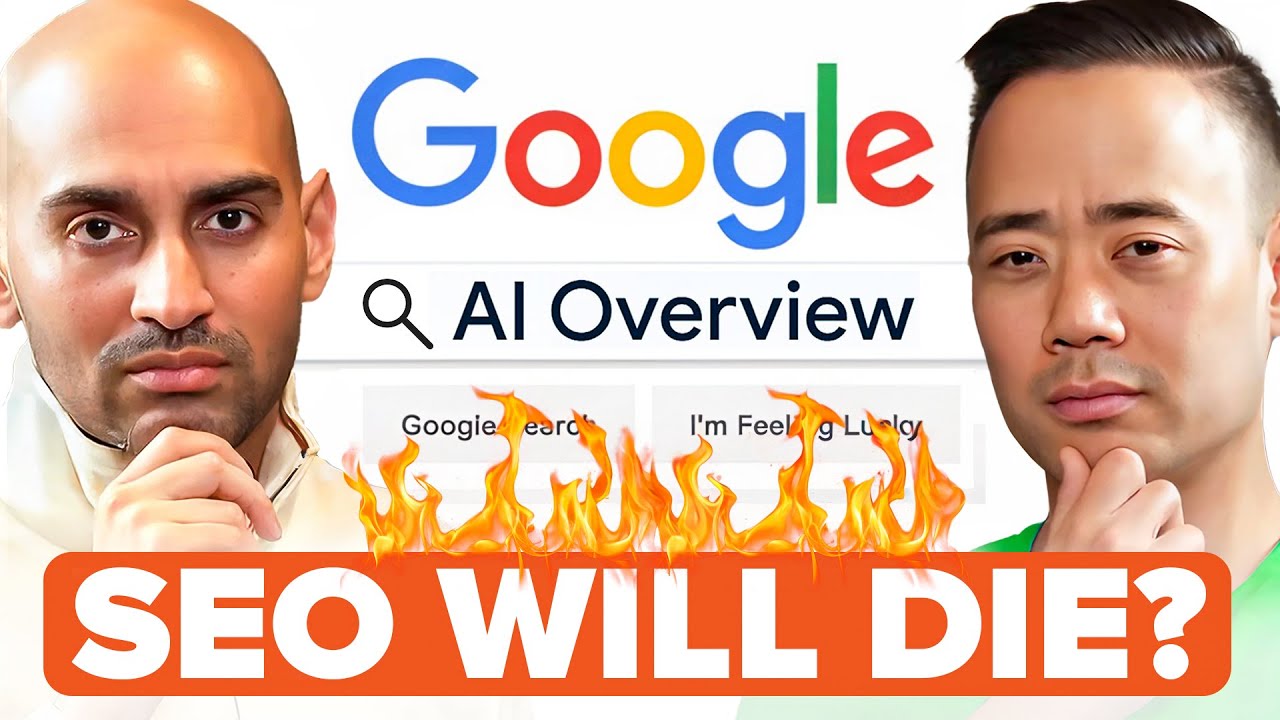
This content was created by Eric Siu. This content was uploaded by Eric Siu. This is a YouTube podcast-style conversation (title: "The impact of AI overviews on SEO, Google starts testing ads in AI overviews, and more") published June 4, 2024. The excerpt is a dialogue between Eric Siu and Neil Patel covering the Search Generative Experience (AI Overviews/SGE), early CTR data and citation accuracy, Google's testing of ads in AI overviews, the impact on affiliate-driven sites, strategies for audience monetization and diversification (emails, account-based marketing), podcast sponsorship and creative ad deals (examples: DreamHost, PayPal, Edelman), and promotion of their Agency Owners Association and marketing services. The tone is conversational and behind-the-scenes, with practical marketing and monetization takeaways.
Chapters
Let's just talk about the impact of AI overviews on SEO. First, let's explain what AI overviews is. It's basically SGE, so search generative experience. It's the AI answers. Yeah, it's basically David Sachs put this in a good way. It's it's basically perplexity. So perplexity is like when you search for something, you get the answer and you get like everything it cited, right?
That's what it is.
And so far, so Siege Media. So this is a Ross Hudgens tweeted this and. I'll just say that he did a post on this and it shows that so far, there's like a slight CTR increase. And when I say slight CTR increase for AI Overviews, for all industries, average CTR, okay, this is May 8th to May 11th. This is pre-AI Overviews, 3.64% average CTR. And then 5/15 to 5/18, the CTR jumps up to 3.75%.
Wow.
And this is on a sample size of 65 million impressions for both. Here's the thing. He even concludes this at the end. It's too early to say anything, right? This thing's in— it just came out of beta and it's going to continue to get better over time. And some people are making fun of the citations saying they're inaccurate and everything. I just think we need to give this at least another 6 to 12 months before calling it out. I think too many SEOs are trying to dive into this a little too early right now. That being said, I am trying to get new data. I know you're getting data too, so you'll share it. I'm getting more data from BrightEdge's CEO, Jim. And I said, whenever you got some new stuff, share it with us and we'll talk about it on the podcast. So I think, you know, hold your horses a little bit.
Yeah. And then do you see Google's testing ads within, you know, the AI overviews?
No. Yeah.
So they're testing ads. So what ends up happening is, is they have the AI overviews, they're citing the sources, and then as you scroll a little bit more, they're showing you paid ads right then and there.
Hmm. I wonder how that'll do for them.
I don't know, but you know they're going to end up doing stuff that's going to make their earnings go up in the long run and not down. And they're going to keep experimenting and testing until they get the formula right.
Yeah.
And at the same time, did you hear what Google CEO said about, what is it called, about being empathetic to content creators that search has wiped out? Pretty much, and this is from Search Engine Land. Google CEO is empathetic to content creators. Search has wiped out.
It's basically like you're shit out of luck.
He's being nice. He's saying like, of course that's not Google's goals. And then they talk to him about certain websites. He's like, well, I have to look into those. Those could be edge cases. And he's empathetic, but do you really think he actually cares?
Nope.
Eric's shaking his head, yeah. I think for them it's just a business. They're here to monetize and do what's best for them.
Yeah, and here's the thing. I got a text from a mutual friend the other day and they're just saying, Dude, our site's lost all its traffic, blah, blah, blah. What else can we do aside from like trying to get Reddit traffic back? Who do you know? And I just made an intro to someone else. But this just goes to show again, like their business— and you know these guys, but their business was all affiliate, right? And when you put all your eggs into one basket like that, just you got to be prepared to deal with the repercussions. And most people don't know how to deal with them because they haven't prepared for it.
Their income was affiliate as in they monetize their organic SEO traffic and then send it to affiliates?
Yeah.
Yeah, most of those businesses really got hit hard.
Yeah. And we have a lot of friends in the affiliate space that got hit. And you know what, one thing Neil did that was really smart, like he, you previously you were getting what, like 4 or 5 million visitors per month, something like that?
Something like that, yeah.
And now you're down to what?
I don't know, I haven't checked. But at least a few million visitors a month.
Point is, Neil was so diligent about collecting emails and building his audience within that. That, that insulated him from any potential hit. Like the hit would hurt him for sure, but at least it's insurance.
It was not even that. We did something else that insulated us even more.
What?
We didn't focus too much on emails. We focused on targeting. We focused actually more on account-based marketing. Who's our ideal customers? How do we get just in front of them and start winning business that way? And even in this bad market this year, we'll probably grow 20 to 30% organically. Some organic, some M&A.
All right, everyone, quick message from the Agency Owners Association. So this is the peer group for agency owners that Neil and I both put together. This is for people that are doing 6 figures, 7 figures, 8 figures, even 9 figures as well. And we're all here to help you grow your agency faster. In this group, we share leads, we share learnings with each other. It's a community where people can ask questions, their most burning questions personally, professionally. We'll share templates, reports, things like that. We're constantly adding more value to the group. I will tell you that the price is continuing to increase. The good news is that there's no long-term commitment. So you can just learn more by going to marketingschool.io/agency. Once again, that's marketingschool.io/agency to learn more, and we hope to see you inside. By the way, speaking of pricing, you know, we're, we're like coming off this podcast deal, and today we're gonna have Brad from recordeditpodcast.com. He's gonna tell— he's gonna try to pitch us something. I think this is interesting because we, we've had someone pitch us this before. where if they helped us get advertisers, they would get like a percentage of the deal, right?
Yes.
And it's actually a really good deal. It's actually a no-brainer offer if it works, right? Now, I think there's a lot of people coming off of iHeart. There's like famous basketball players coming off of iHeart too.
They're coming off of iHeart?
Yeah, and like, don't get me wrong, iHeart's a great company. I think it's just for us, we want to have more control over kind of what we do.
And too many ad spots for us.
Yeah, yeah, yeah. We want that to come down a little bit too. So anyway, I mean, I think those of you out there—
We want that to come down a lot.
Yeah, we want that to come down a lot. Something that's working pretty well for us right now too with the little community. But I think, you know, people that are interested in helping podcasters out, if you want to come up with a no-brainer offer, this could be it, especially if you have relationships. Because I'll give you an example, like Neil and I, we have relationships with like, you know, the HubSpots, the Microsofts of the world. We have these conversations, they'll happen like every now and then. We just don't have the bandwidth to keep them going. And so if someone can take those on and then like, you know, They will, and we'll just give them a percentage of the revenue and they just handle it all, then it's a pretty good deal.
So, you know, I agree. I don't mind paying commission on this. You know, my corp dev team and my sales team probably can fill up a lot of our ad spots, right?
Really? I didn't know that.
You know how many times they get hit up for people to advertise on our podcast?
No. Well then—
They tell me. I was like, oh, Eric handles it. Like, okay, like let us know. Yeah, yeah, yeah. What? I didn't ever tell you that?
No.
They get hit up.
Useless.
To clarify, Eric's saying I'm useless for this one, which he's— He is right. I never cared for the money. I was like, yeah, whatever, move on to the next.
Until I showed you a really good deal 3 years ago. That was a really good deal. But before, Neil's like, no, we don't need to do ads. I was like, hey, what about this contract over here? He's like, let's do it.
Well, we can tell people the contract.
We had a good deal. We had a good deal.
Go ahead. Uh, so DreamHost, which we love, they have a great culture as a company as well. They were sponsor of podcast for how many years?
3 years, I think. 3 and a half, maybe.
3 and a half years. Less than a 1-minute ad. How long was the ad? Like 20 seconds?
30 to 45 seconds.
30 to 45 seconds per episode. That was our only ad spot. $60 grand a month. There was not really many costs in running a podcast. So Eric and I would pocket around $27.5 grand each.
Yeah. And they were a great partner.
Great partner. And they were happy with us for— they dragged it on for 3 years. We were sad to see them go. I don't know if they were as sad to see us go.
Who knows? We're happy to continue doing this podcast. That's all I know.
Yeah. Well, we never did it for the money in the first place.
No, in the beginning, it was all for the learnings. And we didn't monetize until 3, 4 years into it. Like, that shows you that, like, we weren't in it for the money. So—
Was it that long that it took for us to monetize?
Yeah.
And then I think I was pushing back when you wanted to monetize, right? Yeah.
And by the way, for my first podcast, Leveling Up, I didn't monetize for like 3, 4 years. Same thing.
Did DreamHost ever sponsor the Leveling Up podcast?
They did.
You got the same rate?
Yeah. Well, no, not the same rate. Per views?
Per CPM?
No, they held me at a $60 CPM.
And what were we at?
Uh, we just got held at a flat rate. So it started at $60,000, but then our, our downloads grew. Because when we started with them, we're at like 300,000, 400,000 downloads or so.
On Marketing School?
Yeah. And then it shot up to like a million, 1.1. At a certain point, we're at like 1.5 million. So that would have been really cost prohibitive. Yeah, that probably would have tanked the deal too.
It would have changed it. But we were really happy because a quick ad, we keep getting our $60,000 a month. We're good with it.
Yeah, yeah, yeah. Anyway, that's some behind-the-scenes podcasting info for you guys.
So what other creative deals have you worked out from sponsorships?
I'm sure you have some.
Dude, my best deal that I ever did— maybe not the best deal, but one of my favorite deals. They still hit me up. I tend not to do it. PayPal, they hit me up typically through Edelman.
Oh, that's a fat deal.
Yeah. And every time you create a quick video, $100 grand.
Yeah.
Like just deposit it in your account. And I used to do them 2 to 3 times a year. So it was a quick $200 to $300 grand in pure profit. Those were pretty good deals. Didn't have to travel anywhere. Lo-fi content, just, you know, taking a video, just shooting it. The hardest part with the Edelman deal, no joke, or the PayPal deal, because Edelman would pay me for it, was actually not even signing the contract, submitting the invoice and getting paid. Because it would always come like 3 months late.
So you got paid what, every quarter for that?
I didn't do it 4 times a year. I would do it max of 2 or 3 times a year. And my finance team or AR team would chase it down. So it's not like I had to do anything to get the money. I didn't really pay attention to it.
I want to take a second to tell you about my podcast co-host's agency. So NP Digital, so Neil Patel Digital. What they do is they do a whole host of marketing services. services and they are global. They're worldwide. They have SMB services as well. They have mid-market to enterprise services as well. They cover the entire gamut. So you can just go to mpdigital.com to learn more about it. And now back to the episode. Creative deal. Well, I mean, we actually have people reaching out to us, but the way these creative deals are structured now, there's no $100K deal, but like there's a lot of people offering $10,000, $20,000 just for us to sponsor their podcasts. Or sorry, their product and service. And it could be for like 2, 3 episodes and they might pay like shots of like $10,000, $20,000 or so. And they're not really monitoring the metrics and that's pretty easy. There's like a well-known software company out there. They don't look, they don't track ROI. And so—
Ahrefs?
You know, these people are easy to work with. Yeah.
They're a good company. Just in general, they're a good company. The way I look at a lot of these deals is you can end up doing them. It makes money in marketing, but like, You got to look at the long-term game. You know, do you want a quick $60 grand a month or $100 grand here or there? Or would you rather try to build a multi-billion dollar business and focus all your energy on that? And there's honestly no right or wrong answer. There's a lot of people who did really well just through influencer marketing.
That's the Bryan Johnson quote again. Making money is the most expensive thing you can do.
I still don't think it's the most expensive thing you can do.
We didn't get to clarify it from him. So now it's open to interpretation.
Yeah, it's open to interpretation.
You're totally right.
I don't think it's the most expensive thing to do. I think it is the most expensive to do as a CEO on your health. I do think it takes a toll on your health.
We'll just have to do a round 2 with him. I'll probably have him come to the YPO Miami thing. Let's see if we can do that.
And I do agree, yes, you don't want to monetize too early, but there's also a thing of monetizing too late. And I learned that from Ramit Sethi. I remember when I first started blogging on Quick Sprout, I wouldn't monetize. And I would just keep emailing and emailing, giving value for free for like 6+ years.
Yeah, you trained your audience. Bingo, you got it right.
And Ramit's like, you trained your audience to expect everything for free. You got to actually train them to be open to paying for stuff. And it was a hard transition and we weren't able to monetize well at the beginning. And it took us a year and a half to 2 years to get that to pop.
Longer, I think. Because in the beginning, like people hated you for changing like that. Just like they hated Ramit for like charging $5 and they called him a sellout.
You did the same.
I can tell when you're making that transition, It was very unnatural. But even— and then, you know, you moved into like selling courses for a little bit. Eventually it was like some, I think some group coaching stuff. Eventually it translated to agency. Yeah, affiliate was in there too.
That's right. But it took a few years to really figure out how to make money and the audience to be okay with it. And it was tough because you're losing a lot of your existing audience, you got to bring in new people. I do think if you monetize too early, you're not building your top of funnel big enough. If you're monetizing too late, it hurts you because you've trained your audience to expect it for free. A great example of a company that did it right, in my opinion, is Microsoft with Teams. Remember during COVID Hey, yeah, look, Slack, it's booming, but we're free. And it would really hurt Slack at certain points with their stock, right? Because people are like, yeah, it doesn't matter if your user interface is better, Teams is free.
Yeah.
Like, we as an organization just use Teams because we're like, it's free. It doesn't matter if you say Slack's better or not. Who wants a 6-figure bill a year when you can get something for free?
Dude, a lot of people are coming off of them. Like, there's a lot of alternatives now. Have you just seen David Sacks' alternative, Glue?
Which uses AI.
Yeah, it uses AI. And then like, um, then you have Once, right, from 37signals, where you just pay once.
Yep.
Are you still paying for Slack? Or you're on Teams? You're on Teams.
We're on both. Teams now costs money, but Microsoft eventually ended up making a transition where they started charging for Teams, and I think they did it at the right time. Um, but what's funny is, is For a lot of corporations, people talk about like G Suite. A lot of corporations just use the Microsoft suite because it's cheaper and it's good enough.
Is that what you're on? Outlook?
I'm not on there. My, my company is on there.
But you're just— your Gmail is connected to like your company email?
I know. I don't have a corporate email address.
It's just neilpatel.com.
Yeah, I refuse to use Outlook.
It's hard to use Outlook.
I'm one of the few people. It's just like our company laptops are PCs. I refuse to use a PC.
Wow. Who mandated that?
I have no idea. Your IT person. Yeah, someone picked. There's a point like where you don't know everything. It's just too hard to be on top of everything.
You're just on what you like.
Yeah.
So anyway, that's it for today, everyone. Please don't forget to rate, review, subscribe. marketingschool.io/agency. We're going to show you all how we build this community. And if you have an agency, we're going to help you build your agency faster. So that being said, we'll see you tomorrow.









