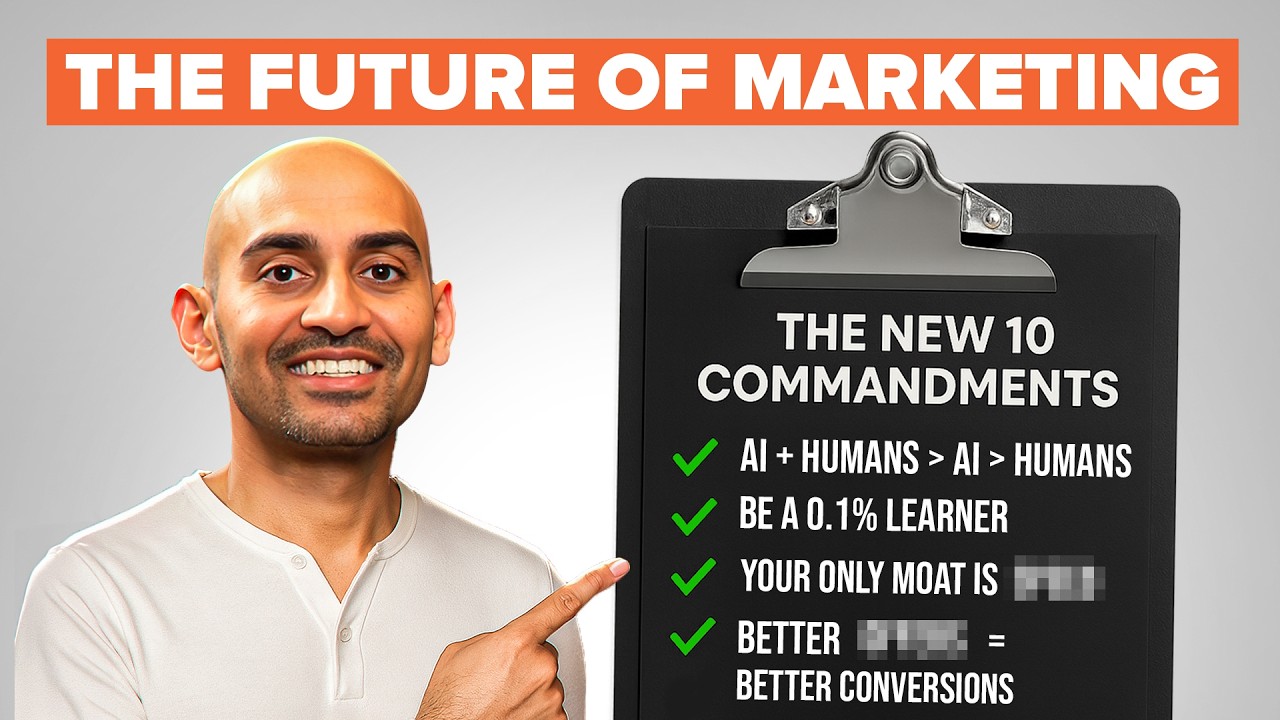
Eric Siu and Neil Patel lay out ten modern marketing principles, from AI and human collaboration to brand as your moat. They stress committing for ten years, optimizing across platforms natively, and focusing on one channel when resources are tight.
Chapters
this type of episode format has done well for us in the past. It's the 10 Commandments of Marketing. But now, we've never done one around the 10 New Commandments of Marketing. So we're totally just coming up with this from scratch. Here's number 1. Number 1. You want to go first?
All right. AI in marketing will not do well unless you combine it with a human. You can't have AI just go and do everything in marketing for you. without humans. Humans won't perform better in marketing than AI. Humans aren't better, AI is not better. The ideal combination is you take both of them and they work together. That is going to create the optimal marketing output.
Number 2, for one of the 10 new commandments of marketing, is you can't just be a top 1% learner, you have to be a top 0.1% learner. Meaning that all the stuff that people talk about with AI that they're trying, you're not, even if you bookmark these posts and you listen to these posts and you put them on NotebookLM and you're learning as much as you can, that's not learning at a top 0.1% level. It means you actually have to be out there implementing. It means you actually have to be out there experimenting and doing. And that's how you're going to have value in the workforce in the future.
Number 3, your only moat in marketing is your brand. People can copy tactics, strategies, products, services. They can even rip off your design that Eric experienced this weekend from some random person in Europe. But your brand is something that people can't just copy. And a great example of this is Air Jordans. Michael Jordan shoes do well. If Eric and I wanted to create a shoe business with enough money, and given a year's worth of time, we can figure out how to make a shoe that's just as comfortable and aerodynamic or weighs light or whatever it may be. I don't think that's the hardest thing to do, but we wouldn't generate a fraction of sales, not even 0.1% of the sales as Air Jordans because we don't have that brand.
This is number 4. So number 4, I believe that when it comes to moats around the future, I think there are 2 moats. I'm going to give the first one right now. The first moat is around data. So if you have, if you have a data moat, you think about all these LLMs, they're trained off of data around the internet, right? So if you have a lot of interesting data you can pull, so Neil, for example, has Ubersuggest, he has Scout, and he has Answer the Public, and I think he has a 4th one. But there's a lot of interesting data that he can pull that he can share to either get more distribution that way, or he can figure out how to take that data and make it more useful for his customers. I think data is going to become increasingly more valuable. And I don't think we're ever going to run short on data. The world's always gaining more and more information every day. And that would be number 4.
Yeah. Number 5, don't waste your time marketing something unless you're willing to do it for 10 years. It takes 10 solid years for a brand to really start getting known. and gaining traction within that industry. So whatever space you're in, it'll take at least 10 years to really gain traction. If you really plan on doing something for a year or 2 or 3, you're wasting your time, go do something else.
Yep. Number 6, the better your offer, the better your conversion rates. And this will always be a commandment of marketing. And so if your offer is download my PDF, And we will give you the 10 Commandments of marketing versus if the offer was get on a call with Neil and Eric for 1 hour, the second one is more valuable. Now, a better one would just be have Eric and Neil give you $1 million. That would be a great offer, right? And so the better your offer is, the higher conversion rates you're going to have. And most people don't think about that.
Number 7. The new SEO is search everywhere optimization. People no longer just search on Google, they're searching everywhere, AI platforms, social media sites, even Booking.com and Hotels.com have a version of a search engine, Airbnb, the list goes on and on. You need to optimize for search on all platforms. If you create content on Instagram, when someone types in handbag, why doesn't your purse show up? Or when someone types in, you know, marketing tools, Or you know why isn't your tool showing up? You got to optimize for all the platforms out there because you don't know where people are going to be looking for your product or service.
All right, number eight. I think number eight is you have to learn how to play the game natively. And what I mean by that is for search everywhere optimization, Neil and I are on a lot of different channels. I won't say we're the best at all these channels, right? In fact, at least for me, I'll just speak for myself. I think I'm pretty decent at some and I suck at some. And so what I mean by that is, if you're on YouTube, for example, you have to understand that the meta, the most optimal way of playing, is optimizing your thumbnail, your headline, the 30-second retention, or if you're doing Shorts, you know, the scroll stopping, all these things, right? If you don't think about the meta for each channel that you're on, and you think you can just play it the same for all of them, you're going to lose. And that's, that's why I'll get to my number 10 that leads into my number 10. But You have to know how to play the game natively. I mean, even Noah here has a YouTube channel, which I— am I allowed to speak to it? Okay, I can't speak to it. But it's a YouTube channel that generates many, many, many views. And, you know, he knows how to play the game natively and he knows how to pull the strings of his viewers. All right, so I wanted to take a moment to tell you about my podcast co-host Neil's agency called NP Digital. And they work with a whole host of global companies or global organization. Also, Neil has SEO tools such as Ubersuggest and AnswerThePublic. All you have to do is go to npdigital.com to learn more, and we'll see you on the other side. Yeah.
Number 9, if you're going to do marketing, it has to be global marketing. From day 1, you need to think about how can you get your content, not just on all platforms, but in all major languages. And there's a lot of tools out there like the HeyGens of the world that can help you do this. You know, recently Forever 21, they announced that they expect to close all US stores and they blame I don't know how to pronounce these names. Shein, and I know the next one. The next one is Temu for their downfall. And these are Asian brands that are disrupting the United States ecosystem and they're taking over and generating a lot of customers. My mom is another example. She tells me all the time, she's like, why do you buy from Amazon? She's like, I buy everything from Temu. It's cheaper. How does my mom, who is barely tech savvy, know to go to Temu to go buy stuff? That's global marketing. If you don't do global marketing, someone else is, and they're going to take your customers for you.
Yep. Number 10, carrying over from number 8, you have to understand, one, if you're to play the game natively, and if you're resource constrained in the beginning, or just resource constrained period, go for one channel first. The problem with a lot of marketers is they try to attack multiple channels at once when they don't have the resources for it. And that strips them of the ability to figure out how to play the game natively for one channel, and they end up playing the game at a very poor level at all of them, and they end up getting no distribution, and they end up just blaming the channel, or they say they're shadow banned or some stupid excuse. So those are the 10 Commandments of Marketing. How's that one, guys? Um, anyway, that's it, guys. Please don't forget to rate, view, subscribe. It helps us grow, and we will see you later.
Bye.









