The New B2B Playbook to Guarantee ROI | Live Webinar with Adam Robinson
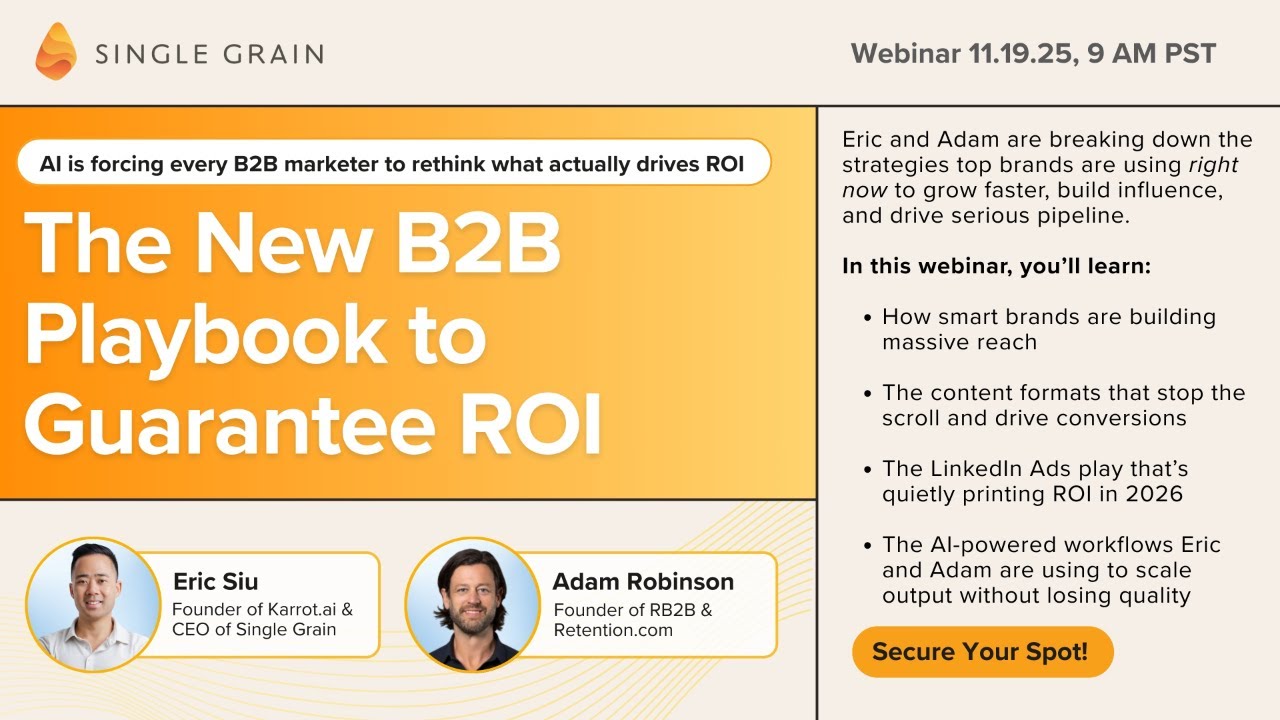
In this live webinar hosted by Eric Siu of Single Grain, founder and CEO Adam Robinson of RB2B joins to discuss the practical B2B growth tactics that are delivering results in 2025. The conversation moves from introductions and a light‑hearted hoodie giveaway to a deep dive into the "new B2B playbook": Founder‑led personal branding and thought‑leadership as the primary top‑of‑funnel engine, with Adam’s LinkedIn presence and live‑revenue dashboard as a case study. The "magic triangle" of resonant content, outbound outreach, and retargeting, and how each pillar is measured. LinkedIn content workflows, paid thought‑leadership ads, and the economics of a $12K/month LinkedIn strategist. YouTube channel evolution from interview‑style long‑form to a structured, script‑driven format, including the role of a dedicated scriptwriter, editor, and AI‑assisted thumbnail creation. Webinar and live‑event tactics, audience size, and the shift to a separate YouTube channel for recorded shows. Programmatic AEO/SEO (the evolution of SEO) using templated pages, human‑in‑the‑loop AI generation, internal linking, and content consolidation. Cold‑email outbound automation via Sales Automation System (Taylor Heron) – domain rotation, inbox warm‑up, and incentive‑driven offers (gift cards, AirPods). Retargeting ads on LinkedIn and Meta, attribution challenges, and the balance between brand spend and measurable pipeline. Staffing and cost analysis for organic social production (LinkedIn strategist $12K, Twitter specialist $4.5K, YouTube editor ~$1K/video) versus the ROI of high‑value customers. AI‑enabled content creation and support: tools like Stanley, Lindy, Gemini, Fin (Intercom AI), Delphi clone, and how AI is being baked into the product itself to run customer support at ~0.3% human involvement. Business metrics: $6.6M ARR, 5% month‑over‑month growth, churn, conversion rates, pipeline valuation, and future product ideas (AI‑driven conversational outreach). The hosts emphasize keeping content creation fun, avoiding burnout, and iterating on workflows. They close with a Q&A on LinkedIn ad ROI, paid vs. organic pipeline contribution, and upcoming AI‑driven outreach ideas.
Chapters
I'm waiting for some people to come in. Maya, my Instagram link is not quite working yet. I'll wait for it. But while you guys are trickling in right now, type in where you guys are coming in. Adam and I are excited to see where you guys are coming in from. We're going to have a great conversation around what's working in B2B today. And it looks like my Instagram thing's working now. All right. It's working. All right.
Um, yeah, where's the chat?
Chat is—
oh, I got it. Private chat.
Okay, private chat's for us. That's, uh—
oh yeah, okay.
Uh, yeah, Maya, where's the chat for everybody else?
Screen share, Loom video, share screen settings.
Oh, I see it. It's a chat, chat, chat. All right guys, type into chat where you guys are coming from right now. Um, we're excited to see, um, see you all, and we're gonna get started in about a minute or so here. And we're going to be talking about what's working in B2B today. It's nerdy stuff, but if you want more enterprise leads, we got you. Even if you want more small business leads, we got you as well. And it's going to be a conversation. We don't know how long we'll go. Maybe it's 45 minutes, maybe it's an hour, maybe it's 3 hours, probably not 3 hours, but appreciate Adam joining here. And by the way, what we have going on here is Adam's wearing a sweater because his HVAC system makes it too cold.
Yeah.
And my HVAC system is too hot right now, so it's really hot. And so we're, uh, yeah, we're doing this for you guys.
Nashville, Tennessee, says Nate Hook.
Oh, Nashville, great, great fried chicken.
What's up, Rodney from LA? Um, I, yeah, I'm, I'm currently in, uh, Austin, Texas, where on November 19th it's 79 degrees at 11 AM. Wild. Uh, but yeah, my, my HVAC situation is, is a problem.
Dude, it is so hot.
I'm wearing the RB2B hoodie. If you want an RB2B hoodie, let's do a swag drop before we start.
Oh my God, how do you get one?
Here, hold on. These, these hoodies are amazing, actually.
Dude, how come I didn't get one of these?
Yeah, well, it was my fault. Um, so here's a pick one. The hoodie's on here. Uh, I I can't even— I can't write in this chat, so maybe I'll put it in the private chat and you can.
Yeah, yeah, I'll show you.
So there's a private chat, and then the code is RB2B.
Okay guys, here, I'm dropping this in.
Yeah, it's Rodney. It's like a really thick RB2B hoodie. It's super cool. Everybody who I send these to, they're like, that's like the best hoodie I got. Um, okay, and then the code is RB2B, uh, and you can send it to yourself. For free, courtesy of your friends at RB2B.
That is amazing. Look at that, guys. You get a drop. I mean, Adam, we gotta do this all the time. You might have a drop next time too. So I feel like this is the way to do it 'cause this is fun, right? And then, but before we do intros here too, so Adam and I were just talking, it's like, okay, there's a reason to do more live streaming. And the story that I shared with Adam is that I think MrBeast threw an event and then it was like a bunch of famous, like a bunch of football players, right? And it was like a celebrity game too. And when the celebrities came out onto the field, the crowd didn't really cheer much. And then they had short-form content creators come onto the field and not really, not a lot of cheering either. And then they had the long-form ones like a MrBeast, for example. He does a lot of long-form. But it was when the streamers came out, there's a lot more cheering. And it's because these guys built a lot more affinity with their audiences because they spend a lot of time streaming. And so Adam and I, we spend time doing webinars every single week and I feel like webinars are very stiff. You have to go through your slides and you're in presenter mode, whatever. Whereas this is how Adam is really, and this is how I am really. And so we thought we'd have a conversation today about the B2B playbook that's helping everyone as people are trickling in. And LinkedIn, by the way, I'm looking at LinkedIn right now. LinkedIn's really growing right now on the LinkedIn side. And so is Instagram.
Sweet.
Okay. So Adam, Do you wanna do a quick, quick intro on yourself? I'll do a quick intro and then we're just gonna jump into some topics and you and I can just share kind of what's working, what we're excited about and all the things.
Yeah, I am Adam Robinson. I'm founder and CEO of rb2binretention.com. We primarily do website identity right now. We're working on a complete reinvention of ourselves to be relevant in the world of AI, which like I think is a pretty important topic. So that's what I do. I create a lot of content centered around building in public. I have a big audience on LinkedIn. I'm working on expanding into other channels, which I had not really successfully done. I'm really interested in talking about YouTube with you, Eric.
Yeah.
We talked about it 18 months ago and I had a breakthrough about 6 weeks ago.
Oh, okay.
So, yeah, so that's it. That is who I am and what I'm up to.
Great. So real quick, my name's Eric Siu and we have a tech-enabled marketing services business called Single Grain. And within that we build fun little products. We have an SEO product called ClickFlow, another one, a LinkedIn account-based marketing product called Karat. And then for fun, I create content like this. I have a podcast called Marketing School and then I do my little YouTube channel as well. And so we should talk about content in a second too, because I was looking at our content costs and I'm getting ripped by my COO right now. In terms of our brand spend. So something worth talking about as well. But maybe, Adam, maybe if we start off talking about just what's working, what's crushing it for us right now, I think that'd be helpful because people love the tactics and we can just jump around and see where this conversation takes us.
Okay. So I think context is helpful. I'm spending most of my time, almost all of it on RB2B, which is A freemium PLG, $200 a month, 14-month average life SaaS product sold into the small business segment of the B2B world. So what is working for me there is the top of funnel is my thought leadership founder brand. And If you follow me on LinkedIn, I do not talk about RB2B very much. It's very much the sort of, you know, not even day-to-day, but like the kind of like tactics around growing an early-stage SaaS company. And I'm like reporting, I share revenue data. You know, I have a live revenue dashboard on my LinkedIn profile page. So I'm very much trying to like bring people along the journey of RB2B and all of those people. who are interested in that journey coincidentally are also potential buyers of our B2B. So, um, that is work that just the, uh, I would say I'm a huge believer in the attention economy these days. I think it's really hard to just do outreach and have that work for you when no one knows who you are and they have no shot of knowing who you are. You can do it, but it's just hard. I heard this term the other day called the magic triangle, and I think if you can attain the magic triangle, you've got a really good shot at growing in today's world. And it's a combination of resonant content— resonant is an important word— plus outreach, plus retargeting. That's like You know, I think like sub-5, maybe even sub-10 million ARR for SaaS. That's like, if you can hit all of those points, content, outreach, and retargeting, that's all you need. And I think that the content part, you know, like, uh, the cursor hits 200 or Lovable hits 200 million ARR in one year, right? With like 100 people or whatever. It's like, Their founder isn't out posting. They have built— a lot of these AI companies are experiencing this unbelievable growth because people can brag about how smart they are on social media by just sort of showing what they've built with the product. And it creates this insane viral loop, right? So, you know, For outreach, I think it's, if you're in B2B, which I am, it's, you know, this PLG product is mostly about cold email, but like automated LinkedIn outreach, I think works really well too. I'm gonna qualify that by saying you've got a 2 or 3% chance of absolutely, of literally destroying your LinkedIn account. So proceed with caution.
It's pretty high.
But yeah, but, but, but were they, you know, I would, I would also, the counterpoint to that is like, um, Guy from Lemlist. If you don't know who Guillaume is from Lemlist, he's like one of the, one of the OG LinkedIn creators. He's been banned 3 times, I think. And his content's so good that he somehow gets back on within months. And then he's like back up to 40,000 followers within, within months of getting back on. So like, I think, uh, while it sucks to have your account banned, You know, she has proven to us that it's not the end of the world. So, so yeah, I mean, that is, and then with, with retargeting ads, I'm just literally like, you know, I have a founder-led motion. My face is on my website. I'm literally just like holding up the iPhone and doing selfie videos with the classic Russell Brunson sort of like who, what, why, and how script. Hey, it's Adam Robinson. RB2B identifies 70 to 80% of your web traffic. You can get started for free today. Click the link below. And just like showing people retargeting ads who are hitting the website, and I'm retargeting people with email and LinkedIn using RB2B. So that is what is working for me in B2B at a basic level. And then you could also, we can dive deep into any part of that that you want.
Cool. And I'll just kinda share from my side what's working too. So it's interesting 'cause we had Procter Gamble reach out to us recently. And one of the first questions we like to ask when we talk to these people on the sales side is, how did you first hear about us? Not just how did you hear about us, but what was the first touchpoint? They said they're doing a lot of Googling, but a lot of AI research too. And they found us as a health and wellness marketing agency, which is ironic because we're more B2B SaaS. And so he said, we just kept popping up, popping up, popping up. And then the interesting thing is yesterday I saw Hugo Boss came in, right? And we don't really do a lot of consumer, but it was a strategic sourcing manager. So a lot of these sourcing managers for these large consumer companies are researching a lot through AI right now. And you can call it AEO. You could call SEO. I think SEO is just— AEO is just an evolution of SEO. That works really well for us. So we do create templated programmatic pages. We do run a human in a loop to make sure that it's not just a bunch of AI-generated slop. And we actually use our internal product for that, right? But you can use anything you want. There's a lot of great products for it. But we create these programmatic pages. And then on the other side, we create a lot more internal links. We delete, we update, we consolidate a lot of content. My background's in SEO, so that works. But on the other side, I'm curious to actually know from you in a second too, Adam, but we're spending around, for just the organic social side of things per month right now, about $22,000, which I think is a bit heavy. But I will say that some of our best customers, our longest tenured customers who love us the most, they came in as fans of Marketing School or Leveling Up and they stayed the longest, they pay the most. And we have one that's about to sign with us for about, they're about to add like $35,000 in monthly recurring revenue. And that one— Their marketing manager is a super fan, right? So what Adam's doing here, the content he creates on LinkedIn, the stuff he's doing on YouTube now, that stuff goes a long way. So it's very easy for my CEO or a CFO type to come in and say, hey, we should cut the cost because we don't know how that spend is going. But that to me is brand cost. And we have to be a little careful there and just not say it's just brand, it's okay, let's YOLO. But we also have to be careful not to just cut it for efficiency's sake. The AEO SEO stuff's working really well. The podcast stuff always works well. I will say that events work really well, whether it's live events like webinars, but us doing mini events too. If I go speak at a conference, I do a mini event where I invite people to a dinner. Let's say it's 10 people. Or if I invite a bunch of senior marketing managers, let's say 20 people or so, and we do a little lunch together or something like that, that goes a long way because you never know, these enterprises might take The sales cycle might be a year, 2 years, 3 years, or they might go to another company and follow you around. That's how you end up converting them. So those are just a handful of things. But Adam, coming back to you for a second, how much do you think you're spending a month right now on organic social?
So when you say spending on organic social, are you talking like editing, just the whole thing, like editing and like, are you paying? But that's not paid social if you're paying. No.
So like, no, I mean by literally just your editors, your strategists, people that are handling your thumbnails, you know, people that might be ghostwriting for you. So.
Yeah. So I, I have a, this kind of sounds crazy. This guy that I use for LinkedIn works with, like, if you're in B2B, he works with all of the B2B CEOs who have like kind of the most prolific voices on LinkedIn. He's $12K a month. He doesn't write for you, but he'll work with other people on your squad. And he's just, you know, I could probably survive without him right now, but like, I'm unwilling to see what that is like. He manages a content calendar, helps with idea generation, tightens everything up or whatever. So that's $12K. I'm about to start working with a Twitter guy called Wiz of Ecom who Who's like $4,500 a month. Now I have a YouTube guy who, if you want to, if you want to send them my, my most recent YouTube videos, they're right here. Uh, this guy is actually doing this for free because of my Build in Public. Uh, but I would imagine he's going to be like $1,000 a video. And he's done— you can see when he took over my videos because all the— they, they looked the same before and they weren't getting any views. And now it's getting way more views. Uh, I mean, we just dropped one that, uh, has 20 one hour ago, but, um, you can see the trend is positive. So all in all, I'm like, you know, a little under 20K. If I factored in the YouTube guy, I'd probably be right around where you are.
Mm-hmm.
My opinion is it's the most valuable thing that I'm doing by orders of magnitude. Like, the organic You know, and it's like, once you've invested the time to get good at the craft, um, you know, keeping the engine going is like, it's just, it's just an absolute necessity. Uh, one thing I don't think I'm doing well at is kind of like this, uh, you know, Like, I'm getting better at it, but like using one, uh, one, one channel to like build another, you know? Like, so these YouTube videos, it's like they'll hit on Friday or Wednesday or whatever, and then I'll send an email and we'll promote it on LinkedIn to try to like get audience from other channels to YouTube. Uh, you know, if I got a big LinkedIn post, I'll send an email to try to get people to like go comment on it, which like gives the post more reach. What I'm not doing at all is like trying to get people to join my newsletter from LinkedIn posts, which a lot of people say that I'm stupid for not doing that. So yeah, I don't think you're spending too much on organic social. You can tell your CFO that.
Yeah. But the thing is we have to debate with them, right? It's like, hey, we should cut the cost 'cause we don't know how to measure it. And then like, what do you say to them with that, right? It's like, well, some of our best clients come from that. Well, how do you measure it? And so this is when you probably have to pull out the CEO founder card and say, hey, We're just going to keep doing it.
Yeah. And I think it makes it easy for me to like, I just never get, you know, every, okay. So RB2B is at like $6.6 million ARR. We launched it 19 months ago. I have 2 other people working on it and the entire business has been my LinkedIn. So like, I just fall back on that. It's like, okay, we're paying Alex $12K a month. That's probably too much. But like, you know, you really wanna mess with it for like to save $5,000 a month or something like that? Like, I think we'll just keep it going.
Yeah.
So, and that was kind of the same argument you were making. It's like, if I look at our long, you know, our longest paying and biggest customers, like with this organic content, there's just, I mean, I just have this belief that the people that it is touching will like, Benefit you in the future in ways that there is no way to possibly— I mean, it's this classic attribution problem, right? You can only measure the conversion point and there's all of this other amazing stuff that's happening from just being a creator that has a good reach.
Yeah. You know, the way I look at it is on the brand side, okay, top of funnel right now, you know, we're doing this and that might just, Ideally, this is gonna drive more emails, right? And I've kind of, we can talk about short form in a second 'cause I hired a short form agency that seems to be doing well now. I'm actually going straight to the studio right after this to record. We can talk about that.
Yeah.
But I just think that when one, this side is to collect emails, okay? That's number one. 2, ideally once you have their emails, you drive 'em to a webinar or you drive 'em to some type of free offer you have, could be some swag or you drive 'em to our B2B, the free version, right? And then you drive conversions that way. What I will say is from one of my short-form videos that we put up a couple weeks ago, and I look at it as like a slot machine. You never know what's gonna work. And so from one of the videos, I'm like Afrojack, okay? Afrojack followed me, right? And I think liked it or commented. So he's a DJ, right? He probably knows a lot of amazing people. The former CEO of T-Mobile liked and got onto the email list, right?
That guy is a boss.
Yeah. John, I think is his name.
He is a total boss.
Yeah. You have Hassan Whiteside, who's like an NBA player, right? And then he got on the email list too. All that to say is like, are these people in our target audience? Probably not. But do they know other amazing people? Yes. And so in my mind, I'm like, why would you stop doing this? Because you just, you never know what's going to— sometimes I'll have a random clip and I'll take off and get like 8 million views, sometimes like 70,000 views, but you just never know. And I might go to like a YPO event. And so Adam and I are in this kind of entrepreneur group.
Yeah.
And when I go to one of these events, it's funny because like 3 or 4 people will come up to me and say, hey, I saw your clip the other day. Right. So like, can you attribute that? It's hard, but you should do it. Yeah.
Yeah. I mean, yes. And you've been at this for, I've been at this for 3 years now. You've been at this for much longer. It's like, it is a skill and like, it takes time to get good at creating content, but like once you're in the groove of doing it, like, and it's just part of your life, like, it's not really a chore anymore. You know, I actually enjoy it. You know, it's like a creative outlet for my job that's like very different than like, oh, like, you know, what do these spreadsheets say about our P&L or whatever, right? Like, it's just totally different.
Um, and, and, uh, well, that's a big thing, Adam. Like, I think, um, I, I told my team this when my YouTube content— and we should go over into YouTube in a second too— but like If my YouTube long-form content starts to feel like a job, I don't want to do it. The moment this feels like a job, I don't want to do it anymore. And so this to me is fun because we're having a conversation. But I was doing these long-form podcast interviews and sure, they might get 600,000, 700,000 long-form views on YouTube, which is great. But one, it wasn't the right audience. Two, I was talking about dating. I was talking about finance. Here, I'm just talking about—
Yeah.
I just like talking about business. And so I think for everybody here, it's like, sure, create content, but the moment it starts to feel like a chore, you should probably look into making it into something where it feels fun again. Because I saw Alex Becker post this the other day. I think it was on LinkedIn, but it's like, should you create a personal brand? The problem with the personal brand, the problem with what you and I are doing, Adam, is that we have to keep it going. But in order to keep it going, it has to stay fun.
Yeah, absolutely. Yeah. I mean, I have a lot of thoughts about this. I think it's like, You know, versus the amount of time and energy I was putting into it when I was trying to learn how to be good at it. Um, I don't feel like I spend a ton of time on it, you know? Uh, and then, so that's, that's one thing. It's like I've compartmentalized it to like probably like maybe like 4 hours a week between like the 1-hour webinar and then, you know, talking to Alec and writing LinkedIn posts and recording a video. Maybe it's like 6 hours a week. Recording a YouTube video. And then I just am, if I think about like a decade, it's like in 10 years, am I still gonna be doing this? It's like, yeah, like it doesn't bother me at all. Like I get this when I write a truly great post, I get this feeling of creative satisfaction that almost nothing else in my work life delivers in the same way. Like, you know, a business is like a much longer term. Like, like if I sit and reflect on the fact that RB2B didn't exist 2 years ago and now it's at $6.6 million ARR and I've only got 2 other people working on it. It's like, wow, that's fucking amazing. Like, but it's not like I did something and then I like sit back and I'm like, ah, like that was sick. You know?
Yeah.
Um, and, and, and again, I just, these skills of creating content, it's like, No matter what I do in the future, I love doing early stage stuff. I love creating stuff from zero, right? And this vehicle I now have to communicate what I'm doing is— there is no— there is nothing cheaper. There's no cheaper attention than being able to create good organic social media content. It is not even close, right? Like, the strange dynamic of our B2B with like how low the subscription price is and how high the churn is and how we're running it, like, You literally can't make that work with paid ads. The only reason we're able to do what we do and have it be a great business is because it's all organic social, it's cheap channels, and then I got AI chatbots running all the customer interaction, and one guy is the overlord of the chatbots. It doesn't work otherwise, you know what I mean? Like, like, uh, people tried it a year and a half ago and they're all doing other stuff. They're like combined it with like a bunch of other stuff and, you know, whatever. So, um, yeah, let's— all of that—
finish your thought first. Sorry, I thought you're done.
Yeah, all of that are reasons, you know, he's right, but that is not a feeling, you know. I will say something that kept me out of the game before I got in the game was that very thing. I'm like, I'm not going to start something where I can never get off the treadmill. Now I'm just like, I don't want to get off the treadmill. Like, I want this optionality of cheap attention for whatever I do, you know, 20, 30, 40 years from now, right? Like, yeah.
Yeah. I think for both of us, the key takeaway here is just keep it fun. And before we kind of talk about the YouTube and kind of your evolution of the webinar side of things too, your LinkedIn, I mean, how much time are you spending on LinkedIn? You said 4 to 6 hours a week on content, but how much goes into LinkedIn and like, how does that $12K a month guy Flow in? Like, does he give you the topics, the strategy? Like, how does that work?
So I spend 30 or 45 minutes every week talking to him about idea generation and then try to leave. I try to leave that conversation with like 5 new post ideas, hook fully fleshed out and like, you know, the main sort of points so that I can later in the week sit down and just knock 2 or 3 posts out. And we're posting like 5 times a week right now, uh, to promote— one of them promotes my live show, one of them promotes a YouTube video, and then one of them is usually repurposed and like 2 are net new content that I wrote that week. So I really only write 2 new posts per week, which mine are very long. Uh, sometimes there's a gimmicky one, but like not really— or not a gimmicky one, just like a fun one that's short. Um, but I tend to write like really long, uh, you know, I try to be incredibly thoughtful about what I'm writing.
Got it.
So it, you know, on a bad week that can take 2 and a half hours, you know, usually it's 30 minutes post, right? And then my YouTube, the guy's writing the script for me. So I spend half an hour getting familiar with the script and then half an hour actually recording in Riverside. And that's the math, that's the commit for YouTube. So Between, yeah, like I said before, it's like kind of like 6 hours, you know, 5 hours, maybe 6 hours total. But what I'm getting is a YouTube that's evergreen, my live webinar, which is going on a separate YouTube channel now. And then this LinkedIn motion is perpetuating. LinkedIn algo is always changing. People get frustrated with it, but like, it's still what's driving my entire, you know, half of like, I have these 2 businesses. It's driving the entire thing.
Yeah. How many views are you getting per month from LinkedIn?
So like a year ago, I would've told you a million reliably.
Yeah.
Now it's probably like 600,000. It's like 150,000 a week. Yeah. But I'm not, you can do things like I had this guy on my live show yesterday who's an executive coach called Eric. Partaker. Partaker. Uh, he is a CEO coach and he's got 1.1 million LinkedIn followers. And if you look at the type of content that he makes, uh, you will see that it is very broad. It is not like, like if you, if you read 200 of his posts, you would still have no idea what the guy stands for. Like whatever, he's just posting stuff about leadership and like—
It gets a lot of engagement.
Yeah. Like here's 10 CEOs that you've heard of and what they're all about or whatever. Right. Um, so I have always preferred a smaller engagement pool than these guys who just like talk about recruiting and HR and like whatever it is, LinkedIn, uh, whatever the stuff that we call LinkedIn trash, like say it that way. I favor much smaller audience, but incredibly niche content, which is like, it very clearly represents my thoughts on what I want people to know how I think. Right.
Like, yeah. So if I were to break it down, the $12,000 a month, and then you get 8 posts, so $1,500 a post, but like, it's worth it.
Yeah. And he like helps out Diana too, you know? And yeah.
Who's Diana?
Uh, he's my co-founder.
Okay.
And if anybody else wanted to post for my, my org, he would too. I just haven't really moved on that yet, but it is again. So like, people are like, uh, Alec only works with, I don't know, like 15 people or something like that, maybe 10. Uh, he won't take new clients unless it's like Varun from Clay, you know. When people ask me if they should work with him, I'm like, Unless there is like a, unless you've, so it's like, if you're a CEO of a, of like an at-scale company who sells to people who do their jobs on LinkedIn, absolutely. It is so worth it to work with him to like nail your voice and like, cuz all of the people, you know, you just go from good to great if you work with him.
Yeah.
If the, but, but, but that is a linear path. to revenue. You know, if you were like, uh, you know, I want to like, I, I sell to plumbers, like no way you should work with a guy who's that expensive on LinkedIn. Like maybe you should post on LinkedIn, but like, it's just not like, like it becomes a huge channel for these, for these, for these types of people who sell into audiences that actually do their job on LinkedIn.
Yeah.
So it's, it's, Very expensive. It's probably overpriced, but like, I'm just trying to be the best at it.
Yeah.
Um, and I wouldn't recommend it unless you were in a position where you were selling to people like me.
This is interesting because, uh, I was at a poker game a few weeks ago with a bunch of founders and one guy was a, like a bestselling author, right? And he has a big YouTube channel, big following. And so I was like, so how does it, how does your YouTube channel, uh, flow go? He's like, oh, the strategists just give me ideas and I go, right? And like, I just pick what I like and I go. And that's what I think if you have the money, a busy founder needs. We need to sometimes just blurt out our thoughts and then get the strategy going and the topics. Because having to sit there and think on your own, it's too much cognitive load, I believe.
Impossible.
Yeah. And I have a company I work with for the short-form side, and the short-form is starting to take off for us. And they give me all the scripts. They look at all the high-performing videos I've done. They look at all the Marketing School. I just don't have time for it, right? But what I've done with these scripts, by the way, is I've gone to Gemini. I made a Gemini Gem and I just take their scripts now and whenever I have an idea, I just dictate it out using Gemini Gem and I get the same quality of scripts. So I'm like, at a certain point, how do you just make like a clone version of this guy that you can talk to whenever?
Yeah, we're close.
Okay.
And I think it's like, we're close to that, but then again, it's back to that cognitive load thing you're talking about. There's just something about somebody serving you something up on a platter and you're just like, okay, all I gotta do is read the script and like have energy. Like, okay, great.
Yeah.
And, and if you want to jump to my YouTube, so like I had been struggling with like what to do with my channel and like, you know, we were doing these webinars and so it kind of turned into this interview thing and like I hired an editor and it kind of didn't do anything and then stopped working with him and then it did less and then This, this, this guy—
wait, can we, can we talk about that for a second? So before we go to YouTube, the webinar piece, because your webinars on LinkedIn, you were getting hundreds of people every single time, right? And, uh, you, you told me kind of, uh, we were texting about this, but you kind of, you're, I guess, maybe winding it down a little bit. So like what, what happened there exactly?
So, so, so by the way, I'm still keeping that weekly show going.
Okay.
We're just putting it on a different YouTube channel than my YouTube channel. And the reason why, and we're, by the way, we're having the same guy edit it so it can be edited kind of like a YouTube video. But he's like, dude, what's your goal for YouTube? I'm like, I want qualified visitors to RBDB's website. He's like, the show that you have right now will not do that on YouTube.
Mm-hmm.
You know, you should look at, he's like, look at Instantly's channel. Look at HubSpot Marketing's channel. He gave me one other one. He's like, You need to be making YouTube videos that are architected like YouTube videos about tangential problems that your ICP is feeling, solve them for them, and then do shameless video sales letter promotion for RB2B for 30% of it, right? So, and he's like, by the way, I'll write your script. Here's your first script. He's literally sent me a gamma presentation with Loom video. Here's your first script, record it, I'll edit it, and like, I'll put it on your channel if you just want to see how this is going to go.
Yeah.
So I'm like, sick, you know, like that sounds awesome. And, uh, kind of like your short form guys, like the flow of working with this guy is so much better than anybody else I've ever worked for because number one, he's writing the script. So like he's, he's just, I feel like really good. What my last agency didn't have was like, he's just really good at like looking through all my content and then coming up with the stuff that probably would work well on, on YouTube. And then I'll add ideas to this doc too. We don't have a weekly call. He's like, here's the next idea. Do you have any more supporting material for it?
Yeah.
So I'll either leave voice notes or send him other content. Then he'll be like, here's your script. And then I'll be like, cool. I like put it on PowerPoint slides, flip it, get it on my teleprompter, record it on Riverside. And then I'm getting faster at all of that now, you know? Uh, and it's just amazing. And then, you know, we promote it on LinkedIn, promote it on the newsletter. And like, this is super niche content. So like, it's not like, oh, how do you get customers with ChatGPT or whatever? You know what I mean? It's like, it's like very specific to like these guys I'm going after. Uh, and already they're getting thousands of views and the retention's pretty good, right? So like, um, like you said before, it's like if you get 750,000 views about like personal finance and like there's not a single person who would like by your core product. And that's kind of like influencing what people think that you are or whatever. I mean, if I can get my channel up to like 25,000, 30,000 views a video talking about early stage SaaS stuff, like that will be an unbelievable thing for me.
Yep.
You know, and this, and I think it's really important. The load of this for me is not substantial, right? It's like, 45 minutes to an hour a week to produce that is, is, is great.
You know, let's take a look at this real quick. So, um, I have your YouTube channel, I'm pulling it up over here. And so I'm using ViewStats. This is the MrBeast tool here. Um, and you can see like legit the growth has con— like it started to move up, um, as of, uh, I guess end of September, right? Is that when you started working with him or publishing this?
Yeah, yeah, yeah. We've made a video a week for 6 weeks now.
Yeah, and here's the thing, like, you have legit thumb— like, before, this is like, uh, you know.
Yeah, it was garbage. It was just all wrong. There was, you know, it was not a YouTube person doing it right. Like, like, I think that's really important. It's like, when you're trying— it's like, okay, so first you need to be able to create social content anywhere. Just focus on one channel. And then when you get what that platform wants for you, from you, like A LinkedIn guy is not going to be able to tweet for you in almost any case. Like Alec can't get my Twitter going like this. There's another dude who like builds founder brands on Twitter. I have a pretty good idea because of who he's worked with. He's gonna be able to build audience a lot better than Alec, just like copy and pasting LinkedIn posts.
Right.
Right. And like the YouTube thing's a great example too. It's like, it took a YouTube guy being like, these are not YouTube videos. Like, let me show you what a YouTube video is, you know? And it's like, any YouTube guy will tell you, like, there's the structure of the post. The intro's gotta be like, it's gotta deliver on your hook and your thumbnail, and it's gotta open a curiosity loop in like the first 10 seconds, right? So like, he does that, and then the rest of the video's gotta structure a look, a feel, or whatever. And he's doing all the A/B testing and the hooks and stuff and like, whatever.
Yeah. So he's writing a script for a 20-minute video. That's a pretty long video. Or are you kind of just, Like riffing.
I have, I, I read the intro and the outro off of a teleprompter and then I go bullets.
Yep.
That's, that's what's worked best for me.
Yeah.
You know?
Yeah. Everyone's different. I mean, some people like the, like I, I, I work well off bullets too. Like if you gimme like a bunch of sentences, I just start to get frustrated. Um, yeah. And then this one over here, your, your 1 hour 35 minute course here.
This is just, this is like an old video that I made, that I made last year. And they just wanted to launch it and drop it on the thing.
Yeah, that's good. But no, but you can see a pattern here, right? It's like how I grew, how I did this. Here's a number over here, how I did, how I hit these numbers over here in X amount of time. That's a format that works well. And so we'll see how this goes, this journey. YouTube is great, but it's also frustrating.
Yeah. MrBeast doesn't think so.
Yeah. Yeah. But—
He thinks it's just great. By the way, did you see that? Did you see that video of him with 10 years ago where he like made a video talking to himself 10 years from now and he's like, okay, this dropped. Yeah, this dropped. It's 2025. If I don't have a million subscribers by then— Yeah, yeah. No, hopefully I'm still— hopefully I'm working. I will have finished middle school and high school. Hopefully I'll be working. Hopefully in YouTube. You know, it's just wild.
450 million or something like that subs now. I will say though, we did get an enterprise lead for one of our products and I was like, so how did you hear about us? I was like, talk to him. And he's like, oh yeah. He's like, so this guy was on the toilet watching one of the videos. And so you never know where these leads come from, man. And there was an enterprise lead. So I don't know why he told me that, but it works.
Okay.
So look, I think we'd be remiss. We've talked about the YouTube side of things, but we'd be remiss not to talk about The cold email outbound strategy, because the crew you, you introed me to, we're using them right now too. And so it was Sales Automation System. So are you still using them right now? Like, how's that going? Because that works for both of us right now.
Yeah. So Taylor Heron, Sales Automation System, is running our cold email. Again, I do this build in public, so like he is doing it. He's doing kind of a smallish program in exchange for me doing a post every month about literally just like what he is doing and how he's doing it in the stats, which that kind of content does great on LinkedIn. Especially my audience just like loves outreach. It's like, how do I make my outreach work better? So the program is, I think we're sending like 50,000 emails a week or a month or something. I mean, it's critical detail, but, uh, in, in his service is that he manages the infrastructure. So like, you can't just send 60,000 cold emails a month from your primary domain. You gotta go buy domains, you gotta go buy a bunch of inboxes, and you send like 2 emails per inbox per day or something like that. And it does this inbox rotation strategy. Um, and, you know, uh, The numbers are not like they were 10 years ago by any stretch of the imagination, but, um, you know, it's getting human positive replies, which by our definition is like a yes, I'm interested. Like that we have very clear and concise copy that just describes what— and by the way, one of these videos is The, the exactly what Taylor is doing for me. If you want to kind of bookmark it and come back later, I'll drop it in, uh, Eric's chat too. You could probably take that UTM off there. Um, but that is exactly what Taylor is doing for us. Uh, all the copy, you know, all of the infrastructure stuff or whatever. So That's definitely working. It's like the bottom corner of this outreach triangle. I view cold email as much as an awareness channel as a direct response channel at this point. Like it's just kind of like canvassing. Like I just think you wanna be everywhere at all times if you can. So, so yeah. What about yours?
So we send about, I think it's 400,000 emails a month. So we, we use the same, we use Tailor and Adam was the one that graciously intro'd us and Our offer is basically a gift card. And you would think that the gift card offer would've faded away, but no, everyone would like a $100 Amazon gift card. That's for sure. Right? And we just pair it with different things. It might be like an AEO service, right? Because that's big right now. Or it might be like our account-based marketing product, whatever. We'll try to pair it with different types of offers. But an incentive always goes a long way. And we know that one of their other customers, they're sending AirPods and AirPods work out really well too. And so you just have to keep testing. I think. And for us, I would say that I think this month we're close to closing maybe 1 or 2 actual deals. I'm not talking about response rates, but actual deals closed from outbound. And outbound's never really worked that well for us in the past. So shout out to them, but they do a good job with the infrastructure setup, warming up the inboxes, all that stuff where you don't have to really worry about it. And they just blitz from there. And yeah.
Yeah. And one thing that's interesting about Taylor's approach, Versus trying to do this all yourself with Instantly or SmartLead or whatever. He's got a full— I don't even know what you would call it. Like a— so like you have a certain amount of domains that you're sending on, right? Let's call that the domain package. He's got a backup domain package sitting there warmed up, constantly warming up, in the event that your primary domain package gets burnt out.
Yeah.
So it's like And he just like flips a switch. So the nice thing is, is you work with him, you have to think about it. You do it through Instantly and SmartLead, there's a risk that you'll wake up and be like, oh, my 50 domains are gone. I gotta go like do all this over again. Yeah. Which is nightmarish for sure.
What are you, what are you doing on the AI side to help with your content stuff right now, if anything?
Okay. I just keep sharing YouTube videos. Can I share? The best Greg Eisenberg, Nick Case, how they're called, how how to write with AI. So this is the best video I have ever seen about writing in general. It happens to be about. Writing with AI, and I truly believe—I just dropped it—I truly believe that this is the role that AI should play in creating your actual post. And the argument Nick makes is like, okay, writing rooms used to work as an editor. And then journalists feeding the editor ideas, and then he'd be like, okay, I like that idea. Right. And then the journalists would then go back and feed them kind of like the meat of the story before they would write it. Right. So his argument is like a social media post is a hook and basically the 3 kind of points that just, that modify the hook and in text. We are now trained to, in like 1 millisecond, decide the value of the post from the hook and then just like scanning the page and whether or not it's worth our time to read it again. So he's like, you know, Greg's kind of a cowboy. I don't know if he's changed his ways or not. I'm kind of a cowboy. I'm trying to write like this, but like, he's like, if you can just use AI to help you make your hook Incredible, which it is incredible at doing that. You can kind of tell it what your, what you, what your idea, what you want the post, your goals for the post, and then be like, give me 10 hook ideas, right? You will be in so much better of a spot than trying to come up with it on your own. And then you use it to also work out what these 3 main supporting points should be of your post. Then you sit down and write it and you write it yourself, right? But Doing that work in advance, he argues, will get you a great post 8 outta 10 times rather than like 2 outta 10 times. Yep. So I'm trying to, every day I try to enforce this discipline on writing this way more and more, but like my old habit is to not do that. So, but I think my content would get a lot better. The day that I'm doing it on every post is the day that my content is a lot better. Yeah. Let's put it that way.
I mean, they say that, you know, 80 cents on the dollar should be spent on the hook, but when you have AI that can help you think through it faster, we keep talking about the cognitive load and Honestly, the hardest thing is to get started. Every time when you have to read, it's a cold start problem, right? But when you have something helping you with that, it goes a long way. Have you heard of a tool called Stanley before?
Oh man, I'm just hearing more about this. This guy does a Build in Public too. He just raised at $100 million valuation or something.
Yeah. So his main company's called Stanley. He raised from Gary Vee, Stephen Bartlett, Alex Hormozi, and all that. So I had him at a dinner recently and then he was telling us all about this tool that he built called Stanley. Stanley. And I actually, here, I'll just share my screen real quick. So this is Stanley over here. And it actually helps me. So it looks at what's performing on LinkedIn and I'll say, hey, draft this post for me in my words. And so I remember I took one of its posts recently and I barely edited it. I just threw it out. I just wanted to see how it performed. This is like 2, 3 weeks ago or so. I think on LinkedIn, 60,000 views, decent. And then on Twitter, I think it got like 160,000 views or so. And all it does is it'll write a post and it's pretty hard to tell it's AI. I would still recommend that you need a human in the loop here. This one's like, Steve Jobs was wrong about storytelling. In the AI age, data visualizer is the most powerful person in the room. And it just writes all this stuff here. You definitely need to edit it and not let it YOLO, but I just let it YOLO and it performed well. And so I think this is gonna be the future. It's gonna be very hard to tell AI from human. It's gonna know you so well in 2, 3, 4 years or whatever. I think 95% of content, maybe not in 3 years, but 5 years will be AI. So this is one of the products and I think this is like $97 a month or so. He's not paying me to say this, but I thought it was interesting.
Yep. Yep. I love that.
Do you use anything like this? We use Lindy and I have this note taker that sits in my internal meetings because that's where your best shit comes out, right? When you're passionate, you're pissed or whatever, and it'll give me all these hooks for X LinkedIn and all that. And then I'll just like throw these ideas in an email to me after.
I don't, but that's sick, dude.
You could, I think you can get a free version of this and it has this like workflow for you.
Yeah. Yeah. I mean, that's sick.
Anyway, that's just kind of the AI stuff that we're nerding out on right now. Anything else on the AI side?
I mean, look, you know, this is a little bit, some people might think it's a little bit not as cool as other uses of AI or whatever, but like How do I say this? So like, I— we have intentionally limited the feature set and functionality of RB2B so that AI can handle the entire customer interaction. Like, we built a dead simple product at a very low price that you get up and running in 3 minutes so that we wouldn't have to have people Sitting around doing it. So, um, for customer support, Intercom's Fin Agent is now fantastic. And like, uh, it's not just fantastic if you're starting a business today and you plug Fin in. Um, you know, Rob has been answering questions by creating new documents for 2 years with RB2B. So like now the training material for Finn answers every possible question that anyone would— could ever ask perfectly, right? Uh, and he's sort of tweaked the guidance and stuff to make it sort of avoid loops and all that stuff. But like, uh, you know, the documentation part of it is the reason it works. Um, so, but like we have a 0.3% human involvement in our support now and, uh, and we use Delphi. Because it's a clone of me on the front of the website. And I haven't logged in in 3 weeks. You know what I mean? Yeah, it's wild. So like that, it's like, are you using AI? It's like, well, probably more as a percentage of my whole operation with RB2B, probably more than literally anyone else alive, but it's this very boring use case of just really, really good chatbots.
Yeah.
You know, it's not like any— then, you know, it's like, I booked 79 million demos with this 4-step work. It's like, yeah, I just made my business so that chatbots could run the whole thing. I mean, you know, I just, rather than trying to bend AI to your business, I literally bent my business to AI.
So how much do you pay per month for Fin right now?
Good question. I think our Intercom bill— Intercom is a bit misleading. So like, I think we get like, maybe 400 or 500 resolved tickets a month. And that's for that part of it.
Yeah.
Our problem is with Intercom, they charge per contact. So we have this free motion and we have like 11,000 active free users. So our Intercom bill's like $3,500 a month. Wow. I love Intercom so much that I don't care. I'm sure there's a much cheaper way to be doing it. It's kind of like the Alec Paul thing. It's like, I'm just not— and we have like a lot of what they charge for is like email sends. They're just super expensive to send a lot of emails. So we kind of laid some of that off through putting some on SendGrid or whatever else. But it is annoying how expensive it is, but it's not annoying enough to change it.
Well, I mean, you're basically paying $42,000 a year. I mean, even if we want to be conservative, let's double it and call it $84,000 a year. You're still like all the customer support headcount that you're saving there is still—
Yeah. On an almost $7 million ARR business, it's like we're paying $45,000.
That's a good deal.
And not just any support, by the way, around the clock, 365 days a year, right? Like, this was the problem I tried to solve. I had American employees for my first startup only, and I was like trying to solve this weekend. I didn't want anyone to have to come in on the weekend and like go at night, but like, how do you have live chat support? And like, we tried, we tried all sorts of stuff. Um, tried this, like, we literally, there was a service There was a Shopify app called Parrot where they had a chatbot and then they had a farm in wherever, like Indonesia or something, that for $1 an hour, they would take the question, plug it into your knowledge base, and then spit back the response. But it was a person doing it and it was terrible. It was, we stopped using it. It was absolutely horrible. Like Finn is so much better than that. It is indescribable.
Yeah.
You know, it is just so much better than that.
Yeah. Okay. How does, so Fin sounds amazing. And then when you use Delphi in the front end, 'cause I had an instance of Delphi where it looked at all the YouTube videos I've ever done, all the podcasts, Leveling Up Marketing School, everything. And so like what I couldn't quite figure out the right use case for me 'cause it's mostly services and we have products as well. But like how, what's your use case? Like how does the flow work?
So I would call our sales model influencer-led. My face is on the website. The only reason we haven't put Finn on that, on RB2B, is because I think it's cool to have an Adam Robinson clone. Does that make sense? On the outside. So for $99, Delphi gives you that. Um, I had originally put all of my other stuff, my YouTube, my Twitter, my LinkedIn, all of it in there. My voice was excellent, but like somebody would ask about credits and it would go to like an interview with Arun and talk about Clay credits, you know what I mean? So like now it's only trained on the support docs for RB2B because that's the only thing I'm doing with it. Um, and my voice is not nearly as good. It's not captured at all, but that doesn't really matter. It's like what you care about in that use case is like the accuracy of the information it's providing. And it does one thing wrong that I can't figure out how to fix. Uh, A high-traffic website asked for a price quote. Generally with high-traffic websites, people don't resolve all of their page views. They only put it on certain pages and like whatever else. No matter what I do, I can't really get it to explain it in that way because so many places on the website it says 40% of US traffic to person level and 30% of global traffic to whatever.
Yeah.
And it's kind of a statistical model, so it's like really hard To be like, okay, when it asks this one thing, like, yeah. Anyway, that's the one limitation I've had with this Delphi thing. Otherwise it's, it's just been amazing. It's like, you're— price is unbelievable. $99 a month.
If you're front-facing, like, it's like a, you know, an 80% version of you that's able to answer questions. Um, and it does lead to more deals for you.
Yeah. Yeah, for sure. I mean, it asks all of those questions that people need answered before they sign up.
Got it. Okay, great. Guys, we're gonna open up for Q&A probably in 2 minutes or so for 5 minutes. We're gonna do Q&A for 5 minutes just 'cause we've been having a great time here. So what are you, I mean, what are you personally excited about for the business in 2026? For the business or even personally?
I, so for my business, I think all of my businesses are very old world SaaS in many ways, and I have ideas for reinvention. that are like new world AI. You know what I mean? Like RBW is this website identity platform. I want to add cold email and LinkedIn outreach as channels, but not how they exist today. I want to add conversational outreach and like try to like, you know how Drift did like that conversational marketing push in 2018?
Yeah.
Same thing. Just marketing out, outreach in, and like make the argument that like every cold email should be different. We live in the age of AI. Like, why would they, why would you be only substituting like 3 versions of 1 sentence, right?
Yep.
And then LinkedIn pipeline building should be conversational as well. So that's what I'm excited about, you know, and the way you would use that product is the way that you use Delphi. Not the way that you use HeyReach, right? Like you don't set up a decision tree. It's like you set up your voice, you set up the goal, right? Like, so yeah, I'm very excited about that. Cool.
That's awesome. All right. We are going to open it up for Q&A for 5 minutes. So whatever questions you got, here's one. So you guys can ask your questions in chat, but this Daniel Petroski asked, he said, apparently this guy's roommate founded Vimeo. That's true.
Yeah, true story. Uh, yeah, I have a— I can, I can, I can drop the YouTube of me interviewing him a few weeks ago, uh, in, in the chat if you want. Yeah, showed up to New York, these guys were building a website in one of the rooms in our apartment in Dreamweaver. It was baby blue and it said Vimeo at the top.
That's funny. Yeah. Dylan's got a question here. Okay. I guess we can cover this one. So from the event bullets, we didn't cover this yet. So what is LinkedIn? What is the LinkedIn ads play that's quietly printing ROI for you guys? I mean, for us, thought leader ads work well and then Carrot works really well if you're targeting enterprise. And so that's our internal product. I'm sure there's some other ones out there, but that does personalized LinkedIn ads and personalized LinkedIn landing pages. You can also use it for sales too. So that's what we use. And that's worked for our enterprise customers using it in terms of generating leads that are stuck in their pipeline. So that's the one. But how about you, Adam? Anything there?
Dude, I'm not doing that much sophisticated LinkedIn stuff. I'm just doing some thought leadership ads, but without A real purpose. And then, um, doing retargeting on LinkedIn. Um, that's it. Uh, my problem is like, my problem is with this freemium product, it's like really hard to look at the funnel and not just think I'm really wasting a lot of money because I'm like paying $78 for a free signup and like, you know, 10% of these guys are putting the script on and it's just whatever.
You know? Yeah. Makes sense. How much are you spending on the thought leader ad stuff each month, you think? Or the paid ad stuff?
So across, and mind you, this is for a $6.6 million ARR company since I think I'm spending like $12K on ad spend total for retargeting ads. You know, and like, again, you look at the actual click-through To a paid customer of RB2B and it just looks like trash. Yeah. But like, I still want to do it because I think that it's helping people down the funnel and like other people who are not click-through conversions are actually valuable customers who are seeing the ads.
Yeah. And that's $12,000 a month.
Yeah. Across Facebook, LinkedIn. Yeah. Across LinkedIn and Meta. Yeah. Mostly on Meta, I think actually.
Yeah. Do you have a rough sense of how much pipeline you're driving in aggregate from paid and organic each month?
Um, well, if you want to look at it this way, uh, here, drop my, my Baremetrics dashboard into the chat. Um, in, in the way I would think about monthly pipeline— oh man, are these guys having some like Cloudflare problems or something?
No, it works for me here. I'll share my screen.
Okay. Works. Yeah. Share your screen. So the way I would think about pipeline per month is go to, in the top right, go to last 30 days breakdown.
Oh, breakdown below, below.
Yeah. Last 30 days. So those new trials, I would think about that as pipeline. Got it.
It's freemium. And this is primarily your paid stuff is mostly we're talking retargeting and thought leader ads.
Yeah, exactly. So, so I would say most of the funnel is, uh, organic. And by the way, our growth was 5% per month until this month. I did this community thing last year and everyone who tried to renew annually asked for a refund. So it's totally hammering us right now. Uh, but, but yeah, this is more or less the funnel. It's like we get like a 12% conversion rate on a couple thousand signups. Uh, the churn sucks and, uh, you know, it is what it is.
Yeah, dude, this is fun. I think we should, we should do another one. We can probably go more into the, the business side of things too and more, uh, what we're excited about. But anything else you want to add before we hop out of here?
No, it was really fun. Thanks for having me. Thanks everybody for showing up. Um, and if you got a hoodie, then, uh, I hope you enjoy it.
Yeah, make sure you get a hoodie. If you guys are just joining us now, go to the very start of this live stream and then you'll see the details around the, the hoodie. Code is RB2B. Adam, thanks so much for doing this. And we're gonna be doing a lot more. And yeah, we'll catch you later. Goodbye.









