The Next Big Thing in AI Won’t Be Software or Coding
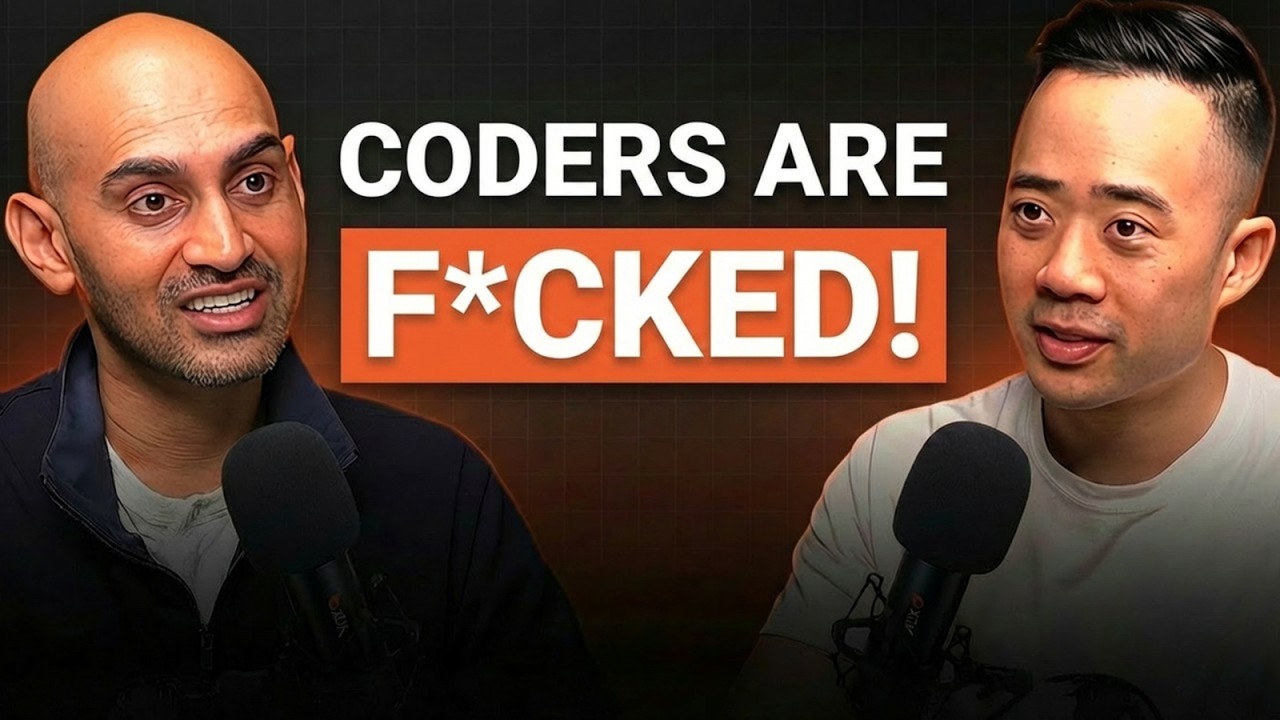
This content was created by Eric Siu. This content was uploaded by Eric Siu. This is a YouTube episode titled "The Next Big Thing in AI Won’t Be Software or Coding" (uploaded April 23, 2026) featuring a conversational, interview-style discussion between Eric Siu and Neil Patel. The hosts discuss AI-driven go-to-market tactics (including a case study of an OpenClaw-based pool-rendering marketing funnel that sends postcards to homeowners), Sequoia’s "sell work, not software" $1 trillion thesis (services-as-software / outcome-based AI), AI+human workflows for content and marketing, risks of automating regulated work, and practical growth/SEO tactics. The excerpt also includes a brief ClickFlow sponsor ad and mentions companies/tools like Mannus/Manus, Madness AI, and ClickFlow.
Chapters
Neil, did you see this guy that builds pools? Okay, so he basically closes these $50,000 pool deals. Like here, I'm going to show you over here. He uses OpenClaw for this. Pool?
Like a swimming pool or you're talking about a pool?
Swimming pool. Swimming pool. Okay, thank you for that. So, okay, Neil, this OpenClaw bot finds $500 grand to $1.2 million homes without pools. It renders a pool in their backyard and mails the owner a postcard showing the before and after on autopilot. Here's how pool builders can close $50K deals with this system. Okay, so it scans the satellite imagery, it filters by lot size, it does all this stuff over here. And then check this out. So this guy's marketing tactic, comment pool, and I'll show you the full breakdown. And so he gets 1.2 million views on this. I think this is genius, right?
Wow.
You can see the rendering here. I'll make it a little bigger. You can see that. So you can see lots scanned over here, lots scanned in Tampa, pool rendered, and literally they get a postcard. So I think this is pretty cool because now you have an agent that can end-to-end handle this. So look at all the homes, and it'll create the postcard, it'll create the rendering, and this is a nice way to get people's attention when it comes to outbound. But what's funny to me, Neil, is when you look at what this guy has, if I can come off of this real quick, he gets 1.2 million views on this, and then at the very bottom, he's like, DM me if you want a custom Open Claw for your system. So, Open Claw system for your business, okay? So, he's calling this out as a case study. That's cool. But you know what's funnier, Neil? Mannus comes in. So, this employee from Mannus, you can see, Go-to-market at Madness. Oh, look, another homie, Neil. Um, but he's like, hey, I saw this and I just had to try it with Madness AI. Delivered all of these in one session, personalized to your name and needs. This is hyper-personalized sales at its best. So it's like marketing on marketing on marketing.
Did I tell you I got hit up by Madness? Have they hit you up for social posts?
Videos? Yeah.
They hit you up? The Madness team?
Uh-huh.
Okay. If you ever need to be connected to more people there on that team, let me know.
How come you didn't do a deal? Hey, how come they don't sponsor this podcast? This would be the perfect podcast for them to sponsor. We love Manus. Manus. Okay, Neil's doing it right now. I can see Neil's in the middle of it. Neil's like, oh, good idea. Okay, thank you, Neil. But I made a video for them, by the way, when they first came out. That video got like 200,000 views on it, a long form. So they got some conversions out of that. Okay, and I called it out as a big winner last year, even though the AI said I was sensationalist. Okay, so I'm going to move over as Neil pulls that up. Neil, I want to talk about Sequoia's $1 trillion thesis. Okay, have you heard of this?
Uh-uh.
Okay, so Silicon Valley is finally waking up to this $1 trillion thesis by Sequoia. So Sequoia Capital, they are a popular venture firm. They funded some of the most iconic companies. I think they funded Apple back in the day. Um, so Sequoia's thesis that the next $1 trillion company will sell work, not software, is the most important reframe in AI right now. So the argument is, if you sell a copilot, you're competing with every new model release. But if you sell the outcomes— so books closed, contracts claimed, uh, customers driven, for example, claims handled— every AI improvement makes your margins better, not your product obsolete. So the key insight most people are missing: for every dollar spent on software, $6 is spent on services. Thank God, Neil, that we have a services business for both of us, right? So don't think about AI for accountants. You want to think about the AI accounting firm, not AI for lawyers, but the AI law firm, okay? So you look at this over here. What they're basically saying is that this team, we just published a paper on how to measure these economic outcomes. We call them outcome primitives. We track 1,300 agents over 21 days creating $32 million of economic value. So securing jobs, winning $200K grants, and shipping e-commerce shops. If your AI product is Copilot, you're competing on software margins, losing to big AI labs. If you're an AI product that delivers the primitive, you're competing on services margins, transforming outdated, inefficient industries. So choose your battles wisely. I don't even know how to read this chart over here. All I'll just say is that services as a software, it's become the sexy thing. And thank God we stuck around, Neil. You could have sold out, but you didn't. That's right.
On a side note, I just did an introduction to the Mannus team and told them how your past videos drove a lot of views and they should work with you.
Good luck. Work with us for this podcast?
No, no, I just said to you.
No, I don't want to do a one-off video. That's annoying. I just sponsored this podcast. Like we have HubSpot, they're a great sponsor. We're taking one more.
So cool.
Yeah. Here, try reading this real quick, Neil.
I can't see it. The text color and writing is too hard for me.
Okay, so I'm going to try to understand this real quick. So outcome magnitude, human effort equivalent. Okay, so for AP asset production, decision support, interpersonal navigation, health optimization. Okay, let's look at this. I don't understand this. All we need to know, Neil, is there's a $1 trillion thesis by Sequoia, and that's why you have YC, you have companies like Sequoia talking about backing more services companies.
But this is outcome-based, so you're selling outcomes. They say it's a trillion-dollar dollar.
Exactly, which is what we've been doing anyway. You're selling outcomes, but you're going to do it more efficiently.
But this isn't the same thing as software as a service, is it?
I don't know, it doesn't sound like it. I think, I mean, this Sequoia one over here where you see this picture, I don't know who this is, but services as a software, YC was talking about, I think Sequoia is also talking about it too. So the next trillion-dollar company will sell work, not software, is the most important reframe in AI right now, and I tend to believe that. Which is why we're not trying to. Yeah.
I think they say service as a software is like a $15 trillion industry.
It is because way more people spend money on services than software. It's 6 to 1. Every dollar spent on software, $6 is spent on services.
Uh, global software as a service market with estimated value of $250 billion exceeded.
I mean, you're going to go to town with, um, with, uh, MPXL. That's what I'll say. Yeah.
Time will end up telling, but yeah, we'll try. Uh, I can't find where the rank is. All right, let me just actually use AI. Let's see what it says. Industry size.
What are you looking for? Can you share your screen?
Sure.
Uh, okay. So what do we got here?
So service as a software, it focuses on software as a service.
Oh, it failed. Yeah.
I tried it with ChatGPT the other day too, and it failed as well. It fails.
You know, these things fail quite often. Now that I speak to the agents all day, it fails a lot. Like, but it's still worth the trade-off because the gains you get from it are still worth it. So I'll take, like, you and I are not perfect. We fail a lot every single day.
Yeah.
So I'll leave it at that.
Did I tell you I have a friend who works at a publicly traded company and they did an experiment with different divisions and canning employees for AI, small divisions. Okay.
Nice.
So like they ended up canning quite a bit of people on marketing and they wanted to see what could be done automatically in a few other divisions. So they tried marketing, sales, you get the point, right? And they didn't pick the big divisions that are making billions of dollars. They picked the smaller ones where they could afford to lose some money. And what they found was the ones where they cut people and they couldn't cut everyone, but they cut a lot of people or percentage-wise, it wasn't a big headcount number. So it wasn't big announcements. The results weren't great. And what they found was the biggest issue AI had was with strategy, especially in marketing, and it was doing a lot of subpar mediocre work. But here was a bigger thing. Some of the divisions they have are regulated, and one of them made a mistake that cost them $6 million. So, so at that point, they're just like, this AI stuff is cool. We want to pair it with humans. This is costing us too much money, both on the revenue front and on the penalty front.
Quick break for SaaS founders listening. You know how content marketing works, you know how AI SEO works, and you've been seeing competitors ranking for your keywords all day long, but you don't have the time to write and hiring a content team feels premature or just out of the budget. That's exactly why we built ClickFlow. It helps create AI SEO content that actually sounds like your brand. We're talking Thought leadership, or talking product content comparison pages without having to add more headcount. It also helps you do things such as building FAQs, internal linking, and telling you which old posts are hurting your domain. One user reported saving 90 hours per month, and that was a part-time employee. You can get a 14-day free trial at clickflow.com. Scale your content without scaling your team.
Back to the show.
You know what I think? I mean, so I'll tell you what. The good news. Our marketing school YouTube is growing faster now. And so I want to give Jan credit. But also at the same time, I was speaking to him. So he helps us with the YouTube strategy. And so, you know, he made a statement. I was just talking to him about it yesterday and I'll just make it public. But it's like, he's like, yeah, you know, I don't tend to trust AI when it comes to, you know, titles and strategy and all that. It's like, no, it's not AI or human, it's AI and human. When you do AI and human and use something like YouTube API, you're going to get better results ultimately. 'Cause it's going to spot patterns that you wouldn't have spotted on your own, right? And so I think that's what people need to get right. It's not or, it's and.
Yeah, watch this everyone. And Eric, be honest. Do you think I'm a— if you had to rate my skills for writing copy, what would you rate me on a 1 to 10? Be honest. At least for marketing copy, like for stuff—
Probably 8.5 to 9.
Okay, what would you rate me if I had to write marketing copy for a marketing company, like marketing software or marketing agency?
Probably like a 4 or 5.
Out of 10?
Yeah.
Like writing copy for my own website?
For, okay. Writing copy for your own stuff. Like when I think about like Quick Sprout, for example, like I think 8.5, 9 out of 10. I think if you're writing for an agency, actually, no, you have written for your agency. I think, no, I think you do do a good job with, yeah. So I would say probably around the same range. Uh, but I don't know why I think you, what area do you suck in? I clearly think you suck in one area. What is it?
In copywriting?
Yeah. What area do you suck? I think you suck at something, but I don't know what it is.
No, in copywriting or something specific in marketing?
So no, in copywriting.
No, overall in copy, I'm really good.
Yeah. But so my point is, I think you're good overall, but I clearly, I think you suck at something. I don't know what it is, but continue.
Go ahead.
Okay.
So let's say he's an 8.5. I agree. I'm not the best marketer at everything. I probably would give myself a 9 out of 10. So similar, I think Eric was around 8.5.
I thought 8.59, yeah.
Yeah, so similar. I would give myself a 9 out of 10. I never give 10s. I always think you can get better. But how often do you think I use AI or now let's rate ChatGPT or Claude or any of these for copywriting compared to me?
2 or 3.
Okay, so people would assume, and Eric already knows the answer to this, he doesn't know where I was going with this, but he knows the answer. Even though I'm a much better copywriter than AI itself, I'll come up with copy variations and once I have the versions I really like and want, not always, but maybe like 15% of the time, 20% of the time max, I'll put it into AI and ask them for more variations because you know what? If you give them a good input—
Yep.
Sometimes, very rarely, but sometimes it does come out with even better variations than what I came up with. So even though AI is not as good a copywriter as me, if you take someone who's really good at what they do, And then they input that into AI, it can give you really good outputs.
Yeah. And to Neil's point, this is all garbage in, garbage out again. So if Neil has already written it already and then he just runs it through a prompt, it's going to be much better than saying, write me a good marketing article. That's not going to work well, right? And you know why my X articles do well? It's because I work with it all the time. I'm like, hey, what's all the cool stuff we worked on recently? And then I might dictate out something I want to talk about on top of that. So you have 2 layers, then you get something really good, right? But you're not going to get it. If you don't give it good context. Because like, again, like how's somebody supposed to just read your mind and just create something that's going to work? Like it's never worked like that.
So. I know we're running out of time, but I'll give you a pro tip. You probably may already be doing this. I was talking with Sam from Writesonic. He's doing something that's really interesting. He takes all the news within a category. So you could be AI marketing, you pick whatever industry you're in. Then he looks at that news that's coming out. He looks at backlinks, social shares, comments, engagement, shares, whatever metrics he can get because some platforms are closed, some you can easily crawl and scrape. And he's looking at that in real time. So like an hourly basis, right? As close to real time as possible. And then of course he's still looking back a day, 2 days, a week, etc. That tells him what's really hot in his industry. And then he looks at everything that he's created in the past that's resonated with his audience. And what hasn't. So it cross-references that, eliminates all the stuff that it thinks would not do well based on his audience type. And then he has AI create variations of the stuff that did well with his own taste and flavor and adding his own thoughts. So he's not just ripping or copying, he's just using that topic. Like if there's something new in the news that Claude is releasing a new model and everyone's sharing it and it's going viral, call it, 9.8 out of 10 times. He'll be like, if I create something on this tied to marketing, it'll do well. And the AI creates something related to that based on what it can see around the web. He goes in there, fine-tunes it, publishes it. His engagement numbers from the stats that he was showing, he was screen sharing, so it wasn't actual like a dashboard comparing posts, but we went through like 10 posts. No joke, it was more than double the engagement for all the posts that he was using the AI. Versus the ones that he was doing by hand. So the AI ones performed by double compared to the ones he was doing by hand. Sure, he had input on the AI ones, but it just goes to show the power if you combine humans with AI.
Yep. Yeah, I mean, guys, it's just, it's just technology. It's no different. Like, all technology exists to help make human life better. That's what I believe. So anyway, that's a good place to end it. We will see you all tomorrow. Don't forget to rate, review, subscribe.









