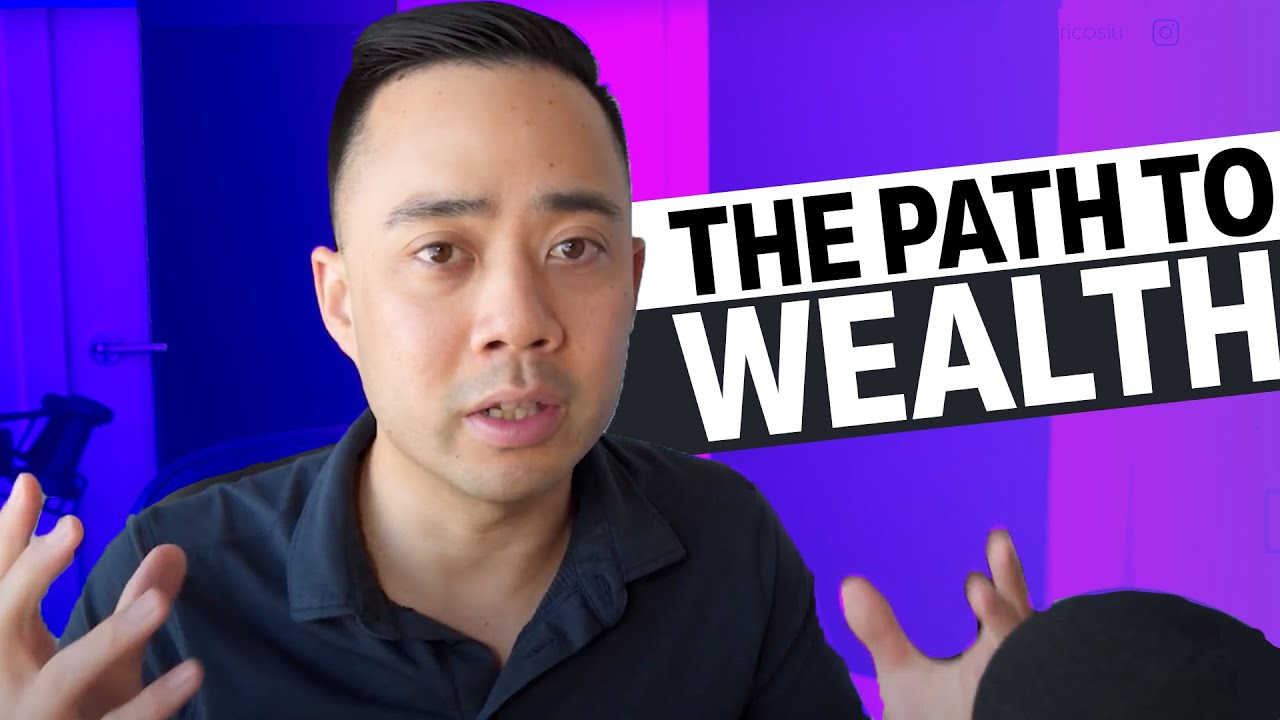
In this solo presentation, Eric Siu outlines a seven‑stage framework for building wealth when starting with no inheritance, connections, or capital. He begins with Stage 1, where an individual lacks a marketable skill and must take low‑tier employment. Stage 2 involves acquiring a skill (e.g., marketing, web design, sales) and securing a full‑time job that pays a higher salary. In Stage 3 the person leverages that skill to launch a "launchpad" business—freelancing, dropshipping, or digital products—aiming to replace their salary and generate $100‑200 k in annual take‑home. Stage 4 adds leverage by hiring staff, turning the launchpad into an agency or a more operational business. Stage 5 focuses on productization: selling SaaS, courses, events, or other scalable products to increase revenue per employee. Stage 6 describes building a network‑effect business where value grows with each additional user, citing Facebook, Instagram, TikTok, Uber, etc. Finally, Stage 7 is the investor mindset, where profits are reinvested to acquire other businesses, drawing parallels to Warren Buffett and Charlie Munger. Siu emphasizes that the stages can overlap, that each step builds on the previous, and he ends with a call to action for viewers to like, subscribe, and comment.
Chapters
Hey guys, it's Eric Siu here, and today we are going to talk about the stages of wealth if you are starting from nothing. So you have no inheritance, you have nothing from your friends, nothing is gonna come help you. You are literally starting from nothing. So the first stage of wealth is when you have no marketable skill, right? You are at ground zero, you don't have a skill, and what ends up happening is you have to take a lower-tier job because you have not built up the right habits for yourself and then built up beyond that the right skills. Okay, that's stage 1. Now stage 2 would be when you've picked up a skill. It could be like marketing, it could be web design, or it could be sales where you're actually helping a company move along even further and you get paid more, you get compensated more because you're solving a greater problem. Well, then what ends up happening is you can get hired by somebody so you can go work for someone. So When I say that, I mean you can go work a full-time job doing— you can become a marketing director, you can become a marketing manager. And in the United States, maybe that could mean making $50,000 a year, $75,000 a year, $100,000 in, you know, maybe if you're working in Silicon Valley, or maybe even more, a little more than that, right? So you have— maybe you start out, you have no marketable skill. Stage 2 is is when you go off and you work for someone, but maybe stage 3 is when you get pretty good at your craft and you have people reaching out to you. Maybe you might have some clients on the side. You start freelancing for people. And the freelancing income that you're getting, maybe before you're making, you know, $50,000 a year, now you start making money from freelancing where you, you go on a site like Upwork, for example, or if you're a designer, you put your portfolio on Dribbble, that's with 3 Bs, and you can go to Behance as well. Um, and people find you, they want to work with you, and you start charging maybe hourly, and you start doing freelance work. Pretty soon, the freelance income that you're making, let's say initially maybe you're making, you know, an extra $1,000 a month, extra $2,000 a month. Well, keep in mind, with your full-time job, if you're making $50 grand a year, you're probably, you're making around $4,000 a month. Your aim is to replace that income. So you're going to replace that income, and that becomes, you know, maybe you're making $4,000, $6,000 a month or so, and then you can quit. And you can go more full-time on your freelancing gig. In that scenario, I actually did a podcast with a guy named Andrew Wilkinson from a company called Tiny Capital, and they own a bunch of different businesses. And he talked about the concept of a launchpad business. So this could be consulting, or this could be starting a dropshipping business, right? So typically you start with freelancing or you start with dropshipping, or you might have a digital products business that you can sell, could be courses as well. But typically a dropshipping business, what you're trying to do first is you are trying to, you're trying to build a business That can generate you anywhere from $100,000 to $200,000 a year take-home so you can cover your costs, you can take care of your family, and you're good to go. Because after that's taken care of, everything else is gravy. You can take risks, you can take shots because you want to have that foundational piece that, um, you know, is strong enough, sturdy enough to not go away. And then from there you feel risk-free. The, the, the burden on your shoulders and even on your mind, the mental burden as well, is gone. So you can take— shots, um, and, and, you know, do what you ultimately want to do. All right. Well, that's stage 3. So stage 1, marketable skill, uh, working for someone, starting a launchpad business. And then stage 4 would be hiring a team for that launchpad business. So maybe initially you're doing the work for people and people want to work with you, but you become so busy that you just don't have the time of day anymore. And we all have the same number of hours. So you've got to figure out how to build leverage. And the way to build leverage is to start to hire people. All right, so when you hire people, guess what? Your consulting or your freelancing business will upgrade into an agency type of business where you have people, you have staff on your team, you're building a culture. Or your dropshipping business could be upgraded into an actual— could be you're actually fulfilling your orders now, right? You're holding inventory, you're fulfilling orders if you want to get to that point, right? So you're upgrading the level up, and that's basically stage 4. Now stage 5 would be When you're selling products, right? So an example would be, I have an ad agency called Single Grain. That is the launchpad business, but I also have software. I have events that are tied to my podcast. We're also doing other, other interesting things, things with our podcast as well. And then we're also considering doing an educational program. We actually have an educational program to teach people how to grow their agency. So we have a lot, we have our hands in a lot of different, we have irons in a lot of different fires. I don't even know if that's an expression. Yeah, you can sell products. You can sell software as a service. Um, where you can do software as a service, you can sell courses, but you're selling products and that allows you to scale more. Um, because even when you build an agency, still as you scale it, you're going to have to throw more people at the problem. And, um, that is, um, it's not the best business model unless you have, um, you know, you're charging based on, uh, performance or you're charging based on value where you can charge a lot more, um, and make a lot more revenue per employee. Level 6 is building a network effect type of business. So it could be like, uh, Facebook, it could be like Instagram. A network effects type of business is when a business starts to— the network becomes more valuable as more people start to use it. So with Facebook, imagine if Facebook had no users right now, it would be useless. Same thing with Instagram. The more people that use it, the more people that are interacting with each other, the more valuable the network becomes. So that is known as network effects business. And that's why these businesses are so big. That's why WhatsApp was bought for $16 billion. Instagram was bought for a billion when it was in the very early days, and you see these companies getting bigger and bigger. TikTok's getting bigger and bigger as of this recording. Snapchat is big; they're public. Twitter's public. Facebook is public. So there's a lot of power in a network effects types of business. Network effect types of network effects type of business. There we go. Uber is another example, and that's level six. So you know you can imagine. I mean. You have a lot of billionaires that have these types of businesses, right? You have Mark Zuckerberg, the person that sold WhatsApp as well. You know, he's a billionaire, right? He sold the company for $16 billion. Now level 7 is— this can kind of go in tandem with some of these stages, but I like to look at level 7 as, you know, when you think about beyond just your business, you know, what are you gonna do with the profits of that business? Are you gonna reinvest it? Are you gonna try to reinvest it into the business? Are you gonna go out and you're gonna acquire other businesses, right? So that is a mindset shift. And when you shift your mindset into that of an investor, and you know, people can say, yeah, they're investors in the stock market. That is certainly an investor. But there's also being an investor in the context of you actually buying other businesses and putting operators in them. Not a lot of people know how to do that. But once you know how to, you know, scale and start a business, you're going to know exactly what you need. And most people don't know how to do that, which is why most people just buy stocks. But they don't really fundamentally understand what it takes to run a business. Now, Warren Buffett and Charlie Munger, it's a different story because they've learned over the years how to run a business. They, they look at the financials a lot. They read a lot. They spend, you know, hours and hours each day reading, but they've learned what it takes to run a business. And even Berkshire Hathaway, their main office has about 30 people or so. So they know a thing or two about running a great business and what it takes to, you know, produce amazing results. Those are the 7 stages of wealth. I'm going to start from the top again. Stage 1, no marketable skill. Stage 2 is you're working for someone. Stage 3 is you're starting a launchpad business. Stage 4 is you're hiring people to help scale that launchpad business. And then stage 5 is you are selling products. So it could be like SaaS products. Stage 6, you're building a network effect business, easier said than done. And stage 7, you are an investor and you are also looking at acquiring other businesses as well. Some of these are interchangeable. So I'm just giving you kind of a, this is just one view of it. Um, but obviously with business, you can, you know, um, there's many different ways to To do this, all right? So if you enjoyed this, hit the like button, subscribe if you want to grow faster, if you want to grow both personally and professionally a lot faster. My name is Eric Siu. Leave a comment below, let me know what you think, and we will see you in the next video. Bye.