The World’s Richest Man Shared His Wealth Formulas In This Book…
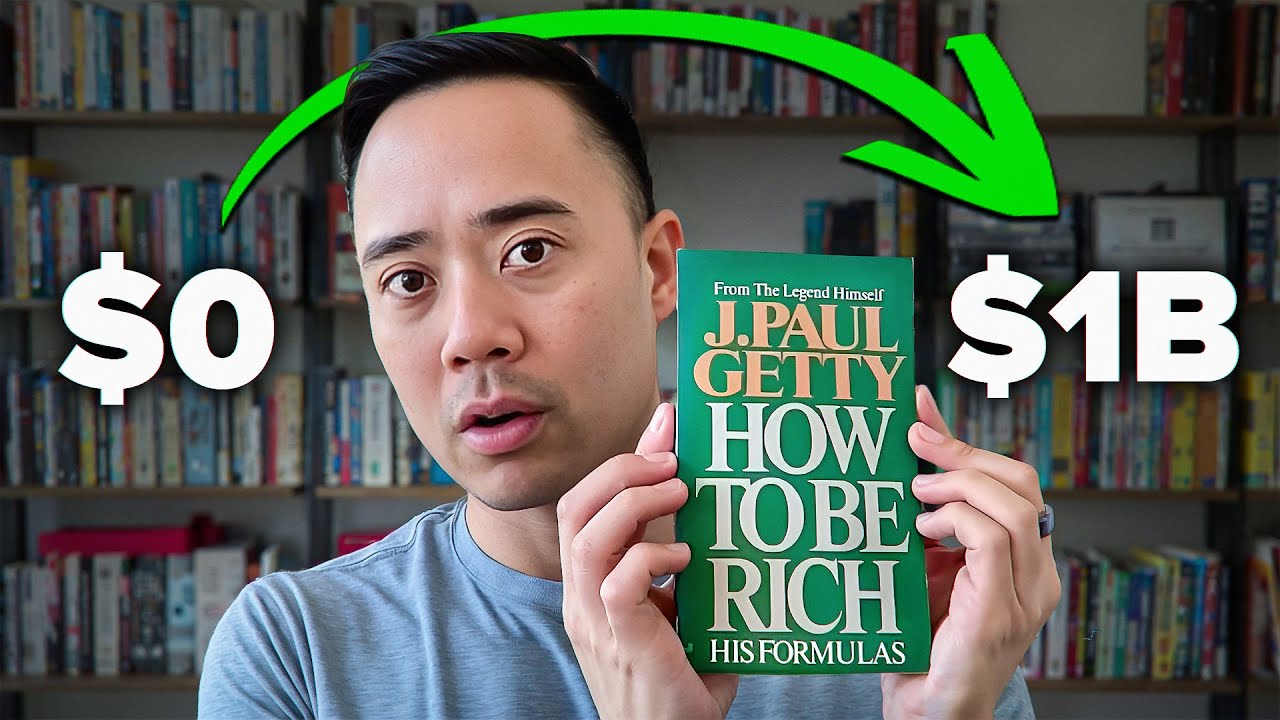
Eric Siu reviews J. Paul Getty's How to Be Rich, pulling out lessons on being a working businessman, hiring decisions, habit formation, and long-term investing. Getty emphasizes incentives over management and warns that wealth comes with social costs entrepreneurs should understand.
Chapters
This book over here was written by the richest man in the world at the time. His name's J. Paul Getty. So he was an oil tycoon. And those of you that are familiar with the Getty Museum, the Getty Villa, it's this guy. There are a ton of lessons from this book. This is gonna be a nice book review that you can take a couple things away from. Again, the title is How to Be Rich. So this is a book written by a billionaire to show you how to be rich. And the book was actually released a month before he passed away. I think he passed away at around age 73 or so. So a lot of good lessons here. And I'm just going to jump into it. So the one thing I'll say is if you want to be successful, okay, this is something that not a lot of people maybe jive with, but you got to think of becoming a businessman as being an artist. So the aim of a businessman is to operate businesses that contribute their share to the economy, progressive upward movement of the world's economy. And what ultimately happens is more jobs are created and it makes life better for all, right? So I like his framing around how you should look at business as an art. And a lot of people don't look at it that way, right? And a lot of people instead, they want to think about, they want to retire, they want to go party, they want to have really nice things. And I certainly wanted that in my late teens and even into my 20s. I think a lot of my friends wanted that. But then what you realize is that that's not what it's all about. And so on page 9 of the book, he talks about How in Southern California at age 24, he had already made his first million. So he's a millionaire. And his thinking at age 24 was, I'm going to go party. So he bought a brand new Cadillac. He'd always be in Hollywood. He'd be partying it up. And after a year, he realized that that type of life is extremely empty. And he thought to himself, well, it actually makes sense to Go back to work because being productive is actually probably something that you can have fun with for a very long time. Partying gets old very quickly. Hanging out on the beach gets old very quickly, right? And so his father told him this, you've got to use your money to create, operate, and build businesses. Your wealth represents potential jobs for countless others, and it can produce wealth and a better life for a great many people as well as for yourself. And so he's saying, look, if you do this, you're going to help a lot of other people, but you're also going to help yourself. But sitting around expecting things to come to you and just chilling, that's not what we're put on this earth for. We're put on this earth to make life hopefully better for other people, right? Not a lot of people look at things that way, but you listening to this right now, you can do that, right? I do want to call out too, his father came from nothing. He was basically poor. And at the time, I think his father ended up leaving J-Paul Getty with maybe $15 million at the time. So $50 million at the time, by the way, probably was, I don't know, I want to say at least over $100 million. So it was a lot of money. And so he was going to be fine no matter what. And his father wasn't really focused on taking care of himself all the time. He donated a lot of money to charities. He would build pools, he would build schools, and he would give a lot back. And a lot of those things he didn't really take for himself. And that just shows you what type of character his father had. And so when you have a father like that, it's really easy to grow up with a silver spoon and not contribute to society. But I believe his father instilled good values into J. Paul Getty. And I think this is a way that you want to go about bringing up your kids too. I think that that's a key lesson for me. It's the type of parent that you're going to be. Hopefully, this is someone that you feel like the way you parent is something your child can try to emulate in the future. And you want your child to ideally look up to you. And J. Paul Getty, the son, really looked up to him. So he says over here, it took me a while to wake up to the fact that I was only wasting time and that I was bored. By the end of 1918, I was thoroughly fed up. Early in 1919, I was back in the oil business, not a little abashed by the I told you so smile I got from my father when I informed him that being retired at 24, I was coming out of retirement at 26. So, you know, his dad, you know, told him what he thought and let him do his thing. But eventually, you know, he realized he would come around. So that's that. Now, I would say one of the key takeaways I got from this book, probably one of the best things Is the idea of a working businessman, and you hear a lot of people talk about on you know on social media like yeah you know you got to hire you got to you can go buy a company coming out of college and you could just go hire CEO and they'll run the company for you right if it's too easy if it sounds too good to be true it probably is and if it sounds easy it's not business is not easy right business is a form of It's a lot of adversity. It's a lot of ups and downs. It's a lot of suffering, but the rewards you get from it are worth infinitely more in my opinion. The lessons you learn from it, the people that you meet, the experiences that you get to have. But most people just don't want to put in the work because most people are most people. And so his whole point about, okay, so what does a working businessman mean? A working businessman means that you have to be involved in your business, meaning That sure, you can hire a CEO. Yes, you need to hire executives. These people are very important. But if you don't provide them the vision, you don't provide them the sense of values, the mission, and you're not the one that's constantly trying to drive the vision forward, you're out there being the visionary. I don't care if you're the CEO, I don't care if you're the chairman, the business will slow down. It will fall apart because there's nobody more incentivized than the founders of the business because you own the lion's share of the equity. You should be incentivized to continue to push. And when you don't want to push anymore, just sell the business, get rid of it. Do something else with it. Go find something else to do. And it took me a very long time to learn that, I would say. The first time I learned that was when I first took over my ad agency, Single Grain. I first took it over and I read this book called Let My People Go Surfing. And it was written by the Patagonia co-founder. And the premise of the book is like, yeah, let your people go do their thing. They're going to perform for you, right? And the book is amazing. I just took it a little too literally. And I was like, oh yeah, Let my people go surfing. I stopped showing up to the office. And what ended up happening was pandemonium, right? You had people that would not show up to work, people that would show up to work in their pajamas and wearing flip-flops and eating chips while watching Family Guy. And it became a disaster. And there's no one else to blame but myself because I had a very idealistic version or idealistic way of thinking that if I left people to their own devices and didn't micromanage them, That they would do fine. And by the way, I don't think micromanagement is a good or bad thing. I think there's a spectrum to it. And I think if it's a very high-risk thing and you're the only one that knows about it, then yes, you should micromanage it. If it's a very low-risk thing, such as walking out into the snow and your kids aren't wearing boots, well, okay, next time they'll know to put on boots, right? That's something that you can let happen. And so that's why I've learned over the years and I had to relearn that lesson as well. You know, when we bought some companies and I stepped away from the business again, I was like, hey, you got it, right? You got it. Hey, you've been there, done that. You got it, right? Because you want to hire people that have been there, done that. And they didn't have it. And I'm not going to blame them. I'm more so just going to blame myself at the end of the day, right? And so that's another thing he says in this book too. All the mistakes, all the things that happen in your business, the main person that's responsible at the end of the day, it is you. Yeah. You are the founder. You can try to blame other people. Sure, it might be their fault too, but who ended up hiring them? Who spent too long to fire them, right? So the working businessman being involved, touching different areas of the business, kind of playing free safety out there, paying attention to what's going on, jumping in where there's a problem, right? Running to the ball. And then also at the same time in business, you're also the point guard. You're passing the ball around. You're seeing different opportunities. Hey, here's this opportunity over here. Boom, right? Here's this opportunity over here. Take this opportunity. Boom, boom, boom. Yes, you need an amazing executive team. You need to have people that you can trust. But most importantly, I believe you have to stay involved. And I used to think that having— is there such thing as a 10x employee or 100x employee? And I would say that the founders being involved in the business, those people are 10x, they're 100x. The amount of intensity they can drive, their decision-making ability, the way they set the tone. You have to be involved with your business. Yeah. You have to be a working businessman. All right, quick note, this is about my company. It's called Single Grain. And Single Grain is an ad agency where we're focused on driving innovation. And so I want to talk about a couple of new strategies. And if you need help with marketing, great. If not, here are a couple of new strategies that you should try out. One is programmatic CRO. So we are doing programmatic conversion rate optimization on our site. We're building products that will automatically optimize your site to increase conversion rates. We're also auto-optimizing, auto-updating From an SEO standpoint. And we're constantly thinking about what else we can do in terms of enriching the visitors that are hitting your website and also tailoring custom messages for them using AI. And so there's a handful of things that we're doing from a marketing standpoint. And our mission is just to drive more innovation. So if you want to learn more, just go to singlegrain.com, grain like rice. So singlegrain.com to learn more, and we'll see you inside. Now, on page 38 over here, I'm going to read this out. So I have a statue back here. I think it's over here actually. So this is Charlie Munger, okay? The late Charlie Munger, rest in peace. So he was Warren Buffett's partner. And the phrase he likes to use is, show me the incentive and I'll show you the outcome. And so I'm going to read this passage to you over here. So this guy George that works for him. So keep in mind, J. Paul Getty's in oil. He drills a lot of different— he buys land, drills oil, collects a bunch of oil, right? Some things work out, some things don't. But so he talks about this guy, George. He says, he possessed all the qualifications of a top-notch superintendent. After some weeks, I had a man-to-man talk with him. I informed George bluntly that I thought there was considerable room for improvement in the manner in which he was handling his job. You know, George, it's funny, but I need to only spend an hour on one of the sites and I spot several things we can do better or cheaper and increase production and profits, I told him. Frankly, I can't understand why you don't see them too. And so George responds. He says, But you own the properties, the superintendent declared. You have a direct personal interest in everything that happens on or to them. That's enough to sharpen any man's eyes to ways of saving and thereby making more money. Truth to tell, I've never thought of it in quite that way before. I mulled over what George said for several days and then decided to try an experiment. I had another talk with Miller, George. So look, George, suppose I farmed the properties out to you, I suggested. Instead of paying you a salary, I'll give you a percent of the profits. The more efficient our operations, the bigger those profits will be and the more money you'll make. And then basically he accepted the offer enthusiastically and everything took off. He never really had to worry about George anymore. So incentives drive the world. And bear in mind, you can't just give incentives to someone that's maybe like a kindergartner, for example, or like a baby, right? They wouldn't understand what to do. The experience quite isn't there. That's an extreme example. Now, what I've done in the past is I've incentivized people that weren't quite— they didn't quite have the experience or they weren't quite where we needed them to be in terms of matching our values and being that A player, right? And again, I take responsibility for that. But I will say when you put the right incentives in front of someone that's very driven and they're an A player, they're going to rip it. As I'm talking right now, I'm trying to think about, wow, there's actually other people on my team that I'd like to have these incentives set up for. Yeah. And they'll go for it. They'll blow the numbers out of the water and they'll feel like they're owners, right? And that's what you have to do. You have to think about incentives that will align people with putting in the work that needs to be put in to achieve the results that you want. So incentives drive everything. All right. So this book over here, you can see that there are, there's so many dog ears, right? That this is a hallmark of a really good book. I'm going to go to another little bookmark I have, and this is on 51. And J. Paul Getty talks about what makes a good executive, right? So number 1, he says, number 1, example is the best means to instruct or inspire others. The man who shows them as well as tells them is the one who gets the most from his subordinates. All right? I can go with that, right? When you show someone, like for example, you make a Loom video, hey, here's how you do this over here. Or maybe you're coaching them on a call and you're saying, hey, hey, this is how you do it over here. When you show them examples and you're actually in the trenches with them, they do respect you more. Number 2, a good executive accepts full responsibility for the actions of the people under him. If called before his superiors because something has gone wrong in his department or office, he accepts full personal blame for the fault is his for having exercised poor supervision. What'd I say earlier? Everything is your fault at the end of the day if you're a founder of the company or you're a leader in the company, you're responsible for your entire team. Some people don't want to own up to that. And those are people that don't last a very long time in my company. And not saying we're amazing or anything, I'm just saying that you get what you tolerate. And if you have executives that exercise— they don't take responsibility, guess what's going to happen? Their subordinates won't take responsibility because they're looking up and then their subordinates won't take responsibility. And then what happens is you're left with the bozo explosion. You have a bunch of bozos working in your company. You cannot tolerate that. You have to keep— Yeah. Your standards unreasonably high, and that's something something I've been telling my team pretty frequently now. We need to have an unreasonably high bar when it comes to talent because talent is the X factor when it comes to running any business. Now, number three: The best leader never asks anyone under him to do anything he is unable or unwilling to do himself. So for me, if I have to jump in and assist with let's say sales, for example, I have to jump in and assist with marketing, for example, to jump in to assist with client services, for example, I have to jump in to figure out what's going on on the operation side or the hiring, the recruiting side, the people side of things, I will jump in. Do I want to jump in? I don't want to jump in. And I really hate doing admin work in just any type of admin work. You ask me to recover a password for you, I just go insane, right? But if I have to do it, I will do it, right? So nothing is ever beneath you. If you need to clean the toilets, go freaking clean the toilets, right? And it's a sign of humility when you're able to, when you're willing and you're ready and willing to do that. Number 4, we got 2 more here. So number 4, the man in charge must be fair but firm with his subordinates, showing concerns for their needs and doing all he can to meet their reasonable requests. He treats his juniors with patience, understanding, and respect, and backs them to the hilt. On the other hand, he does not pamper them and always bears in mind that familiarity breeds contempt. So what this means is that yes, you should absolutely care about your subordinates. You should do what you can to support them. But also, if they start to be Pampered, it becomes an expectation. And this last line over here, familiarity breeds contempt. They're always going to test you. And it's the same thing with the family. If you have kids, they're going to test you. Same thing if you have a spouse, you're going to test each other, right? Same thing with the organization. When there's any form of authority, people are going to test to see what boundaries they can push. It's on you to set those boundaries. It's on you to be fair but firm. So be very fair to your team. Support them where you can, but But also don't let yourself be taken advantage of. And the phrase here that comes to mind is, don't let people mistake your kindness for weakness. All right. Number 5, there's one seemingly small, but actually very important point that all executives should remember. Praise should always be given in public. Criticism should always be delivered in private. Employees who have done a good job should be told in front of their fellows. This raises morale all around. Employees who have done something wrong should be told so in private, otherwise they will be humiliated and morale will drop. I used to subscribe to this. I'm still a big fan of praising in public. But what I do now is I learned this from Jensen, the CEO founder of NVIDIA. His reasoning is if someone makes a mistake, it's on your dime and it's on the company's dime. Why would you deprive other people of the learnings? Just be respectful with the feedback. You want to give that feedback openly. And we've done that, right? Yeah. And let's say I make a mistake. Let's say, hey, Eric, we made a mistake here and it's okay. And we paid for it as a company, but would you mind if I gave you some feedback here so we can do better? And so everyone's aware of a mistake we can avoid next time. If you could be respectful with this feedback, because it is in public, right? And it's still probably jarring for people. But I do believe that if it's a learning opportunity and you can disseminate it to multiple people at once, I think it's worth it. I think the payoff is worth it. And it does kind of set the tone too, that we're willing to speak up on these things and not let things fester. So you kind of get a 2-in-1 here. You're not letting things fester and you're setting the tone for the rest of the company in terms of creating an open culture where you can disagree or you can kind of call each other out. And sometimes I get called out in public too. So that's what I'd say. These are the things that make an executive. That's pretty good. I got to take a minute to tell you about the Agency Owners Association. This is a peer group for agency owners. Owners think YPO or EO, but for agency owners. And I just wanted to read you a couple of testimonials. So this first one comes from Carrie, and we asked her, what do you like most about the group? She said, having a group of people to discuss and bounce ideas. The leads are great too. Yes, we share leads in this group as well. This one from Aliyan, he says, the ability to really post whatever I want and need, and the group responds. Great experienced members, getting a lot of insights from conversations with other members, getting a lot of value from sessions from Eric, getting advice from others as well. And so if you want to grow your agency faster and you want a peer group to do so, just go to marketingschool.io/agency. This is a group that both Neil and I created. And our hope here is to create a vibrant community of agency owners and do a lot more with it in the future. So again, marketingschool.io/agency, and we'll see you inside. Continuing on, some, some more of my dog ears over here. So he has a chapter here where he talks about the force of habit. And there are so many amazing chapters in here. I can't go through the entire book, but I want to cover some of the key things here, right? So one thing he says is this: any individual's advantage and best interest to be prompt, whether it is in keeping an appointment, paying a debt, meeting an obligation, or keeping a promise of any kind. The habitually late dinner guest discommodes his hosts and the others who have been invited to the affair. He quickly becomes unpopular and sooner or later, He is dropped from guest lists. Habitual promptness is an especially valuable asset for any businessman. The ancient adage, time is money, has always been valid, and it is more valid today than ever before. So basically what he's saying is this, there are a lot of people out there that can't be on time to save their life. And this is just one of those habits. You have to develop good habits instead of falling into bad ones, right? You have to be proactive with your habits. And so he just talks about the force of habit. Good habits compound over a long period of time. And so, for example, you go work out in the morning, you wake up early, you knock out a bunch of things, you eat a healthy breakfast, you're powered up, ready to go. You have a nice walk in the morning, right? All these things add up. You're getting that momentum going in the morning. You're building unstoppable morning. And no matter what comes at you later in the day, you can take it because you've built up some resilience, some resilience to start the day because you've built some great habits. So, that's what I would say. Now, one thing that does stick with me, and I actually don't have the dog ear for this one, but there's a story that sticks with me that he talks about in, again, in this book over here. And so Getty cites the founder of Firestone, so Firestone Tires. And what the Firestone Tires guy said is basically inorganic growth can actually kill companies. Forced growth can actually kill a business. So when someone gets overambitious with acquiring too many companies at once, What ends up happening is your employees can't support it because the integrations maybe don't work out because you're integrating too many companies at once. Or let's say you are, you're able to get 10,000 additional leads per month, but maybe you can't scale that because you don't have the people ready to take on that work. And what happens is your current clients will suffer and also your employees are going to suffer burnout too. So everything ends up falling apart. And I've experienced this before where we did too many acquisitions at once and it just became pandemonium, right? I used that word a little earlier, but that's the word that comes to mind again. So you got to— what ends up making a lot of sense is not trying to control the growth too much. Yes, you can be aggressive every now and then, but don't be overly aggressive, right? Because if you're overly aggressive, what ends up happening is things get out of control and you might end up losing it all instead of gaining maybe a 20% gain, you might end up losing it all. So what I've learned over the years is that slow and steady growth. Okay? So let's say you're surfing a wave over here. You want to surf a wave, right? You're calm. You're you're you're you're you're going with the flow. But if you try to take control of the water, what ends up happening is you just end up sinking. And so forced growth can end up killing a business. Take it from me firsthand. Almost bankrupted a couple times because of that. Now, we've talked about earlier. I I did talk about how to parent. You know, coming from a wealthy family. So I think he had good family values here. We kind of talked about that already. But What's interesting is when he was about to die as a business, none of the oil companies would back him. Or I think he needed some type of bridge loan or something to kind of keep his business going because he wasn't successful. Once he came back at age 26, he actually wasn't able to strike oil for a while. And then everyone was going to kind of just let him bleed out, right? All the other oil companies, they're kind of satisfied with that. Now, Shell Company came in. I think he wrote a letter to the president of Shell or someone really high up at Shell. And the guy actually said, hey, let's meet. And they ended up meeting and he wasn't sure, like this was a long shot. He didn't think this Shell thing would even pan out. And the Shell president was like, okay, well, you know what? Tomorrow we're going to run a pipe through all of your— sorry, he actually had the oil, but nobody would buy it from him. I think that's what it is. And then Shell said, hey, we'll buy the oil from you and we'll actually connect our pipelines to your oil reserves, right? However you— Yeah. Look at that. But main thing is Shell company jumped in and saved him. So you never know, that one last ditch effort might save you and it might turn out to be the most unlikely savior at the end of the day. And it also reminds me too, the president of Shell was like, this stuff really pisses me off because I needed a lot of support when I was starting out. And so one of his mindsets was like, hey, I'm going to pay it forward and I'm going to help you out. And so in entrepreneurship, for me at least, Thinking about it. And a lot of people I know actually, we do think quite often about how do we pay it forward? How do we help other people? And just because it's a very hard journey, it's a very lonely journey. And again, it's one of the hardest things you can do. I believe it's one of the best personal growth engines, but it's not for the faint of heart. That's what I want to say. And I think another lesson from the Shell thing is success isn't instant. And it took him a long time to get there. Like he was a millionaire by 24. Sure, he got a little lucky, but you know, 26 years old or so, it took him a while to kind of strike oil again. And then when he did, then you know, he was almost about to you know be forced out of the business until Shell came and saved him, right? So there's a lot of ups and downs, and you know, even though he came from a rich family, it doesn't guarantee success. There's a couple of near-death experiences, and there's a lot of lessons learned here here, and I'm glad that he. he shared these things. The one thing that's also, I think is worth talking about too, is there's a chapter in here called The Businessman at Bay. And I think this is an incredible chapter because we just talked a little bit about adversity, right? So look, here's what he says. So he says, the successful businessman, the true business leader is the individual who develops the ability to retain his composure in times of stress and in the face of setbacks. The young businessman should strive to acquire and develop this and the related traits I have previously mentioned. And he should try very early in his career, for it will not be long before he encounters his first reverses and adversities. The manner in which he meets the first few tight situations in which he finds himself will often set the pattern for the rest of his career. Plainly, it is not possible for anyone to give a businessman specific step-by-step advice on what he should or should not do when he suffers business reverses. There are far too many variables. Each situation differs greatly from the rest or the next. On the other hand, there are certain fundamental principles which will greatly aid any businessman in meeting adverse situations and transforming setbacks into successes. So I'm going to give a couple here. Number 1, no matter what happens, do not panic. The panic-stricken individual cannot think or act efficiently. A certain amount of trouble is inevitable in any business career. When it comes, it should be met with calm determination. Now, number 2, when things go wrong, it is always a wise idea to pull back temporarily, to withdraw just long enough and far enough to view and evaluate the situation objectively. So take a step back, breathe, right? Maybe you need a couple days to take yourself away from the situation, then maybe think things through. Don't get distracted by things around you. Number 3, in the opening stages of any developing adverse situation, it may be necessary and advisable to give some ground, to sacrifice those things which are least important and most expendable. But it should be a fighting withdrawal, a retrograde action that goes only that goes back only so far and no further. It must never be a disorderly retreat. Next, all factors in the situation must be examined with meticulous care. Every possible course of action must be weighed. All available resources, cerebral as cerebral as well as financial, creative as well as practical, must be marshaled. Five counter moves must be planned with the greatest care and in the greatest of detail, yet with allowances for alternative. Alternative courses in the event unforeseen obstacles are encountered. Counteraction must be planned on a scale consistent with the resources available, and the goals must be conceivably attainable. I have some comments here. So don't panic, stay calm. So spending time meditating and not trying to react to every single thing, I'm still working on that myself, right? Not being that reactive leader, because if people see someone that's not calm, then they're going to start to panic as well. And in number three, he talks about giving some ground. So you might have to cut. You might have to cut departments that are unprofitable, departments that are maybe a long-term thing. You just don't have the resources for that right now. So you might have to cut. And that's a reality business. You have to you have to make tough decisions from from time to time. Actually, all the time. Number four. So he talks about okay, you know basically you have to spend time in the details. And if you're not a detail-oriented person like myself, you have to hire. You have to have detailed person. People around you to do that diligence, right? And even if you're not the detailed person, you need to spend time doing that due diligence as well. And counter moves are interesting because if you take a counter move sometimes, yeah, you might shoot past all your competitors at the end of the day. So I think the businessman at bay, I think it's just learning how to deal with adversity. That's a very big one when it comes to business. And just, you want to talk about how to be rich, right? So you can either be an investor or you can be a business owner. And a business owner to me is they're investing resources. So it's resource allocation. And to me, they're an investor in some way, shape, and form. To me, investing in business, you are investing in business, right? So at the end of the day, everything ladders up to business. That's how I look at it. So if you want to be rich, it's not you hitting the lotto. It's not just you expecting that the leprechaun gives you a pot of gold or something like that. Pot of gold is probably not going to make you rich either, but that's what it is. And I used to think in my teens and in my 20s, like, oh my God, how fortunate would it be if I was just like my rich friends, right? And then I realized what a blessing that I didn't have that. What a blessing that I got to struggle. What a blessing that I had to go through adversity. What a blessing that there were a couple near-death experiences and that I'm still here. What a blessing. And without those lessons, I wouldn't be half the person I am right now. And I'll tell you this, no matter what happens, because you've spent so much time learning, so much time experiencing things, so much time talking to people, Your mind, if your mind is rich, you can never be poor. If your mind, again, if your mind is rich, you got the right habits, you understand the patterns to success, I don't believe you can fail. And that's why Warren Buffett likes to say, and I think he's over here, Warren Buffett likes to say that the greatest investment you can make is in yourself because nobody can ever take that away from you. You might lose it all, but you can build it back up again because you're resourceful and your mind is so trained, right? It's hard to stop that. And by the way, it can't just be all reading. It can't just be all talking to people. It has to be, you have to be actively experiencing things to get ahead of the curve. So there's that. Now there's a section he talks about bureaucracy. And I remember that Steve Jobs, so Steve Jobs of Apple, used to always say that Apple is the world's biggest startup. They got things done very quickly. They shipped all the time. They shipped on time, right? Back when they were shipping the— it was the iPod and then it was the iPhone, right? And there was the iPad and they're shipping all these things, the AirPods, right? And so what J. Paul Getty is saying is that structure bureaucracy holds companies back. And this goes all the way back to you got to be a working businessman. If you're involved with the company, you're going to try to hold back bureaucracy as long as you can because the company gets bigger, They start to add a lot of process. They start to add a lot of layers of middle management. You have people on your team that are often asking for more resources all the time. Then that's never going to stop. He said, then this is another thing. He's like, this is why you got to be frugal. You got to say no a lot more. People are always going to be asking for more resources, but you got to be frugal. And again, structure bureaucracy is what holds companies back. And so how do you fight that? Well, you stay the working businessman, whether you're a chairman or a CEO. Yes, you need to build an executive team, But it is a pipe dream to believe that someone, you can just hire someone to come in and just leave them alone. You cannot just leave them alone. Otherwise, they're going to drive— it's going to be all the things that they want to do at the end of the day. And they're not nearly as incentivized as you are. So don't think you could just do that. I think that's one of the biggest mistakes that you can make. And I believe that the chickens have come to roost for a lot of these people bragging about their holding companies the last couple of years. And so, you know, you take that for what it is. He does have a couple of chapters on investing here. So the one thing he says about investing, he says, this is both for real estate, this is both for stocks. And Warren Buffett says this all the time. And in fact, most investors that are long-term investors, it's just this. You find something that you would hold for at least 10 years, okay? You watch it like a hawk and you hold. And whatever vacillations happen in the market, you might buy more when it goes down. If you believe in the company and management's good, you believe in the product, you believe in the service, Then you keep investing, and that's what he did. He kept investing into oil companies, kept investing into oil companies. Everyone's like, "What are you doing? What are you doing? The market's crashing." Kept putting more money in, right? He invested in real estate, and he bought a lot of things, and he held them for a very long time, and they appreciated, right? He saw a lot of people; they would buy stuff and release it too early and try to get that quick buck. But you know, anytime people try to make a quick buck, whether it's in the stock markets or real estate, it doesn't really work out for them. You got to give things time to compound. And you know, as long as the thesis holds for whatever stocks or businesses that you have, or Investments, then you hold on to it. So that's what it is. And so he has a page, which I think is really interesting. So I'll just tell you this. I traveled to Italy recently, and I'll just say that I wasn't really interested in culture or art before, but I think after going on this trip, and I was there last year too, but here's what he says. So he says, this chapter is called The Educated Barbarians. Okay? He's basically talking about Americans. So we're educated, but we're kind of barbarians because we're not cultured. So he says, Americans, and especially American men, must realize that an understanding and appreciation of literature, drama, art, music, in short, of culture, will give them a broader, better foundation in life and will enable them to enjoy life more and more fully. It will provide them with better balance and perspective, with interests that are pleasing to the senses and inwardly satisfying and gratifying. Far from emasculating or effeminizing a man, a cultural interest serves to make him more completely male, as well as a more complete human being. It stimulates and vitalizes him as an individual and sharpens his tastes, sensibilities, and sensitivity for and to all things in life. And I think that's beautiful. Now I'm like, oh yeah, maybe I should find some art that speaks to me, right? But that's what it is at the end of the day. And then he has a chapter about investing in fine art. And he said the best thing about fine art is Even if it goes down to zero, you still appreciate the art and it still means something to you. And so I used to think people would just— he would actually talk about this in his book. There's people that just buy art to buy art or they try to one-up each other. For him, art is more of a taste thing, right? And so he studied a lot of different art and there's certain artists that he likes and certain artists that he doesn't like. And he just buys the art from the artist that he likes. And I think there's a painting where he bought for $200. He's like, this kind of looks like One of my famous artists, and then they actually appraised it later. It turns out it was from a famous artist, and I think that painting is worth like a couple million dollars now, right? So you just you just never know. And I think art does bring a sense of life to where you live, and it brings a sense of it brings soul to where you live, right? So I think investing into learning about culture is great, and I think he's kind of changed my mind on that, and he's kind of changed my mind on like maybe I'll probably buy some art later, right? Not right now, but not too interested in it. Not too interested in anything right now, but when I do find some stuff, I'll buy it. And then the final thing I'm going to leave you with is he has this chapter basically on— it's called The Morals of Money, but I would just kind of rephrase it to the problems with being rich. He mentioned that at his height, and I think this went all the way to when he died, he would get 3,000 letters per month. And a lot of people were women that were saying that they would Leave their husbands to marry him as long as he paid for the costs. Or he would have, you know, like doctors say, hey, can you pay $500,000 and help me get a yacht? And you have enough money to spare. Or, you know, there's like this other $250,000 a year. Like, by the way, that's a lot of money at the time. People that are really well off saying, hey, you can spare more, right? He's basically saying that mindset never changes. And no matter what you do as a rich person, you're always going to be a marked man, meaning that you're going to be a target. Because let's say you decide to stay home all the time. Okay, you're a hermit, you're a recluse. You go out all the time and maybe you're having dinner with this young person that might be like your niece, for example. And you have dinner with that niece a couple of times. Oh my God, this is a new love, right? And so he's just saying this stuff happens over and over and there's always going to be a target. Envy, Charlie Munger says this, greed is not the problem in the world, it's envy. And he basically reinforced in saying, yeah, envy is a big problem. And he just talks about how funny it is that— Yeah. All these women are like, they're so happy to leave their husbands. And they're like, you know, hey, it seems like you need a wife, J. Paul Getty, and I'd be a perfect wife for you. I am happy to leave my husband. And it just, it does show how the world kind of goes round and round. So those are kind of my takeaways from this book. Again, J. Paul Getty's book, How to Be Rich. It says his formulas, right? So if you want formulas, I think this is a book that's worth rereading. Again, look at all these dog ears over here. Let me know what you think in the comments about this, if you enjoyed this at all. And that being said, we'll catch you in the— we'll catch you in the next video. And don't forget to rate, view, subscribe.









