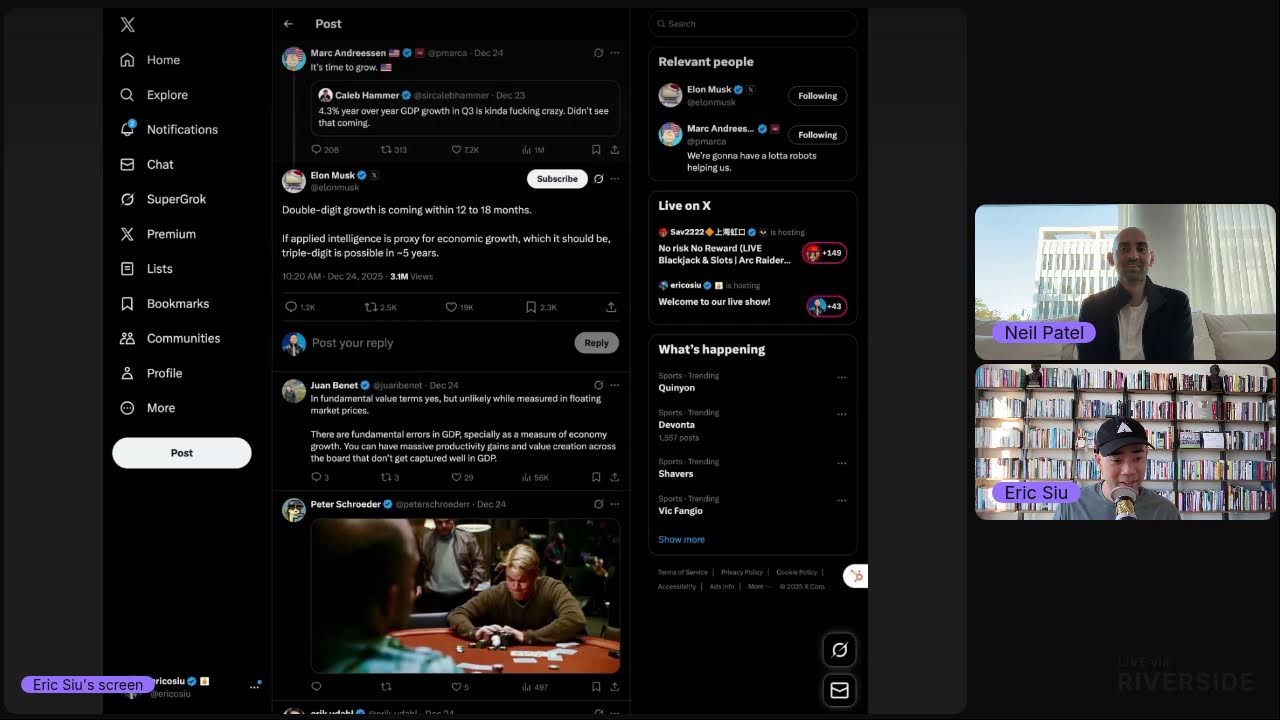
In this live, conversational episode Eric Siu and Neil Patel discuss the accelerating impact of AI on businesses and the workforce, emphasizing the need for AI fluency by 2026. They critique common marketing metrics, urging deeper data fluency and strategic analysis of engagement versus revenue relevance. The hosts explore emerging AI agentic browsers like Comet for automating audience insights, and debate the relative importance of high agency versus high intelligence in the AI era. They examine the build‑vs‑buy decision in product development, highlighting rapid prototyping tools (e.g., Alloy) that replace traditional MVP processes. The conversation shifts to macroeconomic trends, noting AI’s role in reducing software development costs, reshaping large organizations, and driving valuation shifts in financial services through automation and blockchain. They also analyze generative AI market share dynamics, observing a decline in ChatGPT’s traffic share and a rise in Gemini, and discuss platform preferences (Threads, X). Throughout, they share anecdotes from Zapier, Klarna, and banks, concluding with bullish outlooks for 2026 driven by AI, blockchain, and favorable credit conditions.
Chapters
One more time before the new year. So it's December 28th right now as of this recording. This is Sunday. And this will be the final, final episode of Marketing School for the year. Tell us where you're calling in from if you're listening to us live right now. I know it looks like I'm going live on all these different platforms. Neil, I actually have a good one to start with here. I have it highlighted in green. I want to talk about why companies are not hiring in 2026, more specifically big companies. Have you seen this trend?
I have not seen that trend. I assume companies are hiring in 2026.
Yeah. So let's talk about what these big companies are doing and then let's talk about what we're doing. Because I think you and I are probably, um, I'll speak for myself. I, we are looking to make a more aggressive push. Um, but if you look at, um, I'm looking at Wall Street Journal right now. Okay. So companies are outlining plans for 2026. Hiring isn't one of them. So this is why big companies are not hiring in 2026. So you got Shopify, Chime Financial, they're vowing to keep the size of their employee bases roughly flat. Um, and then Midtown Manhattan, um, this is a gathering of CEOs by the Yale School of Management. 66% of leaders surveyed said they plan to either fire workers or maintain the size of their existing teams, and only a third said they plan to hire. So, um, right now you have, um, you know, someone saying you're seeing a lot of wait and see. Some of the looming uncertainty will mean that we're going to see an investment in capital over people. Um, so employment— unemployment rose 44.6% in November. It's the highest in 4 years. while the US added jobs in healthcare and education. I think what's going on right now is what you're seeing too is IBM. This will be the last point over here. IBM employees are leaving the technology giant at the lowest rate in 30 years. 30 years, dude. And so he's basically saying that the CEO, Arvind, of IBM, voluntary attrition at IBM is under 2%, which is amazing.
Okay.
A decline from the typical 7%. So people are looking to stay put right now. And then at the same time, big companies, they're looking to see what type of efficiencies they're going to gain from AI, I think, in 2026. I think we're going to continue to figure things out, but at least for us, I think it's worth talking about. And before I switch it over to you to see what you're doing right now, here's another data point. Wells Fargo CEO said the bank expected to have fewer people as it heads into next year. The company's workforce has fallen from roughly 275,000 people in 2019 to about 210,000 today. executives have cut costs and overhauled the bank. Let me give you another bonus. My, um, one of my relatives who works, um, in the government, um, he's like, many people have been cut and I'm all for it. Um, I'm like, why would you say you're all for it? He's like, because we're too bloated. Um, so I'll flip it over to you. What are you guys doing? Uh, there—
so we haven't been doing much, uh, firing. We have been Doing hiring to backfill open roles. We haven't been doing much hiring as in like, let's just go crazy and hire. I think you and I have been in the same situation as most people in our industry, in which if you look at the marketing space in general, other than the platforms, platforms being Google Ads, Facebook Ads, TikTok Ads, et cetera, most people have been seeing a decline in revenue. I'm assuming you would agree with that since mid-2022. Right? When rates started going really sky high, this is at least U.S., and we're global, so we see data, you know, in multiple countries. And I do think the economy is starting to turn around. I have no proof of it. I was watching the All In podcast with Scott Bessent. I do follow a lot of the stuff that he ends up talking about online, whether it's CNBC or New York Times or whoever wants to end up pulling from him. It's kind of funny watching his New York Times interview. Uh, during their— I forgot what it was called— deal book or something like that.
Yeah, yeah.
Um, that was quite entertaining. But if you look at taxes are going to be lower starting Jan 1st, right? You're going to have more and more deregulation, rates are going down. And when you look at all those things, I do believe it's going to cause businesses to pick up. If businesses start picking up I believe that's going to cause people to hire more than what they're predicting right now. But people are planning based on what the economy is today. I'm not saying for certain it's going to go up by 2026. I'm just a little bit more hopeful. I don't think rates are going to go drastically down in the next 3 months. But, you know, I think we get a new Fed chair, what, March or something like that, or February or March or April is one of those dates.
Could announce it in January. But yeah.
Yeah. And I know one person can't make, you know, a call on rates going lower because it's a committee. But I would say by the end of 2026, I think things are gonna start getting better. Because if you look at, uh, you can actually— you may know this stat. I don't know how many people are on hourly wages, um, but it's a lot. The last time I looked it up, I looked it up like, I don't know, when they were doing the big beautiful bill. I was looking at how many people are on hourly wages and how— what percentage of America makes tips from their Working force? 80 to—
yeah, 80 million people. Um, so that's around 5.7%.
So I was just like, not 5%, can't be 5%.
No, 55%. Oh yeah, yeah, yeah. So it's a majority. That makes sense.
So when you look at those numbers, I'm like, wait, giving those people more money to spend, I think that's going to be great. I wish the government did 2 more things, but I don't think they're going to end up doing it. One is no taxes on anyone making under $100 grand federally. Um, and I think they should tax the rich more. I'm happy to pay more money as well. Uh, and the other thing I would do is they should reserve homes in certain prices for people under certain incomes and make it where they had to put a much lower down payment. I know they have FHA, which is like 3%, but like end up making it where it's almost 0% from and, uh, make it a little bit easier.
Oh dude, we gotta talk about, um, We got it.
But I think that'll cause the whole, you know, business economy to make money. And here's the kicker, if you don't charge taxes on people making less than $100 grand a year federally, right, for business owners like me, even if I pay more taxes— this may sound selfish— I will make more money because they will spend more money, which then ends up feeding back to me.
Yep. So here's how I see it. And so to answer the question directly, are you guys looking to, um, stay pat Aggressively hire, hire more, or slow down hiring? What's the move for you guys next year?
We have no plans on either. We planned our 2026 budgets based on how the economy is today, not by things improving.
Okay.
And if they change, we will ramp up hiring faster.
Here are my thoughts with next year. So the 2 podcasts that Neil mentioned, more so the All-In podcast with Scott Besson on it. So those that don't know, he's our treasury secretary. Very smart guy, hedge fund guy. And when you listen to him talk, by the way, I've actually, to be honest with you, I've never listened to Treasury Secretary's talk. But when you listen to him talk, I'm like, man, this guy is smart. And I feel like we're lucky to have him. But a couple things I believe. So market's pricing in one interest rate cut next year. I don't believe that's going to happen. I think there's going to be multiple interest rate cuts. That's just my opinion. I think GDP, okay, so Elon, and we can talk about this in a second too, but Elon sees double-digit GDP growth coming, then triple-digit in 5 years. I don't know if that's going to be the case next year, but I do think we're going to see GDP growth. We're going to see acceleration just because we're continuing to figure out the AI game. And for whatever reason, yesterday when I was on X, there seems to be picked up a huge pickup of chatter, which we can come back to in a second. So I think we're going to see more AI growth for GDP. And then I think on the other side of things, what Neil mentioned too, so when you give people money, it's naturally, that's going to stimulate spending, and hopefully that gets things moving more. The other thing too is, we thought that, you and I both thought, I think in the beginning of the year, we're like, hey, maybe this tariff thing is maybe not such a good idea, at least for the United States. Turns out, at least for the United States, tariffs so far have proven to be, we've collected revenue from it, and Scott says deflationary, right? We'll see what happens. But I've always believed that maybe we should collect a 5 to 10% tariff so we don't just lose our shirt to everyone. And that seems to be what's happening. So for us, we are looking at hiring, making a hiring push, especially in Q1, because we already have these people mapped out, especially for what we want to do next year. So if the economy picks up, then we're going to be even more aggressive with hiring. So it's very much a year of— hopefully it's a good year and we can make more bets on people, which is what we talked about in the last podcast, our best investments Has always been people.
By far it has been people. And I don't think you can grow a business to be large. I don't mean this in a rude way, but Eric hasn't built a large business. I haven't built a large business yet either. And we'll both admit that publicly. I'm not trying to pick on him or anyone else. And I'm in the same camp as him to build a really big business. If you look at any company, whether it's Nvidia, Tesla, Netflix, even Walmart, even the ones like IBM that no one cares to talk about anymore. They have some really strong leaders, not just the CEO. Their leadership team is extremely strong. It is hard to build businesses that are really large without having some amazing talent.
Yep.
It's that simple. You need it to build something big.
Yep. And by the way, I mean, speaking of, we're talking about Nvidia and then I was looking at, I was listening to the HubSpot CEO talk and they all have different, everyone has different management style, right? So you look at Jensen, for example, he has 60 direct reports, I believe. Brian Halligan, back in the day, he had, I think, 15 direct reports. In some cases, you look at HubSpot CEO, like 90% of the time, I mean, he was just saying he was in a bad mood, right? And for him, I mean, he's always felt paranoid and an imposter, right? And then Nvidia, the CEO, he's always felt like he'll look in the mirror and say, I'm a piece of poo-poo, right? Or, you're a piece of poo-poo, and look at himself. And so I don't think there's any right or wrong way to lead. And so if you want to hire the right people, you have to know how to lead. And leading actually just means getting people to follow you. And well, in order to build a great company, you have to learn how to get people to follow you. So that's something to keep in mind. Because I would just say that in my 20s, I read— like, I'm sure I have a lot of books behind me. I've read a lot of these management books. I've read a lot of biographies. Okay. I've interviewed a lot of people.
Okay.
And I will tell you, it really management style, leadership style kind of goes the spectrum and there's no right or wrong way. So for example, us at my company, we give feedback in public and 99% of people do not like that, right? People give me feedback in public in front of other people. There's certain ways Neil does things too. Neil's going to kind of jump around, right? His management style is not managing people directly. And so all that to say is if you want to get the right people, you're going to have to learn your management style over time, not necessarily just rely on all these books because that's certainly what I did in the beginning. You're going to have to Sure, read the books, but also gain experience.
Yeah, no. So when you look at, because you have a topic there that NVIDIA and HubSpot C management styles, what's the difference? I'm actually curious. I don't know the difference on the CEO's management styles.
Yeah.
And I mean, you're speaking about Brian Halligan or are you talking about the, I forgot what the lady's name is. Yasmin?
No, I'm talking about Brian Halligan. So Brian Halligan was very, he was very direct. And then when he was angry, he would wear his heart on his sleeve and you can tell when he's pissed off, right? And he wouldn't, he's very impatient too. And he was working very— he was 996. And so was Jensen, 996, meaning that you're working all the time. It's actually 996+ because you're basically working, you think about work 24/7, right?
What's 996? What is that defined as?
996 is—
9 hours a day, 6 days a week?
Yeah. So it was popularized in Chinese culture, right? So you're working 9:00 AM to 9:00 PM, okay? 6 days a week. But theirs is more like 997 or even 996+, meaning that they're just thinking about work all the time. So both of them are similar in that respect. I think both of them wouldn't hold back when they were pissed off and they're very direct and they would just say things in front of people. For sure, Jensen would do that. Jensen's style too is he would want people to fill out the 5 main things that they're working on, 5 trends that they see and all that. He'd read those every single day. Anyway, all that to say is they're similar in many ways, but also different in many ways too, because Brian, the reason why I brought this topic up too was because as Brian was learning, because they raised money from a bunch of different VC firms, right? And they're like, oh, you need to build a management team. You need to do this. You need to do this. And he felt like he wasn't being him. And he was becoming this version of him that just felt like a Frankenstein. Jensen felt the same way. Everyone's like, oh, Jensen, you need to have a management team. You can only have 10 direct reports. And then over time, they all realized that, oh, dude, screw what you guys say. Screw The management philosophy is I'm just going to do what's right for me.
Yes. Are you pretty direct with your staff? Do you wear it on your sleeve, your emotions?
Now I am. Now I'm very direct and I do it in front of other people. I didn't do that before because I was afraid of what people thought about me. I'm still respectful about it. I'm not just a dick. It's like, hey, here's how I feel right now. If we don't do this, this is what's going to happen. It works. And don't get me wrong, I feel bad sometimes, but it feels good. It feels like I'm doing the right thing.
I haven't gotten mad at an employee in a very long time. I can't think of one.
You don't get mad at employees. You get mad at like other things. When you get scammed, when you feel like you get scammed, that's when you get really mad.
What do you mean scammed?
For example, the store in Beverly Hills that overcharged you, or when you're getting overcharged by your contractors.
Yeah, that kind of—
yeah, you lose it.
I lose it. Eric's right, I go off. I know I shouldn't go off. I don't actually have a temper, but when people are screwing me over, I let them know that you cannot screw me over, and I make it very clear. Um, and I can be very, uh, direct is probably a kind way. Um, but they usually don't do it again. In business, I used to be really direct. Like, if I had someone underneath me who works under social media or whatever. Actually, here's a good example. Saulo is underneath me in marketing. Because I have a great relationship with him, I'm extremely direct. So much so, sometimes I know he's just pissed off at me because I just, you know, like if someone screws up or someone does it wrong and I have a good relationship with them, I will just not just lay it out, I will really lay it out where it's very clear. Like, you should never do this again. I can't believe you did this. Wow.
You know who else you've done this to? You've done this to me before. You've done this to Mike Kamo before too.
Yeah, but typically we have a small organization, but let's say if you have 1,000+ people like us—
By the way, guys, when Neil says small, it's still 1,000 people. So just FYI, just context for everyone. When he's comparing it, he's really comparing it to the multi-trillion dollar companies.
No, even the multi, like someone worth like $50 billion, $100 billion, $10 billion.
Still a magnitude.
Yeah, yeah. So when I look at like at our size, there's too many people that I don't know. So it's like if someone's just really terrible and I have no relationship with them, instead of laying into them, I will just go message someone who's in charge of those people. I'm like, you need to figure this out, this is a problem, and if you don't fix it, you're going to be left with this mess.
Yeah.
And I have my neck to choke. I know that sounds really bad, but let's say the easiest example for me is because we're we're in so many countries, I have managers just for like Australia, manager just for India, manager just for I don't know South Korea, etc. You get the point. So if someone is off in let's say Australia, I'm not saying there is, but I'm making it up. What I would do is I would just go to Dan. And I'm like, Dan, this is a problem. You need to fix it. If not, this is an issue and it affects our numbers. This is on you. Pretty much I have my neck to choke, as bad as that sounds.
Yeah. In management, they call it one throat to choke.
Yes.
Yeah.
Because it's too hard for me to individually manage every single person. I just want to make sure that my managers are doing what's right. And what I've found is, no matter what department that you're in, Managers who are coin-operated, like they tend to just work for other organizations versus being entrepreneurs, they tend to be slower to hire and they tend to also be slower to fire. You know, they say hire slowly, fire fast.
Yeah.
I found that when you hire good managers, they tend to hire slowly because they don't want to screw up the numbers and the P&L, and they want to be cautious, get the right people, which is right. But they also find that they tend to be slow to fire.
Yep. Yep. You know, that's the one thing since knowing Neil. So Neil and I, I've known him, I was 24 years old, he was 25, but Neil's always been fast to fire.
Remember the mustache guy who claimed he was amazing marketer?
Yeah. Well, you hired him too quickly. I never told you to hire him for that. That's your fault.
Yes. But how long did it take me to fire him?
Within 2 weeks.
Yeah. This isn't going to work.
You're terrible. Goodbye.
I'm much nicer than that, but pretty much. Those people hate me after.
Yeah. Well, here's the thing too. And we're not going to say we're right all the time too, because oftentimes I will say something or Neil will say something. I'm talking about more in public, right? So we're very direct with our thoughts, but sometimes we'll also backtrack too. So I'm also very quick to apologize. So just keep that in mind. You have to figure out what management style works for you. Again, I've read the Patagonia book, Let My People Go Surfing, where it's like you literally let your people go surfing during lunch because you trust them so much, right? And then you have other books where you read the NVIDIA way where it's like direct feedback in public and I will torture you into greatness type of thing, right? And so there's all these different management styles. And again, I think it's helpful to know these things, but you're going to have to figure out your style. And the only way you figured it out is actually by doing, which brings me to my next point over here. So I was listening to the HubSpot CEO talk and he was just saying that running a company is like a shit sandwich every day. So I would almost say it's more than a shit sandwich, 'cause the shit, like you had the log in the middle and you had the 2 breads on the side. I was almost saying the 2 logs are on the outside and the bread's in the middle, right? So it's a weird image to think about, but he was just saying that 90% of the time he's in a bad mood and people keep bringing you shit all the time. They keep dumping shit on you. And literally what you're doing is like you're the umbrella and you're just trying, your umbrella is just like a shit deflector, okay? And so he's just like, dude, the whole time at HubSpot I was paranoid. I've always felt like an imposter. And I'm like, yeah, running a company is a shit sandwich every day because everything eventually flows back up to you. And here's the thing, like Neil, I'll just bring it back to you for a second. All of the stuff that you have to look at, if the numbers are off even a little bit, guess what happens, right? You start making phone calls and then you start to see, oh my God, it's not just a can of worms, it's a whole bowl of worms, right? And then you have to investigate more and more. You start to get more and more frustrated. And so do you agree with that? Running a company is like a shit sandwich every day.
Uh, yeah, because you're saying running a company. I would say, because I'm thinking about from an entrepreneur standpoint, I'm like, it's not actually that bad, but I actually don't run my company, so I don't experience a shit sandwich every single day.
There's problems that you always have to solve.
No, no, you're totally right. But would you agree that my situation is much better than someone who's a CEO?
Yes, yes, because The main shit that you have to deal with is people problems, and you don't deal with people problems.
Correct. I don't have to.
Yeah, so I have to deal with executives, but we handpick really good executives.
I don't really have too many problems. Now, my CEO and executive team really does deal with a lot of crappy problems each and every single day, but here's the kicker: they usually tell me about them after they're solved. They're like, oh, if you only know what we had to do 2 weeks ago. I'm like, what? This happened and this or this and this client and this employee and all this.
Yeah. You influence them.
I'm like, oh, so what are we going to do? They're like, oh, it's all solved. It's all good. I'm like, we lose revenue? They're like, no, we actually found an opportunity. We upsold and we made some more money here and we're above budget here. I'm like, okay, do I need to worry about anything?
Nope. All good. No, that's the dangerous question. They know if you ask that, they have to say yes. If you say no, that's when the problems come from you.
Yes.
So yeah, I actually heard this quote recently too. It's the price of doing great work is actually more work. And if you think about it, people can hate on the most successful people in the world or whatever, but why are they all working right now? It's because Jensen doesn't need to work right now, has the most valuable company in the world. Tim Cook doesn't need to work. What is it? Satya Nadella doesn't need to work. Sundar doesn't need to work. But the price of doing great work is more work. I think you and I, we're not comparing ourselves to them. I'm just saying that as we continue to grow in our careers, there's always going to be more work to do. It's enjoyable. So you have to find, ideally you're finding something that you want to work on for the next 10, 20, 30 years or so.
I agree. When I look at life, it's about if you don't enjoy what you're doing, you're going to be screwed because you're not going to put in the time and effort. But speaking of some of these CEOs, if you look at the Google CEO Sundar, right? I not only think that he really loves what he's doing, But someone actually posed an interesting question to me today because Google is a massive ad giant, right? I think it's $116-ish billion or so in profit each year. And they're like, man, Larry Page is leaving California. Peter Thiel's leaving California. Did you see that? Yeah. Because they don't want to pay the potential—
One of our mutual friends saw Peter Thiel at a restaurant yesterday in Miami.
Exactly. He's already gone. Why? Because he doesn't want to potentially pay the 5% in wealth tax. But I think he'll move back if it doesn't exist, right?
Yeah, probably.
A lot of these guys already have houses in multiple places. Um, and when you're, when you're looking at some of them, you know, one of my buddies has asked me like, dude, what do you think Sundar is gonna do? Because he's a billionaire now. And I'm like, well, Sundar made his money for managing Google and he made a crapload of it. So he'll have no choice but to pay the 5%. And that's his problem. And the executives probably look at it or the board looks at it as you should be grateful that you're the CEO of Google and we made you rich with with stock and you also made us rich, but our employees are here. So you're just going to have to deal with it. Because when you look at California as a state, it's amazing talent, especially for marketing. People forget, like, you know, a lot of these billionaires will say, we're moving out of California. Tesla is a great example. Did you know Tesla employs more people in California now than before Elon actually moved out?
Yeah, you mentioned this.
Yeah. So it's just like, you can end up saying that, but if Facebook, if Mark Zuckerberg, if Google and Larry Page and Sergey Brin wanted to move out, James, uh, uh, or I always mess up his first name, uh, Nvidia CEO.
You know, Jensen Huang.
Jensen, there you go. Uh, if you want to move out, the Netflix founders and all this, and they're like, we're moving out. Oracle, he already moved out. You can't just take your employee base with you. You know how hard it is to get the talent pool that there is in California? We have a great education system, great universities, great job pool. You can't just go and replace all those people. In the middle of nowhere and expect to get amazing talent. I moved back from Nevada to California, paying more taxes because I wanted my kids to have an amazing education. And California has one of the best education systems. My kids go to a school that is probably, if not the number one, top 3 schools for elementary going all the way up to high school for education for children. It was extremely hard to get into. They don't care if you have money or whatnot, but like you get a lot of that kind of stuff in California, even Boston. You know, Massachusetts has a tax for rich people. Dharmesh, Brian Halligan, all those people have to end up paying it. Where are you going to find a ton of people? You can't just pick up and leave and take all your employees with you. It doesn't work that way.
Yeah. To Neil's point, I mean, at the end of the day, look, if you're Peter Thiel or if you're like a David Sacks, or if you're, you know, any of these people, you already have multiple homes and you can just keep domiciling in different areas. Um, and, but a lot of these people aren't necessarily like a Peter Thiel. is not operating his business right now. David Sacks works for the government. He can move around, right? But to Neil's point, if you're operating and if you're Sundar and you work for Google, you're basically like, sure, you get paid a lot and you can do whatever you want right now, but you are an employee basically. You have to stay there and run the ship. Yep.
Yeah, you had to run it. And you know what? These people make a lot of money. They make the founders a lot of money. It is what it is. Founders can easily pick up and leave. The rest of the company cannot easily pick up and leave. All those offices, people have homes, kids, friends, not a simple thing.
Yep. By the way, I mean, we can close off on this one and then I want to talk about the Nick Shirley thing. Do you know what I'm talking about? Nick Shirley?
No, I have no idea.
I'm going to show you in a second. You might've seen this. If not, you should watch this with your family tonight. This would be entertaining. So we've talked about The best investment we've made is in people, right? But the 2 best investments you can make, what do you think they are, Neil?
The 2 best investments? Are you talking about business-wise or personal or?
Both actually. The best investment you can make personally and the best investment you can make business-wise.
Personally, picking the right spouse and getting married. I think that can end up really changing your life in a positive way. Business, probably the same. Pick amazing co-founder. I think it's really hard to do it on your own. Having an amazing co-founder that can do, is great at the things that you suck at, is really worth its weight in gold.
Yeah. So here's what I would say. So I don't know if you can see my statues behind me, the Warren Buffett one, but Warren Buffett has always said that the greatest investment you can ever make is in yourself. And so It's investing in learning. And then through the learning, you eventually learn how to do things. And through the doing things, you eventually, you gain experience and you figure out what you want to specialize in. And through that, you gain the competence and you're able to eventually attract the spouse of your dreams. Okay. That's at least on the man side of things. So the best investment you can make is in yourself. That's number one. Number 2, from a business standpoint, the best investment you can make is in people. And to Neil's point, Neil's actually talking about 2 spouses, right? Your co-founder is technically your spouse because you're talking to them all the time. You're complaining all the time to them, right? And they know what your other problems are. I will say, yes, I agree with that. But all of it comes down to, it is finding the right co-founder. That is recruiting. And then recruiting the team underneath, that is recruiting, right? So it is your team at the end of the day. So my 2 best investments you could ever make is one, yourself, and 2 is your team.
Yeah, I'm with you on that. It's, if you invest in yourself and you double down on it, I think that's a huge investment. Um, people underestimate it, you know. Like, I was sitting with some people earlier today and they're telling me how they're making 10% returns on this money doing some margin stuff with, uh, uh, Meta and Tesla stock. And there's like, dude, there's almost no risk. And I'm like, I don't believe that, you know.
When they say that, there's always a risk.
There's always risk. There's no such thing, especially when you're doing stuff on margin with borrowed money and all that kind of stuff and leverage. Um, I actually think that would be even more risk. But, um, the, the point I'm getting at is it's like some of these people, they talk about the returns they, they're making, and I'm like, man, if they just put this money in themselves, they would make double, triple their money. And one of them opened up a restaurant and is doing really well, uh, and whatever he put into the restaurant, he'll probably make back double that every single year. In profit. Okay. So, you know, you're pretty much doubling your money the first year. The second year you gain double again, but you've already returned your capital to year one. I'm like, these are way better returns. Why not just keep investing in yourself? And people tend to not like that kind of stuff because like, oh, it's not easy. And I'm like, it's actually less risky than putting 10%, putting your money with someone else who's promising you 10% using leverage. And I also think that if you keep improving yourself and getting better, instead of making double your money each year, you may end up getting to triple or even more than that because you'll figure out how to be better and continually just level up. But very few people want to keep investing in themselves because they look at it as hard. And this is the way, the reason I think you and I have done decently well as marketers is because we've continually invested in ourselves for 10, 15 years. Now, nor Eric or I think we're the best marketers. We always think we can get better and continually improve. But what's allowed us to do well is we've continually invested in our own craft for 10, 15, for me, it's been 24 years. I don't know how many years you're in, but you have to be over 10. Yeah.
I was thinking about this the other day. So how many years would you say you've been lightning-focused or not lightning, but laser-focused? MP Digital, would you say you've been focused, laser-focused 8 years since you guys have been in?
I would say, yeah, probably been laser-focused for 8 years straight.
How about in the last— how long have you been laser-focused for? Last, what, 10 years?
No, 8 years.
8 years. Okay. So I was thinking about this the other day. I was like, okay, how many years with Single Grain have I actually been laser-focused? Okay. Whereas I was— because there's many years where I would go off on a tour and do something else, right? I would get the entrepreneurial ADD. And By the way, almost all of you listening to this, if you're in your 20s or even a teenager right now as an entrepreneur, you're going to have that ADD. You're going to have to learn how to conquer that. Both Neil and I had to learn how to conquer that over time. And I would say for me, Single Grain, I was maybe— okay, I've only been focused on Single Grain, laser-focused for maybe 5 years total in aggregate. I had a spurt in the middle. And then in these last few years, I've been laser-focused. And so my point of saying this is I think year 10, when you look at Neil, what he's built in 10 years for NP Digital, It's going to be very, very— it's already impressive, right? But it's going to be even more impressive, more impressive than he would've ever dreamed of since he first started the thing. I'll tell you, you look at the next 5 years or so, my hypothesis is if you can give 10 years of laser focus to one business, you're going to build something amazing. That's my bet.
I agree with that, but most people don't want to put in the time.
Yeah. Everybody wants to get rich. Nobody wants to get rich slowly.
No, no one wants to get rich slowly. Seriously. And but I do think that's the key to success. It's not going to happen overnight. And Warren Buffett always breaks this down. He's like, the key to getting rich is just slowly over time and it just compounds. And people forget that. And a great example of compounding, like people believe that when you law of large numbers, it's harder to grow. But yet the Googles of the world, the Microsofts of the world, the Nvidias have continually grown and compound. It is hard. But it doesn't mean it's impossible. You can still grow at 20%, 30%, 40%, even at large numbers.
Dude, speaking of large numbers, so you know Costco, right? So Costco, they founded it, they were founded in 1970. How much revenue do you think they do per year right now?
Costco?
Yep.
Per year, maybe $200 billion?
Close, $230 billion. Okay. And about $7.5 billion of that is operating profit. Their margins are just called 11% or something like that. But my point of bringing up Costco is they started in 1970. And then if you smooth it out over a long period of time up to now, it's been 10%, 10% return over time. Sure, they exploded in the beginning, but after that, it's just been 10%, right? It's because they have a very good business model and then they're very focused on customers and their membership model. I think it's 96% retention. And then whoever spends on their memberships, if you're executive level or higher, you end up spending a lot more. So all that to say is that it takes a very long time to build something generational, which actually brings me to my next topic here. So Neil, you haven't seen this yet. I'm going to share my screen over here. So have you seen this guy over here, Nick Shirley?
No, I have not.
Neil's too busy texting people.
Oh yes, I have seen him. He's the one who did all the Somalia. I think he found over Over $100 million.
Yeah. Yeah.
Yeah.
So $110 billion. Oh, sorry. $110 million in one day.
Yeah.
So here's the deal. This guy looks like he's probably, I don't know, mid-20s, late 20s or so, but this video on X has 94 million views. You have JD Vance, you have a lot of these politicians, a lot of powerful entrepreneurs are saying, this is the type of journalism, citizen journalism that we need because you don't see any of the other large media companies covering this. Right? And so This actually gives the opportunity to a lot of kids right now. I don't care which side you're on, to actually take up your phone or take up your microphone and go do the type of journalism that he's doing. Because on this video alone on X, you have a lot of smart people seeing this. I guarantee you next week, Neil, maybe the week after, a lot of people are going to be talking about this, right?
Yeah.
Because you look at the— when I was talking to my relative who works for the government, he's like, dude, the fraud that we see right now, the billions that we spent on homelessness, it's going nowhere. It's going to all these NGOs and things like that. This is just— this guy, this older dude in this video over here, he's just like, this is ground zero. He feels like Minnesota's ground zero. And this is not a political podcast, but I'm just saying, if you can take your crew out there and then bring awareness to these things that media companies aren't willing to cover, I think you're going to be able to do well for yourself. And if you do it for a long time, I think you're going to be able to build something very significant.
But here's the kicker with him. So he reported on this. It's all over. You're seeing a lot of wealthy, powerful people like the Bill Ackmans of the world retweeting this and pushing it out there, uh, Elon, etc. You're not seeing any of the news outlets covering it though, still today, even after he uncovered a lot of this. They don't want to cover it.
It is like the holidays on Sunday.
No, but okay, you're telling me people at New York Times, you know, uh, Fox, ABC, etc., NBC, none of them want to have reporters going right now?
Yeah, I mean, I would hope something starts to happen tomorrow when it's Monday, but I mean, you look at this stuff, like, you've seen this? The Leering Center, Quality Leering Center. It's not even Learning Center.
But he hasn't been here. This has been out for more than a day.
Yeah, it's been out for 2 days.
Yeah, it should have already been covered.
Yeah, so my point is, this is— you agree though, this is real news that should be covered by the outlets, right?
Yeah.
I think more and more people need to do this type of stuff because otherwise many people are just not going to know what the truth is. Yeah. Yeah.
No, most people will not know the truth.
Yeah. So you've actually seen this video then?
I've seen a lot of the videos that he's put out.
Yes. Yeah. Anyway, I'll just leave it at that. I think it's—
So because on X they've broken them into short clips, or at least a lot of people have, and I've watched a few of them. He may have like one long version that's hours.
Yeah, it's, it's only, it's only 42 minutes. So I watched it on 1.5x yesterday. It is fascinating. Basically, he's walking around and all these learning centers, these childcare centers, right? They're all black. The windows are all blacked out and nobody's really working there. The doors are locked the whole time. And then when they try to talk to the people, they're just like, hey, can I, can I check my son Joey? And they're like, no, you can't do that. No, no, no, no, no, no. It's like the weirdest thing.
Did you see one of them? They couldn't even spell learning right.
Yeah, I just showed it to you. Leering Center. Quality Leering Center. And then, um, He talked to one of the guys on the street. He's like, dude, one of the guys on the street is like, dude, I've been here since 2017. I haven't seen any kids go into that thing.
Right?
And so they have these transportation businesses or they have these child learning things and there's just all this fraud. And you and I have talked about people that are making use of other government services and building 9-figure businesses that way.
Right?
And I think a lot of this stuff is going to come to roost next year. And I think this is just the very beginning. So I'm just saying that, look, if you're listening to this right now, and I think there's a good— citizen journalism is on the rise. And Now's a good time to kind of take up your microphone and your camera.
My favorite is how people get the government contracts and not everyone performs. And when I say not everyone performs, some people get government contracts, get paid an arm and a leg, and they just couldn't deliver, period. They couldn't deliver at all. If someone paid you or me and we couldn't deliver, what would happen to us?
We get chewed out and fired.
And we'd probably get sued and people try to recuperate all their money.
Yes. Yes.
Agree with this, right? How the heck are people just able to get money from the US government, not deliver, and they don't have to return money?
Yeah. That's why the IRS has its hands full right now with all this fraud. And one more thing I'll add for this. So each of these learning centers is getting like $1 million to $3 million to $5 million a year. Okay? And they're not verifying. Nobody's coming in to check to see, hey, do you actually have kids there? Are you actually doing what you said you would do? Right? I saw someone respond in a tweet yesterday. There's this gal in Florida and she had a child learning center and they're like, dude, in Florida they would check us at least every month, if not every other month, to see if we were doing what we said we would do. Right. And so this is negligence that we're seeing. And I just hope more of this stuff— I don't care which side you're on. I think this stuff needs to be brought to the front and then we can make our decisions as humans. And I think the fact that this got a lot of reach and exposure is a good example of, I don't know, call it newsjacking. Yeah.
Yeah, but the, the biggest thing that people should take away, if you're listening to this podcast right now, people believe that if you have a tiny budget, it's impossible for you to get the traction because you can't run ads, you can't get the Foxes, the NBCs, the CNNs, BBCs, etc., whatever they may be, New York Times covering you. But look at this guy who's able to post something on social media. I don't know if he had followers or whatnot. I never heard of him. before this, and now everyone is talking about him because he shared some content. And what Eric's talking about is how can your business be relatable to something that's trending or news related, and you can trend jack and ride that wave, and it's a good way for you to get eyeballs. But the key here is it has to be related, because if it's not related to what you do, you're going to get the eyeballs, but then those eyeballs will never convert into revenue.
I actually tweeted this recently, but you and I have been talking about how we've been taking more influencer deals. And so I was just thinking about how you should price yourself as a creator-operator or an operator-creator. So I wrote this out. Let me just put this topic in here. So how you should price yourself as an operator-creator. And what I mean by this is if you own a business and you also happen to be a content creator. And so Neil owns a business, I own a business. I see us I see ourselves as secondary content creators. Would you agree with that?
Yes.
Okay. So I believe that most creator operators are, they're underpricing themselves. I think that if you're making less than $1 million a year, ideally you're not doing any of these deals at all where people are offering you to do a post. But if you're going to take one, maybe you're charging $3,000. Okay. If you're under $1 million, if you're doing $1 million to $5 million a year, maybe you're charging $5,000 to $10,000. If you're doing $5 to $10 million a year, you're charging $10,000 to $25,000. If you're making 10 million plus a year, charge 25 grand. And what I mean by this is per post, okay? So someone might ask Neil, do a video. Okay, video is going to be 25 grand. You want me to do a LinkedIn post? Okay, 25 grand. In some cases, it will be even more than that, right? But most of the time right now when people are messaging me, I don't know how it is for you, Neil. I just say, I always say it starts at 25 grand, okay? And I would say maybe 25 to 30% of people say, okay, let's talk. But the rest of them are like, They're like, oh, we can't afford it. And that's good. This is a good thing because the opportunity cost of being taken away from running your business is actually worth more than the 25 grand or whatever that you're being paid. And so I remember the other day someone sent us a message and they're like, oh, but you only get X amount of views. But it was very disrespectful. I'm like, yeah, that's why I charge 25 grand plus because I'd have to deal with people like you. And so I'm just saying that you have to have some standards when someone reaches out to you, because I think more and more of these B2B creator-operator, operator-creator type deals are going to pop up. And the vast majority of the time, I don't know about you, Neil, but I get irritated having to make them. So yeah.
For me, it's not fun, but you may be like, all right, that's cool.
And the other problem too, as Neil looks at his phone. So the other problem I'll tell you is One, you don't want to do it. Okay? You end up doing it and you get treated like a second-class citizen. And then it takes you out of your mojo when it comes to running your business and operating your business, right? It's not just like a 5-minute post or whatever. You have to work on the script with them. Sometimes you even have to get on a call with them. And so it might be—
No, I don't have to do any of that. I have a team that does any of that. I still don't like it though.
Yeah. But I'm saying the call has to happen and then they write the script for you. And then you say something that you don't want to say. It's a lot of like, it just doesn't feel like you, right? But my point of saying this is it sounds like maybe we're coming from a place of privilege. And I would say maybe we are, but you're going to make a lot more money in the long term focusing on your business. The other problem too is if you focus on too many of these creator deals, you end up getting sucked into this creator world because $10,000 a pop, $25,000 a pop, you do a few of these, it starts to add up and you're like, man, I'm really doing well right now. And you are personally, but it's not good for your business.
So funny. I'm like, oh, I kind I don't want to buy a Tesla because it's too expensive, but I really want a new Tesla.
Is that what you're texting right now in the middle of this thing?
On the Tesla?
Yeah, someone's texting me. This guy, man, no microphone texting about Teslas. Look at this.
I want a new Tesla Model Y because it'll save me time every single day because I spend so much time—
Here's your problem. You keep talking about this one and then this one's like, I'm just like, you should just get it.
It's too expensive though. It's like $57 grand. But I was like, oh, I could do an influencer deal.
You had more expensive cars than this one. And it's a way better car.
But I'm trying to live a, uh, an, an, uh, more modest life.
No, okay, see, that's the— that's BS. See, that is what we call disingenuous. Okay, so, but yeah, maybe you should do— you should— I think one or two of these posts should get you that car.
Yeah, so I haven't done the influencer deal. Well, technically I did two in December. We're in December, um, but they were signed earlier. Now we get hit up a lot for influencer deals. We usually just ignore them and never respond back. We don't even respond with budget. We just don't respond. The 2 I did, they were with current clients. I tend to only do them with, in 2 circumstances, one, current clients, or B, with companies that I want as a client, but they're not going to be as a client. And I'm, I would look at who's hitting me up because if it's another ad agency hitting me up, it's not going to help me get them as a client. So I need the company to actually reach out and then I can get in the door and potentially get more contracts with them. But I don't do influencer deals unless it's one of those two. And I'm pretty flexible. I think I only just charge like $50 grand, but it's just for one post. And when I say I only charge $50 grand, I think I only charge $50 grand, not $49, not $45. It's just $50, take it or leave it.
Yeah.
I've done deals where I charge $100, but then what I found is when you start charging like $100, they start wanting a lot more quote-unquote involvement, uh, and the involvement isn't worth it. At $50 grand though, I can jump on a call. I usually don't even have to jump on a call, but sometimes I'll jump on for like 5 minutes, introduce them to my team. My team handles the scripting, uh, and everything. Just will send it to me for my approval, then send it to them, coordinate everything— the postings, the scheduling, what they want. And then I just go in and when I'm filming my other content No joke, it's usually short form. I can do it in less than one minute and one take, and that's it.
You know what's interesting? Um, this platform that we're hosting on, they actually just reached out recently. They're like, oh, we want to sponsor this and then the podcast, whatever. I was like, hey, we're podcast down, but hey, for the other ones, we're probably charging you at least $25 if not $50.
So your favorite sponsor that we've ever had is what?
DreamHost.
Okay. Other than that one, uh, yes, Financially, that was really amazing.
For the record, we'll give the details on the DreamHost one because it's been so long already. That one, that's true, for 3 years they paid us $60 grand a month for 3 years. They never asked for any metrics, never asked for anything, and they were a great partner. We really—
We sent them metrics, but they didn't care for it. We would have to send them metrics.
And yeah, I mean, we're getting like 1.2 million downloads a month, so yeah.
Yeah. Uh, and I would say my favorite sponsor other than that Is I forgot the name. I should know it. The suitcase company.
Oh, Sterling Pacific.
Uh huh. Sterling Pacific.
There you go. Oh my god! Do you use the suitcase?
I have used the suitcase. It's really good.
Yeah. Yeah.
Have you used yours yet?
I haven't used it yet. I'm too scared. I keep using my old Ramoas here because I like. It's too beautiful to use. It's like a stupid reasoning in my head, but it's like here. Look, I still have it over here. Like. I still have it. I still have it in its cover, dude.
So check this out, okay? So I traveled with my Sterling Pacific suitcase, and my dad ended up, uh, taking me over to his house, picked me up, spent some time there. And then, uh, what was it called? I had more luggage and stuff like that. I couldn't fit it all in my trunk because my dad wanted me to take some stuff that was mine. Like I have a lot of old clothes at my dad's house, and my wife was just like, "Hey, we should go sell this stuff." I forgot what website she uses, but you can sell like designer clothes and make some money.
And I have like not Etsy.
What is it? We get checks from every once in a while. I should know the name. But like I have so many designer clothes that I never wore in the past, and now I just wear like Yuri or whatever it is. So I didn't have room in the car for all the suitcase because I didn't want to put the suitcase on top of like suits and stuff. I had no joke. I sold 19 suits on that website. I only have one suit left, and that was a suit that I wore at your, uh, mom's funeral.
Yeah.
Um, and so my dad held the suitcase. So then when I got back the stuff from my suitcase, you know, he was coming over to my house, uh, like a week later, and he's like, oh, mom washed your clothes, we'll just bring you all the clothes, everything's clean. I was like, oh, thanks, sounds good. He kept the suitcase but gave me back the clean clothes.
I figured he kept it.
He's like, I like the suitcase. He says, you have so many. And he's like, but I cleaned your clothes for you. I was like, oh, thanks.
That's awesome. Yeah. But Sterling Pacific has been great. They worked. I mean, that was through a mutual friend of ours, Guy Tano. And I saw him with it. I was like, oh, this is a really nice suitcase. He put me in touch with them and then we got a very simple deal done and we talked about them. And then I think they ended up running ads towards that short-form video as well. So yeah, but the point that we bring that up is because they were very easygoing and we didn't need to charge them like, you know, $25,000 or $50,000 or something like that. It was just a great product and we're happy to talk about it.
Yeah. So, but no, I think that that model works out really well in getting sponsorships. You just have to make sure that you really love the brand, you care for it, because if you don't, because Eric and I have had a lot of potential sponsorship inquiries for marketing school. And we said no to most of them. And the reason we said no to most of them, especially at the beginning, we're like, crap brand, crap brand, we don't like it, terrible product. It's just like, we don't want to end up pitching something that we really hate. It's just a shitty feeling. And then forget it, getting out of your zone, it's just like you feel scummy to your followers. And it's just not the same feeling. And then I also believe that you lose trust at the same time.
Yep. That being said, I mean, look, if it's, again, if it's a big brand, we'll think about it and we'll take it. But the other thing too is, yes, you lose trust with your brand or sorry, with your audience. But I don't know. I mean, again, if you go too far into the, I'm enjoying this content creation game and I like the commissions I'm getting paid or the sponsorships I'm getting paid, what ends up happening is you become a content creator, not a business person first. And I've seen, you and I have talked about this and we should talk about this for a sec because yesterday we were talking about business creators. You were sending me some reels. Yeah. Right? And then we see one guy who's a CPA who Neil likes every single one of this guy's videos.
It's so legit because Eric's interviewed some of the people that he's had on his podcast in the past. And like, dude, they just spit so much bullshit. And I'm not a CPA, but I would say, you know, I'm pretty modest on when I say like I'm decent at something. Like I'll say I'm a decent marketer, but I'll never say I'm a tax CPA.
You're pretty good at the tax stuff.
I'm pretty good at taxes. I'm probably better than most CPAs.
You're probably better at taxes than you are as a marketer. Would you say that?
I probably am better at taxes than I am as a marketer. That is probably a true statement.
Yeah. Okay. But going back to— and we should talk about what were these creators in a second, because what happens is there's nothing wrong with this, right? But they've been sucked into the creator world where everything's a sponsorship deal and everything is like, oh, I need Managers to manage a sponsor, and then I need this editing team over here, all these things. And you forget that that's maybe not the best way to build a sustainable business for the long term. And that when we look at these guys, what ends up happening is the content you create, you have to become more and more sensational. And what ends up happening is you start to bullshit your audience. And then what happens after that is you have guys like this CPA who start calling you out on your bullshit. And then what happens is you have to start to react to being called out and it starts to become a game that you shouldn't be playing in the first place.
Yeah, like one of them, there was this girl called Your Rich BFF, okay? And she created a video on the Trump family burying, uh, Donald Trump's ex-wife on his golf course so he can get a whole write-off for his old golf course. For tax purposes. It doesn't work that way. Like, I, I don't even need to read a book on taxes to know this, and I read a lot of books and articles on taxes because I don't just focus on taxes in the United States. I focus on taxes in roughly 28 countries because we operate in 28 countries. So I learn all the taxes for every single country to not break the law, but to do what's efficient and makes sense from a legal aspect. I don't like playing in gray areas really, but it's more so just following the laws and being as tax efficient as you can. And it's just like people start creating content on just the most ridiculous things to get likes. Like, you know, there was this other video that he went on and this girl's just like, you know, I bought a home with cash. I shouldn't have bought it with cash. I should just put 20% down so I get a write-off on the whole thing. You can't get a write-off on your house. You can write off a portion of your interest if you're a real estate professional and it's a rental property and you list it for rent. You can start doing things like bonus depreciation, but you got to start proving these things and you've got to do cost segregation to do that. But like when you think about all these tax loopholes and stuff like that, and I'm familiar with a lot of them, not just on a federal level or not just on a country level, but also on a state level, or at least for the United States. You know, like when you do bonus depreciation, bonus depreciation on real estate property does not work in the state of California. It works federally, but it does not work on the state of California. State of California, you have to, you know, straight-line it anyways. Um, you can do a cost segregation and certain things you can start, uh, depreciating a little bit quicker in the state, but they don't accept the bonus depreciation The way the federal government does, and the point I'm getting at this is Eric's spot on. We're starting to see way too many people on social media just create content that's just a ton of bullshit so they can get likes, and it makes me just start disliking these people and be like, "I don't care if you claim you worked at Goldman Sachs. You're you're you have no clue what you're talking about. Focus on what you know. Stop talking about all this bullcrap." Well, here's the thing.
So there's a period of time, maybe two three years ago or so, where I was interviewing these people, and I was enjoying the interviews. Don't get me. wrong, but it was actually distracting me from my business. So I saw a path where I was starting to pick the guests for the sake of how many views I could get. And sure, I enjoyed talking about sex, finance, relationships, all these things, right? Sure, hundreds of thousands of long-form views, but—
Hundreds of thousands?
Yeah. He got millions of some of them. Short-form views.
Short-form, some of them, I bet you got over a million views, guaranteed.
Short-form was like 7 to 8 million views on some of these, right? Um, actually, no, that 7 to 8 million views one was with you and me talking about discounts. So—
Oh yeah, on the mall in Italy. But you had another one with Your Rich BFF, the same one that the guy called out, and she's talking about in your video, which went viral, if you want to do well in the corporate world, she's claiming that you need to switch jobs every, what, 2 years or a year and a half or something like that? If you look at the most successful, or the most, um, if you look at the CEOs with the highest comp packages, who are billionaires now, Tim Cook, Satya from Microsoft, Sundar from Google. What have they done consistently? They've stayed with the same company for a very long time. Like, her gospel that you need to switch a job every year and a half or 2 years or whatever it is, it's just a bunch of bull. You know why some people keep switching jobs to get promotions? Because they suck at what they do. If you're really good at what you do, the company will see value and you should get promotions and do better. And if you can't, that means either the company you work for sucks or you suck and you just don't see it, or there's some sort of disconnect and your value is not seen by them and vice versa, right?
Yeah.
But that concept that you need to switch jobs every year and a half, no, you need to get better at what you're trying to do so the company sees value in you.
I will say though, when I first, I think her advice on that one, it depends. Like if you're early in your career, maybe the first couple years you can do that. But after that, people need to see consistency. They need to see tenure. They need to see a history of promotions. Because my very first year working full-time, Neil, I actually switched 5 jobs in the first year. And every job I just, I got better and I got more pay each time. Um, and then I started to settle down, right? Because I, I was more so chasing the opportunity, not necessarily chasing money. I just didn't feel like I was growing quickly enough. So literally 2, 3 months in, I didn't feel like I was growing enough. I would switch. But your, your future employer doesn't want to see that. They want to see consistency because they want to know that they can rely on you for at least 2 to 3 years, if not more, because that's typical tenure. The final thing we'll say on this, and then I want to move on, is again, Neil has tried this too. We've tried going long-form wide TAM on this content before. Sure, it gets views. Don't get me wrong, but it pulls us in the wrong direction. It doesn't feel good and it doesn't drive conversions for our main business ultimately. Yeah.
And when we say it doesn't drive conversions for our main business, what Eric's saying is it doesn't drive conversions for us at all. Maybe if we wanted to do something else, it would drive conversions, but not for what we do. Some of Eric's friends know me from creating an article back in the day, like I spent X hundred thousand dollars on clothes and this is what it did for me. A lot of people came up to me for years after that being like, wow, you're the guy who spent all this money on clothes. That was a cool experiment. Generated $0 in revenue.
Yep. You know, I tweeted this yesterday because I was pissed off. Yesterday was Saturday, December 27th, right? And I'm looking at everyone, you know, Andrej Karpathy saying like, I have never felt more behind as a programmer. He's like one of the world's top AI researchers. Then everyone's talking about Claude Code yesterday. Everyone's talking about Opus. I don't know why yesterday everything just blew up that way, but I was just thinking, I was like, man, I hear from people sometimes. There's people that are really AI-enabled right now. At our company, we have a designer on the team who's like, he met with my CTO and then my CTO was like, wait, why aren't we just doing work the way you're doing it right now? He's like, well, because I'm being told to do other work. I'm just like, what the heck? Why is he being told to do other— and then my CTO was like, wait, but if we did it your way, how much more efficient would it be? He's like, in a year, I'll probably be at least 10 times, if not 100 times more efficient, which might be a little bit of exaggeration. But my point of saying this is that—
Wait, wait, wait. Who's telling him to do other work?
The manager, which this is what led to this tweet over here. Okay? So I put in air quotes over here. I said, look, people who say, I don't have time to learn AI, I'm too busy with work, that's the biggest BS excuse because the definition of work is you want to be useful to your your company. But the definition of useful is changing. So the way you might've designed back in the day is you might've designed creative by hand. Well, today you're orchestrating different workflows for maybe 10x the output or for recruiting us as an example. If we're sourcing, we're using sourcing and screening agents for 10x the output. Okay? And so that's the world that we're going into. And we can bring you to water, but we can't make you drink. And in my mind, I'm just like, dude, There's no escaping this future. Okay? We're going to bring you with us. We want to bring our teams with us, but we're also going to move on very quickly from people who don't want to jump on the journey. And we're going to— my whole thing is you got to do it quickly because I just talked about last week, I spoke to Wade from Zapier and he's like, yeah, we cut 10% of our staff. I'm like, why'd you cut 10%? He's like, because these people didn't want to come along for the journey. Obviously there's other reasons too, but it just, if you're not, it's not even just the AI thing. This is a very easy way to see who's down to learn right now and get better and who's constantly trying to get 1% better every single day. And if you don't want to do it, it's okay. Just don't do it here. But I still see right now, we're trying to bring— I'm very focused on AI fluency for 2026 because 2025 we talked about a lot, but we didn't do it. And no matter how much you try to show people, now we're going to bring people along for the ride. But if they still don't want to do it, you got to go, man.
And if you wanted to pick one thing for your team and marketing or anyone should get better on. One thing that I would recommend, because everyone's talking about AI right now, that's fine, but I think people lack data fluency and just basic understanding of how data works. And I'll give you a great example of this. So I was shooting long-form content yesterday because I'm traveling for a few weeks. I shot 4 videos yesterday. It took me almost a month's worth of content depending on if there's 4 weeks or 5 weeks and we'll get the Shorts from it too. But it took me no more than an hour and 30 minutes, maybe an hour and 20-ish minutes.
Efficient.
Yeah, so I'm pretty efficient. And when I was recording, I take breaks in between because my back starts hurting and I stretch and get up and all that kind of stuff. But I did something called like the marketing roundtable with my team. All right. And it was the idea of some of the people that help us with our content creation. So we sat down in a room, recorded for roughly an hour and just spitballing about the topic of search Everywhere optimization. I thought the content was good. My view count wasn't that great, and the guy who's helping film my marketing stuff, he tells me yesterday, he's like, "You know what, Neil? We should do more of them." I'm like, "Why? The view counts were really terrible." He's like, "Yeah, but if you look at the hours watch, the hours watch and the comments were really amazing compared to your normal stuff. So it's equivalent if you look at hours watch." Watch. And I said, "Okay." I said, okay, that's interesting. And then I said, um, go through it and let me know every single person who commented and messaged related to that, and let me know what their job title and the company they work at. All right, so then he's just like, you really want to do all that? I'm like, yeah, why wouldn't I want to do all that? And he started getting some of that data to me. I started seeing some of it this morning. All right.
Okay.
And guess what size companies they were, if you had to take a guess?
Small businesses?
Really, really small businesses, not our ideal customers. It was actually mainly people who are interested in learning marketing versus corporations. So I was like, this is fine. I get you're saying hours. Even if the watch time was 10x, I wouldn't be as interested. And he said, why? And I said, because the people watching are learning marketing. And if you look at their titles on LinkedIn, they're not just learning marketing specifically. Most of them are doing their own thing like as entrepreneurs and they're related to the marketing space, like creating agencies or they're being a freelancer and helping other people with their marketing. I'm like, this is not who's paying us for our work. But on the flip side, we've done some videos that get very terrible views on very specific topics like international SEO or charts on very specific topics. Like what people are doing with their budgets in 2026 marketing budgets, and they tell me, "Oh, we shouldn't publish as much of this stuff on your social media." I was like, "Why?" They're like, "The engagement isn't as good." I'm like, "Let's see all the people engaging with it." So we start going through it, and they're like, "Oh, it's a lot of people who work at corporations," and I'm like, "Bingo! Our ideal customer." And I'm like, "Just because something doesn't look as good from a data aspect." aspect, you got to actually dig in and look at the data that is relevant or irrelevant to your business and then make your call. You can't just look at surface-level numbers. And this is one of my biggest pet peeves with marketers. They just look at a number like likes or engagement and they make decisions based off that versus really diving in and figuring out, is this type of content worth us creating more of? Or is this type of content just getting us views but it's never going to drive us revenue? Or is this the type of content? It doesn't get us a ton of views, but it gets us a lot of engagement with our ideal potential customers.
Dude, you just gave me an idea based on what you just said. So yesterday I was using Comet. Have you used Perplexity's browser Comet? Okay.
So for I only tested it for just as a heads up. I only tested for like thirty forty minutes. My fear with all these browsers is security, so I tend not to use them, and I use them on a random computer. That is not my daily computer, so it doesn't have access to banking information, financials, or anything, because they say a lot of these browsers aren't as secure as Chrome or Safari.
I think that's correct. I think so. A lot of these AI browsers, like a Comet, maybe not as secure, but I will say a novel use case for Comet yesterday. I was using it for, for example, your YouTube comments, right? So I agree, having someone research your YouTube comments and seeing who they are on LinkedIn and seeing how big their businesses are, That's obviously going to take time, human time, right? But when you pull up Comet and you pull up your YouTube comments, right? Comet is C-O-M-E-T, by the way, not comment. But it'll look at all your YouTube and it'll scan everything and it'll actually make a table for you based on who all these people are. And you can have someone doing that with Comet. We actually have a lot of job postings up right now for people because we're on a hiring push for Q1. And with job postings, guess what? Someone needs to review all the job postings to see if people follow the directions. Nobody wants to do that though. I was like, oh, huh, what if I do this for using Comet yesterday? I was doing all the work and it's better than any of these other agentic browsers that I've seen. But Neil is right, there's a security thing. But I think with something that's maybe a lower lift like the YouTube where anyone can view it, I think you can have Comet do that. That's in support of the data fluency thing that Neil's talking about. Going back to that, I think that's a starting point. Knowing how to talk about data and knowing how to think about it will help you better query these AI command centers for you so you can get the right data faster, so you can take action faster, so you can make revenue faster. Yeah.
And as a marketer, people look at views, likes, engagement, or the other extreme is they look at revenue, like what's my conversion rate, revenue, and profitability. Now, both those metrics aren't bad, and I'm not saying you shouldn't look at them. The one on the right about revenue and ROI and all that kind of stuff, definitely very important. But the problem with marketing is it's that big middle that drives a lot of revenue where people have multiple touchpoints. And you need to figure out in that big messy middle, what is actually going to drive more ROI at the end? Because a lot of those touchpoints don't cause direct conversions, but they drive assists, right? Or indirect conversions. And if you don't know how to look at the data right, You're going to end up spending your time on the wrong stuff in the messy middle, which is going to screw up your numbers at the very bottom of your funnel.
Yep. Well said. By the way, I mean, this can move into, since we're talking about AI right now. So Neil, if you had to pick between agency and intelligence, what do you think is more important? And do you want me to describe what agency means?
Agency is a company that just goes, assuming we're talking about marketing agencies, but a company that Just agencies in general?
No, I'm referring to the word agency, like a trait. And so you have intelligence or agency. So when I say agency, someone who is high agency is someone who knows how to figure things out. They know how to get shit done. Okay? So in today's day and age, what do you think is more important? High intellect or high agency?
High agency of just getting stuff done because you can get a lot of the intellect from AI.
Yep. Okay. So check this out over here.
I feel like you need both though.
Yes, yes. Hopefully you would have both. But Sebastian Siemiatkowski, this is Klarna CEO. That's what I was just saying. Okay. So remember Klarna back last year, they were going all in on their agents and then they kind of had to roll that back. So he tweets this, 2026 will be the—
You're talking about Klarna, the buy now, pay later company? Yes, correct. CEO was like, hey, we got rid of a lot of our support people. But then I think he went back on that and started hiring them.
He rehired them. Yeah. He rehired them. Anyway, he tweets this, 2026 will be the year when AI starts affecting for real. Been preparing for this since 2022. Software dev costs dropping to zero. Context engineering will be central. Build will win over buy, which is something we can talk about. Build will win over buy. I want to highlight that one for a second. In large organizations, doing things faster yourself versus delegating. Agency now supersedes experience and know-how. Reply. It's a quote tweet based on Andrej Karpathy's from yesterday or 2 days ago saying that he's never felt this behind as a programmer because there's all this new stuff that's coming out all the time. Subagents, MCPs, all these other things. He's like, I have a sense that I could become 10x more powerful if I just properly string together what has become. This is one of the top guys in AI. I think this is interesting because Andrej Karpathy earlier this year has basically said that agency is greater than And so what do you think about this? We can go ahead and react to this because there's a lot of implications here.
I think you ideally need both. I don't think it's one or the other. I think forget 2026. If you want to go forward a few more years, if you don't have both, I think you're screwed. I think you're already screwed right now. If you look at the top people who get paid the most, they'll have both.
Yeah. We talked about this a few days ago, but But when I was talking to co-founder Sean, he's like, yeah, well, I basically generated close to a billion tokens. I'm not saying that's a good proxy. He's also written 10x more lines of code than he has usually. I think now when I use AI Studio or when I use all these things, we're just able to do a lot more with less. This is an interesting comment over here. This guy Klaas tweets this. Wouldn't this also essentially mean the end of large organizations? Sebastian responds, he says, yes, it very well might. 2 trends will meet, large org CEO doing founder AI mode, small companies growing insanely fast, and they meet up in the middle. We're already seeing this very quickly. There's a lot of companies getting to $20 million ARR in 3 to 6 months or so, hundreds of millions in ARR in 1 to 2 years. I think it's tough if you're incumbent, if you're a very large agency holding company, what do you do in that situation? I think the biggest thing you can do right now, if you're listening to this and you're 18, 20 years old or whatever it is exactly, is you go out and you experiment with these things. This goes back to what I was saying. If you say you don't have time to learn this, even spending 10 to 20% of your time or your working hours learning this stuff, it's crazy to me to not know this. And you're going to have such an advantage over other people. who have been in the workforce for a very long time who don't want to adapt and think they can get away with this. The reality is they can't. Because again, my conversation with the CEO of Zapier, he's like, yeah, we do hackathons every 3 to 4 months or so. Initially, they shut the company off or down for a week and they just focus on getting everyone's AI adoption up. And this is a baseline requirement now. And so agencies, number one, I think this other This other comment over here, Neil's interesting. He's saying build will win over buy. What do you think about that?
I think it depends on the context. And when I say context, a lot of times people buy companies because of their attention and audience, not because of the product or the service. A lot of it's the brand and the recognition they've built up over years, which is hard to replace from just building. Again, I always think there's context, right? Some cases yes, some cases no. I think for a lot of stuff, like we bought a writing company, I don't know what, let's call it a month ago.
Yeah.
We did it because it'll take our dev time down by more than half. I think they actually said we'll end up getting out an MVP version. We bought it, I think sometime December. We'll get it out by the end of January. Let's call it, give my team another week or 2 in case it delays. But if we didn't do that, it would've taken us A few more months on top of that. And then the money we spent was cheaper than the extra time it would've cost to pay engineers.
This is the beautiful thing. I think your team, maybe you're not in the details on this, but we're not even going to be saying the word MVP anymore. It's just going to be like, hey, just get a prototype out. A prototype now is just like a vibe-coded thing that's designed well, or you're using something like alloy.app and it takes your screen. You take a screenshot of something that you like. Neil, we used to do this all the time. We'll screenshot things that we like and say, Hey, can you go to your dev team? Can you do this? Or your designers, can you just do this? Now it's just like, you just take the screenshot, drag it over to Alloy and say, hey, just fold it into my app and boom, you have a screenshot and then you just move a lot faster. That's where we're going, guys. Things are just going to move a lot faster.
Yes. And I think that's really a big key in winning, whether it's entrepreneurship or marketing, really speed and execution matter so much. People stress about perfection. Perfection is overrated. I'm a big believer in executing and being directionally correct. You don't have to be correct all the time. Just be directionally correct and just keep firing in that direction. Just keep pushing hard and go through as many walls as you need. That's how I tend to operate as a founder. That's not necessarily the most efficient way, but it's worked for me.
I mean, I actually think that's the only way because there's a book that I have behind me here called Why Greatness Cannot Be Planned. And when you think about This is going into human psychology or human evolution over time, right? So we started out as a single cell of bacteria and we became what we are now. But who knew this was going to happen? Or someone that invented electricity, who knew that it would power all these things that we use today, right? And so all that to say is, if you want to build something that's great for yourself, you just need to take one step forward every single day. Imagine yourself, you're in a marsh, okay? And you only have one stepping stone in front of you. You're going to take one step forward. Sometimes you have to take 2 steps back and that's all it is. Everything in front of you is fog. You just don't know what's going to happen. So all that to say is high agency, high speed. And by the way, high agency people have high speed anyway, right?
Yeah.
So here, let's come over to this real quick. This is SimilarWeb traffic and we see, okay, a month ago, ChatGPT. Okay, let me go back a year. 12 months ago, ChatGPT was 87% of gen AI website traffic share. Gemini was 5.4%. You fast forward to December 5th, ChatGPT is 68%, Gemini is 18.2%. You know what's interesting, Neil? Last week we talked about how you said that your nephews and maybe the young kids, they're all using Gemini. I actually tweeted this out and it's actually a mixed bag. Some kids are using Perplexity, some kids are using ChatGPT, a lot are using Gemini. It's a mixed bag right now. The reason they say ChatGPT is for old people, it is because old people like us, Keep talking about it all the time.
No, but I, I've talked to enough young people after that and I still say the majority end up using Google products. And the reason being is not because it's better or worse, it's because it's free and they don't have credit cards to spend. Can't go to your parents and be like, I want to cheat on my schoolwork. Can you pay for an upgraded version of ChatGPT? It doesn't work.
Yeah. I mean, 68% though, to drop from 87.2% to 68% is pretty significant.
I think, and here's what people aren't taking into account. Google through their AI drives a lot more than that in traffic. A lot of it's through AI overviews, which I consider AI, right? But that's not included in this.
Yep. Okay. Here's a fun one. So I kind of mentioned this.
If you included AI overviews, Google would be driving more traffic than ChatGPT.
I think that's kind of cheating though. It's like when WhatsApp was saying, or Meta was saying, oh, we have so much usage. But it's like that cheap little search My favorite is on Meta.
We crossed 100 million users on Threads so fast. I think they beat everyone in a record speed because they just— but who the heck uses Threads?
Threads is a cesspool. I told you. So, so I, I enjoy my time just trolling people on Threads because it gets a lot of engagement. So whatever I'm feeling like, I'm feeling feisty, I just go on there and just like, you know, click away on my keyboard.
Dude, if you haven't seen Eric on Threads yet, it is entertaining. Just go log on Threads, go look at Eric's post, and then go look at the comments. Go look at the ones that were really taken off.
Yeah.
They're really, uh, polarizing viewpoints. Uh, I don't think they're too extreme or anything like that, but the comments, like just some of the people, you could just tell where people stand politically on Threads. It's very, very clear. Yeah. It's also pretty clear on X as well.
Yeah. They're both very, uh, Here's what I'll say about these 2 platforms, and not to be political or anything. Threads vilify success. I'm just like, all the time you spend vilifying success, you could spend time making yourself better. My X is more finely tuned, and so I'm constantly learning. There's AI stuff I see popping up, the latest research, all these papers, dumping into No Big Elephant. It's very productive for me. I'm almost trying to be like the old uncle on Threads and just trying to educate people and turn people around to Hey, spend time investing in yourself. Don't spend time pointing. But I'm very sassy about the way I do it. And so I'll just leave it at that. So Neil, speaking of X over here, what do you think about this? So Elon Musk says this, okay? Double-digit growth. Okay, we're talking about GDP growth is coming within 12 to 18 months. If applied intelligence is proxy for economic growth, which it should be, triple-digit is possible in 5 years. I need you to see this from Rounders, Matt Damon going all in.
I do believe that the economy is ripe for a bull run.
Look at this. Marc Andreessen, it's not even time to build anymore, Neil. It's time to grow. And then after hearing Scott Bessen, I can't help but feel bullish. But the thing is, when everyone's feeling bullish, maybe that's a time for a correction. But when you listen to Scott Bessen, you listen to David Sacks, it's like, dude, even Scott Bessen saying, I saw someone tweet, he's saying, hey guys, You know, money's gonna fall from the sky in 2026. Um, but yeah, 4.3% year-over-year GDP growth into Q3 is kind of effing crazy. Didn't see that coming.
Yeah, but they're, they're saying the growth is going to be even more next year.
I, I believe it.
We're seeing in banking, dude, so many of my friends who have businesses are getting bigger loans, more flexible terms, and cheaper rates than ever before. I'm talking about in the last 5, 10 years. I've never seen anything like this, but it's because of deregulation. It's just the average person does not see it. Like, if I go to a bank right now and asking for money, it is ridiculously easy and cheap for almost anything right now, even in this economy. Like, banks are throwing money on anything. I got someone hitting me up the other day. They're like, do you want to pull money out of your house? They're like, you can pull up to 75-80% interest only. And I would have a jumbo mortgage, and the mortgage isn't covered by what, Fannie Mae or Freddie Mac. It would be the bank using their own money. They're like, we'll be really flexible, we'll give you better rates. I think they offered me, it was like 4.6% or something like that, which isn't bad for, um, an interest-only loan on a jumbo product. Dude, I didn't take it.
Here's what I'll end it with. Actually, you brought up a good point. Okay, go ahead, finish your point.
And, and by the way, you know, So as you start making more money, uh, the financial terms get even better. You know, like I have a mortgage on one of my homes, okay? You know, if I want to change my rate, I don't ever have to refinance. I just call them up and say, can you just change me to the most recent rate? I think they charged me like $1,500 or $1,250 each time, and they just update my rate. Very little paperwork. When I say very little paperwork, they just sent me a one-pager or 2 pages. I think it's actually 2 pages. Sign and just mail it off to them and you know send them the digital copy that I just authorized them to charge me a thousand two hundred and fifty bucks.
Yeah, so if you guys can't sense it, Neil and I are feeling a little bullish about 2026. We we did feel bullish about 2025, but I think there are some you know stuff to kind of get set with this foundation. But you know Tom Lee, you know the the fun strat dude right that you see on CNBC all the time. So he actually thinks Goldman Sachs and JP Morgan will actually hit Mag Seven status, right? And I was like what? So his reasoning is basically on the transformative impact of AI and blockchain. You're going to see a lot more stablecoin use. You're talking about credit terms loosening up. Interest rates are going down. Scott Bessen was saying there's going to be a lot more loans, which is what you just mentioned. The impact of AI as well. They're probably going to become a lot more profitable, a lot more efficient, and all the money that they have, all the lending that they're going to be doing. And so I think he's just saying that You want to take a look at Goldman and JP Morgan. So not financial advice, but I think it was an interesting thesis.
It is. And, uh, when you look at the lending side, which really helps make the economy go round and round, I'm getting a lot of banks hitting me up, and I have been for like 6, 7 months now, being like, hey, do any of your friends need loans? Like, no joke, banks are asking me for introductions because they're like, our bank's pretty flexible. They have a really strong appetite to lend more money Right now. And like, I've been meeting up. I did lunch with, uh, JP Morgan at, um, the Maybourne here in Beverly Hills.
Is that why you're wearing your watch today?
The what?
Is that why you're wearing the watch today?
No, I usually wear a watch when I go out of the house.
Oh, you do? Always.
It's when I go downstairs, I consider that part of the house, so I don't wear a watch usually. But if I'm wearing a watch, that means I went out of the house. Uh, JP Morgan, um, Truist took me out as well. Um, and there's been a few other banks that I've talked to. KeyBank, um, Zions Bank has been hitting us up looking for more loans and people. But like, I'm telling you, the number of companies these guys are all looking to fund, they can't find enough of it right now. And they're all telling me the same thing. Our management is telling us, hey, go find more loans. We will loan right now. They're trying to be super aggressive on rates and everything.
Yeah, knock on wood. Here, here's the last thing I'll read. I got this from Grok as we're talking here. So Lee highlights how these technologies will dramatically reduce employee intensity in financial services, allowing firms like Goldman to operate with fewer human resources per dollar revenue. This efficiency gain expected to drive substantial margin expansion without necessarily requiring top-line growth, as AI automates back-office tasks, risk management, and operations, while blockchain streamlines settlements, tokenizes assets, and enhances payment systems. As a result, banks could shift from being valued as traditional lenders with lower multiples to high-growth software-driven platforms, leading to a 2 to 3x rerating of valuations and treating more like hyper-efficient tech companies. We'll see. I can see that happening.
I hope so.
Yeah.
Time will tell.
All right, guys, uh, that is it for today. Please don't forget to rate, review, subscribe, and we'll see you officially in the new year. Have a safe and happy new year.









