What to Do When Business Gets Really Tough
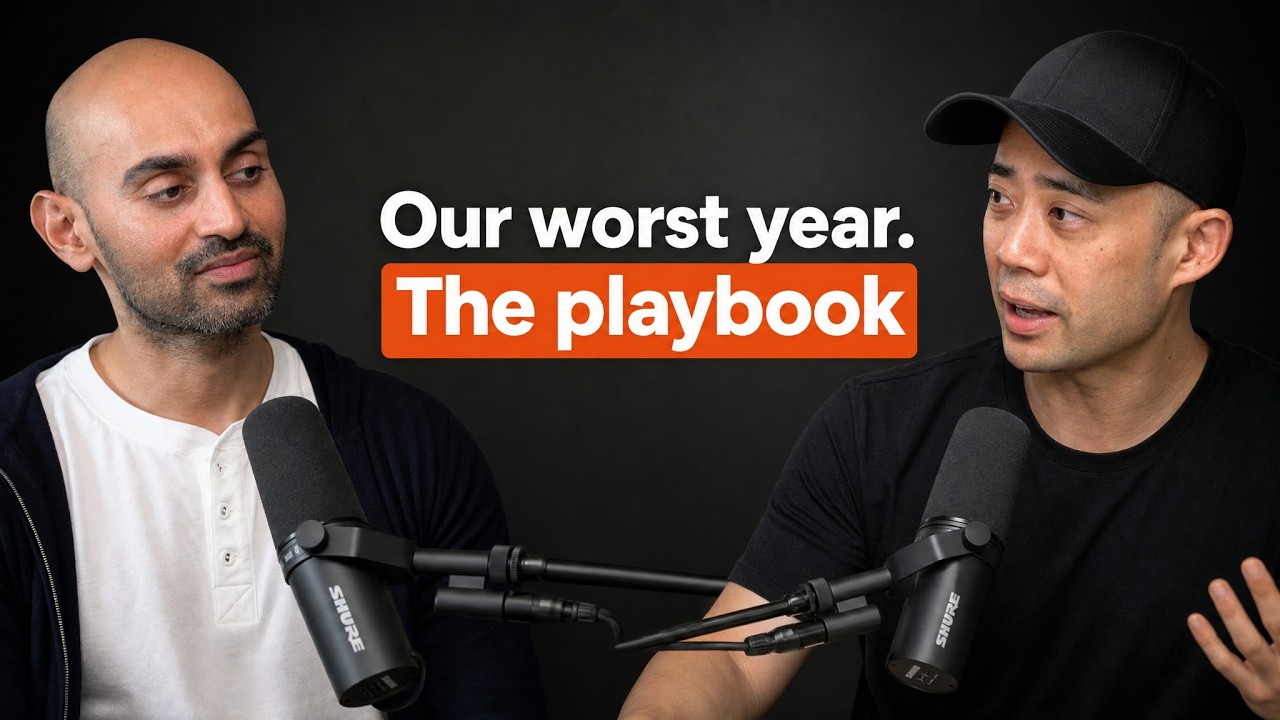
In this conversational episode, Eric Siu and Neil Patel discuss how entrepreneurs can navigate severe business challenges. Eric recounts a 2021 crisis involving two acquisitions, sabotage, and personal stress, emphasizing the importance of daily incremental progress and perseverance. Neil shares his financial playbook of liquidating assets, leveraging low‑interest mortgages, and weighing family considerations when contemplating high‑risk moves. They explore hiring philosophy, advocating anti‑selling interviews and rejecting expectations of stability in fast‑growing startups. The hosts contrast productive chaos with stability, noting that growth often requires embracing pressure. They then examine paid‑ad activity for hot AI startups, providing specific active‑ad counts and testing volumes. The episode culminates in a detailed case study of a freelance masseuse: they recommend upfront deposits, price increases, shifting from out‑call to in‑call services, adding upsells (hot stones, masks), hiring apprentices, and implementing referral incentives to boost profitability. A brief promo for Eric’s agency SingleGrain is also included.
Chapters
So I wanted to talk about one more thing 'cause I was talking to an entrepreneur today and, you know, this is a good topic, right? So what to do when things get really tough in business. So this is an entrepreneur and he's like, you know, I'm really overwhelmed right now and this and that. And I think about, we can share our moments where we're most overwhelmed, right? I think about 2021. I'll go deep in here for a moment. We did 2 acquisitions, okay? Everything started crumbling. We had a GM that was sabotaging the business, right? And so we're losing employees at the same time. We're losing clients 'cause of that sabotage that was going on. I had also, that's a very personal thing, I'll just leave it at that. But I had a personal situation to deal with as well. And so when everything was crumbling down, you know, I was like, man, I think I might just throw in the towel. 'Cause there's like, you know, there's like debt situation as well. There's just everything, like the walls were compressing on me, right?
I told you to throw in the towel, remember?
And Neil called me, he's like, hey, I have an idea. I was like, what? You should just bankrupt it. I was like, yeah, that's pretty reasonable, right? But like in that moment, I'm like, you know what? If I keep going, right? And we make it work, it's going to be a great story at the end of the day. And I'm going to learn a lot too. Or I could just throw in the towel right now. It's still debatable right now if that millions of dollars going back into things to save it was worth it. But I will say that In terms of how I got through it, it's just every day, it's like you look at this as an elephant, right? Just a little piece of it every day, right? A little piece of it. Just one step forward every day. Sometimes it might be 10 steps back, but just one step forward every day and things will get really tough. And I was just telling this entrepreneur today, I'm like, look, man, I get that you're overwhelmed and I get that you need to think about it on all these things. But the reason why people succeed is because they keep going, right?
Yes.
It's really, you don't have to be that smart. You just have to kind of keep going.
But But in your situation, and you can cut this if you don't want this in here, you got royally screwed by someone.
By many people. Yes.
And they wanted money for something that they didn't deserve money for. And it was a lot of false promises. Eric's a nice guy. He can be stern. I would say I'm a little bit more cutthroat than you.
Oh, for sure.
I would've just been like, I'm suing you. I don't care. You're not going to get anything. Eric's much more nicer. I was like, you should bankrupt him and give him zero. And I'm like, you know, and there's other ways around it where he could have saved it or done some different structure things. But I'm like, the other people are just trying to take advantage of him. They lied to him and they screwed him over and they didn't tell him, they didn't disclose everything that they legally were supposed to disclose.
Yep. No, it was, I would say one deal screwed me. The other one didn't. The other guy was like a good guy. I structured that wrong. I should have kept the founder there. That would have worked out. But then there's like the hire we made that had screwed, you know, like a mutual friend of ours in a company before.
Oh yeah, yeah, yeah. I remember that. Yeah.
So, but That was a tough time in business where there's tough things going on personally. There's pressure coming in from all sides, but you either, you can throw in the towel or you keep going. And it's the people that keep, like, you think about James Dyson, the Dyson guy, right? 14 years of failures, thousands of, I think it's 1,400, something like that, vacuums that failed. And he had 3 kids. His wife still stuck with him and look at him today, right? I think it was the lion's share of businesses.
Although the last few years, I don't think Dyson's been doing as well, but they're so big. They still do well relatively.
It's okay. He has an exit every year.
Yeah, yeah. No, they make a crap ton of money, but Dyson's had had a lot of competitors and companies that are just taking a good chunk of their market share. Like Shark is one. Miele has vacuums that are really popular and really good now, but there's tons of players who are copying Dyson's way of taking—
I like how you know the best vacuums.
Uh-huh.
Dude, we have so many of them in my house.
Yep. And you even have the one I told you to buy and you still haven't taken it out of the box yet.
I know.
See, that's the one you can give to your kids and say, hey, you know, you can say, hey, Matic, follow me. And it just follows you around the house and you can clean this.
But I have a full-time cleaner 8 hours a day, 7 days a week. But it gives the kids something to do. No, I want the kids to clean up their own stuff and do their own chores.
Oh, you want them to pick it up with their own hand?
No, I make them do it and my wife makes them do it. And then at the end of the day, after they make their bed, the housekeeper comes in and remakes their bed because the kids—
Because it wasn't good enough. Yeah.
But it doesn't matter. They need to learn to go and do stuff. I'm not gonna raise lazy kids. They need to have some grit and grind and they need to be responsible and they need to understand that Mom and dad worked hard to deserve this life. They did not work hard to deserve this life. They got born into it. I do appreciate them. I brought them in, so it is my responsibility, but that doesn't mean that they should just be spoiled and not have to do anything.
So let's talk about— so I just gave an example, what to do when things get really tough in business. Why don't you go for one?
Mine's actually similar. Every time I've had things that get really tough, I push through. I usually figure out how to— typically when things get tough, it's usually tied to money. Either you're not closing enough revenue or the profit isn't there or something bad is happening. And that you could say people solve it or better product will solve it. But I look at the root as in if you had more money, it buys you time and you can hire the people or buy the companies that are competitors or build better products. Money comes down to a lot of it. What I usually do during hard times, I haven't done this in a long time, is I liquidate everything that I owe, like a home, literally my homes. If you look at how many times I've moved, think about how many times I moved. My average hold for a house is 1.5 years, 1.5 years. Anytime things get tougher in business or I see opportunity, it's one or the other, I will liquidate whatever I need to so that way I can double down on the business. And that has worked out well for me, but I only do it when I really have conviction. But I will say this, the other day my co-founder asked me, he's just like, you got a mortgage on your house, right? And I was like, yeah. He's like, why'd you take out the mortgage? And I was like, dude, I get a really cheap rate. Call it 4.5%. I believe it's interest only, which is dirt cheap in this economy.
Mm-hmm.
And I was like, dude, there were some stocks that were, I believe, at 60, 70% discounts that I just put the money into. And he's like, why'd you do that? I'm like, I believe I'll make more than the overall mortgage, like the dollars that I owe, like the debt I owe on the house. And in 12 months, I bet you I'll be able to pay off the mortgage. And keep the same amount of money that I pulled off. And I only did it for that reason because I thought it was very low risk. But generally speaking, he's like, so then why would you want to pay off your home after? And I'm like, well, whether I do that, the stock sells or not, I would just pay it off in the next 12 months. I don't want a mortgage. And he's like, why don't you want a mortgage? I'm like, I have a family, I have a wife. If I pass away, I don't want less. I want less worries for my family so then that way they don't stress out. So then he asked me, if we found this amazing business opportunity and it required you to liquidate everything, would you do it? And I said, one, at this point in the business, I don't think that's realistic and we would have to, but two, I'm open to it. I would have a family discussion, but I don't want to. And he's like, why don't you want to? And Eric mentioned this to me, or was it someone? No, I think maybe Eric did, but also My head of EMEA, Mark Fagan, mentioned this to me. He's like, have a nice home with a big backyard, and a big backyard's hard to find in Los Angeles, so that way your kids can run around and be happy. And they're so happy. And the moments I have with my son when I'm home and I'm not traveling, I play soccer with him almost every single day in the backyard. We do foolish stuff like try to kick the ball on the roof or get it stuck in a tree. I know we're not supposed to do that and mess up the— roof tiles, but I don't care. Those memories to me are priceless and worth more than how much more I can make in the business.
Yeah. Well, also they're old enough to know what's going on now, right? And like before when Neil built the home and he moved out like a month after he finished building it, like they didn't know what was going on yet. Now it's like they're building, they're building something here. They're like making friends and all that. You have a community here now, so it's harder to pull it out.
You nailed it. My son, when we moved into the house, you know what he said? Mommy, I love my room. I love this house, but don't let daddy sell this one. I want this one.
Yep. So when you say family meeting, it's never a family meeting. It's Neil's decision.
Yes, my wife would be down for whatever. She's always down for anything. And she doesn't care too much about homes and stuff like that. If she had to pick the number one thing she cares about other than health and family, it would actually be kids' education. If I said, hey, we had to pull our kids out of the school, That is a very hard conversation that I won't win.
It's nice to have stability, right? Speaking of stability, so we've been interviewing like these people to join the company, right? And I always anti-sell them at the end. And this guy was like, you know, the company I'm at right now, like this guy's an SEO leader, right? He's like, the company I'm at right now, they're just not AI forward. I'm like, how many people are you coming to AI forward, right? Like he's like 5%. I'm like, he's like, yeah, you know, I really want to grow. And he's like, you know, what's also really important to me in this point of my career is stability. I'm like, wait, but you want to grow. And he kept using the word stability, right? And so at the end of the interview, I was like, look, man, I'm going to anti-sell you right now. And this is for anybody that wants to join and work with us, right? First of all, if you're going to work with us, it's not a 9 to 5, it's a startup environment.
Okay?
So don't expect to clock in, clock out. So the second thing is don't expect stability, right? It's like when you're growing very quickly, I would say that it's stable from a, you're going to learn a lot. It's a good job. And we have great clients and all that. But inherently, if you're trying to grow, like if you're lifting weights, for example, you're tearing muscles in your body all the time, right? Like that part is unstable. And I also said, what else did I say? I said, oh, expect direct feedback and expect it in public sometimes too, right? So by the way, Neil does a good job with anti-selling people. Sometimes it works, sometimes it doesn't. But you're better off from a toughness standpoint doing that because if you end up hiring these people and they're not a fit, it's way more painful. So stability is not something that's necessarily in my vocabulary right now. Because of the nature of where things are.
You have quite a bit of stability. You and I are actually very similar. If you think about it, either we're stable on our personal life or stable on our business life. We're very rarely ever stable on both. You are stable right now on your personal life. I'm very stable right now on my personal life. Both our businesses are chaotic. I wouldn't say they're chaotic in the way they're doing bad. We're just Changing a lot of stuff. We're pushing, we're putting a lot of pressure, we're trying to grow faster. There's a lot of chaos in business. I would say personal life is very stable.
I prefer the chaos in business, so.
Yes, I don't know how to create—
The good chaos, the good chaos, not the bad chaos. Not the whole like 5 years ago, now it's like good. Yeah, yeah, yeah.
I don't consider that chaos. I look at that as a disaster. I look at chaos as in like you're changing a lot of stuff, so it creates pressure, people get uncomfortable. But from that usually causes more growth. So I like that.
Dude.
Yeah. No pressure, no diamond. Yes. But I found that real quick, if you want to acquire customers faster and more efficiently this year with the latest strategies and tactics, then check out singlegrain.com. That is my ad agency. Again, www.singlegrain.com. Check it out. And if it seems like a fit, we'll get in touch and help you with a free marketing plan.
When things— I've never had both very stable. I have to have one that's somewhat chaotic because I get bored.
As long as I've known you, you've mostly had stable, you know, personal stuff for the majority.
Yeah, it's usually business.
Yeah, you've never— on a personal side, I've never seen you that unstable.
Yeah, it's usually business.
Business side, but the business instability is caused by you wanting to grow. So it's been It's been good.
The business chaos is usually stuff like me yesterday. I get my CEO on the phone, I get my CFO on the phone, I get our head of legal on the phone because we have in-house counsel. And I'm like, hey, I got a deal. A buddy wants to sell his company. These are the numbers he told me. He needs to close in 30 days. Let's make it happen. You have the data room acting—
See you guys later.
In less than 3 hours. And I'm right. I was like, see you guys later, but let me know if you want to call. They're like, how about we have a talk tomorrow morning? I'm like, analyze the data room today. But I was like, I'm speaking in the morning, so I won't be able to do the call.
I did—
we did analyze the data the day it came into the data room within an hour or 2. And then the chaos went away because we quickly realized the numbers don't work out. And it wasn't that it's a bad company. The numbers that I was told over the phone versus what the numbers were really were 2 different things.
So then Isn't it funny? What percent of the time are the numbers that they tell you versus the real numbers accurate?
Dude.
0%.
No, not 0%. Are you talking about banker processes or non-banker processes?
Let's go both.
Non-banker processes, almost 100% of the time, their numbers are off. That's what I'm saying. Banker processes, the numbers aren't really off. It's just how they move around numbers. But in non-bank processes, someone could be like, I'm doing $3 million a year in profit or $5 million a year.
And you look at the numbers, you're like, this is not $5 million This is $3 million a year in profit.
You're off by $2 million.
Mm-hmm.
You know, when you do $3 million, I don't know how you think $3 million is $5 million. There's a big difference. You should know the cash flow.
And I saw this firsthand when I was talking to someone and we were trying to do a deal. They're like, yeah, we grew really fast. In a year and a half, we're now at $3 million a month. So they're growing extremely fast, more than tripling. And we were trying to analyze, see if we can do a deal. And then within a few weeks they're like, oh, we were off by your numbers by 8 figures. And I'm like, how the heck are you off by our numbers by 8 figures? 8 figures is more than $10 million. You should know in your bank account if you can see the money or not.
Mm-hmm.
Non-banker deals almost always are off. Banker deals, they're pretty accurate on their revenue. They're pretty, they're not as accurate on their profit because it's what they classify as profit. I had another deal that we were about to do. We walked away from 2 deals literally in 2 days that we thought we were going to do. The one yesterday, it was a long shot.
We didn't really think we were going to do it. We're like, if the numbers are true, I told the person on the phone, I'm like, we'll do the deal. The numbers weren't, so I don't feel bad.
But the other one we were talking for a month, dude, they added back a lot of salaries and they consider that profit. And I'm like, but when I buy this company, I have to pay all those people, right?
Yeah. Yeah.
So that is not profit.
Yeah. And I'm like, it doesn't matter how you classify it.
That's not profit.
I got to pay these people.
And I see it all the time.
But when it's banker-led, like we were dealing with a business 6 months ago, their profit didn't decrease much, but it was because a lot of people took pay cuts. And I was like, well, if I bought that business, I'm going to have to pay people what they're really worth. So then there goes a lot of the profit. I'll buy you on what the real profit is, not on you guys all getting pay cuts and expecting a pay raise the next day.
So this is why even though Neil doesn't declare himself a CEO, officially doesn't have that title, I also declare him a CEO because the CEO causes a thing called the lightning bolt CEO where you find something amazing and you strike the lightning bolt and it's like, here's the problem, right? Goodbye guys. And you're back again, right? And so that's a very CEO thing to do. So 2 more things. I, there's a case study I want to talk about with this, this massage place. But one more thing. So when you look at Cursor, Whisperflow, Replit, HeyGen, Victor, how many active ads do you think they have at any given time? So these are kind of the— these are AI startups that are pretty hot right now. Gamma's in there, Framer's in there, Superhuman's in there.
How much they spend on ads or how many ads they have in their platform?
How many active ads they have at a time.
Like when people are using their app, how many ads do they see?
No, how many active ads in like Meta ad library or something like that?
Oh, I get what you mean. I don't know, maybe 3,000, 4,000?
At an average, any given time?
I'm assuming they're using AI and just testing a lot of ads.
So Cursor's 1,100, Whisperflow is 820, Emergent 410, HeyGen's 400, Victor 620. And to Neil's point around testing, Cursor 6,400 tested, okay? Whisperflow's 3,300 tested, Emergent 7,000 tested, HeyGen 1,700. And so, You know, this is from Ira Bodnar, but it's often more ads than you think you actually need. And people think it's like, it's a whatever thing right now and you can just kind of get by. So just wanted to call that out that paid ads still exists.
Yes.
Yeah.
So let's wrap up with a case study and this will be a fun case study. Eric and I have a friend who worked at a 5-star hotel in the spa. He was giving massages. The hotel wasn't doing well and they shut down the spa. So you had to figure out what to do. So Eric and I were like, dude, we, you live in Los Angeles. Why don't you just do, uh, I think it's called outcall where you go to people's houses, right? Is it outcall or in-call?
That's an escorting term, I think. I don't know.
Like, what is it called when people go to out— I think it's just really outcall.
Okay. So outcall massage. Okay.
Okay.
So, you know, I was just like, all right, how do you make more money? Now, this person was doing outcall massages and making $5,000 a month, which may seem like a good income, but keep in mind, you got to drive to people's houses. You got to pay for—
Parking, maybe? Parking.
Gas. You got to— it takes time out of your day.
It's like 3 hours for a 1-hour session.
And then you got to pay for materials.
Right.
Uh, towels, hot stones. Oh, that actually sounds nice. You know, when you take the stones and they push it on your back.
They don't push it. They rub it on your back.
I thought like they push it.
That's something else.
Okay.
So, uh, uh, or cupping, you know, like when they put the cups on there.
Uh, although that may be, uh, not chiropractic.
What is that called? Like the needling?
The lavender scents, you know, all that stuff. Lavender scents.
Oh, the aroma.
You know, those machines that blow smoke and stuff like that. The table costs money, wear and tear on the table over time. You have to buy a new one. I could be wrong.
Yeah.
So let's, so So here's what happened, right? So for this, this, this massage, this masseuse, so basically he was charging around, let's say, you know, $300 per massage, right?
No, it was less than that. It was, call it $200.
Okay, $200. Now here's the thing, it's a supply and demand equation because this person was getting around 30 leads, 30 inquiries a day, right? So—
But 30 inquiries a day, most of his clientele were people that worked in Offices, like people who could pay money.
These people make good money too.
They make good money. The issue though is most of them wanted him to massage after working hours from like 5 to 7 o'clock or something like that.
So really had 2 slots. Yeah, exactly.
2 slots. And that's if you're not driving, people want to be done before dinner, but they didn't want to do it during the day because a lot of these people did not work from home. And out of the 30 inquiries, He mentioned how 6 were real that would've really paid money.
Yep.
Because a lot of tire kickers being like, yeah, I'm interested. Oh, I'll book it when I have time. Or, oh, how much is it going to be? Oh, I don't want to spend that. Can I get a coupon or a discount? But he had 6 really solid ones. The first thing we told him to do, because he was like, hey, how do I increase my pipe? How do I do more marketing to get people who want massage services during the day? Kind of like a hotel and spa. I'm like, that's a different clientele than what you're getting for marketing yourself online. And the first thing Eric and I told him was, one, you have some no-shows. Everyone should Venmo you the money in advance because then if they don't show up, at least you got paid.
Yep. By the way, OpenTable does that all the time. They take a reserve.
Yeah.
For a lot of restaurants. 2, we also told him you should increase your pricing. So call instead of $200, we said go to $300 right away because you have 6 people that'll take the slot, but you only have 2. He didn't want to charge $400. Eric and I said we should just double up the pricing.
I said go $500.
Yeah.
And he's just like, that's too much money for people in Los Angeles. So I'm like, dude, if you're massaging people in places like Beverly Hills, Century City, these are, there's big office complexes here in Century City with a lot of executives making tons of money, tons of private equity stuff. So we're just like, you should charge more. He did increase pricing 50% and it's doing well and it hasn't affected the take rate and all the slots are still getting full.
In fact, of a sample size of 10 people, 4 declined. But 6 took it. Yeah, the higher price.
And then the other thing we said is start making everyone come to your house, set up a room.
In-call.
In-call instead of, uh, having to drive because you lose a lot of time and money on the transportation. And if people want you to go to their house, charge even more money because of your costs.
Quadruple. Yeah, I, I don't know about quadruple, but quadruple the original rate, you know, maybe triple, maybe triple. Yeah.
But my point is like $500, like you were saying.
Yeah. But like it, To have to go through the— it's very tiring to have to do like 2 outcalls in a day, right? That makes it not worth it. But if you can bring them in, you know, whatever, and then the deposits, you end up making net more. So instead of $5,000, which is amazing, you end up making what?
Well, the best advice we gave is he was working 6 to 7 days a week. He was having just not brain dead, but like he felt just worn out, tired. Because you have to remember, if you're massaging people using your muscles, I don't know what muscles, but in your hands, your fingers, I bet you they hurt after a while. Your wrist muscles.
I don't know how to massage. I'm really bad at it. Like this, you know, like sometimes I press.
I have a Theragun. You know what a Theragun is?
Yes, I know what a Theragun is. I have one. I don't use it though.
Those are amazing. I don't use mine either that much, but I have one. So what we said is increase your pricing, work only 5 days a week, and then that way you make more profit and you also have Relaxation for yourself, for your muscles, your brain, and you're just more energized.
It's all more peace of mind. The in-call piece, like that's going to save you time and energy. The deposits, you're going to make net more money so you don't have to work as much. And so it's all about making these little tweaks as you're going through it. And then this person now has a menu that they're optimizing, right? Yeah.
So yeah, I give them really cuckoo ideas like, hey, while you give them a massage, offer them like a face mask. Like, you know, like the aestheticians, what is it called?
Whatever, like beauty esthetician?
I don't know how to pronounce it. You know, like people put, like you see on the thing, you know, you see on those TV shows or movies, people have like those cucumbers and a green mask over their face. And I was like, dude, offer upsells.
Those are all upsells.
Yeah.
The hot stones that are real, like if you get it at Encore or whatever, you're adding like another $30 or $60.
Are you talking about Wynn Encore?
Yeah. Wynn Encore.
Yeah.
Man, that's Encore. They're going to charge you double.
I know, but when you get a nice massage, it's at least $300 to $400, right? And you add this and then the lavender, $30 here, the hot stone here, $30 here. Oh, you want to, you know, uh, you want an extension to like 90 minutes or whatever, and then 2-hour massage. And before you know it, you spend like, you know, an arm and a leg.
Yes.
The other thing Eric and I also recommended was hire an apprentice, uh, because some of his clients are couples. And instead of doing one back to another, you could do couples massages. And you can have apprentices charge more, 2 tables, and then you can knock out more in the day versus just doing one and then doing another.
And by the way, what we're talking about here, you might— why are they talking about massages? Well, because this applies to any service business.
It's also a funnel. We talked about so many upsells and downsells, ways to charge more, reduce. In this case, there's no refunds, but there is people who book you and then they cancel on you last minute and you don't get the money, which is just as bad as a refund.
Yep.
Because you can't do something else.
And then you can play with other stuff too. Like your favorite customers, they give you referrals or whatever. You can do like a, you know, give them some, give them free referral or something like that. Free massage from a That's true.
He's been getting referrals.
Yep.
And we told him about setting up referral programs where people give a lot of referrals, let them have the older rate.
Yep.
So it just incentivizes.
Grandfathered in.
Yeah.
So there's all these things that it's, these things carry over into whatever business that you're in. So we hope you enjoyed that one. If you want more case studies like this, let us know and we'll see you tomorrow.









