What We Learned From Acquiring Companies
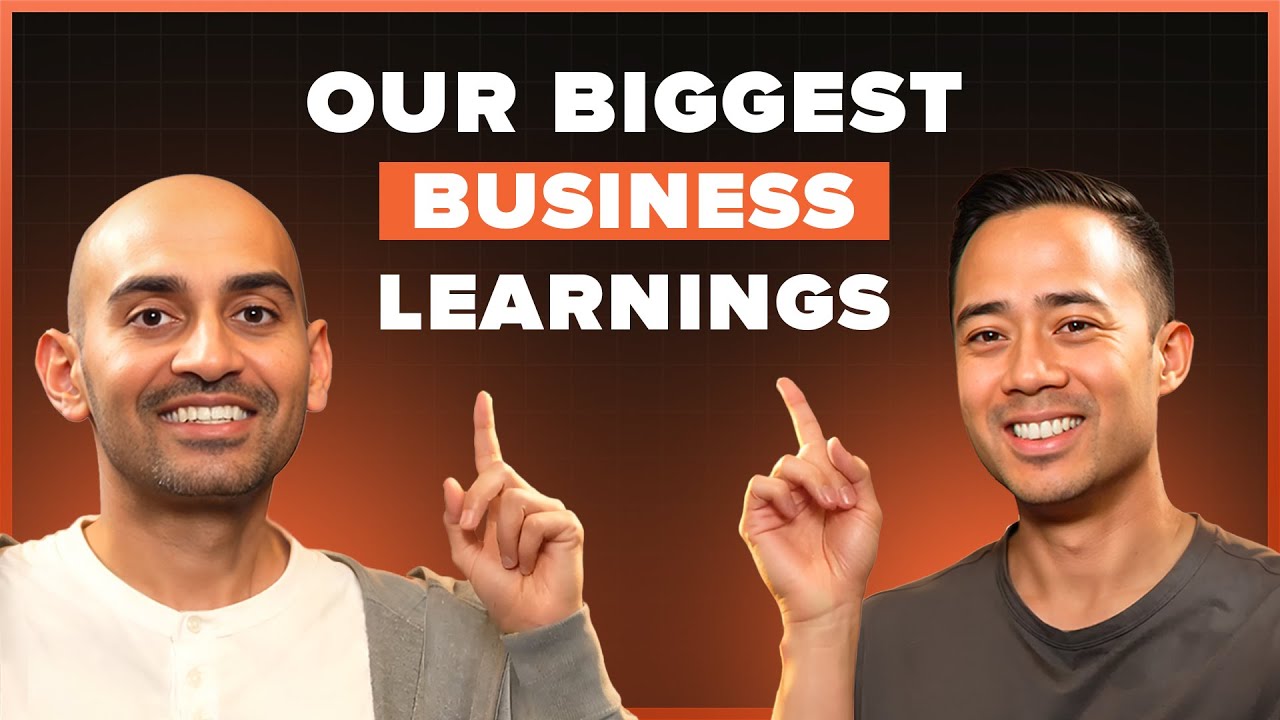
Eric Siu and Neil Patel discuss what they learned buying agencies and SaaS companies like Ubersuggest and Kissmetrics. They cover spotting technical debt, keeping founders around, and using acquisitions to cross-sell and expand into new regions.
Chapters
Now let's talk about what we learned from acquiring companies.
Do you want to go first? Because you've acquired two companies and neither worked out, right?
Yeah. So the two most recent ones didn't work out. So let's talk about these. So and then I want to get your side because you've now done like what fifteen? I don't know sixteen.
It depends which company you're talking about. Well, we acquired a lot.
Okay. So I'll go on my side. I'll just go with the lessons here. My main thing looking back now is at the time, the 2 I bought, there were actually 2 other ones that were very additive that were, and they were acquired by, by, by like agencies that are, that are well known. One, I should have bought agencies that are complementary. Okay. Meaning that if I did SEO and paid media, for example, there's actually an analytics firm I was looking at that's doing very, and they actually had software too. So I was looking at them. And then I was looking at a creative firm as well. But instead I bought an e-commerce paid media firm and I bought a small business SEO firm, okay? The other thing is this. So if that part makes sense to you, do you have any clarifying questions there?
No.
Second part is I would've— go ahead.
Oh, oh, wait, do you want to explain to the audience on why you would choose something that's complementary so they can get a better understanding?
Because it's easy to cross-sell, upsell, and then to build. So one, you get higher retention. 2, your LTV goes higher, your lifetime value goes higher. And then 3, the other thing too is people generally like, they, as long as you can do things pretty well across the board, they'd rather de-risk you. They see themselves as de-risking if they're going through a firm that can do multiple things. So Amazon, for example, a long time ago, we did paid media for them. They're like, dude, you guys are really good at paid media, but we need someone that does a lot of these different things and you guys don't do that. So.
Yeah, so what Eric is talking about, just to give you guys all more context, if Eric does SEO, and another company does just paid media and he acquires them, what ends up happening is, is their customers, in theory, if they're doing paid media, could also use SEO. So you can now pitch all of their customers on SEO services. And for Eric's customers that all pay him for SEO, in theory, he could pitch them all on paid media services. So when you combine the entities, if they do $1 million in revenue and Eric does $1 million in revenue, you don't have $2 million. You ideally want to see if you can get to $2.5 or $3 million because you're cross-selling. The second thing he's talking about with churn is if someone pays you for one service, it's not as sticky as if they paid you for 2 services or 3 or 4, because the moment they pay you for a lot of things, they're more reliant on you, which makes it harder for them to leave you. So then you make more money because they pay you for longer. But those are the main 2 aspects that he's talking about when he says complimentary.
I'm going to give you 2 more and then I'm going to flip it to you. So the second one is, For one of them, I would've kept the founder because the founder, ideally you're buying a company where the founders stay because a lot of these agencies are, it's almost like a little cult. They follow the founder, the founder drives a lot of the energy.
Yeah.
And usually they're the ones bringing a lot of the ideas, the strategy. They're just pushers, right? That's how they started this thing. One guy was an absolute grinder, and I would, I think had we just done that from the beginning, it would've worked out perfectly. And I could tell he just loves working, he doesn't stop, right? Now the other company, this will lead into the third piece. The third piece here is you want to make sure whatever you're buying, the culture aligns. So for the guy that was a grinder, that actually goes through the entire organization. People follow the leader, right? And they were much more aligned with us versus the other one. The guy optimized the business to not grow. So he wanted to cap the revenue and not grow. And therefore I didn't vet the culture.
Yeah.
And so when you look at one of the cultures, like, okay, I think that we can make this one work. But the other one was just like, people want to chill during a client call. They sometimes, they might not show up to the client call. They'll go do a yoga class instead. Right. They didn't care enough because it was a job to chill. And he also didn't pay his people that well. He paid people like really low. And so then we ran into those issues too. Right. So even though he had a lot of people, it was a lot of people that weren't really motivated and a lot of people that weren't incentivized to be motivated. And plus it was my logic there was to combine that SMB, all those SMB people with the software that we had at the time, the SEO software. I was like, okay, I think we might be able to make that work. But because the tech wasn't good enough, that didn't work. So we had a lot of technical debt. So, but that's a whole nother conversation, but I'll give you those 3 and I'm sure you have more.
Well, you recently did 2 acquisitions. They did not work out. What was the, if you had a, take away the biggest thing that you would do differently in those acquisitions, what would it be? If you give me your top 3.
I'm just going to give you top 1. Top 1. Okay. Top 1 is had I been involved from the very beginning with those acquisitions, all 3 probably would have worked out. Had I been involved, like we're talking, because each acquisition will add like hours to your day. I probably should have been working until like 12:00 AM or so, but I drank the Kool-Aid and we hired a GM and that GM actually ended up stealing from us and then stole clients and stole people and had done the same thing their previous agency and did the same thing to the next agency. So while— so you have each acquisition, you're adding a ton of debt, like a lot to shoulder. One, you add 2, that's already like 2 big weights on your shoulders. Then you add in someone that's stealing from you, that's 3 big weights on your shoulders. And plus, arguably the most valuable person at that time to drive things forward was me, and I was sitting on the sidelines.
Yeah. So I've learned quite a few things as well. I've done a lot of deals between all my organizations. Some of them have been as simple as buying a domain name. Like I bought Kissmetrics from my previous—
$500 grand?
Yeah, company that I co-founded for $500,000. That deal was really well worth it for me.
Ubersuggest?
Ubersuggest I bought for $120-something thousand bucks, I believe.
See, the funny thing is that the week before I bought a senior living site and the next week you're like, look what I bought. I got this idea from you. I was like, oh, that's nice.
Well, it was in the works for quite a bit more than a week, but yes.
But it, um, but continue, continue.
Yeah. Um, uh, but Uber says, I don't know what we put into the company. My guess is $3 to $5 million afterwards.
The domain didn't come with employees. Uh, Kissmetrics didn't, but Ubersuggest, did it come with employees?
Uh-uh. AnswerThePublic did not come with employees either. Okay.
See, so that's actually important. So these 3 did not have employees.
Yeah. Um, and I've done quite a few over the years. Like it's too many to count. I've done Hello Bar back in the day. What I found from acquiring SaaS, because my background as an entrepreneur is not in the agency world, it genuinely is SaaS. I have way more SaaS experience than any other industry. It's easy for me to buy marketing SaaS and know how to fix it and grow it and not really need a ton of the people that were working prior on that corporation. I can't do that for all industries, but for marketing SaaS specifically, When I'm buying a company, I'm buying it because, call it, I quote unquote have a bag of tricks and I can go in and implement the bag of tricks. And I already know before I buy it, that company, how much more revenue and profit can I squeeze out literally within 3, 4 months? And I could tell you I could squeeze out the profit in 30 days, but it takes me longer than 30 days to implement everything. Usually I get everything implemented within 6 months. Usually I get a lot implemented within the first 3 months. And that's gone really well because I'm just rinsing and repeating the same playbook over and over again that I've been doing.
It's no different than like a Vista Equity or something like that.
Yeah, they're just—
You have a checklist.
Exactly. Vista is just better at it with way more money than me. And Robert, their, you know, co-founder, and Brian are on the Forbes list and I'm not. So just to give you an idea of their success versus mine.
It's okay, they're a little older too. So, you know.
Yeah. When it comes to agencies, we've bought some agencies and the big thing that we've tried optimizing for is A, complementary services. So what services are they offering that we don't offer a ton of or we're not known for? So for example, when we bought Rebel House in Canada, they'd done a lot of TV commercials like Snoop Dogg stuff or J.Lo stuff, and not even just the celebrity stuff, they'd done really good work for B2B companies as well, like, you know, SaaS companies. And they've done even corporate work as well for like the Marriotts of the world. And when I say corporate, I'm not talking about a Marriott commercial for TV. I'm talking about like Marriott commercials for internal use or B2B use. And that was an easy plugin because they offered a service that we didn't really offer much of. So when we plugged it in, we were able to drive them revenue and we were able to take their clients and sell them our services. And it became a quick win-win. What we also found is by buying complementary services or companies, we were able to get included in bigger pitches where if we didn't own that company, we would have never got included in them. A great example that you mentioned was Amazon and how you lost Amazon because you didn't offer enough of what they're looking for. Right. But we weren't getting included in every single pitch that we should have been because we didn't offer enough services. We felt we should have been getting included in them, but reality is the customers didn't care. And there's still pitches today that we don't get included in because we don't meet the requirements. And another example of this is if Microsoft issues that global RFP, they expect you to have boots on the ground in almost every major country. We don't have that. We can say we're in 20+ countries, but being in 20+ countries is not being in 70, 80, 100. If you're not in all the countries that they require you to be in, you're not going to get those deals. So we've been acquiring agencies in other countries where we don't have as big of a team, and it infills the talent, the logos, and the reputation. And that's helped us grow quite a bit. But when I look at our main M&A strategy, we keep the founders because the moment you don't have the founders, there's risk. There's always something a founder knows that you don't. And it's just risky to take it on without having the founders, especially when it's a business that requires relationships and maintaining the relationships. The second thing that I've really learned is out of all the acquisitions I've done, the ones that tend to work out the best are the ones where they offer a service that we don't, in ideally a region that we're not in. So when you combine both of them, you're now in a new region that, assuming we have high demand for, and a new service that we don't offer. So it plugs 2 holes and that causes the fastest—
2 plus 2 equals 4.
Yeah. So that causes the fastest growth for us. And, you know, by the time this podcast airs, we would have closed a company in the UK, even though we're in there. They infill a service that we're not known for, and they only specialize on this service. And fast forward 2 more months, we'll acquire 2 more companies in Europe. It helps us infill on the regions and gives us a much bigger headcount, but it also provides services that we're not known for.
If you're in B2B, here's the deal. LinkedIn account-based marketing sucks, but It doesn't have to. With Karrot, it allows you to create personalized ads towards your customers and also personalized landing pages that align with the ads. So you're gonna have higher conversions and influence pipeline reporting to prove that your ABM works. So if you wanna learn more, just go to karrot.ai and you can join the waitlist. Again, it's Karrot, K-A-R-R-O-T.ai, and we'll see you on the other side. Let me ask you something, side note, so we can move on from this topic, but do you think in the next couple years, within the next 5 years, you're gonna be back in an office? You, just you?
No, no, but I've never done well in an office.
That's right, we talked about this last time. But do you think most of your people will be back in the office?
No, I think it's too hard for us to go back into office. We're too remote. Once COVID happened, we stopped hiring within those cities. That's actually the wrong way to put it. We stopped making a requirement that you live in that city to work for us, like San Diego or Lehigh. And we more so made it where we'll pull from anywhere in the United States, even if we don't have an office. And we have some amazing people that work for us in a lot of random places throughout the world, where it just makes it too hard to be like, we're required to go back to office. It's just, we're not big enough like a Microsoft or Apple where we have offices everywhere. And that would be just too expensive for our size.
Yep. That is it for today, guys. Please don't forget to rate, view, subscribe, and we'll see you See you tomorrow.
See you tomorrow.









