What's Really Working for Organic Growth in 2024
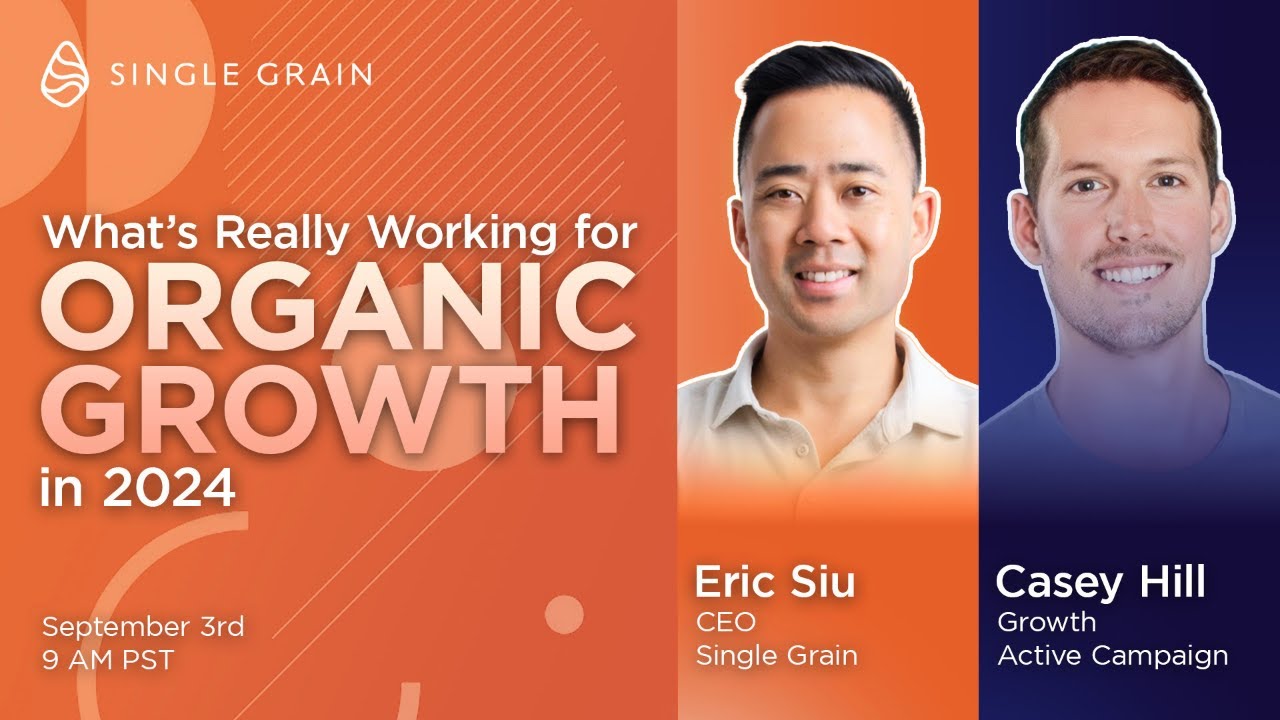
Eric Siu and Casey from ActiveCampaign walk through what's working for organic growth in 2024: programmatic SEO, AI agents for automation, podcast repurposing, and B2B email strategies. They share case studies from Single Grain and Toast, demo AI workflows, and answer live questions.
Chapters
All right, everybody. Welcome to our little webinar today. Today's a special one. We got a collaboration going on with ActiveCampaign. So the way this will go is I'm gonna kick it off and then we're gonna have Casey over here kick it off. But Casey, first and foremost, do you wanna introduce yourself?
Yeah, thanks so much for having me, Eric. My name's Casey. I run growth over at ActiveCampaign. I've been in the email world for 10+ years and it's changed quite a bit. So I'm really excited to get tactical and give you guys some great takeaways, hopefully, if you're running B2B newsletters on what you could do as best practice there.
All right, awesome. So on my end, I'm gonna be covering some AI workflows that we've been using that have worked well for us. I'm gonna jump around my talk and then I'm gonna give some time for Casey as well. There should be ample time here, but without further ado, we're gonna get going on this and I'm gonna share my screen. Let's go ahead and do this over here and I'm gonna go into slideshow. All right, so I'm gonna jump into it. We're gonna talk about AI growth secrets that are 10xing traffic and leads for us. And quick background on myself, I run an ad agency called Single Grain where we help people with performance marketing. So SEO, paid, CRO, creative, all that type of stuff. And then I have 2 podcasts. One's called Leveling Up. The other one is called Marketing School. And this is what the podcast looks like. This is myself talking with my friend Alex Hormozi. And then when we do well with the podcast, we're usually number 1, around number 1 for marketing, and then all the way up to top 10 for business. So it does pretty well, over 100 million downloads for that one. And yeah, we're gonna jump right into it. The thing I wanna talk about is really how to think about, I think the word AI is being overplayed, especially by marketers now, it's being overhyped. And I'll just say that for me, this will probably be one of my last talks where I have AI in the title because I believe if we keep using AI in the title, well, at the end of the day, if you think about the internet, we no longer say we're gonna go on the internet or we're gonna log onto the World Wide Web. That's just part of what we do now. I think the sooner that happens, that means the sooner AI has become more ingrained in our day-to-day workflow. I don't think we're quite there yet. Now, what I think is interesting before I talk about this slide is last week I had one of our developers test out Cursor. Cursor AI, it basically has made him 2 times faster as a developer. What was taking him 5 hours for one workflow is now taking him 2.5 hours. He's becoming a lot more efficient. And he thinks overall his speed has probably increased by 3 to 4x. And that's just gonna continue to happen, right? So people are using Cursor, some people are using v0, they're combining it there and they're using Replit, R-E-P-L-I-T. I'm not technical, but I do know that there are non-technical people that are building stuff using these apps now. And I'm gonna push my team to do so. I'm gonna spend weekends learning this stuff. And I believe this is where the world is, this is where the world is going, right? And so, what I have talked about here, if you can see where my cursor is, 131 million visitors per month. This is TripAdvisor, right? So TripAdvisor ranks for things to do in Seattle, things to do in Tokyo, things to do in Japan. They rank for 24 million keywords and they would be paying Google $66 million per month for that traffic, right? So they do this thing called programmatic SEO. And this is something that I've talked about for a little bit, but again, I'm not saying you need to do programmatic SEO. I more so want you to think about, hey, how are they doing some things? How can we apply it to our business? Because the agentic workflows that I'll show you in a little bit, the programmatic CRO stuff, all this will help you drive more traffic and more leads at the end of the day. And for us, this is not to brag, at Single Grain, we went for about 6,000 or 7,000 agency-related keywords and it wasn't always smooth sailing for us, right? Now because of AI, this is now programmatic SEO is now available to people like you and me. And you can see in the very beginning, our traffic was moving up and to the right, and then it moves all the way up here and then it starts to stall. And you can see here, boom, up and to the right, and then it stalls out over here. But what happens? It shoots up and to the right again. And what happened here was where the stalling happened was there's a Google core update that happened. We were putting out too many pages. We were more focused on quantity than quality. And that's why they didn't do so well, right? So you can see over here, shot up into the right. It's like, and then it starts going down. It's like, oh, what's happening to our website? And you can see here, oh wait, what happened? Wait, it stalled out. Why is it moving up into the right again? And here's the thing. It's moving even higher than this now in the last couple of weeks because Google has another update that just happened and it's continuing to recover, I should say. Now, what's interesting is we started really slow with PSEO. So slow start over here. And then we didn't push hard enough. That's one of the mistakes that we made. We didn't push hard enough over here. And then, okay, then when we got hit by it, it's like, oh, well, how do we recover? What we did was we focused more on quality. And that means that we focused on deleting content that had zero links, that had zero traffic in the last 30 to 45 days or so. So if there's a signal to Google, Google looks at clickstream data, right? If they're looking at clickstream data and the page isn't getting any clicks, doesn't seem like it's a very important page. It's not really getting any clicks, not getting any links, that's a negative signal. Okay, maybe we should think about not paying too much attention to this page. Because even if you have a page that is important that doesn't get traffic or links like a contact page, that's okay. You can leave it there and people can navigate to it, but search engines shouldn't be prioritizing those pages. Those pages just aren't that important at the end of the day. Google has said it in their— there's a Google leak that happened earlier this year You wanna focus on deleting content, consolidating content, and updating content. Not enough people do that. And again, they pay a lot of attention to clickstream data. They own Android, they own Chrome. There's a lot of information that they have on pages that drive traffic versus pages that don't. And you can see here, for us, programmatic SEO was quickly profitable, generating 300% ROI, $26K invested, and $105,000 in revenue out the gate. So pretty good for a couple of For an initial test, I should say. Now, this is a client that we had, and I'm not gonna spend too much time here, but this client, they had pages that only had an average click-through rate of 0.8%. So, okay, of every 100 people or so, not even 1 person is clicking through, right? And so that's not that good. So our challenge here, the goal here was to, how do we scale more content while driving more conversions? 'Cause that's ultimately what's important for this client. This client, right? This is a client in the wine space. And you can see here, we successfully created 200 new pages. Okay, so 200 new pages. And what we did, programmatic SEO again, was we created best wine type under price point. Okay, so best Chardonnay under $10, best Sauvignon Blanc under $50. There's a lot of permutations that you can create from this. If you have locations, different types of product lines or different types of services, you can definitely use programmatic SEO. And we didn't need to make 6,000 pages here. We just made 200 pages and it did pretty well for us. So that's what worked. And what happened was, and this is a smaller website, mind you, so we don't need to go for pages with, or sites with hundreds of thousands or millions of visits. I'm saying anybody can do this, right? So instead of the previous average of 3,400 clicks and 100,000 impressions, you get 6,300 clicks and 184,000 impressions. So pretty significant jump, almost double. On the click side. And then click-through rate instead of 0.8% jumped up to 3.4%. And you can see it's moving up to the right. The screenshot's a little dated. It's actually continuing to move up into the right. And then 1,123 new keywords ultimately. And then you got 105 new product cart adds and then 155 cart views. Average before was 75 and 94 respectively. So you can see the graph moving up into the right in terms of events. This stuff really works at the end of the day. And by the way, if you like the stuff that I'm saying right now, take your phone out. You can just scan the QR code over here. You can get on our email list. We share the latest in marketing with Marketing School, with Leveling Up, or the events that I do. I just spoke at an event last week, interviewed a couple people, a couple, 2 billionaires, right? You would be the first to hear about this stuff in terms of how they've grown their businesses, how they've leveraged debt, $1.2 billion in debt, $800 million in debt, right? So you can just scan this. I'll leave 5. 4, 3, 2, and 1. And we'll move on here. So a couple more things I'm gonna show you, and then I'm gonna move it over to Casey, is the concept that we're doing with our podcast, right? So tomorrow I'm gonna go record live Marketing School. I do it with my buddy Neil. And you can see some of these Reels over here, these are Instagram Reels. One has 900,000 views, the other one has 2 million, the other one has 142,000. And so what we do is we take the clips from the podcast, right? And we throw 'em onto YouTube Shorts, TikToks, we throw 'em onto IG Reels as well, and they do pretty well. So we repurpose them. But I have an SEO background. My thinking is how do we maximize this content from an SEO background or SEO perspective? So sure, we get 10 million, 11 million views per month right now. I think it's decent. I don't think it's good enough. I think we can do a lot better. And reality is that we probably can get this to 30, 40, 50 million views, maybe even 100 million views if we allocate more budget and we just continue to do what we're doing. But it's pretty decent, right? So what we do is we call this AI-assisted content. You can call this AI for podcast SEO. These numbers have actually gotten even better, and there's a similar graph where it's just shooting up into the right right now. All we're doing is we're taking the transcript from Riverside, And then we're plugging into ChatGPT and then we have a human in the loop to handle the last mile, right? So maybe you get 70 to 80% of a blog post from ChatGPT off the transcripts, but then we wanna fact check, we wanna add links, we wanna add statistics, we wanna add pictures. Having a human in the loop is probably the, it's just the right move at least for probably the next year to 3 years or so. It just, trusting an AI to do everything for you just doesn't work as well in today's day and age. We're just not quite there yet. So the initial setup for this was that we were paying about $100 per blog post. Sorry, this annoying support thing keeps hitting me on Restream. But initial setup was $100 per blog post and then 5 posts per week. Now that's okay. It's not that great because before we're paying maybe $300 per blog post and we're maybe getting, I don't know, 2 to 3 posts out per week or so. So this is a significant change, but we wanted to do better. And so we continue to optimize this over the year. And you can see now the current setup was AI will create the drafts and then humans will publish. So it's $25 per post and then 25 posts per week. So 5 times the amount and then we're getting 25% of the cost, right? Or 75% discount. So 75% discount, 5x efficiency seems pretty good. I think we can continue to do better than that. Now I'll give you a little bonus here. The bonus here is that a couple weeks ago, so I just shared kind of the SEO workflow, that we have for our podcast to gain the benefits. Sure, we're repurposing for short form, we're doing long form, but we also want benefits on our blog as well 'cause we have pretty good domain rating. But for X, LinkedIn Threads, I don't think we're doing a great job with that right now. So I found the product, I was just scanning X a couple weeks ago and then Gary Tan, the president of Y Combinator, talked about this product called Overlap and it's completely free. If you go to joinoverlap.com, what it does is you just plug in all your YouTube videos And then it'll find the right moments for you. And then from that I just write captions and then they go on LinkedIn, they go on X, they go on Threads and they do a lot better than my original posts. And it's easy for me because for me to write each post probably takes 5 to 10 minutes or so. Sure, it's a little tedious to do, but nobody knows the interviews better than I do 'cause I was actually sitting in those moments. Eventually we'll try to hand it off to the team to see what they can do. But early preliminary test, very preliminary. 24x more reach by doing this, right? And we're just repurposing the content. We're making the most of what we have and we're writing it natively for each platform. So that's worked out really well for us and it's using Overlap. Again, joinoverlap.com. It's completely free right now and they're gonna add a whole host of other features. They're not paying me to say this. The last thing I'm gonna leave you with, I'm gonna try to go fast here 'cause I wanna give Casey a lot of time, is with PCRO. So if we're going to do PSEO where we're producing hundreds or thousands of pages, that's to increase traffic, but we need to also increase conversion rates at the same time. And so if you look over here where it says get quality leads, that's a call to action on one of our PCRO pages, right? So what PCRO means is that we'll scan all the PSEO pages that we make, so programmatic SEO, and then we'll scan the context of those pages and say, hey, instead of our standard work with us call to action, Let's change the call to action to something relevant on that page. And so what that does is it changes Work with us to get quality leads, 'cause the headline over here is Pay-per-lead agency. So, okay, well, what happens? And we also changed the— on the popup, we changed the headline and the subheader as well. And so what happens is we boost the clicks on these pages by about 50%. That's pretty good for not spending a lot of time doing this. This is very scalable. And this is something that all of you can do 'cause I'm gonna try to share the prompts with you guys as well. So you combine PSEO with PCRO if it makes sense for your business and you take it one step at a time and boom, your clicks might jump up by 50% or so and then your conversions might jump up significantly as well. And so this is an idea of input that we'll put into our developer, we'll put in. For example, as a system, you'll receive a JSON object as input. The JSON object will contain a benefits key with its values providing context. Your task is to read the values under benefits key and use them to update the hero headline, unique CTA, and form subtitle. You can see this is written by a developer. You can take a screenshot of this. I'll give you 5 seconds. 5, 4, 3, 2, and 1 if you want some ideas. I'm actually going to show you some prompts in a couple of minutes here. But one of the last things I actually wanna show you is that we've kind of created these, we call this AI workforce, right? So the whole idea with this is we're looking to automate a lot of the tedious tasks that our people have to do. Well, in order to do that, we need to figure out all the jobs to be done for an SEO manager. So let's say this is a human SEO manager. So we map out, okay, you gotta do keyword research, you gotta do on-page SEO, off-page SEO, technical SEO, content strategy. All this stuff, long-tail discovery, trending analysis. These are all very tedious things to do. First, you gotta map all the jobs to be done. Don't just go haphazardly into it. First, map all the jobs to be done. Then from there, one of the tasks we need to do as an SEO manager is we need to consolidate content. Earlier I talked about consolidating content or deleting content. This is an agent. This shows you the workflow here where they fetch Google Search Console data. This is the agent going in and figuring out what should we be consolidating. They'll look at Google Analytics metrics for URLs. They'll tag recent URLs based on GSC data. And they'll just continue to go on, identify closest vector match, filter Google Search Console data, fetch URL data, fetch URL keyword, determine page type, and then provide URL consolidation recommendations.
This is what happens.
And so these agents, you can actually daisy chain them together. And then eventually over the next couple years, these agents will become more and more autonomous. You just have to decide which guardrails how much guardrails you wanna put in 'cause you put in too many guardrails, it becomes too robotic. But no guardrails means it's not going to be ideal. And by the way, you look at the top left over there, you guys can actually scan that QR code at any given time to join the email list completely free and you could stay up to date with— we try to be the most innovative marketing company that drives customers. So if you want the most innovative marketing strategies and tactics, just scan that. But going back to this workflow over here, we map out all the jobs to be done and then we look at each job and then we can create each agent. Then we can daisy chain the agents together. If this happens, then this happens, then this happens, and we have a human in the loop just to make sure that everything's working as intended. You can see over here, we have a keyword SEO article with human review, refresh PSEO agency pages, summarize top SERP results, analyze writing style and tone, fetch top keywords from GSC. We're just looking to automate as much as we can. That's how we're thinking about agents right now. I think they're going to become way more sophisticated in the next couple years. But again, think about how you can apply this to your business. It doesn't have to just be for SEO. Think broader, right? And you're gonna, if you're working for a company right now, you're gonna add so much more value if you're able to do this. All right, so here's an example. AI updates meta information at scale with workflows reused across clients, increasing efficiency by 10x. So updating your meta description, your meta title that increase your click-through rate, increases your click-through rates, that brings more people to the point of sale. And if you bring more people to the point of sale, you're doing marketing well, okay? Now, I'm gonna share the final prompts with you guys and then I'm gonna turn it over to Casey, but here's a prompt for PSEO. I'm gonna give you guys 10 seconds to scan this with your phone while I take a sip of water. All right, 3 seconds, 2, 1. And 1. That's the prompt for PSEO. Steal it, use it. This is PCRO over here, okay? We also switch up the logos depending on the page as well. Here's the prompt for PCRO. I'm gonna give you 10 seconds. 2 and 1. And here's what the output looks like, by the way, for PSEO. So when it comes out, this is what it looks like. I probably should have reversed the slides, one for PSEO, one for PCRO, but that will be changed. And the final thing I wanna talk about, final, final thing for real now, is the whole idea of the future of SEO. And the whole idea that if you think about, you look at the Google search results, oh, well, what do I see more of? I see Quora, I see Reddit. Well, look at these numbers over here. Look at this. So you see Shopify's community is moving up into the right. You see HubSpot's community is going up into the right. Zapier's moving up into the right. It's not quite as strong. steep as these curves over here, but just goes to show you that community is the future of SEO because people like user-generated content. I read a lot of stuff from Reddit. I get a lot of answers there. And I would say you can use platforms like Skool, that's S-K-O-O-L, or you can use Circle.so. Those are both great community platforms. I think community's great for SEO, but more importantly, community gets people to stay and community is a retention mechanism. This is why Neil and I, we have a community for agency owners called the Agency Owners Association. You go to marketingschool.io/agency for that. Again, that's marketingschool.io/agency if you wanna learn more about that. But building community for us is, it's been one of my favorite things to do even though I'm more of an introvert. So it's my way of bringing people to me. And then Satya Nadella says this, he says, AI agents will become the primary way we interact with computers in the future. They would be able to understand our needs and preferences and proactively help us with tasks and decision-making. And I think agents are probably the new websites back in the '90s. And I think it's very exciting. So that being said, we're gonna just leave your questions for after Casey finishes as well. So you can drop your questions into chat and we'll go from there. But I'm gonna come off camera and Casey, you are gonna come on. So I'm gonna stop my share and turn it over to you, Casey. Are you ready?
I am. Yeah, that was awesome, Eric. Thank you so much for walking through all that. I know I took a ton of notes myself. On my little notepad here, so I hope folks do the same.
Cool. I'll be taking notes on my side. Go for it.
Cool. Love it. All right, guys. Well, I'm gonna dive into email, a world that has changed dramatically over the last decade. And I think what used to be kind of an amalgamation of everything— people used it for company updates, people used it for promos, people used it for team changes and case studies, all sorts of things— now requires a much more nuanced approach. So I'm gonna try to keep this very light on theory, and I'm gonna try to give you guys as many specifics modeled off of a lot of examples of the top-performing B2B newsletters. So you guys can hopefully walk away from this talk and go implement a handful of very specific things. So I'm gonna go ahead, share my screen here, and we can kind of get into it. So the first thing that I want to kind of scaffold before we even go into any of the specific examples It's just a quick notation around engagement. What actually matters today when it comes to engagement with your newsletter? Because I think this can be a little bit confusing for folks, and I think it's a very important place to start. So what is the least valuable right now is opens. Opens get manipulated because of Apple auto-opens. Opens get manipulated by a lot of the vendors themselves when they'll double count. Say someone opens an email, 3 times the same person, it'll count those as progressive opens. So there's a lot of manipulation right now in opens. In fact, most automation platforms don't even recommend that you run triggers based off of opens anymore because of how much that number is manipulated. So what's better than opens? What's better than opens is clicks. Clicks is obviously a much higher intent behavior, so it's definitely better than opens, but you still can actually get auto clicks. Microsoft has things like Barracuda, and Barracuda will essentially check for malware, and it will also auto-click through links. A couple things to note when you have something like Barracuda that acts— it will click on every single link. So if you have 5 links in an email and you see someone just opened 1 or 2 links, that is almost assuredly a human. But if you see people that have opened every single link, that, that could be a bot. And so Clicks, better than opens, but still not the best metric. One step above that is you get to page views. So page views are much better because when someone clicks, when it's an auto-click, it actually is going to be an immediate bounce. So because of that, if you're actually tracking, just add a basic pixel to any of the pages on your site, that is gonna be a much more reliable metric. And I strongly encourage anyone who's doing email marketing, who's running a newsletter, to have a basic pixel installed so you can see those page views and also where people navigate on the website. And then your golden standard above everything is going to be replies. The average reply rate when people are just talking with their friends or with their peers is 80+%— whereas in bulk email, that sits at just 2%. So it's a really easy signal for the inbox to know, hey, put you in promotions. Hey, put you in spam. Hey, put you in an alternative folder. Based on that reply rate. So strongly encourage people to ask very specific targeted questions. We're gonna get deeper dive into some of these specifics, but just as a high level, I think it's a good important scaffolding to remember opens at the bottom, better than those are clicks, better than those are page views, and better than those are replies. So next I wanna kinda walk you through some specific examples from top B2B newsletters so we can kind of look at what actually works. So the first thing, this is from a newsletter called The Reader, and it does a couple things quite well. And I think sometimes the opt-in experience is almost forgotten. Most newsletters, if you go to websites, is literally just like a join our newsletter. You get almost no context, no expectation to reality matching, and it's a huge missed opportunity. So a couple things you wanna do in that initial opt-in experience. Number one is, what is it about, right? The Reader is a weekly newsletter about content strategy. And you can get actionable writing and marketing advice every Saturday. So not only are we saying what it is, but we're also setting the expectation of when the person is going to hear from us. Also super important. And he even gives an expectation that each episode is 5 minutes or less. So it's bite-sized. It's gonna be quick. It's gonna be actionable. This is a great initial opt-in intake experience right here. Next, I want to show you a welcome email. So this is something also kind of like the opt-in page that often gets overlooked. And that is this initial welcome email when someone first opts into that newsletter. What does that look like? Right. And so Growth Unhinged is one of the most successful B2B newsletters out there, and they do a lot of things great. And this is one of those examples. So the first thing is, as we kind of talked about on the opt-in experience, You wanna set a very specific expectation. Every Wednesday at 6:50 Eastern time, I'll send you XYZ. So I know exactly when they're going to contact me and what they're gonna contact me about. The second one, probably the biggest missed opportunity, I see this happen all the time. You opt into someone's newsletter and then crickets until the next send 2 weeks later. That is a horrible experience. What you wanna do is you wanna curate your highest engagement content and have it in that welcome message. So while that intent signal is very high, that person can jump in and action it immediately. So you see right here, he gives 5 of his top articles so someone can see that and immediately dive in and start that engagement process. The third thing, the third kind of key to a great welcome email is to have that question. Right now, I would recommend or I would encourage folks to have a more detailed question than the one here. This one's a little bit general. But I definitely think that encouraging a reply is such a critical signal for making sure that you're arriving at the top of the inbox. I would encourage everyone in that first experience to hike up that open rate, even for very large newsletters, hundreds and hundreds of thousands of subscribers. If you're able to get those first couple emails in a 10+% reply rate, it is quite likely that you're gonna land in that primary folder. And it's one of the biggest signals right now to inboxes around that. So really strongly encourage folks to go through that process of asking that targeted question and creating that engagement at that stage. So I'm gonna hop back in here for a moment now to the presentation and take you through. So you had your opt-in, you have your opt-in page, you now have that great welcome email. Now, there's another piece here. I was working with Johns Hopkins, the large training hospital. They have a bunch of locations all over the United States, and they had a problem. They had a ton, huge newsletters, like hundreds of thousands of subscribers, but they were completely undifferentiated. So the challenge was some people came in for women's health, some people came in because they had a specific condition like Alzheimer's or Parkinson's. It was just all over the place in terms of what people expected when they came to the newsletter. So what we did is we created a page where people could opt into 12 different newsletters that were focused on either Parkinson's or the physicians, the hospitals, women's health, whatever was most topical and relevant to that group. And we saw a massive increase in the engagement, the replies, the opens. And the beauty of giving people a couple options is you'll actually have some people that will opt into multiple newsletters. And as a byproduct of doing that, you're actually now doubling the amount of opens and engagement you get, which I think is really powerful. So that's a great best practice if you have a newsletter that currently contains an audience that is a little more split. Another thing that people tell me a lot, like when I'm working with any people that operate like a marketplace, is should we have something different for the buyer and the seller side? And the answer is almost always yes, you should, 'cause what they're after, what insights are valuable to them, is often completely different. So again, if you're in a situation like that, Makes a ton of sense to have these individual newsletters that are differentiated. The next thing that's kinda interesting is what about personalization, right? So should you ask for anything more than just an email? And it's definitely an interesting question. You'll notice that 90+% of what you find online is just straight email. And people just wanna lower that barrier of entry. They wanna get people through the door. But interestingly enough, if you look at like Morning Brew, one of the most successful newsletters out there, They ask a ton of questions. And granted, I don't recommend people who are just starting out go have 11 questions like Morning Brew does. They can get away with that because they have the size and the name recognition. But I do think that asking a couple of targeted questions can be a really smart play. And what you can do is there's something called progressive profiling. What progressive profiling means is you ask someone first, say their name and email, or even just their email, but they can hit a next button and you can gather more information. If they want to provide it while still capturing that initial email. So that's a really good way to get the best of all worlds. You get that person in with a low barrier of entry, but you can then add additional context afterwards if you want. So the other thing about B2B newsletters specifically for folks that are in the B2B realm is I think you wanna get really deep on data, right? If you think about what is this place for, say, social media and what is the place for a newsletter, Social media is kind of at the top. It's to grab attention. It's to pull people into a concept. Hey, this is a really interesting story. But once you go one layer deeper and you're at the newsletter, I think that is your opportunity to really expound, get really specific, right? And so I think Scaling SaaS by SaaStr is an awesome example of this. They get really deep and really into unique data that they've kind of gleaned from their research team. I think it's one of the reasons why people continue to return and check out that content is because of that fact. So give something unique, give something that they can't find just in a blog article or anywhere on the web that they're gonna get specifically through your newsletter, I think is a really smart best practice. Next, we all know about skimmability and trying to make your stuff accessible. One company that, again, I wanna give you guys as many examples, we had the welcome message. From Growth Unhinged, we had the reader for that opt-in experience. You got Scaling SaaS for data-specific stuff. Mutiny is a B2B newsletter that is really great at how they break stuff up. So at the top of every Mutiny newsletter, you're gonna see what is everything covered in the scope of this newsletter, right? So it's very specific about here's all the stuff we're gonna talk about, and then they have very specific headers. And so the advantage of that is you have this capacity to say, Hey, I don't care about A, I don't care about B, but oh, C is really interesting. So I wanna jump in, I wanna engage in that. And that gives you that ability to grab people through in a longer email where if you didn't have that, they might just tune out. Now you have the capacity to essentially pull them in with something like this. So I think that's a really smart best practice for you to utilize as you're going through that process. And finally here, I do want to touch on— so another brand that I work with, a larger brand, is a company called Toast. They're in the restaurant space, and you probably, if you're not familiar with the name, you've probably used their products when you go in and you pay on one of those devices they bring to your table. And essentially, you know, you select your tip and they take your card right there at the table. So I was working with Toast, and Toast essentially had a challenge with their overall newsletter. It was quite big, but it wasn't getting very good engagement. It was— I'm trying to remember exactly the starting engagement point, but I wanna say we were something around like 15% open rates, which obviously is a lot of room for improvement and progress. And one of the things we did when we were optimizing and increasing their click-through rate substantially, less than 1% to over 2.5%, as well as their open rates, is we try to be very intentional about those subject lines. So I just wanna highlight, here is an example. So something like, why tipping culture is changing the restaurant industry. People might think, hey, that piques interest, that pulls people in. The problem is, in B2B especially, you want that value proposition, like, what am I actually gonna get from this, to be really clear. So that's where, like, we changed it to, how to increase tips for your restaurant by 18% through preselection. And that performed substantially better. And so I think that this is one of those categories where even if someone's not familiar with the word preselection, although I think most people can intuitively figure out what that is, the idea is that there's a very specific value prop. If I'm a restaurant, I'm not just like, oh, okay, there's some change going on, some generic benchmark study. It's how do I increase tips by 18%? Every restaurant would love to increase the tips. And therefore, that's a very clear value prop that they can just walk in and grab off the bat. So I think this is a good example of a structural thing that you can essentially do as you're kind of going about this. And the other thing that I wanna highlight here is the importance of just having a clear direction in your newsletter, right? So the other thing was there was so many sections. We talk about how Mutiny kind of breaks that up into those headers, and that's a good idea. If you're gonna have disparate concepts, I definitely strongly encourage you to do that, but also be thinking thoughtfully about the number of CTAs you have and that overall skim test. Can someone within 3 to 5 seconds assess and draw value from what you're saying? And if the answer is no, then that's probably problematic, right? That's probably gonna be something that's gonna lead to your newsletter not having a ton of buy-in, essentially. So I think overall, obviously there's so many different pieces that come into creating an effective newsletter, but at a very high level, I think the core is you wanna set that crystal clear expectation to reality. You want people to be able to engage immediately so they can gain value and essentially know right off the bat, this is what I'm going to be getting when I opt into this newsletter. And then you wanna present unique data, unique information. One of the biggest problems is people always seem to tend to just take a social post or a blog post and say, I'll just repurpose it. I'll repurpose it and I'll throw it in there. And I think that has a lot of fundamental challenges. And one last bonus I'll say before, I'd love to open this up for questions and get feedback from you guys, is one of the biggest keys for all of content is around distribution. How do I get more distribution? One of the things that I have found very effective around distribution is to work with partners. And I'm not talking about just like a basic link swap. I think oftentimes that can feel kind of spammy, but take outside content that is high quality, incorporate it into your content, and then let those parties know, hey, we're gonna be highlighting this to 10,000 people. We're gonna be highlighting this to 20,000 people. And by having that built in, that distribution mechanism, because you're working with other parties, you can often get far more people sharing Which I think can be really valuable in increasing the reach and exposure of your newsletter as you're building it. So I hope that's kind of helpful, high-level scaffolding. I hope there's a couple very specific things that you can do when you're kicking off your newsletter and that you can implement quickly. This week, you can go in and fix maybe some of that welcome experience or some of those initial emails that go out. So with that, I'd love to invite Eric back on and field any questions you guys have. Either on the SEO stuff or on email.
Nice job. I think we got one we can kick it off with over here. Somebody asked, what platforms do you recommend to create AI agents? I'll just go ahead and answer that. It's AirOps. That's one that we go about using. I'll type this into chat right now. It's A-I-R-O-P-S. That is something you can go explore. The things I talked about earlier, if you wanna just increase your efficiency with coding in general, check out Cursor, Replit, and v0.
I noticed there's a question that says from Victoria, my newsletter data is telling me the amount of clicks is exactly 17 per person on 100 people. Is this an indication of automation? The answer is this question. I'm not sure if you're talking about like ever historical clicks or if it is a specific campaign. If it's a specific campaign, yes, definitely. If it's 17 clicks per person, that's definitely going to be the case that that is automation or auto clicks. If that is historical, if you've been messaging those 100 people for a while, then potentially that is accurate. I would say the best way to detect is to click into any individual contact from a recent campaign. If you see that they've clicked every single link, oftentimes people will have like little social tabs at the bottom of their newsletter. If they click through every single one of those too, almost assured indication that that is an auto-click. So that would be how I would spot-check if anyone is uncertain. Yeah, within 5 days. Yeah. So almost assuredly that is coming through auto-clicks. That doesn't sound like a human behavior.
All right, Maya, we got anything else from Livestorm? All right, so if there are no further questions, I guess the question for you, Casey, is where's the best way for people to find you online?
Yeah. So if people wanna find— for me personally, I talk a lot about organic growth. Find me on LinkedIn. I post several times a week there. That is the biggest hub of me sharing my firsthand experiences. And if you're curious in the email space, I come from ActiveCampaign. So go to activecampaign.com if that's something that you're— if you're looking for a newsletter tool and to uplevel in that world, that's a great option for small businesses. Cool.
And Mike, can you pull up that slide? I think you have the The slide with both of us on it. There you go. All right guys, so you can just scan this on both sides for both of us. So I'm just @EricOsu on the X or the LinkedIn or the Instagrams. And then singlegrain.com if you wanna learn more about the marketing agency. Again, we focus more on performance marketing. And that being said, I hope you all enjoyed this. And if you're on our email list, we will send you the recording afterwards. So go ahead and scan those.
We'll leave this up for a for little bit longer.
Awesome. another 10 seconds or so, but thank you all for your time. I hope you all have a good rest of your day.
Thank you.









