Why A Company Brain Will 100x Your Income (Framework Revealed)
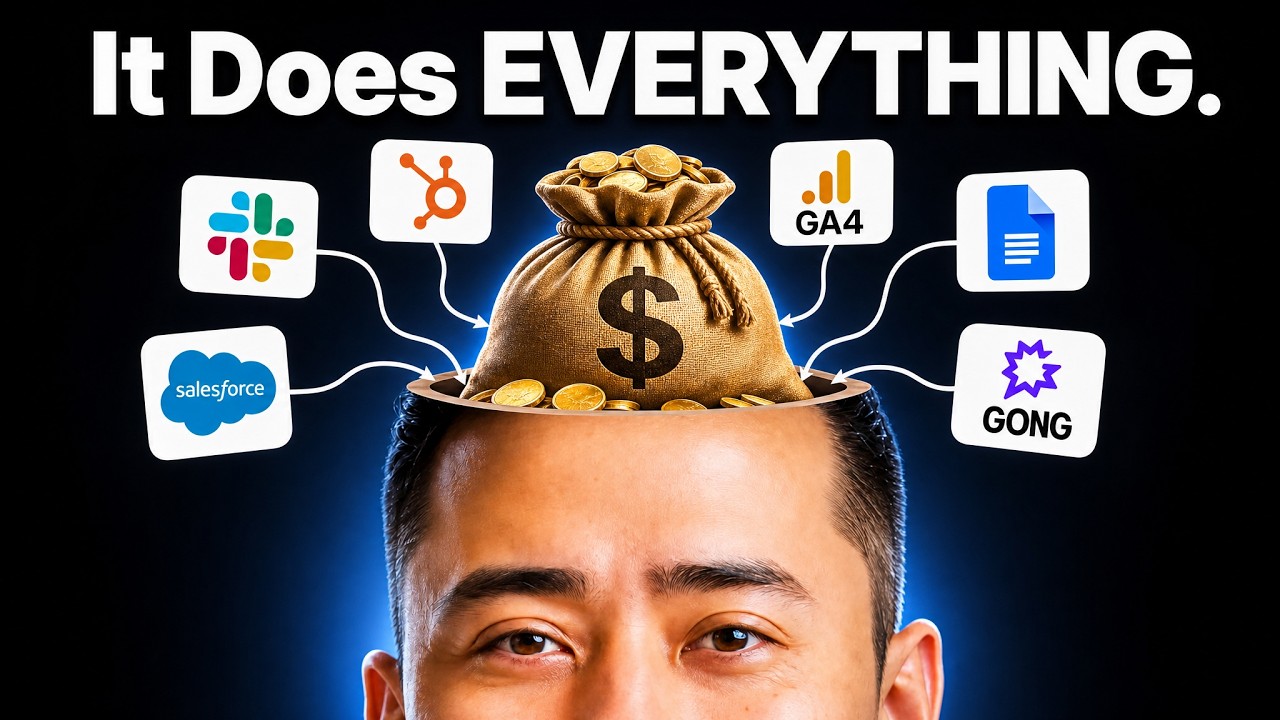
Eric Siu explains how to build a "company brain" that connects Slack, call transcripts, CRM, and other tools into a unified system. Persistent memory and indexed data let specialized agents handle workflows automatically. He walks through the architecture layers: capture, retrieval, permissioning, and feedback loops.
Chapters
Most people are buying AI backwards, so they're buying copilots, they're buying agents, they're buying all this different tooling. And what's really the thing that matters the most is the ability to combine everything together. This concept of having a company brain, a single brain, that's missing. And in this video, what I'm going to do is I'm going to show you how you can go about doing this and how we went about doing this as well, and how it's going to change everything about how you go about doing things yourself or how you go about doing things with whatever organization that you're working with, because I guarantee you it's going to make you a lot more more money. Let's get into it. So you can see over here, the whole idea here is, is look, you're disconnected before was that you had a lot of different files, you had a lot of different disparate tools. So you might have Slack, you might have Gong, you might have, let's say, your CRM, right? You might have Salesforce or HubSpot, you might have your different— you might have different GitHub repos, you might have different analytics tools to plug in. So everything was, was this situation before where things weren't talking to each other. But the idea that you have now is that you have this company brain where everything's connecting to it. Okay? So you have your different Slack channels and then this Brain is then feeding these agents that you have over here, which will then lead to the different output that you can get out, which I'll show you in a second. But literally what our company Brain is doing for us is that it's publishing X posts that are getting hundreds of thousands of views. And I think last month, for us at least, it's for my personal account, we did break a record in terms of getting about 2.3 million views or so, which is great because our X account is continuing to compound. Whereas months and months ago, we were maybe getting maybe 100,000 views or something like that. So that's going up quite a bit. And it's making it where one person can do a lot more. And that's because we have the ability to have these company brain agents talk to our people, and that makes things a lot easier. So here's what I'll call it here. So at Single Grain, which is my ad agency, we have this running across like 500,000 tokens of persistent memory. You have 90+ daily crons, multiple specialized agents, and thousands of sales calls that are feeding the system. And so you basically have one sort One source that, that the one source set includes 2,800 Gong call transcripts turned into operational playbooks. So this is how we do things in general because we've been doing these calls for such a long time. And, and so you can see 15 calls produced 390 insights, 470 facts, and 125 frameworks. So this whole idea of creating a searchable company, a queryable company, you can only do this if you have a company brain, a single brain. So what matters is that, you know, you don't just look at a call as just a call. It is one, one call artifact. Produces way more. It produces an objection library. You get sales training input. You get a positioning signal. You get a content idea source, CRM risk flag. You get future agent instructions. So you get way more output from your input. Okay? And that to me is very high leverage. And so for me, everything I think about doing is how do I get a 4-to-1 return on investment? A company brain, it should then convert knowledge into better execution. All right? So if you look at this execution architecture in 5 layers, you can see that capture, that's at the very bottom, right? So your calls, your CRM, your SOPs overall. So you want to make sure Again, that's the foundation. That's why people are talking about building this queryable company. And you want the stuff to be searchable, right? So your agents can find it. Then retrieval. So you want the right context at the right time. You want the source of truth, you know what to trust. You want to make sure that you're, you're feeding good guardrails, or you're providing good guardrails in terms of judgment for your agents. And then it'll learn with you over time. And then permission, who can use what? So who gets what in your company? Okay. And then feedback, corrections and rules, and then execution agents and workflows, right? So That's all great, but you got to make sure that again, you want to think of this as a cake. So at the very bottom, again, you start with capture. Again, most people aren't thinking about even the capture part. So if you're thinking about that right now, you're already way ahead of the game. Okay, so we've talked about the layers over here. If we click on this over here, you can see that what actually gets captured, like what are we talking about? So call transcripts, Slack threads, docs, briefs, wikis, CRM activity, internal SOPs, content decisions, agent outputs, daily logs. If you're starting a company right now, you should start doing all of this just day one. You should be doing this. Okay, you want to make sure you're Capture the raw material. You want to normalize it, label it, right? Store and then index. And you want to make sure that you continue this going. You continue. You continue to move the ball forward. Okay. So what ends up happening is as you continue to do this over time, it compounds with you. So we'd like to talk about how you know compounding is the the eighth wonder of the world. And you can see over here that that's actually that that's Warren Buffett. Okay. That's a statue of Warren Buffett. Compounding. You never want to interrupt compounding. You want to keep building here, right? And so that's what it is. You want to make sure that you're managing this over time. Eventually, you're going to need a full-time role just to managing, just dedicated to managing the The capture portion. And then the next level is that you're moving to retrieval, right? So you want to identify the task, retrieve and rank context, assemble the context pack, and then go from there. So you want to have the right context for the task. And so you can see what's happening here. By the way, all these artifacts that you're seeing from this post, this post was AI generated and this artifact was AI generated. And this wouldn't have been possible without that company brain where initially I fed context to it and then I fed context and then someone else took it over from me. And went from there. Okay. So agent doesn't need the entire history of the company. It just needs 6 pieces of context that matter for the task in front of it. Okay. So anyway, I would just say is that all that to say is that, look, I'm not going to read through all of this. You should definitely go to my X, check out the article over here. And then also you want to figure out, you know, what is the source of truth? Okay. So for example, if maybe I'm pulling from a Gong call that is talking about sales objections that maybe it's from 6 years ago versus something that's maybe more recent. I'm probably going to want the more recent thing just so you should think about there's a time decay of content as well. You should also consider that someone that has more authority in the space should be given a higher trust score. So for example, if it's coming from the sales leader versus someone that is a, let's say, a product leader when it comes to the sales process, you'd probably trust the sales leader over the other person. So you would need to continue to train your company brain on what makes sense and what doesn't. And I would also even recommend that the fact that you're watching this video right now, Take the transcript from this video. You can go to like one of these transcript websites, take it, and then figure out how you can make your own based on what I'm talking about right here. By the way, if you want to grow faster, you need to have a single brain unified intelligence sitting inside of your chat. So it could be inside of Slack or Teams, but you can see right here this bot's working and it's creating ad creatives. It is doing data pulls from Meta, from Google. You can pull your SEO data. So imagine having all these data connectors. You can ask whatever question you want. get the data pulls a lot faster. Your team can see it as well. They can choose to execute, and then you can run your other specialist agents that you have inside. So we have ad creative agents, we have email infrastructure agents. There's all these agents that can do a bunch of things. And the whole idea is they're all playing together. They're playing with your team as well. That way you're going to be able to just move a lot faster and then grow a lot faster. So check it out. Just go to singlebrain.com. singlebrain.com. We'll see you inside. Permissioning. So is it— if we're talking about HR details, should this be available to everyone in your company? Probably not. If we're talking about M&A details, should everyone in your company be able to see it? Probably not. Client context, maybe everyone can see it. That's, that's cool. Financial context depends, right? Depends on the client. So it's really make sure— it's really important that you make sure to set up the right permissioning here. With the wrong permissioning, it can cause a ton of legal issues for your company. So you want to have the right brain for the right workflow. All right. And then number, number 5, layer 5 over here is feedback loops. Okay. So you want to make sure That if you're not letting your agent learn over time, you're not providing feedback, you're not having evals that it can learn from, right? If you're not training it, it's not going to get better. And you're going to need someone that's on top of that. Maybe whoever is managing— you have different people managing these layers. The operating rules here, you want to capture every correction, structure the signal, update the right layers, improve continuously, and then humans set the standard ultimately. And you want to continue that loop over time. I don't think humans are ever going to be out of the loop here. You're always going to want to make sure that over time, maybe some loops need more checking over time, maybe some not as much. I don't think that's going to go away for a while, right? So ultimately, you have 6 layers of this company brain here. So broken versus what work— what's working. Okay. So for the broken version, you have notes that are scattered everywhere under capture, right? We're talking about getting the raw material in. For number 2, for retrieval, you have— talking about finding the right context for the right task. For the task, human finds the context slowly. So, you know, this obviously is like, oh, I'm going to get back to you in a couple of days. Oh, that data pull? Yeah, it's going to take about 4 days or so. Yeah, no, it's not going to do that, right? So this one, the agent pulls chunks at runtime, so you get it right now. And if we go back for number 1, I didn't talk about working version for number 1. Calls, CRM, Slack, SOPs, those are all automatically captured. You look at your granular calls, you look at your— just, you want to make sure that obviously you want to sanitize it and make sure that the sensitive things are sensitive. And this is always growing over time. And then you can think about using Obsidian as kind of the primary— if you need another set of notes, you want to store all your notes in one area, Obsidian is a great place to kind of store all those notes, all the decisions that you've made over time. That's super helpful. And then number 3, your source of truth. So deciding what What's true and what to trust. So AI trusts stale documents, old info, weak sources, outdated SOPs. I think this is where a lot of people go wrong. And I would say even recently we have gone wrong. That was something we need to continue to watch over. But freshness and hierarchy decides what wins. So you need to define what that hierarchy is. So live is greater than recent is greater than historical. Trusted sources rise over time. So just keep that in mind. Number 4, permissioning. Control who can see what and when. If everyone sees everything, that's high risk. Too much access, hard to contain. In fact, this, this, this graphic is so good that I need to share it with the AI product team on my side. Access depends on workflow over here. So right context, right people, right boundaries. Number 5, feedback. Turn human corrections into system learning so corrections disappear, correction becomes rules, and every connection strengthens the system for everyone. Because you want to think about— by the way, if you want to get better at systems thinking, read the book Thinking in Systems, because everything that you're building right now is a system. It's not just a company brain, it's on top of that whatever plugs into it as well. And then number 6, execution. You want to deliver value You inside the real work. So before you had AI drafts, isolated tasks, one-off outputs, no ownership, no impact. It's hard to scale that, right? And then, well, the working version is agents ship inside real workflows. So integrated, accountable, measurable outcomes. You want predictability there. And again, like feedback, you don't want to just fix it once and last forever. And that's the problem, right? I think especially with a lot of agencies, you have this issue over here where just a lot of this stuff is broken. If you can fix this, you're going to be able to scale. So each layer depends on the one before. Together they create the company brain that learns protects and compounds. That's what makes everything fantastic. And that is how you build a company brain. So hope you enjoyed this video. You can check out more videos on the channel around building this company brain or just talking about AI, business and marketing in general. And we'll see you on the other side.









