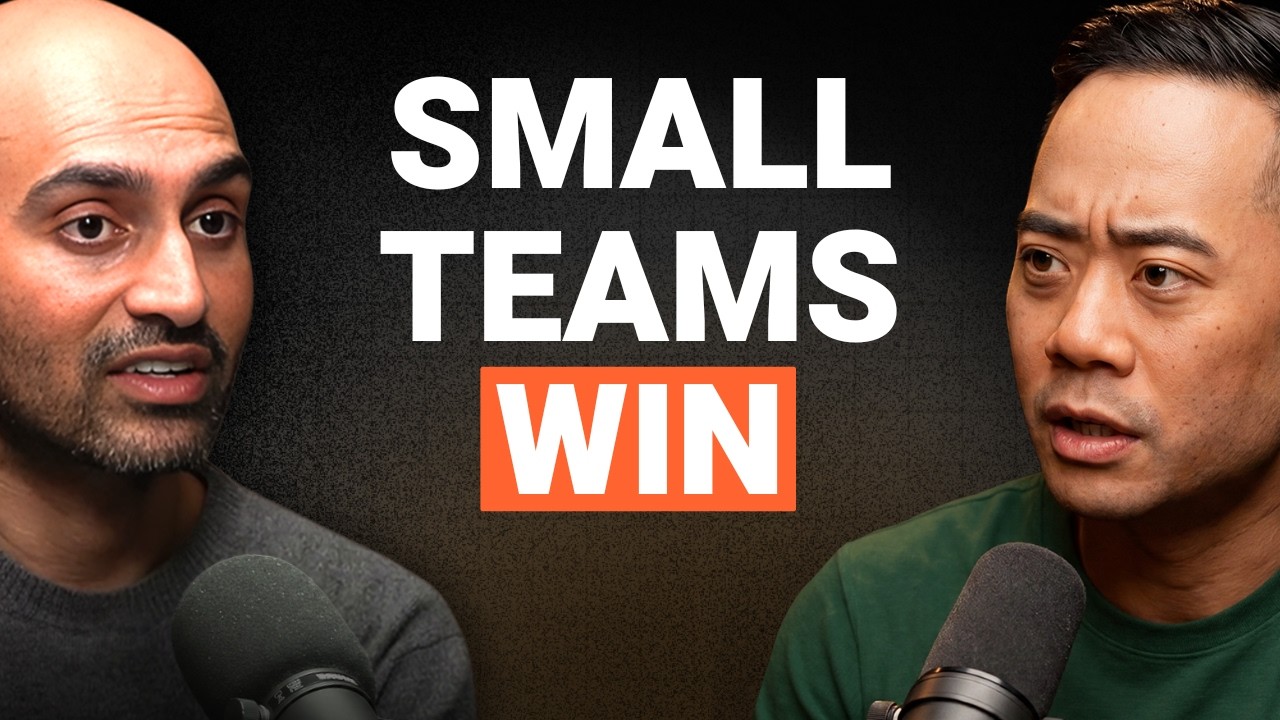
Eric Siu and Neil Patel argue that AI agents let one person do the work of a whole product team, collapsing coordination costs between designers, product managers, and engineers. They point to Coinbase's "pod of one" model and tools like SingleBrain that orchestrate specialist agents to handle everything from code to QA to release notes.
Chapters
I want to talk about the new structure for startup teams. So the new structure for startup teams is one-person teams. So let me show you what I mean by this. So Coinbase, they are talking about this concept known as the pod of one. So this is the new organization, the new org building block. So as a Coinbase board member, this is Gokul. It's been a privilege to watch Brian Armstrong, which is CEO, and the Coinbase team build a true AI-native company. So the one thing that's worth calling out here is this. Okay, he's like, I want to focus on one thing, on one thing that Coinbase is testing, which is quote unquote one-person product teams. All right, so most of the AI discourse has focused on one-person companies. The most powerful and more broadly applicable construct will likely be one-person teams inside companies. So the old product org split across 3 people. You had the designer for user experience, you had the product manager held the customer and prioritization context, And then you had the engineer that held the code and systems context. Coordination was the price you paid to combine those views into one shipping decisions. Agents reduce that coordination cost. This is interesting, Neil, because earlier we had just talked about how the rise— we're seeing a rise in product manager job postings. It went from 10,000 to low 4,000. Now it's up 79%. Okay, so a single high agency person can now ask agents to draft flows, Write code, run QA, summarize customer feedback, generate variants, check edge cases, and produce release notes. Here's what I want to call out, and then we can react to this. So I think this one-person product team, it could be a product manager, it could be a designer, it could be a developer, it could be any of those. If they have taste around all these areas, they— if you're a designer, you might have more taste around design, okay? That's how your product team's going to look over there. If you have— you're an engineer, okay, you have more engineering taste, but you can do all these things together now. And this model rewards a very specific kind of builder. They're technical enough to inspect the work. They're product-minded enough to choose the right problem. Very important. Tasteful enough to reject mediocre output. Designers are good at that. Fast enough to ship before the org forms around the idea. The scarce skill— scarce skill is judgment. What do we think about this?
I, I, I think it's great. I have no issues with it. I like it. I also wrote it earlier too, but You also what? I also read it earlier because I saw it right when it went live.
Yeah. So here's what I think about this. I think that sure, one-person companies are interesting. I still think you're going to need people no matter what if you want to build a really good company. Everything around this world is based on people. I'm sorry, that's the world we live in, right? And I do agree the scarce skill is judgment, but this is why we've been saying that AI-pilled people, if this is the very This is the forming of it, right? One-person product teams is in fact a super AI-pilled person. And that's why I'm stretching our people as much as we can. Literally, our people are going through a hackathon right now. Actually, Chris from my team is watching this as he's doing the hackathon right now on the team. So, hey, Chris. But my point is, you have to— one, both Neil's company and my company, we're trying to create the conditions for success so we can have these one-person teams. That's exactly what we're trying to do. And most people, they want to come along. You just got to set the conditions for them to be successful. And there's going to be some people that don't want to come along. So I said to Neil last week, or maybe the week before, I was like, I'm counting on people to get better. I'm also counting on some people who don't want to take the ride to not want to take the ride and kind of self-select themselves out, right? And that's why there's so much intensity going into this right now.
Yeah, and when Coinbase and others talk about a one-person product team that can do a lot of stuff, I think this kind of stuff is amazing for startups, And companies that are trying to iterate and just get stuff out really quickly. But no matter what, if you want to build something big, it's not going to end up being one person. You're going to have to add more people to the mix. And yes, it can slow things down if you add too many people, but eventually you're going to have to have more people, whether it's for product or marketing or any roles. You can't be Claude and only have one person in marketing, or Anthropic and one person in marketing, and they can do everything. If they can do everything, that means you're using tons of agencies and contractors and vendors to help.
All right, so let me show you something, Neil. I had actually formed a model on this. I've been working with my Hermes agent. Thank you, Jobe, or I don't know if I pronounce it Jobe Kenobe. I don't know how to pronounce it. Jobe? Jobe. Always a treat jumping into a think tank with these 2 legends. Thank you for that. We appreciate that. All right, Neil, check this out. So I'm literally working on this kind of new model for how we're thinking about agency, basically. So the old operating model is up here. Okay, this is a .md file right here. So proposed operating model from agency pause to agent-native revenue loop. So this is from a services context. Okay, so old operating model is you have a client account, your client account up top. So let's say it's like, I don't know, Mattel or something like that. Okay, client account up top, you have an account manager. This is the agency, you have a strategist, an SEO specialist, paid media specialist, content team, designer, developer, depending on whatever services that they're paying for, analytics support, reporting, and QA. And the characteristics of the old model is work organized by function, organized by function. Human specialists perform most production. Knowledge lives in people and scattered documentation. Reporting is often retrospective. Well, you do like a postmortem, right? Margin improves mainly through utilization and staffing leverage. Okay, that model is starting to crumble a little bit, right? The future operating model, again, you don't need all this over here. This is just like assuming it's completely built out. You have a client revenue system. So you have an outcome owner.
Okay.
It's like, hey, we're going to deliver more leads for you. You have a strategic lead, the smart marketer that I think is the MVP of this or the leader. Channel loop owner. So what a loop is, Neil, is when you have multiple parts of the process, you know, keyword research, content production, the review, the reviewing of the content, the linking, internal linking, you know, backlinking, all these things. That is an entire loop.
Yeah.
So you might have acquisition loops, conversion loops. This is where you might have your channel specialists running these loops. And then you have an agent fleet layer where you have the engineers making these agents, right? So my point of saying all this, guys, is it's time to move into the future. You have work organized by business loops and outcome. Agents handle repeatable execution and monitoring. Knowledge compounds in infrastructure. Reporting becomes continuous insight and action. Margin improves through automation, reuse, and productized discovery. So I think I don't care if you're a product company right now. I don't care if you are a services company. This is how this stuff is going to look, and it's going to be organized in this way. And I think these one-person teams are going to be sitting in these different roles. They're just going to be doing more. That's what we've been getting at.
The one thing I would add though, Eric has on the bottom, margin improves through automation, reuse, and productized delivery. Productized delivery, sorry, I'm like, it's a little hard for me to read. Your margins, as they improve, I recommend that you double down and you do more and keep your margins the same, but just give more for the money because that's the way you're going to win in today's world. Because if you just try to eke out more profits, I believe someone else is just going to come in and run a similar playbook and offer to do it for cheaper. So the one who provides more value, goes above and beyond, I believe is the one who's going to win.
We should talk about that, Neil. I mean, I mean, it's when you think about Silicon Valley startups, for example, they raise a bunch of money there. Their VCs don't want them to become profitable. They want them to grow even faster. So they want all that money to go back and be like, oh my God, it's not profitable. It's losing so much money, right? The reason I remember sitting with taxi drivers like, oh, he called me an idiot basically, right? Like, oh, that business going out of business. You have no idea what's going to happen, right? And it's talking down to me basically. I'm like, okay, well, so what happened?
Uber?
Yeah. They're like, they're not making any money. They're losing money. They're not profitable. They're going to go out of business. I'm like, okay, sure. So look at Uber now. Very strong business, right? And you got Uber Eats, they have all these different lines. Um, and so my point of saying this is that Neil is saying, hey, not necessarily— you don't want to burn cash exactly like a Silicon Valley startup because maybe you can't afford to because you didn't raise a bunch of money, but you want to maybe take elements of that thinking to say, hey, what did Jeff Bezos say before? Your margin is my opportunity. Again, your margin is my opportunity. So that margin that you could be taking in for yourself right now, the profits, If you spend it more on better people on your team, right, you grow your team out more, which will lead to more product investment, more services investment, it's going to be better for you in the long run. Because it's very much like it's— we're kind of exploring in this new world right now. You want to explore as much as you can. And it takes resources to be able to explore.
Yeah, dude. It's, again, we'll see what happens in a few years. But I think it's going to be a fun journey.
Quick break. Look, I know what you're thinking. Another AI content tool. Great. More garbage content on the internet. And I thought the same thing. That's why we spent years building ClickFlow differently. Here's actual feedback from a user. It's sophisticated, grounded in real language, authoritative, but not academic. You've hit the sweet spot. That's not AI slop. That's content that you would actually publish. ClickFlow also helps with things such as internal linking, building FAQs, and reporting on the content performance. If you're skeptical, you can just go to clickflow.com and try it for free for 14 days. And if it sucks, just cancel, but I don't think you will. Back to the show. Yeah. So speaking of fun journey, Neil, Amazon wants to own your supply chain now. I don't know if you saw this. So Amazon is getting into supply chain as a service, everything as a service, Neil. Okay. Dog walking as a service, right? Supply chain as a service.
Amazon, it caused, uh, it caused FedEx and UPS's stock to go down.
How much?
Uh, enough where it was on the financial sites, but I don't own UPS or FedEx stock, so I didn't pay attention.
Do you own Amazon?
No comment.
Okay, we'll just leave it at that. All right, so any business can now move, store, and deliver anything from raw materials to finished products using the same supply chain that supports Amazon and its independent selling partners. So here's what I'll call out. Neil and I, we use Amazon all the time, okay? When Neil gave me these beautiful yogurt gummies called Yogis, I ordered it immediately. It showed up the next day. That is logistical magic. When he wanted Grooms, he ordered it from Amazon, right? When I'm on the plane, I'm ordering from Amazon so stuff shows up back at my place already. So Amazon's logistics, I think, is second to none. And now this is a service that's available to anybody. But when I say anybody, I'm not just saying every human. It's also available to every agent as well. Every— like earlier we talked about, oh, you can now buy— your agents can now purchase using Stripe, okay? Um, and now your agents can now buy online infrastructure, they can also leverage Amazon's logistics network to help sell stuff for you, or they can just take care of stuff themselves, right? So this part is really important. This is a physical part of the world, and I just think this is great. This is now called Amazon Supply Chain Services, ASCS, opening its freight distribution fulfillment and parcel shipping capabilities to businesses of all types and sizes. Leading brands Procter Gamble, 3M, Lands' End, and American Eagle Outfitters are among the first to sign up. Look, Neil and I, we don't sell physical products, but in this type of world, maybe we will have some physical products just for the hell of it, right? Because it's pretty easy to just get going now. So—
On a side note, if you want another good snack, because Eric's talking about Yogi's, I used to bring— when we were doing podcast recordings for like 1 or 2 times, I brought him this snack that my kids eat, which is like just like a little breadstick, but it has like a little chocolate mushroom shape on top. So it's like a chocolate cracker that's shaped in the form of a mushroom. It's really tiny. So then he wanted something else the other time that was a little bit more healthier, got the Yogis. But if you want another version that my kids love is go to Erewhon, order Painterland Sisters yogurt and get vanilla flavor. Vanilla bean, I believe, is the flavor. They have a lot of them in stock. You can Uber Eats it. Get Ghirardelli chocolate chips. The baking ones and pop them in there, mix it. It tastes like delicious ice cream that's pretty healthy for you.
Neil, what a bad user experience. You can't talk about it and not show it, okay? This is what Neil's talking about over here. These are the Meiji Choco Shrooms, okay? Choco Rooms. Chocolatey cap with a crispy cracker. You know what, Neil? Since you said that, add to cart, okay? I'll show you. All right? So, but this looks pretty good. I've had some of these. I'm just like, I don't want to eat too much chocolate, but because Neil spited me, it's a chocolatey cap with a crispy cracker. And you look at all this stuff, I have like dark chocolate here and all this other stuff. And all these bags.
Do you know how many of those bags I have in my house? If you had to guess, how many do you think?
I think you probably have like 6 boxes of these.
Uh-huh. I have like hundreds.
Hundreds.
Yeah.
So 24 times 6. There you go.
We get the bigger bags, so ours don't have 24 per box, but it's a similar size box, but the bags are bigger and there's more chocolates in each bag. But we have at least 100 to 200 of them sitting in the house. 100 easily, maybe 200.
While we're doing this, we might as well pull up the Yogi's too. So, uh, the Yogi's, I would just go for the strawberry on this side. Okay, strawberry is great. These are like real fruit bites coated in creamy yogurt. Okay, so we're, we're now sharing— we're sharing our product taste with you all.
Um, but check out Painterland Sisters. You're gonna have to Google it. Vanilla bean flavor. I'm telling you, dude, just put the Ghirardelli chocolate chips in there. It tastes better than having like, um, Chocolate chip ice cream and it's healthier, a lot healthier, high protein. The Pain and Ancestors yogurt. Uh-huh. They sell it in Erewhon.
Oh.
And if you have lactose problems, it's lactose-free, so you won't have issues.
I don't like yogurt. Anyway, well, Neil, we have 2 more minutes here. So what do you got in 2 minutes? Anything fun to share that you're working on? One project.
One project that I'm working on? Okay, you'll like this one. I'm trying to figure out how to dominate China in marketing.
Okay. And you're using a team of people that will help you with that?
Yeah, I'm talking to a few people who are really good with China because here's the thing, China, I know a lot of people don't care for it as a market, at least people in the US, but when my mom keeps getting packages every single day from Temu, You know, like, why am I not the agency that's not only helping companies market in China but helping these massive Chinese companies, because there's so many of them now, market to other regions in Europe and Latin America and America, etc.? Like, dude, some of these Chinese companies are just massive and they print cash, and it's like, this is a great market to enter into. Not only do I want to speak there at least 4 times a year. Uh, if anyone's well connected with China, hit me up. And, you know, I'm trying to figure out how to build a team there over time.
I love it. Well, great. You will, you will have a lot of experiences there. This is me saying this as a Chinese person, but I think it's, it's a good market. You're definitely gonna have a lot of experiences.
Um, but before we change on the experience, one thing that China does— like, I use Uber Eats, so typically when I go to a hotel, I find that it's easier to just order Uber Eats than it is to get room service. And it is genuinely usually cheaper to use Uber Eats than actually get the room service. But it depends on the country. I was just in Spain. I was at the JW Marriott. Room service for 4 eggs and toast, I did not get a bottle of water because they had free ones in the room, was €11.
€11?
Yeah. At that point, I don't do Uber Eats. The cost is just amazing. And I know that this kind of stuff makes me sound cheap, but it's harder to earn money than it is to save it. So I try to think twice before I spend my money. But in China, or in a lot of hotels, when you order Uber Eats, they make you go down to get it. In China, a robot comes up and delivers it to your door. You just pull it out and I'm like, this is great.
Yep. They're very much living in the future. I'll just leave it at that. So Neil's working on that. If you're connected in China, reach out to him. Here's what I'll show you what I've been working on. Then we can get out of here. We should do this every now and then, Neil. So we should do that at the end of every episode.
What are we working on this week?
Yeah, so dude, this site, look at this, Single Brain, right? One trusted brain for clients. So we're getting a lot of interest in this right now. And here's the thing I'll say about people looking for our revenue agents. Um, when typically when you get on a sales call, sometimes they'll, they'll like, they'll ghost you, right? Nobody ghosts in this scenario. Okay, so this is our, our new singlebrain.com website, and it talks about like the marketing partner companies can't outgrow. We have this one brain, this one agent that manages the specialist fleet of revenue agents or marketing agents, whatever it is exactly, and it kind of explains the infrastructure. So, Neil, I'm sure those of you that can't see this right now, this website I created using Claude Design, and I got my OpenCLAW to then deploy it on singlebrain.com, and then this logo was created by my team. But this is pretty good. I came up with this concept known as SSR. You want your agents to be Secure, stable, and reliable. SSR-grade trust, right? SOC 2 compliant. And then, uh, Single Brain— Single Grain becomes a marketing partner companies cannot outgrow by giving each client one trusted brain connected to a managed fleet of specialist agents on isolated deployments built to SSR-grade trust. Dude, the typography here is good. I'd even write this stuff, Neil. No, this looks good.
Now zoom into the logo. I can't see the logo. Did they put a brain in there? It'd be cool if they did.
No, it's just a Single Grain logo, but a circle. It kind of looks like a brain, no?
Uh, no, I can't. It doesn't look like a brain when you zoom in, but it's too hard for me to tell on my screen. But, uh, no, I also think it's smart that you kept the original single, uh, grain icon in there so that way it ties them together.
Dude, and look, look at this. I was gonna give up on the second page over here. I'm just like, I'm too lazy to get the second page up. And I was like, huh, Claude Design, just make the second page done. And the cool thing is, Neil, when I deployed this, I went to my OpenCLoud, I was like, hey, Are you— are we going to carry over the pixels, like the tracking pixels, the conversion stuff? Is that all going to— like, everything flowed to the new version and it did a smoke test first. I'm just like, dude, Neil, this would have taken us weeks to do and now I can do this end to end. Isn't that crazy? What a good life.
Still, we both still recommend having human modified and fine-tuning it and optimizing for conversions and stuff, but you should be using this for V1.
Why not? Quick and decent. Quick and decent.
What I've been pushing my team on is not just V1, keep iterating on V2, V3, V4, and then when it gets to like V5, then have a human go in.
Dude, and now that you have /goal with OpenAI, it literally will just continue to work, and that's when you use Codex, the app with it. And I'll leave you with one more thing before we go here. OpenAI just came out with this thing called Symphony. Neil, you remember like the Trello boards, like the Kanban boards where it's like doing, done? So you can now just give the tickets to the AI and it'll just continue to do the tickets over time and you can continue to fill it up. And so now it's becoming more and more autonomous, right? That's why a lot of people are switching to Codex, Symphony, using 5.5, using /goal. So there's a lot of crazy stuff happening. That's why you guys should stick around. Check us out on YouTube, subscribe there. Now come to us over on X because we're both going to have post-roll ads for our stuff too. But that being said, yeah, we'll talk to you guys later.
Bye. Bye.









