Why You Should DEFINITELY Get a Chief of Staff
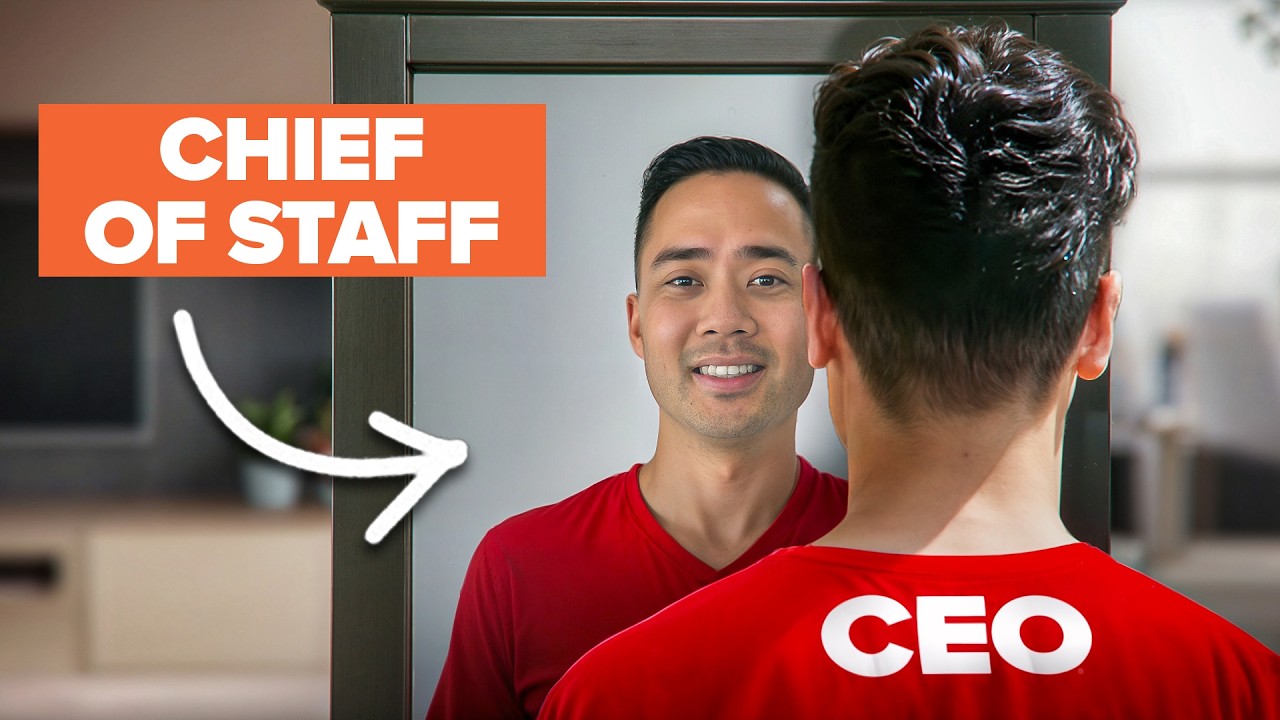
Neil Patel and Eric Siu explain what a chief of staff does and why founders need one. A good chief of staff handles ad creative launches and fixes broken brand and social processes, freeing founders to focus on strategy instead of drowning in operational chaos.
Chapters
If you want to be an efficient operator, especially as a founder, you need a chief of staff. I believe you called it right. You still have a chief of staff or no?
Amazing.
How does it work out? What do they do?
Chief of staff is some Matt Mosheri came up with this. So he wrote the book *The Great CEO Within*. So he coached like Naval Ravikant. I think he coached Sam Altman as well. I could be wrong on that one, but he coached a lot of great people, right? So his his rule is you can't work with me. Unless you have a chief of staff. And it's like, okay, so what's a chief of staff? So a chief of staff is someone that's not a glorified executive assistant. A lot of people treat a chief of staff like that. A chief of staff is someone that you can train up to be your shadow.
Have them sit next to you, literally physically sit next to you for 10, 12 hours a day, like your entire workday. And they see everything that you see, they hear everything that you hear.
Like whatever you're doing, right? They're shadowing you and then They're helping you with the M&A stuff. They're helping you with bringing traffic. They're basically another you, right? And MrBeast is a good example of this. He actually has like, I think 20-ish people on his team that are all like chiefs of staff type roles. And 3 people lived in with him for, I think they still live in with him, right? And they basically are just eating up, they're shadowing him, seeing all his behaviors, all his patterns, and they're becoming a shadow of him. And that's how I see my chief of staff. And that's why I'm like, whoa, we need to build like an organization of chiefs of staff because— They know how I behave, everything I do, and they know how I make decisions. And it's such a high-leverage role, I think, that everyone should have one. And so I got that idea from the great CEO within, and it's been great.
Dude, speaking of living with someone, I lived with my co-founder ages ago when we were much younger. He was my roommate.
Who? Mike. Oh yeah.
He lived in Vegas, and we also lived in San Diego a little bit together. But he learned a lot from me over the years.
And that's how he became who— like, Mike was great already, but being with you and shadowing you and seeing your mannerisms, like, it rubs off.
Yes. And he was already good at sales and operations because he— they had a family business and he was self-running it. But, uh, it did help. I, I would say, you know, looking back on it, if we look at our business now, a lot of the stuff we just do is aligned, and it's because we lived together for a good amount of time. And when I say a good amount of time, probably like 6 months That's a lot.
Yeah.
And, you know, we picked— he picked up off on how I like things, how I don't like things, what I feel works, my risk tolerance. And then I've also learned what works for him, what doesn't, where he's strong at, where he's weak at, and vice versa.
He was in effect your chief of staff to start off with, right? And like in the beginning, so this is a little story on NP Digital, but in the beginning, um, so Mike didn't necessarily want to become CEO, and then they tried to work through a couple CEOs, and then Mike eventually realized he has to become the CEO, right?
Correct.
And then that's how he figured everything out, but Um, you can either hire a chief of staff that's— I've met chiefs of staff that are making like $400,000 or $500,000 a year. Um, and these are really experienced ones, right? And then, you know, they also have like, you know, big stock compensation. Or you can find someone that's like a diamond in the rough that's younger. Um, and that work— I, I think that's way harder. I think it's probably— you don't need to pay $400,000 or $500,000 a year, but you can hire someone that's been an experienced chief of staff. And I think it'll take you a long way. 'Cause I, I spoke to a guy, um, I'm like, so what do you do? He's like, oh, I do the same thing the CEO does. And then he's like, yeah, I'm focused on acquisitions right now. I'm doing this and that.
Mm-hmm.
And I think if you can, one angle is maybe if you can't afford that, you can hire someone that's younger and then maybe hire someone that's a super experienced chief of staff as a coach and then pay them for like, you know, pay them for an hour of their time for like once a month or twice a month.
Yeah. If you had to pick the 3 biggest things that's helped you in your business from having a chief of staff, what would be the top 3 things?
Okay. So starting a new service line, that would be one. You know, we fixed a lot of issues on our brand team.
Well, let's go back. What was the new service line that you guys created?
Ad creative.
Oh, cool.
Yeah.
And it's up and running, it's working well?
Mm-hmm.
And they did all of that or you had to do it?
They did the vast majority. I didn't really have to get involved.
Cool. What was the second one?
The second one is, God, what was I saying? So, oh, so there are a lot of issues with our social side, like the posting and all that stuff, right? So we hired an outsourced team, But there's a lot of blocking and tackling that needs to happen with making sure that, hey, how many Shorts are we hitting out there? Like, how's the reach? How's the engagement? How's the packaging for YouTube? All that stuff, right? We call that the brand team. We fixed a lot of issues there and that was largely due to the chief of staff.
Cool, and you saw more traffic from it?
Uh-huh, yep.
All right, well, something—
That's the second one. And then the third one, I would say, is just say overall, serving as my eyes and ears and, disseminating how I think and how my general demeanor is throughout the organization because they're way more approachable than I am, right? Because I'm the boss, right? I understand that there's a power dynamic, right? But that dynamic doesn't exist with others. And so it's kind of like that they're the conduit for me.
Yeah. And I'm not asking how much you pay your chief of staff, but in general, because you've seen a lot of this data and you know a lot of people who have them, What does it typically cost for someone?
I think if you want someone that's good, you're probably going to be paying, like an experienced, probably someone that's like $150, $200 plus at least.
Oh, wow. So they're not cheap. No.
But yeah, no, it's been good. And why? Are you looking for one?
No.
Why not?
I don't want one.
You kind of have, I mean, you do have a situation where you have multiple assistants and— I only have 2. I do think Mike is a very high level, 'cause the chief of staff eventually can grow into a C-level role, and that's what Mike became. And then Mike still works with you pretty closely, I think, right?
Him and I work daily.
There you go. Yeah.
Yeah. It's just like, for me, I don't like hiring tons of people that I have to work with. It's not that, you know, I love people. I don't want to manage anyone or have anyone—
You love people, but you don't like managing people.
Correct. And I don't want to have anyone that reports underneath me or that I'm responsible for. easy route and people are like, oh, you're not going to make as much money if you do it this way. I don't really care.
Sometimes you're just playing to your strengths.
Yes.
Right? Like, I don't like doing it, but like, you know.
I also like the freedom and flexibility of not having any direct reports.
Yeah. Because in a vein, you are— look, when you hire people, you are working for them. Like, I don't care what you— like, you are working for them, right? And the more people that report to you, the more The problem with people that report to you sometimes, and I'm grateful for it, I love helping people, but oftentimes they'll drop the monkey off on their shoulders, they'll drop it in your office. So we're in an office right now, and then somebody else will come, they'll drop off their monkey for you too. And all of a sudden your room is full of monkeys running around and then you have to solve all the problems, right? So that's what happens sometimes.
Yeah, and I love not having to do the stuff I don't want to do. Like for example, we do annual planning meetings.
I have— Oh, you don't go to them?
I've never been to annual planning meeting. And, uh, they get budget reviews and they're like, yeah, we got the budget for the year. I don't know if they even send me the budgets. I know them, don't get me wrong, but like even every month I get a financial review of the business and how it operates, and it's really thorough and detailed. But the first sentence is either a good month and we're on track for the year, or a bad month and we're off and why. I literally just read the first sentence or 2, and if it says we're on track, I ignore the rest and I just move on.
Well, I don't want anybody to think that listening to this that Neil doesn't pay attention to business because he does. Like, he's looking at everything every day and he's constantly like talking to people, a lot of people every day. And so just because he reads— it's because he knows the numbers already.
Correct. I know the numbers before they're reported at the, you know, on the monthly. I'm like, this isn't hard to see. You can log in and you can see the bank accounts and you can roughly figure out From a cash flow if money's there or it's not. For me, I focus on the things that are going to move the needle. You only have so much time in the day. And we talked a little about this on stage at an event we were at today in which people look at, oh, this is cool, let me do organic social, which is funny enough where most people spend their marketing time. But you look at where they're getting the ROI and it's a totally different place. It's coming from paid ads and SEO and other channels that aren't as sexy. It's just like, focus your energy on what's going to help you move your bottom line. And if you can't, as marketers, you're really just wasting time. And I think that's what Eric and I not have, you know, we've known this for a long time, but we've been really practicing this for many, many years and just focusing on, is this actually going to have an impact? If it's not, cool, move on to the next thing.
All right, so I wanted to take a second to tell you about the Agency Owners Association. So this is an agency peer group ran by my podcast co-host, Neil Patel. And myself, Eric Siu. And these were 9 and 8-figure agency owners respectively. And what I will say is, at the end of the day, you want to learn from people that have been there, done that. If you want to grow your agency to 7 figures, 8 figures, and beyond, this is the group for you. And we bring in other agency owners to speak as well, and it's a great peer group where you can help each other out. And you're going to learn how to acquire more clients, you're going to learn how to take yourself out of the day-to-day and to build the business of your dreams. And the cool thing, till November 30th We are holding a special price and you can apply at marketingschool.io/agency. And the great thing about it as well, if you try to get into group, there's a 7-day free trial, right? So once November 30th hits, we're going to increase the price by $200 per month. So right now you're getting it at the lowest price possible. So go to marketingschool.io/agency to learn more and we'll see you inside. Focus is really hard, guys. Like I'll just say, I think, um, myself included, Neil included as well, it's been a very difficult struggle. But I think the number one reason, and again, going back to the dinner conversation yesterday, I think the number one reason we see most entrepreneurs not reach their potential is because largely due to a lack of focus.
And what's interesting is Eric and I have both had the lack of focus issue. I think we're amazing at focus now, but our personal lives have went from being very stable and focused to the chaos part that we were having within our business. We shifted it to our personal life.
Yeah.
And our business is more—
Focused.
Focused.
Yeah, so I don't know, like, by the way, some people just gravitate towards chaos, and maybe that's an entrepreneur thing, like you're okay with chaos, right? So I don't know.
Like I used to switch ideas all the time. Now I switch cars every few months, and like this is really terrible.
Yeah, yeah, so Neil has this thing where he changes his mind like very rapidly, probably more so than anybody I know, and now it's changed over into real life.
Yes. And in business, I'm really steady.
Dude, when he first moved to LA, there's like this house over here, which I get this house over here, this house over here. And now it's like this house. And then it's like, let's add this upgrade over here.
And then I ended up buying tons of houses and then selling all the ones that we didn't want at losses. And I was like, that seems more like a headache to me than any—
see, what's interesting to me is the personal headaches are way tougher for me versus business headaches. Business headaches I can take all day. The personal headaches are way tougher. Like when you do, when you switch all these houses or whatever, I'm like, how the hell do you deal with all that?
One, I don't deal with it. So I have a decent amount of staff on the personal side who helps, or contractors, whatever you want to call it. Like, you know, we have a, we call it an owner's rep. It's called Real Consulting. They deal with everything related to the house, maintaining, checking, seeing if it's right. Oh, doing construction. Oh, buying a new property. Yes, no, all that kind of stuff. But What I found is my business life, I used to change my mind a lot, didn't have focus. I have laser focus now in business, don't change mind as much. I've seen growth in that. Personal mind, flip-flopped on houses one too many times and cars. It is a pain to deal with the personal stuff, but the growth in the business makes up for the pain in the personal.
I would say this too. You also need to surround yourself with people that focus and people that are more grounded and people that are stabilizers because We earlier mentioned that founders introduce risk, and so when Neil mentions he wants to expand into China, you need someone to kind of talk him off the ledge a little bit. I need the same thing too, right? And so in that case, like that focus thing, by the way, that's an exercise that you need to practice every. It's like working out; you got to do it every day because in that scenario, like that expansion thing, that is like sometimes you can expand too rapidly, right? But when you have a conversation like that, you'll dial it back. And so you do need to surround yourself with people that will help you focus. It's not just like. Oh, we became laser-focused all of a sudden. Like, there's a 60-day moving average there, and you need to make sure that you're constantly, like, you know, doing your curls and, like, you know, doing your shoulder exercises or whatever.
That's right.
Yeah. That is it for today. Again, from Frankfurt, Germany, this is Marketing School. And don't forget to rate, review, subscribe, and go to marketingschool.io/agency if you want to join the Agency Owners Association. And we'll see you tomorrow.









