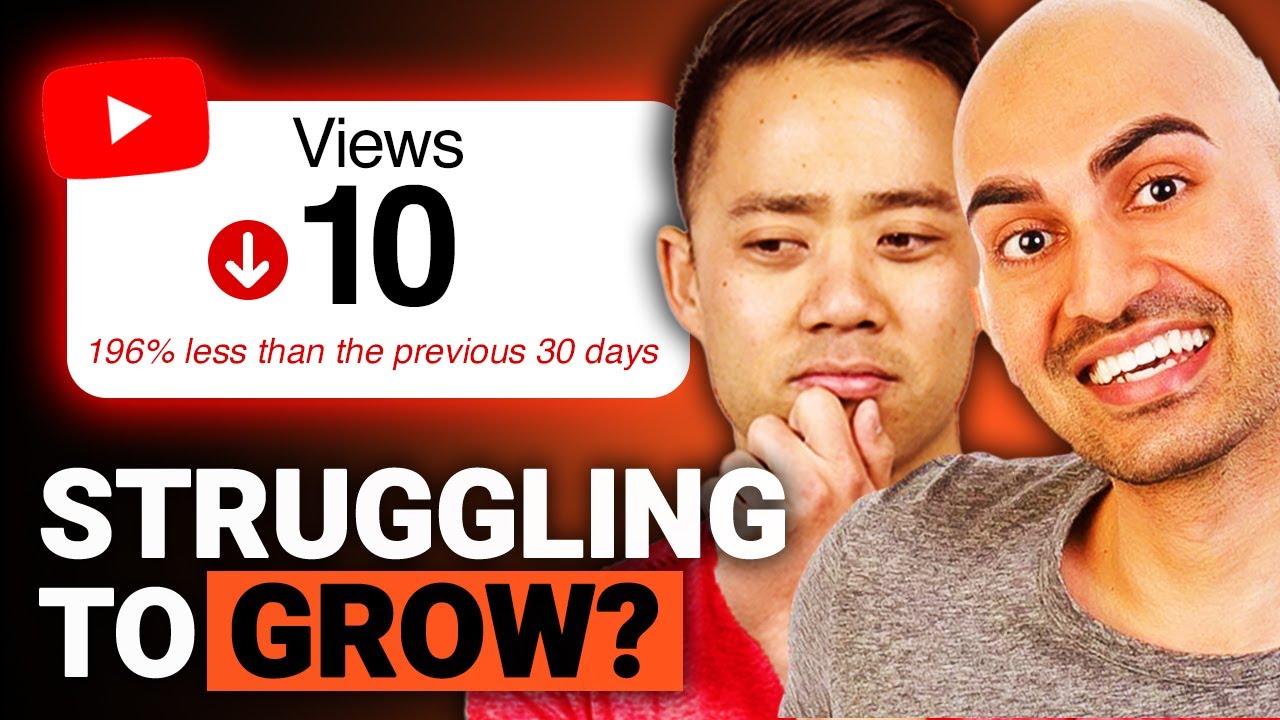
Eric Siu and Neil Patel explain why creators plateau on social media. They argue you need to treat platforms like an employer, post consistently, pick one channel, use new features and ads, and avoid relying solely on ghostwriters. Sahil Bloom, Chamath Palihapitiya, and Russell Brunson show how it's done.
Chapters
If you're going to be creating content, you got to think about what's unique to you. If you want to grow on YouTube, you have to think that you're an employee.
People end up thinking is, I'm on these platforms, the social networks should love me. Without me, they don't have the content. That kind of attitude will not get you the views.
All right, if you're struggling to grow on social media, this one analogy will change the entire game for you. So we're going to hit on this example a little harder. In the last episode, I shared an example from George Gammon and he said, look, he's a YouTuber. He's like, at the end of the day, if you want to grow on YouTube, you have to think that you're an employee of the platform, meaning that you have to post consistently, you have to post good content, right? And you can't talk about different things, right? And usually the audition period could be anywhere from a couple months if you're going hard, or it could be like a year or so, right? But this analogy applies to every single channel.
Yes. And what people end up thinking is, oh, I'm on these platforms, the social networks should love me, they should appreciate me. Without me, they don't have the content. Well, that kind of attitude will not get you the views. Remember, they're the ones holding the power. If you look at their stock prices, Facebook is a massive company that generates over, I don't know what they generate in revenue now, but it's probably over $100 billion a year, maybe a little bit less. Either way, they're massive. If you look at Google, trillion-plus dollar company, even with a recent stock decline. If you look at Microsoft, which runs Bing, they don't really have any social network though, but they're still a massive company. If you look at X, they're publicly traded. Elon does what's best for X. If you look at TikTok, they do what's best for them. You're working for them. They're not working for you. And people get that wrong in which like, oh, I put content on the social web, I should just get traffic, they should appreciate it. It doesn't work that way. And unless you not just create amazing content, but content that they approve of and they like, you're not going to do well. Keep in mind, a lot of these networks do have bias towards certain topics. Just look at like Russell Brand, some of the stuff that he does. Some of these social networks don't like and it doesn't necessarily help them out.
Yep. Here's the other thing I'll say. So I was doing a podcast interview with Sahil Bloom yesterday and he has like a million Twitter subs or Twitter followers, I should say. And he's growing on other channels. I think he's got a couple hundred thousand people on his email list. So it's a pretty significant audience. And he focused on Twitter in the very beginning. He had no subscribers in 2020. I think it was like, it had to be April 2020. His first Where he went from 500 to 2,500 followers, it was because Chamath Palihapitiya reshared something that he wrote. And I asked him, I was like, so how much time were you spending initially? He's like, I think he was spending like 3 hours a day writing content, right? And 3 hours a day times 365 is basically 1,100 hours. That's 45 days of work. And most people don't understand how much work that is. I think it's like, it had to be like over, 70,000, 80,000 words, and that's a lot of work. And so most people don't understand that it's very consistent. Most people don't see the work that's required. And the other problem too is most people get to a certain stage and then they'll stop posting, and then that ends up hurting the channel pretty negatively depending on the channel that you're on. Like YouTube, it hurts you quite a bit if you stop posting for a while.
Yes. But yeah, it's, look, you're beholden to them. You need to figure out the type of content that they want and you need to feed into it. The other thing too is think about being an employee in a company. If your boss and your boss's boss and their boss's boss says, wow, we released this new product or service, it's cool. It doesn't matter what you think about it, they want it out there and they want people using it. So when social network releases something new, whether you like that feature or not, push it, leverage it, you'll get more play. And the reason being is they want you to use it and they want to encourage everyone to use it. Now, when you are on these social networks, keep in mind their eventual long run is to make money from ads. So unless, you know, unless you're willing to run ads in the long run, assume that your organic isn't going to do as well as you want because they're going to cram down the reach so they can make more money from advertising and force people to run ads, even if it's for their channel to just get more subscribers or views on existing videos. But you got to end up playing into what they want. You know, if they want more ad revenue, you got to figure out how to end up leveraging the ads and making it work for you. And you can get creative. For example, Russell Brunson, who runs ClickFunnels, back in the day figured out how to make his ads profitable on social web. And what he did is he pushed advertising to a podcast and he would give you like free headphones and all this kind of stuff.
Oh yeah, yeah, yeah.
And he did that to boost up his follower accounts, boost up his podcast followers. And then from there, he would sell you from all his channels on ClickFunnels and it ended up helping him build a company that generates over $100 million a year. That's not a traditional way of running advertising, but he played into what the social networks wanted and came up with a creative solution to generate revenue at the same time while building his followers.
The final thing I'll say is this, you know, I've tested different things on Twitter, for example, like you can outsource your writing, you can have ghostwriters. When you're doing that, sure, you might get a lot of reach, but you got to think about if you're going to be creating content, you got to think about what's unique to you. What experiences can you share? What stories can you share? What data can you share? And ultimately, that's something that you can compound on. Because if you're going to rely on ghostwriters, you're not able to actually compound on something great and you're going to be reliant on them forever. And also, they're going to be saying things that you might not necessarily agree with, right? And so it's worth it to put in the time. It's worth it to be consistent. I would say if you're going to start from scratch, be a good employee for one channel. Don't try to be an employee of multiple channels to start. Figure out one and then you can scale it.
Cool. Well, that's it for this episode. Make sure you rate and review the episode. We really appreciate it. Thank you for your time and we'll see you tomorrow.