Your Hiring Strategy Is Broken (Here's Why)
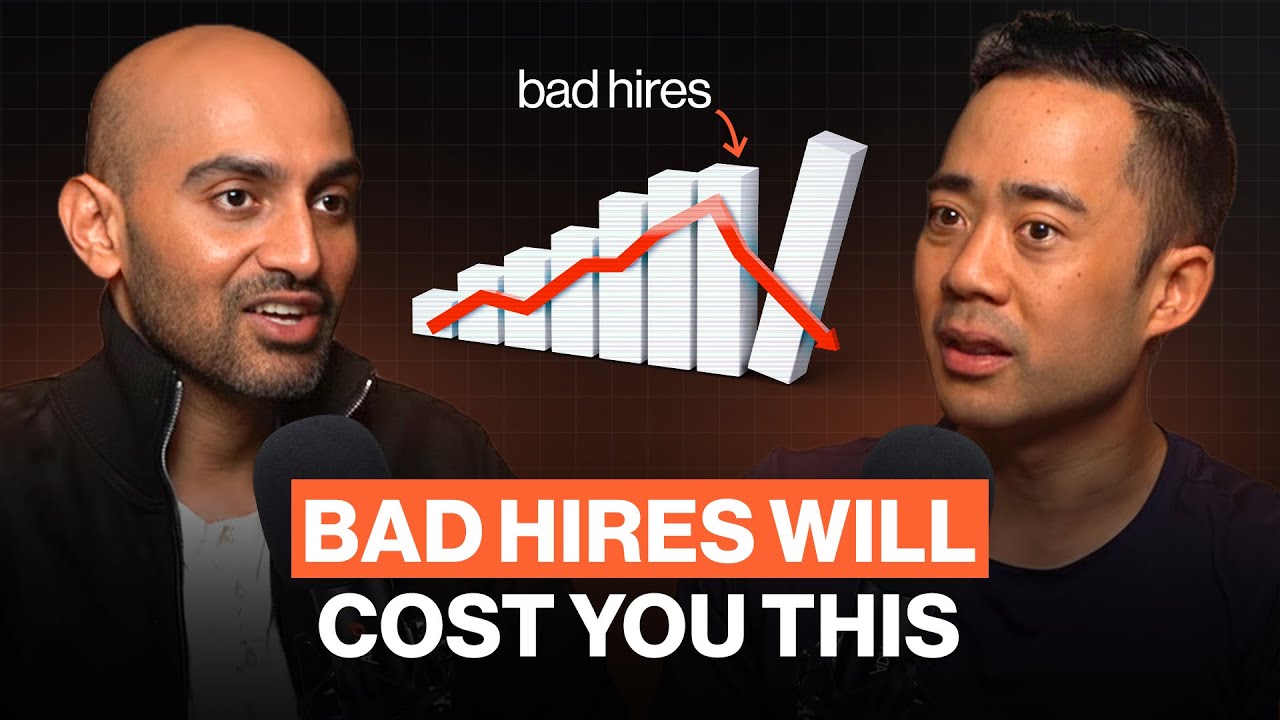
Eric Siu and Neil Patel discuss why most hiring strategies fail. They cover sourcing versus job ads, the hidden cost of hiring mediocre people (the "bozo explosion"), and why referrals and open-to-work signals matter more than traditional recruiting.
Chapters
Question for you. So what percent, and you might not know this, but what percent of people for NP Digital right now of new hires are sourced versus, you know, coming through a job ad?
I have no idea. I'll tell you this, I do know this interesting fact, okay? So we were going, we're recruiting some people right now for some of our tools, Ubersuggest and AnswerThePublic. So then Mike starts hitting up our recruiting team or someone on our team. I don't know who it was. And they were just like, hey, I need help with these roles. And they're like, we don't have the time. And Mike's like, what do you mean we don't have the time? They're like, we're already overwhelmed. We have like 48 open roles right now that we're working on. And he's like, oh. So then Mike just started doing it himself and started recruiting.
Yeah.
But with that many open roles, there's no way that it's being filled by network.
Mm-hmm.
It's, I'm assuming a lot of it is just going out there and recruiting. But on the flip side, I was talking to my CEO about an internal role for our organization. So we're in, I think, 28 countries. I don't know all of them by heart, but let's call it 28 countries that we classify internally. For marketing, I think we use a little bit less. I know we have people in like 35 or something like that countries. But we're in, call it 28 countries. We have at this point a good amount of global clients that pay us for different regions. Some of those clients we communicate all together and we're doing one cohesive plan. Some of those clients we're not because they split up their marketing by region and each person has their own say and they want their own team and they want to do whatever they want, right? So we have to mold and adapt to the organizations. But we were thinking about hiring one person whose job is to work with all the big organizations we have, and their only job would be to land and expand. So if you're a company like McDonald's, who we don't work with, but I'm going to use them as an example because we don't work with them. Their job would be like, oh, we have Brazil here and we have Europe here.
We used to work with McDonald's.
We want to go and network with the people at McDonald's and try to get the relationships for the rest of Europe, then get them from North America, then get them from Canada and work with them for not just a cohesive strategy, but more so work with them to sell within the company and more of a global role who not just builds relationships with clients, but also is in sales. So when we have roles like that, that are more you need someone who's just really good, high level.
You're talking executive level.
Yeah. High level is a bad term. Executive level is the correct terminology for that. When we're looking for someone who's executive level, like those roles, we tend to pull them from our network. We tend not to do recruiting for it because we just see too much failure. Because like, even if you're using recruiting, whether it's executive level or low level, no matter how good you are, you're not going to have 100% success rate. Maybe 3 out of 5 or 4 out of 5 work out if you're lucky. With the executive roles, we don't like ratios like that. So we really try to go within our network if it's super important, because imagine hiring someone to deal with all our existing customers and cross-sell and upsell. You hire a wrong person, not only may you not generate any revenue, and not only are you paying this person time, which is a cost. It's time you lose. But no, even worse, if the person sucks, they can ruin your relationship with your biggest clients and then they can cost you a ton of money.
Yeah, I look at the time lost as, because imagine having the right person, you would've compounded, you would've started to compound and the money you make long-term, it's just, it's a bad hire costs what? At least I think it's like 2 times their salary or something like that. But I look at the time investment as like if you find the right person like Mike Gulliksen for example, right? It's working pretty quickly. But imagine if you wasted a year, you wouldn't waste a year, But imagine if you wasted a year with that CEO that wasn't working out.
Yeah, it would've been expensive.
Yeah.
But it's not just the time loss of the compounding effect. Imagine they're dealing with a book of business that's $60 million.
Yeah.
And they ruin the relationship with a third and you now lost $20 million of revenue. Forget the compounding effect, you just lost $20 million in revenue.
I think the acute pain, the stab in the side is like you lose the revenue, right? But long-term you lose a lot more too.
Yes.
Because that year, like imagine all the bad relationships or the bad hires that they made too. So it starts to eat you like a cancer, right? So the reason, so going back to this question, the reason why I'm asking you this question, I was messaging one of our friends this morning. And so I do agree, like the best people you're going to find, like 95% or so are going to be sourced, right? And that's always been my philosophy, but for lower level roles, what percent of people do you think are being sourced from either being sourced or job ads? For a lower— Yeah, let's say it's like director or something like that.
Yeah.
Just estimate.
Director or higher or director and lower?
Director or lower.
Maybe it's easier if I do one level below a director. If I do one level below a director, I would guess that we're probably recruiting like 70, 80% of them. If it's director and higher, my guess is—
When you say recruiting, job ads?
Job ads, HR, following up with people. If I say it's director and Uh-huh. My guess is we try to use our internal network for at least 70%, 60, 70%.
Yeah, so that's always been my philosophy, right? Like you got to source like, and that ratio seems right, but I was thinking about it this weekend. I was like, okay, the team is like strapped, right? For, and then our recruiting's pushing, but they're strapped for talent right now. And I'm like, well, recently we spent not a lot of money on LinkedIn ads. We spent $2,500 and we got 2 people that are kind of mid-level, I would say, right? And those 2 people seem to be working out. I'm like, Why don't we just spend more on ads? And so I was really annoyed at just like hearing about how like, oh, you know, we're overwhelmed and this and that on the recruiting. So I just like threw up a bunch of job ads over the weekend and all of a sudden some are even director level too. These are the people that have actually the 2 promotions at 2 different companies. I was like, oh, we're actually talking to some amazing people and it's not even costing us a lot of money. And so all that to say is like, I was really against turning on job ads, but you know, from what we're seeing so far, I don't think you're going to find like the COO type or the executive types or even SVP types. But it's worth it. And our mutual friend that I was talking to this morning, they actually have the LinkedIn version that shows you who's open to jobs and it shows you the entire network, right? I know you're probably paying for that too. And funny thing is he shows me screenshots of who's looking at my company too. So yeah, anyway.
When we go and look to acquire a company, we look to see how many of their employees are looking for a new job. Because if you start, like there was a company that we saw in Europe, Yeah. And no joke, I think it was like 70-something percent of their employees were open to work and looking for a new role.
70%?
70-plus percent.
Okay, what's your bar for this?
Our bar?
Yeah, your bar, like what percent is too much?
So our general rule of thumb is we want less than 10% of the people working in a company open to like looking for a new job. Yep.
Yep. Which is interesting because before when it was a shit show 5 years ago, right? 4 or 5 years ago, so many people were looking, right? This time it's less than 10%. Yeah.
And the reason this is an important metric, people like saying like, oh, look at our employee retention numbers. They're really good. And we see that data. So that company that we were looking at that had that high percentage, we told them and they said, no, no, no, this is inaccurate. Look at our employees right now and look how long they've been with us. So we verified the data and they were correct. Their employees actually have a long tenure. But if a lot of your employees are looking for a new job, it means something's wrong. Okay? And a lot of them may have a high tenure because they suck and they can't find jobs in other places.
True.
So we don't just like taking someone's data and seeing how long their employees are there for. We actually like looking at who's looking for a new job because if enough people are, it tells you that either if their numbers are low or the retention in the company is good, that means that they're probably not good and they can't find jobs. But it usually also means there's something wrong with the company culturally for that many people to look for a new job. It's just they're not sharing it and you're not going to find out.
You know, so that's why I say culture is like a, it's a 60-day moving average. So you can't say we had a good culture last year or 2 years ago. It really is what have you done in the last 60 days and how are you behaving right now? And That is a good microcosm of how your culture is right now. It's a culture, it's a very recent thing. And by the way, I asked Perplexity this morning, I was walking back from the gym, just this question, like what percent of talent is sourced by marketing agencies versus using job ads? And how about B2B SaaS, right? And so job ads basically generate the majority of applications and 40, 50% of hires in many markets. So this is not just for agency. Agency account for only a single-digit share of total applications and even a smaller share of hires overall. In B2B SaaS, agencies are used less often. I think it's like, For senior and niche GTM engineering hires. So that's what it is at a high level. But I think your metric is good. 70%, if you're talking director plus, should be sourced. Yeah. If you're talking executive, if we're talking executive level, probably all of it, almost all of it.
For executives, we try to source all of it. It doesn't always work that way for us when we're expanding to other countries.
Yeah.
Because sometimes you don't know, but dude, I remember we acquired a company in Southeast Asia called Search Guru. I think this was like a year ago or something like that, maybe a little bit more than a year ago. And I ended up going down there, met up with the founders. We put someone in place from our end to go and run that. It was someone that we did not, quote unquote, get within our network, and we ended up hiring them. And no joke, I meet them, I talked to them for 10 minutes. I tell the person who's leading up the whole region, APAC, I'm like, they won't work. Yeah. Why? So when I was like, hey, this company that we bought, there were certain individuals within the organization that I saw that had, that needed some improvement. And what I mean by needed improvement, like when we're in client networking, they decided to play ping pong instead of Talking with potential customers. And I don't think it was ping pong, but some other game like that, some office game. So that really irks me. I'm like, that's a no-go with me. So then I go up to all the customers.
Like the leader was doing that?
Not the leader.
Employees?
Employees.
Interesting.
So then this person that we hired, they're like, oh, we need to coddle them. And I'm like, no-go. They're like, if you just rip off the bandage and you're too harsh, it's going to be a culture shock. It's going to create too many problems. And then I'm like, this is a no-go. I get that, but they're being too nice instead of just fixing. And that day, if you have someone paying you, forget about culture or anything else. Your job is to do best for that customer. You need to change whatever you need to for that customer to make sure they're extremely satisfied. And we did eventually end up ripping the bandage and whoever didn't like that philosophy, Did not exist.
You know what I would say?
Or did not stay with the organization.
My key takeaway from this, listening to Neil's story, so when I worked at Wpromote, I remember there was a period of time where the CEO walked by and I was actually playing one of the cornhole. So we had like cornhole and like all these like Google-given like things, right, in the office. And then people would just do it in the middle of the day, things that you didn't like. And I never understood why we had that. In my mind, I'm like, why would I ever do that? But hey, if everyone's doing it, I'm going to do it too, right? So I remember a period of time I was like drinking like a soda or something and I was playing cornhole and he walked right by. But he was like down with it, right? I'm like, okay, that's him. I would never— I don't think I'd do that at my org. And when I had the office in downtown, we never had like games like that, right? And so I think what you're saying though is like, this is what— this is how you run things and this is how it is. I don't think what we're saying is like right or wrong, you know?
Correct. And some people like this lax lifestyle. I'm a big believer that I want to work with amazing individuals who are just obsessed about their work. And I was talking with a startup Yesterday, and they're going to go public. This startup is not paying me. This startup has a lot of issues with their marketing. So I'm talking with the founder. I myself couldn't help but not dig through their website and send a ton of notes of what's wrong and what needs to be fixed. And then when I get a slow response, what do I do? I go call the founder and then I'm like, hey, this needs to be fixed. Who do I need to talk to to get this fixed? I'm so obsessed about having their marketing flows and conversions optimized that I can't stop even though they're not paying me. So much so, I started texting the team and the founders and some of the people in marketing. I'm like, can you please send me data on your existing pricing pages and your flows and what you test and what converted? And then I'm dissecting and they're telling me the numbers. I'm like, this doesn't add up. If you get X amount of signups and this is the conversion rate and you're telling me this is your LTV, your revenue you would be higher by like 3, 4x than what it currently is. Something's off. I'm like, I need your real conversion numbers and it needs to be accurate so I can tell you what changes to make. Because the changes you're telling me that you made that decrease your conversion don't seem right. And I think you actually got a data problem because your numbers aren't adding up.
Yep.
And that's obsessive personality. We both have it, at least when it comes to work.
Yep.
I want people who love what they do.
It's okay. When I was, uh, 25 years old and I told Neil that a girl broke my heart, he just stared at me and he just went back anyway. He just went back to talking about work. Yeah, that sounds about right. Yeah. Okay.
Now I'm a little bit better. Just a little bit.
Yeah. It's okay. We get better over time.
Um, and no, actually I'm a lot better now because I want to hear the story.
Yeah, yeah, yeah, yeah. You like the stories now for your entertainment. But, um, so let me finish on this recruiter piece and we'll, we'll, we'll move on here. So, uh, Smart Recruiter Technology Benchmark shows referrals account for 16% of hires in tech. Okay, 129% above global average. And then this is interesting to me because I think if you're running like a— if you're in San Francisco, you're running like an AI company or something like that, I think the bar for your talent is way higher. And the competition for engineers is way higher too, right? And you need the best of the best and you've raised all this money. And so I actually think my opinion, when you're a service-heavy business, What ends up happening is because people are the business, people start to cut corners. That's what I've seen. And I've seen like with these agencies, they hire so quickly. But then the— I posted something recently, I got a nice graph. I don't know if you saw this, but every B player you hire, it's like you think you can afford to hire B players, but you can't. Because by the time if you hire like 100 B players, okay, you actually have decreased your output by 100%. Okay?
Yes.
That's what it is. And I have a graph for this and I think you would actually like it. All right. So I wanted to take a moment to tell you about my podcast. co-host Neil's agency called NP Digital, and they work with a whole host of global companies or global organizations. Also, Neil has SEO tools such as Ubersuggest and AnswerThePublic. All you have to do is go to npdigital.com to learn more, and we'll see you on the other side. But this actually leads to one of my points here. Before I pull up that graph, let me ask you a question here. Would you rather have a $100 million services business versus a $1 million software business? And I'm going to give you a little more context here. Okay, so let's say one business is in the We were talking about this the other week. Let's say it's in the home health niche, right? Or in the nursing home niche. Okay.
For $100 million?
Yeah, it's doing $100 million a year.
Okay.
So you get to choose this business, right? Which, um, a lot of it is subsidies from the government.
Okay. We talked—
Is it profitable? It's profitable. Okay.
A little bit or a lot?
A little bit. A little bit. Because the margins on this type of business, like, yeah, 3 to 5%.
So $100 million only produces like $3 to $5 million in profit?
Yeah, yeah, yeah. Yeah.
Okay.
Okay. And, but also keep in mind, it's government subsidies. We talked about like the, the 10 grand a month, right? Remember that?
Yes. Where you get paid to take care of parents and stuff like that. Is it that specific business that you want me to compare to the $1 million software business?
Yes. Yes. So would you rather have that business, right? You're cash flowing right now. You have a, you know, a lot of it's coming from government subsidies, or would you rather have a software business that just hit $1 million in ARR? That is, yeah, you get to choose.
How old is the software business?
Year and a half. 2 years.
2 years. So I just want to clarify this for everyone listening because they probably don't fully grasp what that $100 million business is. The $100 million business that Eric's talking about, neither him or I do this, just for clarification, but there's businesses out there in the United States where they help you get paid by the government for you to take care of your parents. So if your parents don't have any assets, Like homes or anything like that, and they have low income and they already live with you, the government pays you money. So what a lot of people do, and this exists in the Indian community as well, which I'm ashamed of, you know, we, my family doesn't do it, but what people are doing is these people who are already doing well, their parents are, you know, have lived here for a bit. They're taking care of their parents anyways than they would've, and they don't need help from the government, but because the government offers subsidies, they're just abusing it and getting free money. I believe those kind of businesses are going away. And the reason I say that is a lot of it is scam-based versus they actually need the government subsidy. I do agree that there are people who are helping other elderly people that need taken care of and they can't afford it. And the person getting paid barely has money. And It's, you know, helping people out. For those people, I think it's great. But a lot of people are making money from this in that $100 million business. It's a lot of sham clientele and scammy clientele where they don't need the money and they're just taking free handouts from the government. So I don't like that business and I would not do it. If it was purely legitimate and it was only for people who are needing it and is running at 5%, I would take that 5% margin business, 'cause that's $5 million a year over the million-dollar software business that's been around for a year and a half. Mm-hmm. Just due to the fact that if it is legitimate, you could sell that business and that $5 million profit business, you probably can get maybe $15 million bucks for.
Mm-hmm.
$20 max.
Yep. But to Neil's point, what we're saying is, would you rather go with something that compounds, that's legit, or would you rather go with a hustle, right? That can go away at any time once the government takes away those subsidies. And they're paying attention to those subsidies now.
Yeah, and in general speaking, Eric and I, even if it was $1 billion, we don't like the hustle type of businesses, not just because it can't go, or not just because it's probably going to go away over time, but because you feel slimy. Business is not just about making money. You want to market a product, run a business that you're passionate about, that you love, not something that's slimy because it's only going to last so long.
You know what's funny? We did a podcast like 2 years ago. I was like, the purpose of business is to help your customers. And Neil's like, the purpose of the business is to make money.
Yes.
But okay, let me, let me go back to the, the graph here.
It is to make money. I believe all businesses should end up making money, but if you don't love what you're doing, it's not worth it.
What if it's a, what if it's like a drug, you're a drug business, you're a drug lord?
That's too unethical. Or I'll give you an example. A publicly traded company hit me up to be the CMO. Okay. Whether you want to consider that Owning a business or being part of a business, massive organization. I would've got paid a nice lump sum to go to New York City. They would've paid for a home, a really nice home by Central Park. And I'm not talking about like a $2, $3 million home or a $5 million home. My upfront fee would've paid for— no joke. Is this recent? It depends.
Couple years ago.
Within a few years. Yeah. Okay. And I, with stock compensation and everything and performance, I should at least hit 8 figures a year. So call it, let's call it $10 million. I'm just rounding. I'm throwing out a number, but most of it was all stock compensation. Okay. Even the upfront, it was, you know, stock grants, but then I would use my own money to buy the home, but it was a way to pay for the home. You're following me, right?
Yeah.
Yeah. And I would have to stay there for a certain amount of time. the money wasn't worth dealing with the internal politics and bureaucracy. Forget that I already have something that makes money.
Yeah.
And it's just, I personally wouldn't be happy working somewhere, even if my current team can maintain my current business and grow it, then in theory I'd be making money from both places. I wouldn't be happy dealing with bureaucracy. I do agree doing a business or doing marketing, it's about growth and making money. But if you're truly going to be miserable, It's not worth it.
And plus your deal, not to give details, but Neil's deal is better. He gets to work on what he wants to work on. And the thing is, if you go work for that company too, you stop the compounding on your business. You slow down the growth significantly.
Correct.
Yeah. So, okay. I want to come back to this thing real quick here. And then I want to talk about, I was talking to our, my YouTube team, the strategy team. I was like, hey, what's wrong with this channel?
Right?
Because the reality is Noah's sitting here, maybe Noah's nice about this, but I'm like, There are a lot of good moments that we talk about, right? And I'm just like, how are these good moments, whether it's you talking or me talking, how are they not making it, right? So I do want to do like a live audit on how we would attack organic social and where, how I think that also applies to paid media. But let me just show you this over here. So I'm patting myself on the back here with this tweet. Okay. So I just said here, look, if you think about B players, right, let's say an A player is 1 unit.
Okay.
Let's say a 90% higher, still an A player is 0.9 units. You following?
Yeah.
Okay. An 80% hire is 0.8 units.
Okay. What is a unit? Like units of value?
Like, yeah, unit of value. Let's say like, like if I'm a B player, I'm 0.8, right? Just 80%. Right. So, but if your company's designed to run on 90% hire, so like A- players, right? Every B player you hire creates a dilution multiplier of 0.8 divided by 0.9, which is 0.88. Okay. So what ends up happening here is if you have this ratio, if you have 5 B players, it ends up being 0.56 units. Okay. And then if you hire 20 B players, it's 0.03. Meaning that you've decreased your expected output by 91%. Okay. And then Gemini actually put together this nice little graph over here. Okay. And it's just the compounding decay of organizational output. So 1 is like 0.88. It's not that bad, right? But you're like, oh, I think I can get away with that. Yeah. Then what happens is you have the bozo explosion. And I literally had the bozo explosion 5 years ago. Okay. And it's really hard, very hard to recover from this.
Very hard.
It's really hard. Very hard. I've done it. Very hard. What are we doing again?
You just gotta cut.
Yeah. So you really gotta cut. That's where we're gonna end because I really need to pee. So goodbye, guys.









