Your Website Has to Sell Before the Sales Call
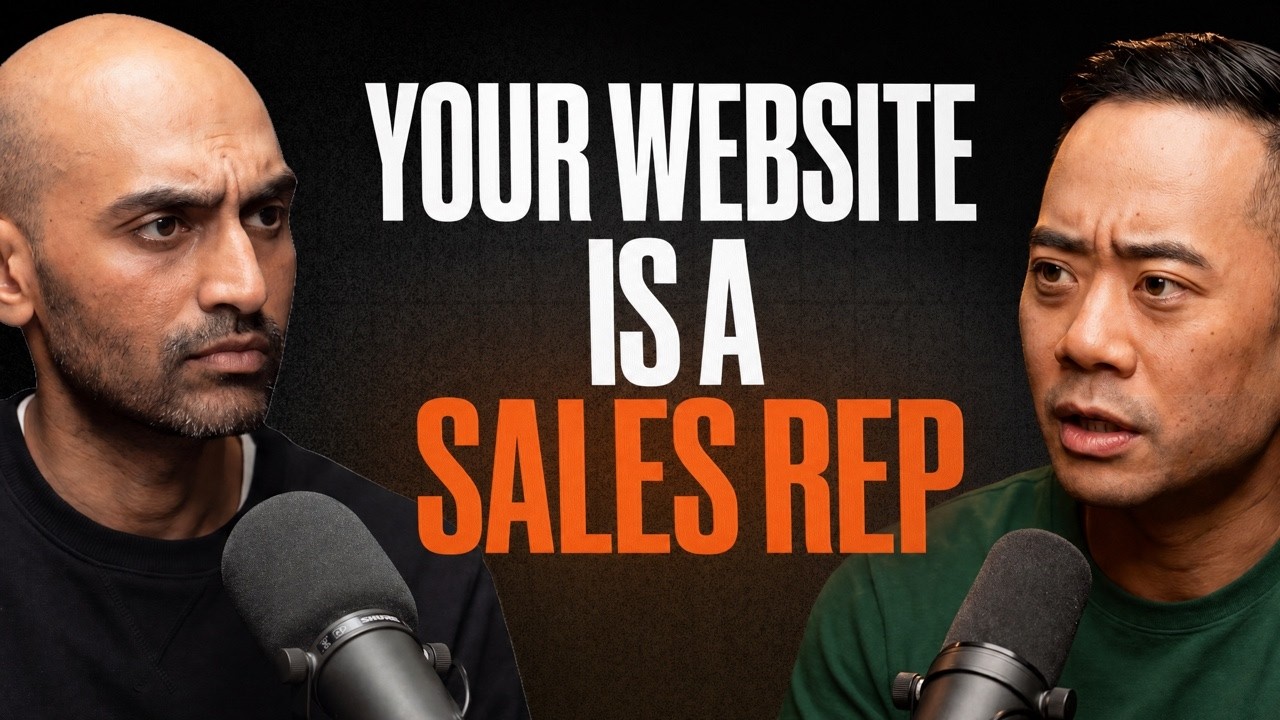
Eric Siu and Neil Patel discuss how websites need to convert visitors into leads before any sales call happens. They cover conversion rate optimization, custom landing pages, and treating your site as a revenue-generating asset rather than just a digital brochure.
Chapters
your website needs to become a revenue agent, right? It's no longer just a brochure. Even if you look at it like what a year or two ago, your website is like a brochure. But now there's, because you can, it can become like a revenue agent, you can, whatever leads it has or whatever visitors are coming in, maybe you can spawn lookalikes off of it. Whoever's visiting, maybe you can figure out, you can figure out how to create, you know, customized outbound campaigns for these people, right? Or you can like create these landing pages that are customized too.
Yeah.
So I'm just like, why, why? We're going to see a lot more of it. Like literally I have a loop running right now for the Single Brain website. It's running CRO tests every week. And basically I said, hey, raise the conversion rate by 30%. So I'll let you know in 4 weeks what happens, but it's actually doing it autonomously right now.
Yeah, I'm curious to see the results from that. And going back to CrowdStrike really quickly, I couldn't resist, but I had to do the math on how much they're worth based on an EBITDA standpoint. I took their last quarter because it's one of their better quarters and I times it by 4. So assume they'll at least maintain that. They're worth 1,541 times profit.
That's crazy. That's crazy.
I myself wouldn't buy this stock. And again, this is not financial advice, but then again, I lost out on 54% gains over the last year. So I'd rather have the 54% gains than my logic.
Yeah. Well, like I think in this case you just have to think about what your edge is and do you even have an edge or not? Right.
Not at 1,541 times profit.
And I'm looking at some stocks right now on my Robinhood trying to pull up. I'm going to show you, like, I think one of them is like 3,000 PE or something like that.
So anyway, dude, and if I take their last month's revenue and times it by 4, so their run rate and take their market cap and divide it by the run rate, they're worth roughly 36.8 times profit.
Hey, SpaceX is up 1.62% year to date. Here, let me show you this, AXTI, and then we can move on.
Wait, before, I had a really interesting investing strategy. Again, I do not recommend this. This is not financial advice. So check this out. So I told you we're a C corp now, right? Did I ever tell you that I changed from an S to a C corp?
I think you did, yeah.
Okay, so for anyone listening, the difference between an S and a C corp is S corp, the taxes flow through on your individual returns, because I know many of you guys do not live in the United States. So if I make $100 in profit as an S corp, call it, I have to pay roughly 40, 50 cents on the dollar to the government, right? As a C corp, the tax rate is roughly 21%, if I'm not mistaken, plus you have to pay state. State taxes are actually lower in most cases that I've looked up in research. I haven't done state by state, but I looked up the states we operate businesses in because you pay taxes based on where you generate the revenue. And it's usually lower. So let's say my average tax rate is 25%. So I ask the bank, because we use debt to grow faster, right? So I ask the bank, hey, we have cash on our balance sheet, but we're not doing tons of M&A right now. Can I just take the cash on the balance sheet and buy whatever stocks I want? Because, you know, when you have debt—
That's your treasury strategy.
The treasury strategy.
Yeah.
They're like, yeah, you know, you may be able to do this. And then we found out that in our terms we can't do it, but we're going and asking for exception. Because I was talking to a few of my executives, I was like, you know what, we do M&A and M&A's not a bad strategy. We spit off cash flow. I'm like, I think I would make more money just taking our profits and putting it into SpaceX for the next 5 years than buying any more company.
Yeah.
I'm not saying I have a bad company. I'm not saying I have bad employees or leadership. I actually think we have a great company, great leadership, great team, but there's no way we're going to beat the returns of SpaceX over the next 20 years as a marketing agency. This is just my take. I could be wrong.
I think you're right.
And I was like, hey, can I just take the profits and buy a lot of SpaceX stock?
Yeah.
And they're like, would you buy it now? I'm like, no, I want more of the pool to unlock.
Release.
Yeah, because a lot of the employees can't sell their shares yet. So I'm waiting for a lot of the investors and employees to be able to sell their shares. Again, this is not financial advice, but in theory, usually when that happens, that puts pressure on a stock which can create downward pressure. And then does that mean if I dollar cost average and I buy SpaceX every quarter, I'm going to buy it and it keeps going up? No, I bet you there's going to be times where I overpaid for it. But again, not financial advice, but over the next 20, 30 years, I believe I'd make a killing over it and probably more than just buying more agencies.
I've tried to get very cute with my, excuse me, my treasury strategies before, but it was a little too aggressive.
So what was your treasury strategy?
My treasury strategy was crypto. It was too aggressive. Yeah, but I do agree, like SpaceX, like that's almost like a for sure bet for the next 15, 20 years.
Again, not financial advice. For sure is not a guarantee.
It's a guarantee for me, not for you.
Yes.
You know what's interesting, Neil? We should talk about this because you just talked about raising some debt, right? And you had talked about raising some money. So I'm going to New York next week and I am going to a couple VC offices to look at raising some money for what we're doing right now. And I was workshopping this with my Fable Five yesterday. I was sitting on my couch, I was like trying to watch X-Men. There's a new X-Men on Disney. It's really good. But anyway, I was workshopping this. I was like, wait a minute. It's like, I'm like, wait, I should raise right now because I have all the talent that's on the bench right now that's ready to go.
Yeah.
And if capital is the constraint for us to move even faster than we want to, why would I not raise money right now? And it's, and I'm like, oh, I'm being a dummy. And then, you know, you want to talk about treasury strategies, things like that. Like that's a whole nother thing, right? But I think what we should talk to the audience about when you should raise debt and when you should maybe even consider VC.
True, we should. And one really quick thing too is, you know, now I'm like, huh, Can I add more debt? Because my cost of borrowing money is pretty cheap. It's in the low 2s plus SOFR. So call it like 6%. What's SOFR right now? SOFR's probably—
4.5?
SOFR rate, it's like 3.46? No, 3.58 now. All right, so 3.58. My cost of borrowing is roughly 6%. Based on today's rate, 6.08%. And I was like, huh.
Can you outgrow that?
I think I can outgrow that. If you look at the SaaS valuations in the stock market, if I hold it for 2, 3 years, I personally believe, and I wouldn't recommend this to anyone else, I personally believe, and I'm willing to take the risk with my own money, if I put it in that, I would clip more than the 6%. And on some of the stocks, I believe I could more than double up my money and that would pay for the debt that I borrowed. And I'm like, cool, I just got some free cash.
Now that's assuming what, but if Neil finds a better engine in his company that's growing a lot faster, of course he's going to put all his money into that.
So it just depends on how fast things are Dude, I told you I took a loan out of my home, right?
This home?
Yeah, the home that I just finished up.
No.
I took a massive loan out on my home.
And this is going into stocks?
Like a solid 8 figures.
Nice.
Like a massive loan, right?
Yeah.
And I just put it all into—
The same ones?
I put one stock.
Is it a SaaS stock?
Yes.
Okay, we'll leave it at that. Yeah. Neil is in this for this, just so everyone knows, Neil's in for this SaaS trade for the next couple years or so because he believes the SaaSpocalypse is overblown, which I can see why.
So I think I'll triple my— I'll double up my money on profit. So I think the stock will go up 3 times. I won't name the stock. So whatever I put in, and you guys can guess how much I have it because I just told you, I just pulled out money from my home. I pulled out 8 figures. I put it into one stock. I think I'll triple up my money. I'll have to pay taxes on it. California tax rates kind of suck. But even then, the long-term gains are, call it 40-ish percent, 39 or 38%, including the NIIT tax, right? The net investment income tax. Plus I have some NOLs, which will help reduce the tax rate. And then boom, use the profits from that, have the mortgage paid off. Although I probably wouldn't pay it off because my rate on the mortgage, it's like 4.5%.
So 2 things. Neil, when he says NOL is net operating losses, The second thing is to do all this, you need to make sure you have a good business first and then you have the optionality to make these moves, right? So that's just not to say go do this immediately or just go, it's not that easy. You just can't go raise a bunch of money, right? But if you do have a good machine, a good engine, then you should consider taking on some more debt or maybe even raising some money. So thankfully for me, I own 100%.
So yeah. Yeah, that's true. I was just like, I'm like going to my wife, I'm like, you know, if we didn't have a home, you know how much more money we would make in our lives without the home.
Real quick, if you want to acquire customers faster and more efficiently this year with the latest strategies and tactics, then check out singlegrain.com. That is my ad agency. Again, www.singlegrain.com. Check it out. And if it seems like a fit, we'll get in touch and help you with a free marketing plan.
And, you know, the feedback I always get back is—
You already have enough.
Yeah, you already have enough. What, what? Okay, if you double the money in the stock, how would our life change? I'm like, well, I can't answer that with a really good answer.
Why can't you just say private jet?
The missus doesn't care for a private jet.
But that's how it would change.
That's true. But in theory, I can just use company profits. We have enough to just go buy a private jet.
Exactly. Your life wouldn't change. You have everything you need. This is the dream for you.
Well, my dream went from wanting to own a private jet, and I almost bought a private jet 2 times. And when I say I almost bought a private jet, I've probably spent 300 hours.
Did you know how many of those pictures you sent me? Yeah.
Looking, going to the shows, negotiating deals on 'em, flying to see ones that I almost wanted to buy. And then my life changed. It was because of something Eric sent me years ago and I was like, dude, I'm really getting exhausted of traveling. It may be better to just not travel as much and not own a jet and spend more time at home.
I did that for a year.
Yeah. And I'm still traveling really heavily, but the other angle that I'm thinking about is, and I know I won't stop traveling, so it won't work, but other than the financial side, I was like, instead of traveling to all these events, maybe I should just go buy businesses that are fixer-uppers, not the ones that are growing fast, because then I can get them on a good financial deal, which makes the arbitrage easier, right? So because I'll break down the economics for anyone who's listening, if you want to end up buying a company, All right? Because you have to equate it with organic growth when you're spending money on marketing. But let's use a company that's doing $1 million in profit because it's the easiest number for me to end up breaking down. If I buy a company that's doing $1 million in profit, you may end up giving them like 3.5 times upfront. So you're getting them $3.5 million upfront and you're giving them the optionality To earn another $3.5 million, if not $4 million. So call it, you pay 7, 7.5 times that company. Assuming you know that company's growing at 20% a year or 10% a year, you could make it grow faster. Maybe after 2 years it costs you 5 times what you paid because of the growth.
Yep.
And you're giving them the earnout based on their original profit, The growth reduces how much your multiple for that business costs. So let's say you pay 5 times for a business. It can still keep growing 20%, but law of large numbers, things usually slow down. You're not going to always keep getting the 20% growth per year, just being realistic. So when you look at it from that perspective, if you just borrow money, to keep this really simple, and you borrowed 5 times, it takes you forever to pay back 5 times.
Mm-hmm.
Depreciation takes a long time depending on which country you're buying it in. Then you got to pay taxes on that money, and then you got to pay it back, and then you got to pay interest on that money. You're lucky if you pay it back in like 7 years, you know? And that means you don't see any cash flow from that business for 7 years.
Mm-hmm.
So then we, Eric and I live by this company called Platinum Equity, and they're known for being buying not necessarily bottom feeder companies, but they're buying more distressed companies, companies that have issue or hair on it, and then they go fix it, clean it up, tear it apart, whatever they need to do. And I look at some of the businesses out there that are for sale. I'm like, man, I can buy some of these businesses for like 2.5 times upfront and pay no more than another 2 times max upfront, but realistically not more than call it 3x, 3.5x, and that's of the upfront. Forget the earnout. I'm just talking about what, let's say I pay 4x upfront. That's actually a better way to put it. Not upfront, sorry, 4x of the total deal. So if the company was doing $1 million in profit, it cost me over 2 years, $4 million.
Mm-hmm.
And then I would be able to ink out instead of a 4x, Call it a 3x or a 2.5 because of the growth that I can get on it. At that point, even though it's not sexy, the cash flow is just really well and it doesn't take long to just pay back. So you just cash flow really well.
And then you could take on more debt.
You could take on more debt, do more of that. And then I wouldn't have to travel as much because I thought about just doing that in all the countries that I traveled to. And I'm like, huh, I probably wouldn't need to travel as much. But knowing me, I would do both and try to get even more growth.
Well, you know, Syed was very— our friend Syed was very wise about this when we did the event a couple years ago at the Beverly Wilshire. He's like, why do all this content when I could just buy other businesses? And that was very good. And then when I did an interview with somebody else and they said they got all their deals from content, turns out that wasn't—
Does this person live in Las Vegas?
Well, now I'm making it obvious, but it's, I don't believe that you can get a lot, most of your deals from content. I think you want to do well, you want to just keep growing, you just, you buy companies and then you can figure out how you want to financially arbitrage this. Yeah.
with that person. The problem with their deal, they're going to get all the deals from content. They're just like, yeah, I'm going to get people to just give me equity. I'm like, no one's going to give you free equity of a really good business. I'm like, I don't care how big your brand is. It's very rare. Yeah.
Well, the thing is, we'll just, there's, there's not a lot. I'll just leave it. I'm going to leave it alone.
Yeah.
Continue.
Continue. They switched the business model from going and buying to doing other stuff.
I don't think there's much buying anymore at all.
Yeah, correct. Or it could be other types of businesses like—
But yeah, no, they have a good model.
Real estate or whatever.
They have a good model. It works for them right now.
So it is— Yeah. And good for them for making money from it, right?
Yeah.
But yeah, you know, and it goes back down to, do you do debt or do you use venture capital? I think when you use venture capital, you have a lot less limitations. But at the same time—
You said a lot less? Oh yeah, bank will give you more limitations.
No, I mean, sorry, when you use venture capital, you can do a— you have a lot A lot of limitations, different limitations than a bank, but they both have their limitations. You can't go and raise venture capital. I was just talking to one of my buddies about this.
You've done both. Kissmetrics?
Yeah, I've done both, but there's limitations on both. And I was just at an event. My buddy's company spits off a ton of profit. Their growth isn't as good anymore. But when I say they spit off a ton of profit, you're talking about like a billion-plus valuation company. I wouldn't say they do $100 million in revenue, Let's call it, they do more like close to $80 million a year in profit. Forget revenue. Revenue is much larger. But because they raise venture capital, they can't just take the balance sheet and just go buy a ton of SpaceX stock.
How much does he own?
Between him and his co-founder, close to majority. But even then you still can't, 'cause there's limitations in the contracts when you raise venture capital. But on the flip side, with private or when you, with bank debt, There's also limitations. They don't want you to focus purely on growth. They want you to focus on responsible growth. They want to profit, making sure all the numbers are good. Sometimes they restrict you on paying yourself. Well, venture capital's like, grow, grow, grow. It's okay if you're losing, you can still pay yourself well. We're not going to handcuff you as much.
Well, pay yourself well is like a founder salary most of the time.
No, they get paid really well.
Well, you can take secondaries. You can take secondaries.
Yes. Or let me rephrase, if you're a startup, A startup raised less than $50 million, it is like what you're saying, like it is, you know, you're paying yourself decent, but you're not paying yourself extremely well. But the companies that have raised like $300, $400, $500 million, billion dollars, a lot of the founders are making millions of dollars a year just in salary.
Remember, remember that, remember that group, the video chat thing that was big during the pandemic where the founder took like $100 million in secondary, so he just like sold the, just got rid of the business.
I know what you're talking about. Yeah. It was used for a lot of live events and stuff like that.
Yeah, yeah, yeah, yeah, yeah. And then he, then it like, he, he raised money.
He had like a billion dollar valuation or something crazy.
Yeah. He raised money and took $100 million in secondaries.
Like, good for them.
Good for him. Yeah.
But I think they would've done better if he just sold the whole business at that point and just cashed out.
Yep.
Yep. Same with like Clubhouse. Remember like LinkedIn or whoever wanted to buy them? They should've just sold the whole thing. It's like they just got too greedy.
Yeah, exactly. So anyway, that's it for today. We'll talk to you later. Goodbye.









