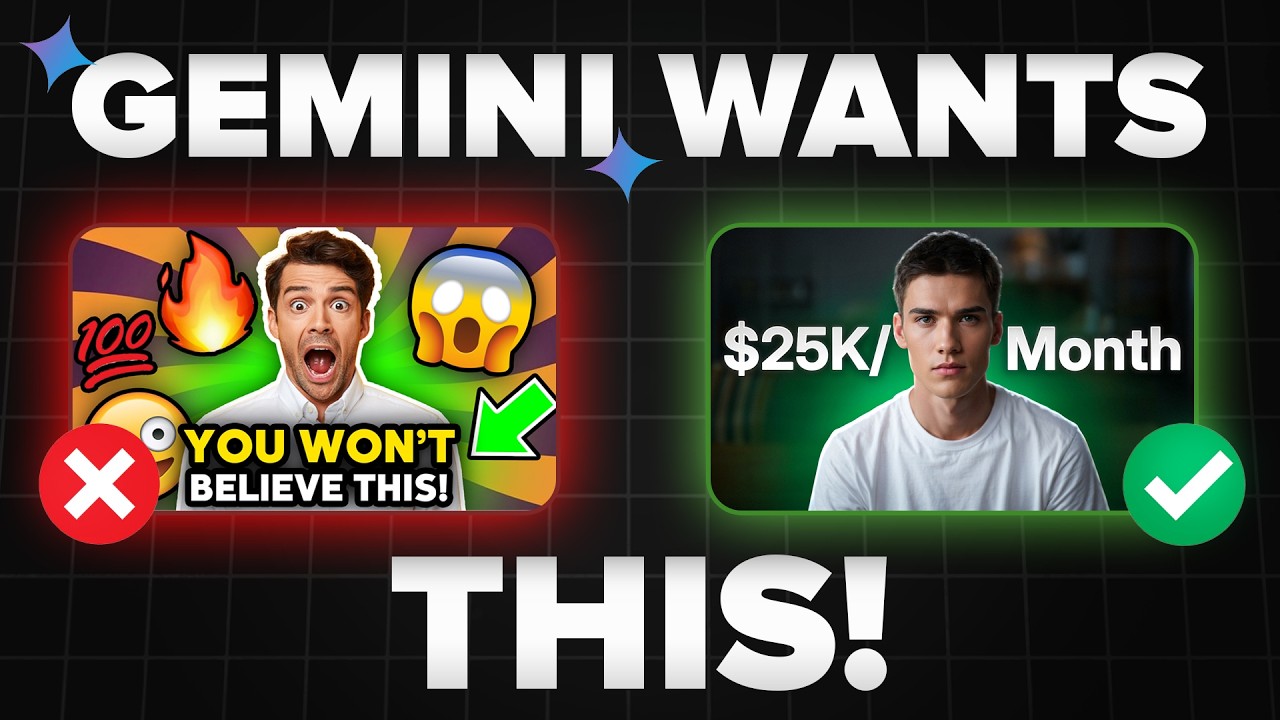
Eric Siu and Neil Patel break down YouTube's new Gemini AI algorithm that prioritizes viewer experience and relevance. The update favors factual details, descriptive thumbnails, and emotion-matching music over flashy edits, potentially giving smaller channels a real shot at growth.
Chapters
YouTube is now in easy mode for new channels in 2025. YouTube apparently made an update recently, so they now run on a dual algorithm system. So they have the old model plus Gemini AI. So Gemini prioritizes viewer experience, relevance, fact-checking, and emotion for YouTube. And so practical strategies now, it's saying that you want to use Google's ranking signals. So it says Use— here, I'm just looking at it. Use Google ranking images and thumbnails. Add factual details, names, dates, locations, and descriptions. Match background music to intended emotion. Encourage context-rich comments by asking questions. So basically what it's saying is these fast edits and all these things and the suspenseful music and all that, Gemini can now detect that and that's not what it's looking for anymore. So Gemini is running quietly in the background. It's learning from videos, audience patterns, and after a year of training, Gemini now helps decide what YouTube recommends and ranks, working alongside the original algorithm, meaning that there are 2 now, which is what I said earlier. And they haven't really publicly announced it because they're still testing it. But basically, and I'll wrap this up here, so focus shift is now on viewer experience. So unlike before, it's not about flashy editing or transitions. Gemini focuses on individual viewer patterns. So what people have watched, what they're evolving to, and what they're likely to watch next. And it creates a profile, right? And that means that if you're a smaller creator, you want to get into YouTube. Neil and I have been talking about YouTube. Quite a bit. Smaller channels can now compete with larger ones by tailoring content to Gemini's priorities. So, haha, that means our marketing school YouTube channel should do better theoretically. And you know what's funny, Neil? My mom kept telling me, she kept asking me why I wasn't getting any views. I didn't realize she was talking about my my marketing school channel or our marketing school channel because each video before would get like twenty to thirty views. And really, yeah, she yeah. But like now it does better. But the content that we have, I think if it's going to go down this path, this algorithm, I think it's going to do a lot better. So it says success. success depends less on entertainment value now and much more on how well the content matches what Gemini expects and verifies. So let's talk about this.
Keep going. I had to send this text. Someone screwed up on my headline. They just published my video on ChatGPT.
Now Neil's pissed. So I know how—
Yeah, now I'm really pissed.
So Neil's out of it now. So I just think my reaction here is that if people are watching deep content. So let's say when I say deep content, like, um, like a screen share for 30 minutes or an hour or something like that. I've seen some people do it well. Um, I know there's this guy, uh, Wes McDowell. I think he does these, these, these 20 to 40 minute videos. Um, and I, I like doing these, these, uh, screen share videos where I like talking for 30 minutes or so. And, um, I think the thing to understand is that if you have a lot of people leaving comments under saying, I don't know why this isn't getting more views, That means your video is probably really good. It's just the algorithm hasn't picked up on yet. And if the algorithm's actually getting smarter, this means that smaller creators are going to have a shot. And I do think my bet in the next 6 to 12 months, if this algorithmic change is true, the Marketing School podcast channel is going to grow a lot faster. And it's about damn time.