Hope for Healing: Constance Lewis — Why Protecting Low AMH Eggs Before IVF Matters
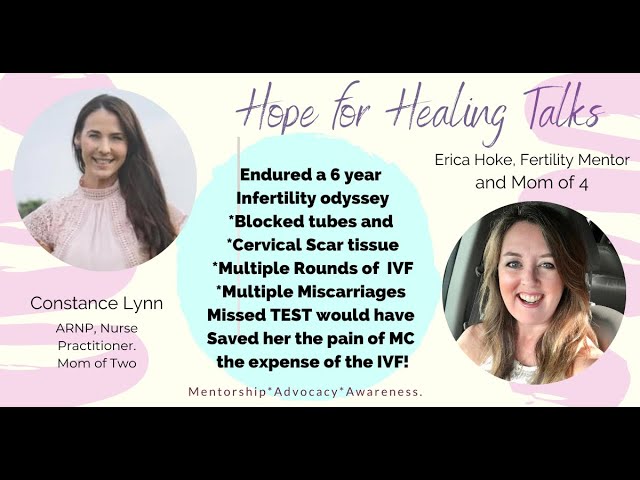
This content was created by Erica Hoke. This content was uploaded by Erica Hoke. This is a YouTube interview titled "Hope for Healing: Constance Lewis — Why Protecting Low AMH Eggs Before IVF Matters" (posted May 24, 2021). It is a recorded live conversation (with technical difficulties) between host Erica Hoke and guest Constance Lewis (a nurse practitioner). They discuss Constance's infertility journey including long-undiagnosed endometriosis, very low AMH, multiple IUIs and IVF cycles, miscarriages, discovery of a balanced chromosomal translocation in her husband, the financial and emotional costs of fertility care, and lessons about patient advocacy (checking your own lab results, seeking second opinions, and genetic testing before IVF).
Chapters
Okay, all right, after some technological difficulties, we are here with, um, Constance Lynn and Hope for Healing Talks, and she's going to tell us about her journey, which is just an amazing and incredible story that you all need to hear, both of hope and of caution. I think that she would agree with that because Constance happens to be a nurse practitioner, and so she is medically trained and has been, you know, she's medically trained and she went through the system as a trained professional and she still had problems getting the proper care that she needed. Things were overlooked that shouldn't, that should have maybe been addressed ahead of time. And so these are really important things to remember when you're talking to your to your doctors and when you're advocating for yourself. So what we're here to do today is just empower you to speak up for yourself and also play a role in your own medical care. So I want Constance to tell you a little bit about herself, and then we're going to go into her story and questions. And if you're watching this in replay, go ahead and drop your questions and comments here. We'll be able to answer them after the fact. This was originally meant to be a live. Um, a live interview, but we had to record it. So if you have some questions, go ahead and drop those and we will take care of them after the fact. Okay. So thank you so much for dealing with all the technological issues that we had today. And thanks for sharing your story. It's such a powerful one and so important. So tell us about your life now, how things are with you now.
Yes, thanks for having me. I'm excited. I'm Constance Lewis and I am a nurse practitioner, um, in the Sarasota area. And I have been a nurse practitioner for almost 7 years. Uh, before that I was a NICU nurse for 12 years, kind of all around and in the area. I'm originally from Virginia and moved to Boston for a little bit and then came down to Sarasota. My husband's originally from Florida, so that's how we ended up here and, um, worked in the NICU. And right now I just work 3 days a week. And I love being a nurse practitioner and I especially love helping people on their journey because I've had so much experience with it. I feel like I was meant to be there for them.
So that's amazing. And I'm just going to go ahead and spoil it for everybody. You have 2 beautiful children.
I do. I have 2 really beautiful children. I have a 3-year-old whose name is Miles. We call him Miracle Miles and I will explain why later. And then we have a second Daughter, her name is Mariah, and she just turned 1 recently. We were busy.
Yes, very busy household. So take us back, Constance, to, um, kind of the beginning of your infertility journey and, um, how things— how, I mean, hindsight, your hindsight is 20/20. You might not have realized it was the beginning of your infertility journey, but when did things start to start to appear to be going sideways for you in that area?
Yeah. So 29, my husband was residency. We waited, we took the longer route for educational purposes and wanted to have a stable lifestyle and all that stuff that a lot of women actually lately are doing. They're having children later on in life. So we did that and I had my IUD removed and was really excited, had normal cycles my whole my life. They were heavy and extremely painful, but they were normal every month. And so I thought, you know, after the first month, I thought, this is it. I'm excited. We're pregnant. This is, you know, how I'm a Type A personality. So I expect things to come. I don't have a lot of patience. So I was like, oh, I said to my husband, I hadn't even missed my period. I'm 4 weeks pregnant already. I mean, you know, this is going to be great.
You know, snap our fingers and it works.
That's how it works for people, right? So I know we started at age 29 and moved from residency from Boston down to Florida. And, you know, it took a while to establish care for, you know, GYN care just from the move and starting my new job as a NICU nurse and kind of feeling out doctors and things like that. So after a year— that all happened in a year. So after a year of trying, I was kind of like, well, this— there's got to be something going on, right? Because it's not happening. And most people who— all my friends who I talked to, it was like on the first try or within 4 months or at least by 6 months. So like something's going on here is, you know, that where it kind of tipped out.
Yeah. And so you had your IUD removed, you tried for a year and then you're not getting pregnant. So what's your next step at that point?
Yeah. So, I mean, as you know, they say in infertility, yeah. A year is where we're not going to do anything for you, you know, unless you're 35.
So, right, right.
That's like the standard. Um, and so I'm like, okay, well, I'm not, I'm not 35, I'm 29, now 30. So, you know, let's just, oh, just relax, have a glass of wine, you know, all the stuff that everybody tells you, right?
Right.
You're too stressed, you're thinking about it too much. So, um, very helpful advice too for all of us. Yeah.
Yes.
So at a year I was like, okay, I had an OB-GYN. I'm like, I had a conversation. I said, you know, I think, you know, she's like, let's go ahead and order some blood work. The very standard for most women. And most women take on that responsibility of fertility, mostly, you know, it's our job to be pregnant. It's our job to have all the tests, most of them anyway. So it's kind of that burden that you burden slash, you know, gift that we're given as a woman, right?
Despite the— yeah, despite the fact that almost a third of infertility is caused by male infertility.
Correct.
Right.
Yeah. So, um, we did blood work and, um, it, it, um, and you know, the, the blood work with the HSG or the hysterosalpingogram was kind of the scheduled step for us, right, along with the semen sample. And we kind of all did those kind of things. And the semen sample was normal. And the bloodwork came back and I was told by my practitioner that everything looked— levels looked normal, everything looked normal at that point. And I didn't— and I was actually in nurse practitioner school at this time, right? I was on my last rotation and I was actually in my infertility rotation, GYN rotation through it. So I just said, okay, my blood work looks great. You know, I was going to look at it myself, but I just wasn't in a hurry. I was told it was good. I was like, okay, this is perfect. And so a couple of weeks went by.
And so let me just ask you, do you remember— it's okay if you don't, but do you remember what that typical blood panel was that they—
Yeah, I do. So like FSH and LH level, luteinizing follicle stimulating hormone, obviously the day 7-day post-ovulation, um, progesterone and the AMH level, which is the anti-Müllerian hormone, your estradiol. And, um, we throw in testosterone. I think I had a testosterone, a DHEA, things like that. Just the basic prolactin, um, things like that. So those were all the blood work that I had done, right? Yeah. So I said, all right, great, I'm glad everything's normal, which is sometimes good and bad because you're like, oh great, everything's normal. But then you're like, well, what's going on?
If everything's normal, what's going on?
Exactly.
Yeah.
I think it was about 2 weeks later that I happened to just— I was like, oh, let me— you know, I was really learning about the lab levels in my fertility class. And so I'm like, let me just go. And we were diving deep into that. So I'm like, let me just go into my lab, my patient portal, and actually take a look at my own lab level. And I saw my AMH level and I was in shock because it was not normal, not even close to being normal. I mean, 1 and above is considered— that an AMH level is basically a level that tells you how many eggs that you have. I mean, it doesn't give you a specific number of how many eggs, but it says you have eggs in your ovaries left, you know, because we know we're born with the number of eggs that we're given our whole entire lifetime, right?
Right.
This number is indicating that you have eggs left. So I saw that—
Yours was what?
Zero. It was 0.13. So 0.13. It wasn't even less than 1. Less than 1. Dramatically less than 1. Right. So I was in shock and I just, I was actually at my clinical, like I was at, sitting there in the doctor's office nurse's station with my my preceptor, and I just, I couldn't move, and I was just staring at the computer, and she was—
did it feel like someone, like, it must have felt like a physical blow at that point, right? Like, you're trying to— yes, are you trying to hold it together?
And yes, trying to hold it together, trying, like, I, like, it was because I knew what it meant, right? I knew the ramification, but I also, to be professional, and I shouldn't have looked at it while I was at work, but we were just talking about it, not at work, but I was clinical, we were having a discussion about it with my clinical preceptor. And she's like, yeah, you know, let's look. And then it was just like, we both kind of looked at each other. So step one is, told I had normal blood work, and I didn't have blood work. And granted, I took a look at it myself. But if you— if it happened to be that I was in school, so I knew it was abnormal, you know, if I didn't take that step to investigate, I would have gone on with not knowing it wasn't abnormal.
Right. Right.
So that was—
yeah. And we advocate a lot in here for having copies of your own blood work and being responsible for that, looking at the ranges and seeing if you can identify anything that is outside of the range.
So yeah. And I, and as a nurse practitioner that deals with the time, I want you to do that. I, I do not find it offending and I, and I'm not intimidated by that at patients come prepared with blood work, with questions, and dive deep into it. It's a great thing. So if your practitioner isn't like that, that's not the right practitioner for you.
Yeah. That's amazing. Collaborative care.
Yeah, exactly. So the HSG or the histosalpingography, still, I'm still moving forward with this journey because you still got to check off all the boxes. I mean, there's a list of diagnostic tests before you get an actual diagnosis, right?
Right.
Even though we were pretty clear of what the diagnosis was at that point. Yeah. No, but at that point we're like, okay, well, so I went to go have the HSG done and the radiologist couldn't pass the catheter through my cervix and it was an extremely painful procedure. Um, you know, just— I— anyone's ever done it, you know, you know, most people, I think probably 50/50 if I had to estimate, or do fine, they have no pain. And then people, it's just super traumatic and the pain is extreme. Um, and I was one of those patients, but he couldn't get the catheter in. So he's like, well, you know, and he was wonderful, they were wonderful, but he was like, you know, I do these all the time, it's not like I haven't done them, but you know, this catheter won't get in, I can't even do the dye test. For you, you need to go see your OB-GYN and see. Sometimes what they do is they have the OB-GYN pass the catheter and then you drive back to the place to get the HSG, which is a little crazy, but that's what they do. So I went to my OB-GYN and he couldn't get the catheter in either. So long story short is that I had a lot of scar tissue in my cervix. So I've had pelvic pain all my life, probably. My periods painful and extremely heavy and missing work. And I started birth control at an early age to control the heaviness and the cycles so I wouldn't miss work. I would bleed through my clothes. It was a lot. And I was misdiagnosed multiple times with, oh, you have irritable bowel syndrome, or you have bladder interstitial cystitis, or you just have cysts on your ovaries. So come— short story short is basically Long story short is basically I have endometriosis and we found that out through— so I have a low AMH and endometriosis. So we found that out through a laparoscopy test that my physician said, "I can't get in through your cervix. This is not normal. There's a bunch of scar tissue in there.
Why?
I don't know, but you've had this long history." And I was new to this OB-GYN, so he investigated for me. This was the good thing, right?
Yeah.
Right. And took me to surgery basically He was like, okay, well, you have stage 1 and 2 endometriosis. Your scar tissue in your cervix was insane. It was like an S. I had to clear it all out and get all the lesions. My left ovary was attached to my bladder. And so it was a pretty big surgery. Right.
And I want to just stop you because I want to circle back around to the very beginning where you said, normal heavy periods, lots of pain and things like that. And, and what I want to do is change the narrative that if you're having that much pain, if you're having that much discomfort during your cycle, that's not normal. That's not a normal cycle. That's not normal pelvic— to have pelvic pain all the time. That's something that requires additional investigation and additional attention.
Yeah. I couldn't have a bowel movement or urinate in the morning without pain. And that is not normal. And I saw multiple specialists. Until I found my OB-GYN that finally said, this isn't normal. Let's take you to surgery.
And you're 30, so you've been menstruating for at least 17 years, 15 to 17 years, right?
Yep.
Wow.
And, you know, endometriosis has become more popular, right? Right. Um, and the other thing about it is too, is that if you read the studies about endometriosis, it go— the average, it goes undiagnosed 9 years. That's the average. I mean, now I think it's getting better, but back 6 years ago when, you know, when I was doing a lot of this research, 9 years. So, so, and that's exactly how long it took them to diagnose, right. For somebody to finally say, okay, let's take you to surgery because, and not that I'm saying everybody needs to go, right. You know, but yeah, you're right. It took, and, and, um, if you actually look at the studies about the typical endometriosis patient, which we're not all typical. So we don't always look at that, but what they say in medical school or nursing school, if it's a horse, it's a horse. It's rarely a zebra. Right. Yeah. You know, white female on the, you know, athletic, thin side, active in school, heavy, you know, there's all go along with the, with the statistics that come out there. So, you know, that was another part of it. So it got missed. For 9 years.
That's incredible.
Irritable bowel, I was treated with it. You know, they were like, you're just, you just, it's all, it's in your head. So it makes you feel crazy. Like you're crazy.
And now maybe a little angry, right?
Yeah. That too, for sure. Yeah. Mm-hmm.
So yeah.
So once that came out, it was like, okay, well you have endometriosis and you have a low AMH level. It must be on you. Like this is, this the infertility, you know, you and that, hey, you know, a lot of women get pregnant after this procedure, this laparoscopy, right? They clean everything out, they take out the— straighten my cervix. Now we can at least do IUIs, that kind of stuff. Minus the fact that your AMH is level, you know, what's the next step?
Mm-hmm.
So on to the next step. Decided to do some IUIs with Clomid. Okay. Though in my practice, honestly, if I see AMH that level, I will say to the person, you need to find a fertility specialist now.
Yeah.
To go through IUI is something that I wouldn't recommend. And that's just because the success rate of, of and the money that you're going to spend on it with my AMH being that low is, is, you know, it's just not going to happen for most.
Very similar. Yeah, for us too. We just opted out of that.
Right, right. And I don't know, I thinking back, I don't know why it was just like, okay, well it's cheaper and it's just the next step and let's just try it and see. I, And I had 6, okay, so that's another problem right there. Right, right. I think that if I would have known what I know now, obviously 2020 is hindsight, I would have maybe only done 2 or 3 and then kind of been like, all right, like, listen, like, my AMH is so low, what's the point? What are we doing? But I spent them 2 at my OB-GYN's office where they're not as controlled because we're not able to do all the like trigger shots and the ultrasounds were just basic cases. Um, but even at my infertility— that I finally got a referral to my fertility clinic after the second IUI, they still performed 4 on me with trigger shots. And after they did a follicular count on the ultrasound that only showed I had 6 follicles.
So, okay. So, but you ended up with 6 if I remember right, if my notes are right, because you switched doctors, right? You had 2 in the office and then you went to a one fertility doctor and then you went someplace else, right?
For a second opinion. I actually hadn't gone someplace else at all yet. I was still with the first fertility specialist for my two IVFs. Okay.
Yeah. All right. So we go 6 different times, 2 in the office, and then we moved to a reproductive endocrinologist and now we've completed 6 IV— 6 IUIs. Some with trigger shots, but all of them unsuccessful. Correct. So at this point then you're like, clearly we just need to move on to IVF. This is not going to work out for me. And then did you switch doctors at that point then?
Not yet, honestly. So where we live in Sarasota, there's a small handpicking of fertility specialists.
Yeah. Um, we're not in a metropolitan area, so Right.
I chose to not go with the local person and I chose to go with somebody up north in Tampa. And that— I think there was like 2 in Tampa at the time, one in Fort Myers and then one in Sarasota. So, you know, I kind of just went with word of mouth and other patients' success stories as people do. Yeah. So we did those 4 IUIs with them and then we said, okay, we're going to— and they recommended, okay, you need to move on to IVF at this point. So that's what was next. So, you know, first IVF, I was— I looked what I expected to look like on an ovary stimulation round. I had 6 follicles that were stimulating and looking good and then went in and they got total— they did get a total of 6 embryos out.. And we did, we had opted to not, we should just do the fresh transfer, right? So basically they get your embryos and then the next, and within 3 to 5 days they put 1, 2. So we opted for that. And we put in, so they don't even let them sit. So if you know a lot about IVF, sometimes if you're going to do genetic testing on them, then you will obviously, they'll, they'll grow them to the blastocyte stage usually, which is day 6. 5, 6, then they'll take a sample and they'll send that off to the lab to get tested. But we didn't even do any of that because we were— they were just like, no, let's just fresh transfer. Let's get the eggs out, let's put the sperm in, and then day 5 we'll put the embryo in. So that's what we did.
Did you feel like you were being pushed in that direction, that that, that was the, the right thing for you to do, or did you just— yeah.
I don't know if the right word would be pushed, but it was just, I, it was just like, this is what we do. It's like standard.
Okay.
Like this is the standard. This is the norm. This is the standard. You know what we do.
No reason to do any testing. Right.
Right.
And you guys are young.
You guys are young. Yeah. I mean, I think we were 32. Yeah. Not, not over 35. So.
Right. Right. Yeah.
And nothing— go ahead.
So I was just going to say this whole time, like initially way back when you had your husband tested, but nothing has been tested for him again up until this point.
Nope. Just the semen sample. And genetically through our family, we don't have infertility at all or any genetic conditions that would— you would think that we would need to be tested at this point. So yeah. So that wasn't— that was just like, oh yeah, you know, clearly it's on you, you're the problem, you have a low AMH, and then you had all the scar tissue through endometriosis and inflammation and infertility too as well, right? So they're like, it's all you. We're like, all right, you know, I took the blame just like most women in this, in this stage take.
And that's a really heavy burden to carry too.
It is. And we— and we— because our whole life that's what we're meant to do, right? Women are meant to carry the babies and and we're meant to do that. So that's what we're supposed to do. And we choose to take that burden. It's not like I isolated my husband out saying, right, you know, and he wanted to be a part of that. He didn't want me to feel like it was all me.
Right, right.
I have a great husband. He's super supportive and he's like, give me some of that, you know, and we do, but we're just, you know, we're women. We take on all of it.
It's really hard.
It's hard. You feel a little bit alone in that. Instant. So yeah, so I woke up from the first IVF. They're like, you, you know, you did great, you got 6 embryos, we're gonna transfer 2, uh, fresh, fresh in day 5. Okay, great, come back. Okay, I come back, they, they put 2 in. There's not the standard of care, as you may find out now, because actually that increased your chance of miscarriage. We, we see in the studies that 1 is better Okay, so, um, 2 were transplanted, and then I got a positive HCG, and, uh, obviously I'm ecstatic. This has been 4 years of this, maybe 3, 4 years, estimating my timeline, and finally it's actually happening. I just forked out all this money, right?
And the pain and the emotions, and right, yeah, and now you're pregnant.
I'm pregnant. I'm totally pregnant.
Yeah.
So excited. So the weeks move on and you know, you're nervous and you're like looking for bleeding every time you go to the bathroom. Everything. And being a nurse practitioner, that sometimes doesn't help because you know a little bit too much sometimes, you know, doing all my shots and taking all my pills that you do with IVF. And at this, we did between like 6 and 7 weeks, you get an ultrasound. With the fertility clinic. It's normal. So I went up there, Andrea and I go, we're super excited and we were just like, show everybody like the first ultrasound. And, you know, it's not normal. There is a, there is, you know, a yolk sac and there is a fetal pole, but it's extremely small. It's not really heartbeat. So, you know, obviously right away I knew what I was looking at because at this point I've been in women's health, you know, working in the, in the field for a while. So I know, right? And, you know, devastating. Obviously, you know, the doctor's trying to say, well, you know, it's still— it can be still early, you know, you could have implanted later, you know, probably not, but, you know, that whole thing. So I left devastated. I remember the feeling to this day because it was the first— I mean, all the other blows came And they went and we— but this was— this one was tough. It was a tough one. I just sobbed the whole way home. I didn't want to talk to anybody. I think I sat on the couch for 3 days and just didn't want to talk to anybody.
It was rough.
Yeah. So, so then I ended up having to have it. Was that when I had to have a DNC? Yeah, that one I had without a heartbeat, irregularity, you know, all that.
So I'm sorry, we're having— we're still having technology problems. So can you repeat that? I think that you cut out for just a minute.
So yes, so I, I had the DNC. Yeah, because the fetus did grow, but grow without— grew basically a little bit without a heartbeat and it wasn't passing. So around, I think we opted to give it making sure. And I think around 8 weeks is when I had the DNC from my OB/GYN, right? So then we were back to square one, and I still had— well, so they ended up letting the other embryos grow out, right, because of the timeline. And so 2 of them we had lost, didn't end up even making it to day 6. And then I had 2 left at this point. So they said, okay, you know, when you're ready, we'll start, you know, a frozen transfer for this. And I said, okay, great. So did everything, all the shots, all that kind of stuff. Um, second transfer of the frozen embryos I had, uh, went in. They implanted 2. Um, day 12, positive HCG. Hey guys, I'm pregnant! But I was still cautious. I was like excited, but like, okay, like I'm getting pregnant, this is great, you know. But yeah, so I hadn't even got a week. I think it was like 6 and a half weeks I had an ultrasound. I hadn't even gotten there yet. And I just happened to pee on a pregnancy test in my office because we had a patient there that it was negative. And it was like, wait, she thinks she's pregnant, but hers is negative. Is it— do we just have a bad strip of HCG or, you know, in-office strips? Because that can happen. We just have the basic strips and they can go bad. So like, oh, I know I'm pregnant. I'll just go pee on one and see. Right. It was nothing was there. And I was like, oh, maybe these really are bad. No, it was basically a blighted ovum. Then, you know, I ended up miscarrying after I stopped the progesterone on my own anyway. So, yeah. And my, and my HCG at that time, which went from 30 to like, I think it was like 2,800. And that was kind of indicating something wasn't correct as well. But they were like, no, it looks good, you're fine. And then than the, the self, you know, the miscarriage.
Yeah. Okay.
So that's my first IVF story. And my second IVF, I would say—
so now we have 2 miscarriages, right? 2 per 2 IVF procedures and 2 miscarriages.
Yeah. 1 IVF for 2 miscarriages.
Right, right, right.
Well, the transfer.
Yeah.
Yeah. So what else do you do? You keep going, right? You want a baby, you got to keep going. So another IVF round. This time I had less follicles. I think I only had 4 on the ultrasound and they're like, oh, you're not doing great. Um, even be your last IVF anyway because we know your AMH level's low. You may not even get your own eggs anyway again after this. So you can go for it if you want, but you might not get good results. And I was like, okay, well, I mean, I'm, I am in the middle of all these shots. You know, I'm already— tomorrow's supposed to be my surgery day and you're telling me I can do it if I want. It doesn't look great, but it's up to me, right? So yeah, so I went for it and we got 2 embryos. And they said, you know, let's, let's see if they grow at least because, you know, you're the other ones, you know, they— we were not going to do the 3-day transfer. We're going to do like day 5 or 6 transfer just to see if they even— um, I go— this is like going into the weekend. I think it was like coming into the weekend. It was a Friday, I remember, and I hadn't heard from anyone yet about the embryos. And so I'm like, well, maybe they're giving it another day. It's day 5, I think, or 6. And I'm like, I haven't heard from anybody. And Finally, on Saturday, I called the emergency line and I said, I haven't heard from anybody. Nobody has called me about anything. And they were like, okay, well, we're going to have the doctor call you. And I was like, oh, okay. And then an hour later, oh, none of your embryos made it. They all didn't make it. And I'm like, how long have you known this? And they're like, oh, because it's now day 6 or 7. Right. I could have got a call 2 days ago. Like, right. You know? Yeah. So that happened.
Um, and devastating. Devastating.
Cause I didn't even get to try that time, you know?
Right.
So finally they're like, yeah, well, because you've had, we're really sorry that happened. You know, we, the staff should have notified us and we should have, you know, whoever, somebody should have told you.
Right, right, right, right.
So then, um, They said, you know, it's interesting that you've had 2 miscarriages now and then you had these other 2 embryos not make it at all. So there has to be something going on, maybe chromosomally. And I said, well, we're going to do a chromosome test on you and your husband. I said, oh, okay, great. More blood work. And, you know, and at this point, again, I'm not fully into nurse practitioning and fully into infertility. So I'm like, okay, chromosome test. I mean, honestly, we in our office, we don't really order chromosome tests them to MFM, maternal fetal medicine, or to a fertility specialist too, right? Because we just don't want to order the wrong thing, or, you know. So I didn't really know. I'm like, oh, we should get our chromosome tested, right? No idea. Yeah. So my husband goes and gets it done. I go and get it done. And then 2 weeks later, doctor tells me that there's something wrong with my husband. And I'm like, oh, thanks for telling me. So my husband has something called balanced translocation. And Basically, without getting too genetic scientific about it, is basically you have a DNA chain and two of the DNA chain switched places. So what that means is that he's balanced. Obviously, he's thriving. He's a man. But 50%, well, technically it's like 50% of his offspring is not compatible with life. And then another 25% would have a significant— or it's like 25% is not compatible with life. 25% would be born with a significant disability if they were born. The other 25% will be a carrier for the same gene but be normal, and then the other 25% would be normal, which all equals 100. Okay. But we went through all of this stuff, this testing, to tell us that very crucial piece of information, right?
Mm-hmm.
So, so what would you—
right, so let's not skip over this, right?
I mean, we would have known that he had this. We would have known that he would have definitely had to freeze our embryos and do genetic testing on them because, because that percentage of how low my egg count was and how little of eggs that I got, we would have known that the percentage of having one healthy embryo was going to be extremely low. So if we would have tested all those embryos, we would have known why I kept having miscarriages. And why those embryos weren't growing normally, because they would have come and they would have come back saying that they were either— they had this translocation, right? And that, and that's evident story. I'll tell you later how I know that, um, that would be that way. So that's cool. So instead of ordering those before we even started IUI, or I— okay, maybe not IUI, but definitely IVF, right?
Right, definitely at that point. Definitely, especially with your low AMH, because I think that that's the critical piece that everybody needs to understand. If you have low AMH and you're going to IVF, you're not— it's not— your eggs are not plentiful, so you're going to have to do whatever it takes to protect them. And, you know, I, I'm not saying, you know, I'm I hope that this doesn't come across offensively to you. I'm sure that you, you know it, but I just want to say out loud that that doctor robbed you of having, having the use of your eggs by not genetically testing them.
I agree completely. Absolutely. Yep.
Yeah. And I'm so sorry that that happened to you because that's—
yeah. And it's, and to go through the two miscarriages, like, right, you know, that hope that you get, you know.
Absolutely.
I would have like, if they would have said, here's the paper and none of these eggs are normal, so we can't put any of them in anyway, right? So that would have been devastating too, obviously.
Right. But in a different way.
In a different way. Yeah. Yeah. To go through the actual like, oh my gosh, I'm pregnant twice, to not really be pregnant. And then the first time it was, so the second time was it miscarried itself, you know, and it, but the first time like there was a fetus there, you know, it was there, but it was just not compatible with life. And that was the problem.
Right.
So yeah, it was, that was when I was like, I'm done. Like, I can't stay here.
Um, not to mention, not to mention, but not to overlook the amount of money at this point that you have both invested into this whole process.
I mean, honestly, at this point we're $150,000 in at this point. Which is— Amazing. Yeah. And I'm very blessed to have a husband that works in the field that he works. And, you know, even still, I mean, we, we don't make that much money, but I'm blessed to be able to put it on a credit card, to move things around or take out a little bit of equity or something. I mean, in the state of Florida, fertility is not covered unless you have an employer that chooses to put it on their insurance. And for people to to afford that is— it's impossible for a lot of people. And I'm very, very lucky and very blessed that I could at least in over 2 years pay it off, you know?
Right, right. Yeah. It's, it's a very intense, um, it's, it's very intense for people. It's intense choices for them to make to finance, you know, their infertility that they then may spend the rest of their life, the rest of their adult life paying off, you know, to get, to get the end results. All right. So we have a diagnosis now, this trans—
transbalance. Uh, yeah. Um, unbalanced translocation.
Okay. So what happens now? Like light bulb has gone off, but now we have a doctor who we feel kind of unhappy with, right?
I'm not going back there. We're not going back there, period. Like, it have to go because again, this town is small. There's not as, you know, good of— I mean, not— there's not good ones. It's just ones that I wouldn't choose for myself and my personal family. Um, so we said, okay, well, we need to do some investigating. We need to figure out. We're going to go see, cause we got to go out of state. Yeah, we're out of town, right? So it was fate, honestly, that I met a patient who had gone to, um, a fertility clinic in Maryland. Um, and so she— and she herself had been through a lot and had done— she was— she's like me, type A personality. We got to do all the research, you know. She's like, so many fertility clinics around the country. Happened to work in ultrasound, like, sales and stuff. So she was at a lot of these places. And so she knows, and she's within the in, right?
So she's like She's seeing behind the scenes. She knows the doctors, right?
Yes. She's like, you got to go here. They're in the top 10 in the country, maybe even the top 5. They're free physician consult. You know, the doctor— my husband is very, um, statistic-based. He's based, okay? So he wants to know the numbers. He's like, you gotta tell me what the percentages are. I wanna know, like, I'm gonna go for money. What, what do we gotta do?
What are we looking at?
What are we looking at? So we met with the physician first. We talked to him online and he kind of went over everything. Basically what happened was he said to my husband and I, unfortunately you both have been struck by lightning. It's rare that this happens, that to both of you something that is, you know, causing infertility. And honestly, the percentage of you having a child together doesn't exist. I mean, Honestly, you know, he's like, I don't mean to, you know, be harsh or to break your heart, but he's like, just being honest with you, like for you and Andre to have a child together with your genetics and his genetics is basically impossible. I mean, you know, there's a percent chance for everything in life, you know, you don't know, but it's less than 1% if there's a chance. So he said, I would recommend donor embryo. And even doing donor, we have to find a donor that's number one, done it before, because we need to know what her history givens is. And we need to find somebody that gives you a ton of eggs because remember, 75% of these embryos are not going to be compatible with like, right, right. So we're like, okay, well, let's do it.
Here we go.
You know, that's another hurdle emotionally, mentally that you have to accept within yourself. And then you're like, well, how bad do you want a kid? You know what I mean? How bad do you want to be pregnant with a kid? Because you Right. You know what I mean? But how bad do I want to be pregnant with a kid? Right. So we're like, all right, let's do it. You know, let's go pick a donor. And, you know, that's a whole story in itself. I mean, sure, you go into it thinking, oh, I'm going to find somebody that looks like me, that is like me, that— the fertility clinic I went to has a very large donor database. I mean, they get— they accept 3,000 applications for donor and they only take 3% because they like really drill it down to health, you know, everything. You know, because going— yeah, and going through egg donation is a lot on somebody's body. So yeah, you know, a lot of people don't make it even though they start off. You got to give your shots all the time, you know, it's a lot.
Yeah.
So we were like, all right, let's do it. We went to the database, we're looking, you know, we're kind of excited at this point. And I'm like, I don't see anybody on there. Like, nope. But nobody looks like me. And he's like, babe, I don't know what to tell you. Like, you just have to pick the one that feels best in your heart. You may not find somebody that looks— you know, it is what it is.
Yeah.
And with this program that we went to, you can do shared risk, which means that you can pick a girl and if you choose, 2 other people could pick her too. And then you do a cycle together. It just keeps it cheaper. But Dr. Lee, or our doctor, was like, you can't do that. Like, you need all the eggs. For me.
Yeah.
So we chose somebody. And so he's like, you need to pick somebody who's done it before.
Well, so now we're narrowing the pool down even more. So it's not just about anymore, for lack of a better description, aesthetics or preference. Right now we have to look for a super producer as well so that you have the best possible odds. Let me ask you this before we, um, before we go on, how, How did you feel about that whole thing, grieving, you know, grieving that, that process and that time? Was it, was it just a matter of, I mean, I know it was painful and I'm not trying to, not trying to poke a wound, but, um, was it for you, was it more hopeful that, hey, at least we now have an answer you know, I really want to carry a baby, I'll do whatever it takes, or was it really intensely a grieving process for you also? Was it both, or was it— it was both.
Um, I remember going on a walk with my husband after we found out that he had balanced translocation, and he said, you see, it's me too. And he was happy about that. Like, he was, he was happy that there was something—
share the burden. Yeah.
And, and that made me somewhat comforted, but also really sad. Like, I, you know, because I carried this, it's just you burden for so long. And I didn't want anybody else. You don't want anybody to feel right.
You don't want anybody that you love to feel that way too.
Exactly. And but then I was like, oh, this is how you, you must be feeling this whole time, right? You know, because you're so in yourself, like it's you're doing all the tests and you're having the miscarriage and you're having the DNC. So it's the physical pain that goes along with it, right, that you're dealing with. But, but, but you take on that emotional pain. And for your loved one to watch you do that is hard for them because they can't do anything about it. But you don't— I don't think about— like, I didn't think about that, you know, when you were going through it.
It was just—
yeah, because you're just trying to come together, right?
Yeah, you're trying to cope, you're trying to process. Yeah, all of it.
Yes. Yeah. Just walk, wake up in the morning and go to work, you know?
Right. Function in an office where you're seeing pregnant women every day.
Yes, exactly. Every— every— I don't know how you do what you do. I mean, you honestly see people get pregnant every day, and 50% of them don't want to get pregnant, or they accidentally get pregnant. Really, it's being thrown in your face. And I'm like, yeah, But I love what I do so much, and I was able to mostly separate that, right? Um, as a nurse, that you can't— you have to separate their, your, your patients' lives with yours because you can't take it home with you because when you get burnt out. So, you know, I'm getting burnt out in nursing, and so that was not as painful. But you're right, it occasionally— there was one or two that you were like, seriously, your friends get pregnant, you're very happy for them. But there's some that, that it kills you inside, right? It kills you. And then there's others, you're like, oh my god, I'm so happy for him. And why?
I don't know.
Like, why did I get more mad about that one? You know, it doesn't— you don't know. It's just the emotions you deal with. But, but I was so sad that he— but he was, he was actually happy because he like, he was like, I can carry this burden with you. You need to stop carrying it. That was a huge, you know, realization in our relationship. And it just, it was a very strong bond for us, honestly. You got to find that in your relationship. I mean, in the beginning of this fertility journey, we had a lot of conversations and arguments because he, I told him he didn't know how to support me in this journey. But he just, I didn't tell him he didn't know how to, because I wasn't letting him support me. Yeah, so it was, it was a learning journey for our relationship, is stronger because of it. But it's a lot on a, on a really, on a family, on a husband and a wife, or partners, you know. Yeah, it is. Yeah. So yeah, so the wound, you know, it, so it was difficult to move past the step of like, Constance, have a child that's genetically yours. I mean, that's what it is. Like, I'm never gonna have a child that's genetically mine, that looks like me. Huge blow to your self-esteem, to your motherhood, just to yourself. Like, you know, and I carried that around for a really long time. And, you know, and even through the whole pregnancy, when I was pregnant with my first child, I carried that. Like, he's going to be born and he's not going to look like me, you know, and people are going to say, oh, he looks just like you. And what are you gonna feel like? What are you gonna think? Are you gonna say to him, he's not, you know, oh, he's not really my— like, what do you do, right?
Yeah. Yeah. So it's a lot of emotions to process and, um, just things that people don't think about, you know, just in general. There's a lot of, there's a lot of things that come out of people's mouths that they should just not say, right?
Yeah. They just don't know. Yeah. So yes. So that, but also the place that we had our donor makes you go to a therapy session with a psychiatrist.
Fantastic.
Fantastic. Because if that appointment sealed the deal for me, and I felt right thing, because she's— the words that came out of her mouth, what she said to me was, you are this baby's— when you get pregnant, have this baby, you're going to be their biological mother. Okay, so you— they can't live their life without you. Like, they're, they're sucking your blood. They're, you know, you're their biological mother. Yes, you may not be their genetic mother. But you are there and they would not live or be here if it wasn't for you. And not to, you know, I know some people who are watching this may, may not be able to have children at all and may have to adopt, but it— but the therapist will say the same thing, like, that is your child. You are the mother. It doesn't matter if it comes from your, from your blood or from your genetics or whatever. You love that child and that is your child.
Yeah, absolutely. Yeah.
So that helped kind of— that helped me in my story personally get over that. And I said she's right, you know, I'm going to be its biological mother and it mattered to me because I, you know, I wanted that pregnancy. Um, so yeah, thanks for asking that question.
Yeah. You wanted the experience of the pregnancy, which was—
yeah, I wanted it.
Yeah.
Yeah.
Me too.
And, and so I, you know, we, we didn't listen to the doctor, partially my fault, but we did not pick a donor that had done it already. Because I just couldn't find somebody I felt connected with. So I was like, I'm just going to pick this girl. I really like her. I feel a connection with her. She's 22. She's young. Yes, I know she hasn't done it before, but let's see. Well, sad to say, it did not work out for her. She ended up with 6 embryos herself, and they actually had to tell her that she quite possibly had an infertility issue too. So here I am, historically Constance Lewis helping others through their infertility journey. I've now helped this girl find out she's infertile, or, you know, is going to have issues at 22. But here I am, more money and no embryos. Right. But again, I didn't listen to the doctor and pick somebody. But, you know, again, hindsight's 20/20.
Yeah.
The timing wasn't meant to be. Right.
And you've got to be thinking to yourself, surely I'm going to get a break on this. You know, like, I'm going to pick someone, everything will be fine.
Everything will be fine.
Everything will be fine.
Right. And the doctor was like, Constance, I can't believe, like, you've literally acquired 3 times. Like, this is stat— because he's a statistics guy, the doctor we picked, statistics. Like, statistically, this doesn't happen. You're in the 1-2%. My husband's like, well, that's where we live. We— any time something happens, we're like, we live in the 1-2%. That's where we We make a joke of it now because that's basically what we do. Yeah. So then we're like, all right, well, let's start over. Luckily, they are extremely kind where I did my fertility treatment and they like gave us a huge discount on the next one because obviously we still have to pay some money because this all went through something, right? So we have to pay some money, but they gave us a huge— on that. So that was really helpful. I mean, I still had to pay, but I had, you know, I had a discount. So here we go. I had a donor that had done it before and she had a good amount of eggs and we're ready to do it. Okay. So we go for it. She gets, I think, 16 total eggs out of— after the days go by, you know how you first get like 20 and then it dwindles down. And yeah, what's average?
Do you know what's average?
I think average is probably between 15 to 25.
Okay.
For a healthy person with a great AMA level. Yeah. Okay. I think she got like 20 and then it dwindled down to like 16 and then it kept dwindling down because remember my husband has this balanced translocation. So you're only— 75% of these embryos aren't compatible life, but that's 75% of the ones that make it to day 6.
Right. So all along they're dwindling down. Mm-hmm.
Yeah. So we get to day 6 and we only have 6 embryos left out of all this. Okay. Send them off for genetic testing and one comes back normal. Just one. And all the other ones are unbalanced. And that's how I know if they would have checked the other embryos, they would have seen they weren't balanced because it was like, oh, this one's 16 and 19 balanced. And this is the numbers that he had unbalanced. Those were the balances in these, these embryos.
Right.
So we call him Miracle Miles because he was our one. We had one.
The one good.
One good egg, right? One little, little egg. Let's put it in and see what happens. And that's Miles, my 3-year-old that I have today that we call Miracle Miles because out of all that—
I have chills, I have goosebumps. Yeah. Yeah. He's so— but let's not skip, let's not skip over the part. So they do the transfer, right? And, but now we're— the rose-colored glasses are off. Okay.
Right.
So you know that he's a healthy embryo and how, how was that waiting time for you? Until you could see the first ultrasound and all of that?
So I, I still, I did not accept the fact that I was pregnant until my baby was born. Honestly, the fear was there the entire pregnancy. And I, and I didn't connect. I, and it's sad to say this, but I didn't feel connected to my baby until he was born. And even a little bit after that, I struggle with postpartum anxiety of losing him. So we'll talk about that later. But yeah, there's a lot of infertility patients go through that.
Sure.
So yeah, so very cautiously excited, but not even— I mean, I was happy, but I still wasn't letting myself get excited. And I have an ultrasound in my office where I work, so— and I have a Doppler in my office, so I'm obsessively checking things, right? You know what I mean?
After everything, like clock in, Check the baby's heartbeat, go to lunch, put the Doppler. Yeah. Yeah.
I'm like, ultrasound tech, are you here today? Come on over. She's like, oh my God, my poor office. I mean, they were so good to me, but they were like, here's the crazy patient coming in again. I mean, I worked there and they called me the crazy patient. I'm like, all right, whatever. You can call me crazy.
Yeah. Call me whatever you want. Just let me see the baby.
Exactly. That's why when I have patients come in, I understand. And I'm like, yeah, we could do an ultrasound, but I mean, Yeah, and I know a lot of offices that are like, well, you got to pay for it, or no, you're not due for it. But I don't— like, my office isn't like that. We will do an ultrasound for you because we just know— we— my doctor has seen it and he knows the feeling from me, and you know, you just know how it feels.
So yeah, the intensity of it is overwhelming. And yeah, so you have your miracle mile.
I'm here. So, you know, as the time goes on and things, you know, we find out it's a boy, you know, that helped make it somewhat more real for me, I think. And, you know, and so everything was good in the pregnancy. I had some preterm labor symptoms a little bit early on and had to go on a little bit of bed rest for a couple of weeks. We had to induce him, pretty typical, right? And so then he came, Miracle Miles, we call him. And then, you know, you know, a lot of infertility patients, like your, your chance of going through post- postpartum depression and anxiety is statistically higher if you've gone through infertility. And if you know, it's just, it is what it is. And so being a nurse practitioner, and this is another thing that I want women to listen and listen loud, is that I am a women's health nurse practitioner, did not catch my own postpartum anxiety, depression, and it got severe. And my family was like, at 6 months of his birth, he was born, you know, he's 6 months old. They were finally like, you need to, you need help. Like, this is not healthy. You're not healthy. And mine was more anxiety. I had a fear of him dying a lot. Like, I probably had 20 thoughts a day visualizing him being dead, hitting his head, like, and, and I just thought, oh, new moms go through. Like, they have their, their fear of losing their baby, but that infertility part comes in because you're like, you went through a miscarriage and you couldn't get pregnant and every— all these bad things happen. So now you're like, more bad stuff's gonna happen, right?
Right.
And so that's what you— that's what I went through. And yeah, not everybody goes through that, but I did go through that intensely.
That's interesting. I have not heard that statistic, but that— it makes total sense. I mean, intuitively know that that happens, and it happened to me too. I had Um, terrible anxiety with my first. I literally thought everything was going to kill him. Like, just, yeah. So, you know, you're just— there's not even a word for it. It's, it's beyond helicopter mom. It's, you know, you just are so concerned for your baby all the time and couldn't, couldn't stand it. Probably the same for you. Couldn't stand to hear him cry, you know, and just Yeah, it was all of that.
And, you know, and he's 3 now, right? Yeah, so you're going through the terrible twos. And but sometimes people will say, you know, oh, you need to be like, you, you know, he kind of gets away with a lot. Not away, like, he's a good kid and we, or we discipline him. But listen, but I was, I could have been maybe, you know, I was a little bit looser on him or stuff, or I was more cuddly and huggy if he got hurt. If he got hurt, I was like, oh, come here, let me, you know. Yeah, again, that's all you can assess everybody's, you know, mothering status and how they mother their children and discipline their children. But, but that also fed into it because, you know, even my own mom and dad sometimes will say, well, you know, you could be a little bit tougher on him. He's getting away with some things. And I'm like, but, but you know what, like, it came from that. It came from that infertility journey and the scare of losing him every day that, that, that's why when he cried, I was right. Yeah, I was right there, you know. Yeah. It's total opposite with my second. I'm like, oh, she fell down again.
I walk away.
I'm like, man, I have a terrible mother.
Is she bleeding?
Yeah. I'm like, is your bone coming out? You're bleeding?
You're good.
And I just, I'm like, it's so different with your, I don't know if it's because of it's your second or you're, it's, you know, I don't know.
I think, I think it's survival, honestly. I think it's the survival mechanism because if, if you lived under that kind of intensity with multiple children in your house, you just You couldn't function, right?
I mean, it would just be, um, with your first, you're, you got, it's just you and that kid, you know?
Yeah. Every, every waking second, every sleeping second, every non-sleeping second, right? Every non-sleeping second. All right. Well, we have to, um, finish your story.
Okay. Yeah.
With wrapping up with your daughter.
Yeah, so the finishing part to that story was another emotional hurdle that I had to get over. Yeah, so we wanted more children. We wanted to do it again. And remember, we only had one embryo. So, right, well, we got to pick, we got to pick, we got to get a donor. Okay, so my thought in my head is like, okay, we're gonna get the same donor. It's gonna go great. You know, we'll at least get one embryo again.
You know, you think all this stuff, and then it happened this way before, this is it's going to go this way again.
Yes. And it's going to go again. So they told me that that donor was not available at this point, now over the age of 35. And she had already done, you know, I guess they have a limit on how many donations they can do. Yeah. And so she had met that limit. And I like literally like called the head because the doctor that we were seeing, it's a huge, huge, huge practice in multiple states. But the doctor that I saw was a co-founding member, like he founded the practice. So he's got, he's the big kahuna, right? Make things happen if things can happen. So I'm like, I'm like calling, begging. I'm like, please, can you just make an exception? And he's like, I would love to, but it's, it's her safety. And, you know, and I got that. I get that, you know. And so, so here's another loss to get over. Another loss. And this one hurt more than the first, like, don't like it. For some reason it hurt more. I don't know why I think like, I think about like if they looked different or when they get older, you know, genetic-wise, like I have to tell them they have different, don't, you know what I mean? That was harder for me. I don't know why, but it took me a couple months to really process that and kind of accept it. I mean, because I'm like, at one point I was like, let's just not do it.
And yeah, well, we talked a little bit about it because it wasn't you anymore. You felt like you were doing something to Miles, right? And that you couldn't give something to him that you wanted to give him, which was a a full sibling, right?
Yeah. I have a brother and I love him and it's that. And I always think about like, if you, you know, and even, even going on, if you have a third one, you lose one, then you only have one, or you only, you know, who would they have? You know, you think about all that stuff. So, so I'm like, okay, let's fork out. Let's do it again. You know? And so I, it did take me a while to, to actually accept that I would be picking a different donor and picked one that had done it already. And she was stellar. I mean, I got 33 eggs from her. She did. Yeah. Amazing. Like she was one of their top donors, um, egg-wise, egg count-wise. And, um, going through the whole process again, and we actually had 9 embryos that were normal.
9.
Wow. That's a lot. That's a lot. And so we picked, we just picked rate them based on how well, how good they look, like their JVs, you know, there's a rating system. So we just said, "Pick the best one that's on the top of your rating system. We don't want to know what it is. We just want you to put it in." I'm superstitious because now the fertility clinic that I went to, you know, out of state, now has some places in this area so I can go there and not go out of town. I'm like, "Nope, I'm not." You're like, "I'm getting on a plane." I'm getting on the same day, I'm going to go to the same place, I'm going to the same food restaurant, you know, crazy. And so we did. And then that's how Mariah happened. And I was, I was able to be with her while she was on the inside. I think I was more accepting and less fearful, but I was still somewhat fearful. I did have some weeks with her. And I actually, she was a, it was a twin pregnancy, actually. So there, it Yeah, so one embryo went in, but it split. And then, um, so we lost the, um, other embryo. We don't know if it would have ever became an actual fetus, infant, or if it was just a blighted ovum, because by the time we got to the ultrasound, it was already shrinking the sac. But, um, so we did— I did have some bleeding at 5 weeks. That was a little scary. And, um, but what— and then the pregnancy was less scary. And I was a lot sicker, but it was less scary. And then she came and she's here, Mariah. And, you know, I— it's just, it's different because it's the second kid. And I didn't have— and I recognize I did have— still have some postpartum, but I recognized it and I didn't have to go on medications this time for it. And I was able to cope better because I'd kind of done the work ahead of time.
Right.
And with a therapist and things like that. And I just You— people ask me, do you think on a daily basis like they're not genetically yours? And I don't think about that at all. I mean, I just look at them and I'm just in love with them. And yeah, those are your babies. Those are my babies. And yes, sometimes I— people will say, oh, you know, they look— she looks like you, or he looks like you, or, or whatever they say. And I just say thank you, you know what I mean? Like, yeah. Yes, I do get it. I don't get a pain. I get like, uh, oh yeah. Like, I don't know. I can't explain that.
I feel like it's just God working it out. Right. Like that people and people want to make that kind of connection and stuff. I have one of my children is, um, very different coloring than the rest of the family. And it's funny because people will say to me, like, People are always trying to figure out things, you know, and they'll say to me like, well, my least favorite one is, oh, it must be the milkman's baby or something. And I'm like, do you really know what you're like actually saying to me right now? It's super offensive. But you know, um, yeah, they say, I know that you have equally dumb things said to you, but people will say that to me because he looks different than his brothers and us, but He's— I'm like, I like to say, well, genetics are fine. I don't know what to tell you. Like, we all have dark hair and he's a towhead blonde. I don't know what to tell you.
Yeah, it's just how the genetics rolled the dice.
Yeah.
You know, you see it. And you know me when I have mixed children, you know, and the funny thing is, is that obviously we're white women. They both have blonde hair though, which is like, I can't find anybody that looks like me. Well, they all had blonde hair. For some reason. That was in the donor pool. And my son has— when he was born, he had black hair, but it all fell out. And it's blonde. It was blonde. It grew back in blonde and straight. He has blonde curly hair. It's starting to fade now. But my husband would take him out, you know, they would be like, you know, say things or even, even I was with him at one point and they were like, oh, how did he get so tan? He's so tan. And I just— and I said, oh, his dad's black. And they just "Look at me," you know, they just look at me like, "Oh, oh, oh, oh," you know, you know, I just, I just like, "Oh, that's why." Well, it's not an accident. Yeah. They're like, "He has blonde hair." I'm like, "Yeah, it's genetics." Like, you know, so I just, you hear it. I just, people are so funny and they don't, they don't mean to, I don't think. They just, you're right. They don't think about it. But yeah, I don't, but when they say they look like you, I don't, I don't get sad. I think, I think I feel, I feel like not sadness, but I'm kind of like, oh yeah, you know, I'm like, thank you. Like, I love that you're saying that and you think that. And inside I'm kind of like, yeah, they're, oh, it's all right, you know. But, but also when you grow a baby inside of you, epigenetics is a thing too. So they can take personality and your, you know what I mean? So absolutely.
Yeah. Environment and all the all that too.
So yeah, so that's my, my journey. And I'm here to— I was, I think I told, I told you, Erica, before that the reason that I think that I was, I went through all of this is because I'm meant to help so many other people.
Absolutely.
That's why I was put here, not solely, but why I do the job that I do and why I love it so much. Why I had to endure so much pain and go through so much. It was, it was for a purpose is how I look at it.
Yeah.
Um, that's how I choose to look at it. It's a gift that I can give back to others.
Absolutely. And yes, thank you for reaching back, um, into the fire just by doing this video and sharing your story. It's going to help so many women, um, you know, just understand how to advocate for themselves. Um, I have one last question for you. We've gone really long, but that's okay.
Yes.
I just— no, no, I'm just saying that because, um, I just want to know, um, what would you like to see change in the infertility world, in the reproductive endocrinology role? I have my own, um, I have my own feelings and opinions about that, but what would you like to see change in terms of testing and limitations and things like that?
Yeah.
Because I know that we had talked a little bit about, you know, kind of creating a movement against this so that there's—
I'm excited to create a movement with you. I'm ready to go. Let's do it.
Yeah.
So I, I think that the education is by far the most important. I am an educator. I was an educator. My father's an educator. I just think education is, is how you can make in most cases, right?
Yeah.
So, so OB-GYNs need to be educated on infertility first of all, because that's going to be a patient's first stop. Okay. Right. And, and so There's— I've had so many patients come to my office as a second opinion and I look at the treatment plan or the plan of care for their fertility. It's like something opposite of what I would order. Not that I know everything either, like, you know what I mean? And not that I'm perfect because I'm constantly updating, I'm constantly calling my like fertility clinics and I have a go-to fertility clinic that I call the doctor and I'm like, tell me what the newest stuff is. Tell me what I'm missing. Right. Because it changes. All the time. I mean, the progesterone level thing's changing now. Like it's a whole different thing. So I'm constantly trying to figure it out. So I can give that basic fertility care, but it comes from education. So OB-GYNs need to be responsible to— if they're going to fertility in their office, they need to be educated on how to see fertility in their office, right?
Yeah.
And they need to follow some sort of standard of care or diagnostics checklist that, you know, we have one in our office. Like, these are the things that we go through and the steps, you know, if this happens or this happens and this, so we're not missing things, you know. And, and, uh, I don't want— and so holding on to those patients too long is what happens, I think, you know. I think if I would have been sent to a fertility specialist a little bit earlier, and also one that test— did the tests that were supposed to be done before I had everything done, I think that that would have saved me at least 2 years and $100,000, right?
Um, which we talked about, like, they didn't test you, they're not giving you a refund, right? So, right, we've had this conversation, you know, both of us feel that that's predatory, you know, towards the patient, that, um, after the fact they say, well, we could have tested for this, or we should have tested for that. And meanwhile, you've forked out all this money. And the money is one thing, but it's really the emotional toll that it takes on you and your family. And honestly, let's be fully honest.
Yeah.
Some people run out of money and emotion. Like they can't, they can't get, they run out of money and then they, if they have the money, they can't emotionally go on after having miscarriage after miscarriage, even if they know what's wrong, even if they feel like they can fix it, they can't roll those dice one more time.
So You are very— and you know, people are like, well, and don't get me wrong, like the kids that I have were chosen, they were given to me, right? They were the chosen ones. And so yes, maybe if I hadn't gone through all of this and it hadn't been done right, would I have gotten these kids? But you can't— like, you got to look at it. Yes, okay, but I did go through this. I have the kids that I have, but I don't want anybody else to go through this. Like, I want it to—
you want people to have choices too, right? That choice was taken away from you. By the timeline and by, you know, the money and also, you know, your eggs not being properly cared for. I don't know what else to say other than that.
No, they were— yeah, they weren't. They really weren't. Like, it just— you're right about it. Yeah. So that's what I want to see. I want to see some sort of— it just, like I said, it comes back to education. Like, you have to be educated. Um, the patient needs to be educated. Like, it's hard. Like, if you're not medical,— and I was medical and I still went through all this. So I mean, it's hard to— if you're not met, you know, be your own advocate. If it doesn't feel right, if it doesn't, you know, try to figure it out. So yes, that, but the change of standards of care, like some sort of checklist or some sort of thing that like if you go to a fertility clinic and these are the steps that they have before you even sign the line of IVF and giving them the money. Like, you know what I mean?
Um, that's really what I would like to see too. Um, you know, I talked to another girl a week or so ago. They were transferring for IUI and her endometrium was 6.
Yeah. You know, and why transfer? It's not thick enough.
I mean, and she was on the table, she was an ultrasound sonographer knowing what she was looking at. And they, they, you know, reassured her that it was fine. And those are the kind of predatory things that we're that we're looking at. And, you know, doctors are just people, and they're not— not everybody is trustworthy, you know.
So, yep, I agree. I want to see Paul, uh, Florida change with insurance. That's a big one that we gotta— I want to try to figure out how to get on that, that bandwagon of trying to get that bill passed. Fertility, to some extent, needs to be covered, you know, at least. Um, and then the other thing is just, um, like you said, the checklist of what people have to do before. And I also am super, super supportive of mental health and what I went through and postpartum depression and things. So I really think that you are, you should be required to some extent to see a counselor within that, like a fertility clinic should have a counselor on site and more of a holistic approach to— Yeah, holistic approach to help you like, okay, you're getting ready to go through this process, like IVF, it's intense, you're going to have these emotions. Let's, let's talk about them. What are your What are you like? Just somebody that can walk them, that they feel comfortable talking to. And like, you know, I know not everybody believes in counselors. I get that. But I just think that that should be in place. Um, and they mandated that we saw a counselor in order to go through donor IVF. I mean, I don't think—
What a blessing for you, right?
Yeah, absolute blessing. I don't think they mandated it in my place for like just regular IVF. You know, you're, you're a donor, but I think it needs to be across the board because truly I think that's something, the mental health piece, um, that goes into it. And they can also be aware that if you do have this child, postpartum anxiety and depression may be an issue too. Right, right.
Well, I cannot thank you enough. I, um, am so happy to share your story and have been looking forward to it all week. And, um, thank you for your time. Um, if you're watching on YouTube and you haven't done so already, go ahead and hit that like and subscribe subscribe button so you can get more content like this. Constance, I have a feeling that we'll be doing some more work together. So yes, I do too.
I'm very excited. And, um, I look forward to the questions. Please feel free to ask me any question. I love that kind of stuff too. So if you ever need anything, you can contact me. I'm always here. You can get, get me through Erica Hoke.
Okay. Excellent. Health and blessings to you guys.
Same to you.
All right. Bye-bye.
Bye.
More from Erica

The 90 Day Fertility WIndow: Why What You Do Know Matters MORE Than What You Already Tried






Women over 35 are told to “be patient” when what they really need is direction


Even with unexplained infertility, even if you’re over 35 even if you have multiple diagnoses like I
