Infertility Success Book, Amanda Ignot Author Interview
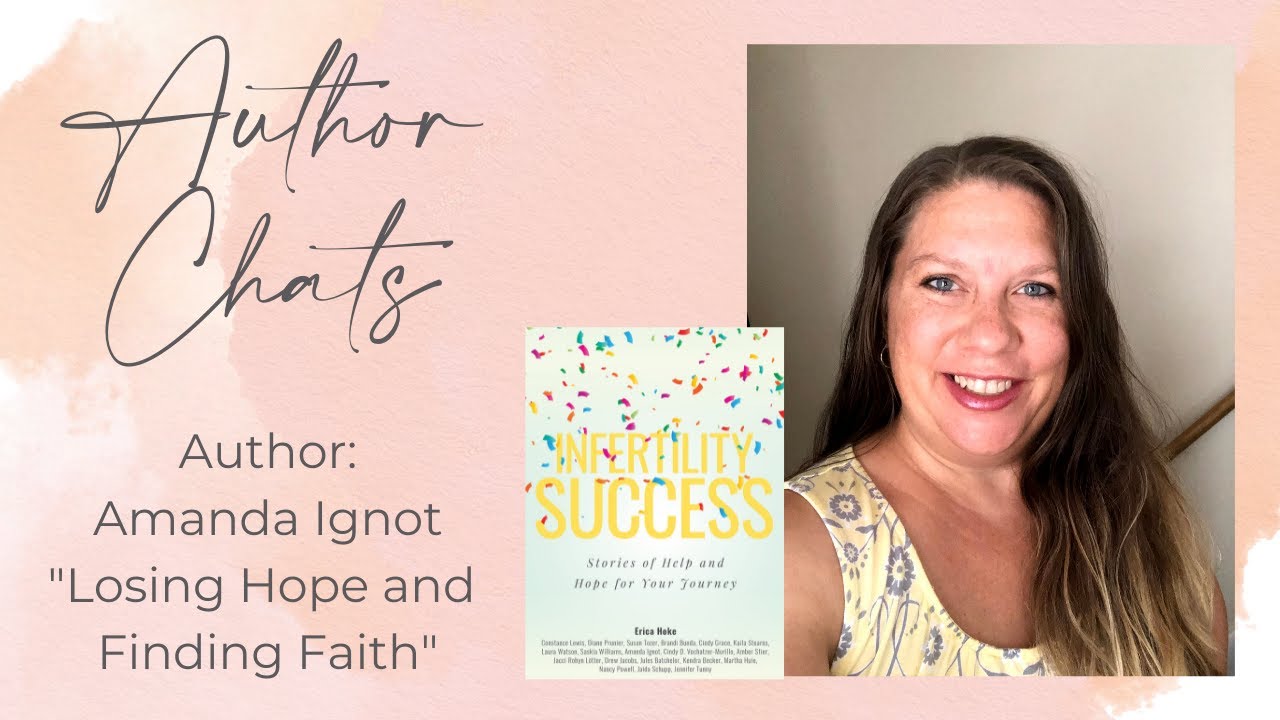
This content was created by Erica Hoke. This content was uploaded by Erica Hoke. This is a YouTube interview titled "Infertility Success Book, Amanda Ignot Author Interview" (posted 2022-01-13) — an English conversation hosted by Erica Hoke with author Amanda Ignot about her chapter "Losing Hope and Finding Faith" in the book Infertility Success. Amanda shares her infertility journey (a miscarriage decades earlier, years of trying, several failed IUIs and a successful fourth IUI), challenges in reproductive care, advocacy with doctors, faith, later-in-life motherhood (children born at 37, 40, 41, 43), birth experiences, and resources she offers (an empowered birth checklist and other support). The interview both promotes the book and offers emotional and practical guidance to people facing infertility.
Chapters
Thanks so much for joining us. We are here with Amanda Ignot tonight. We're doing Infertility Success author chat and the title of Amanda's chapter is Losing Hope and Finding Faith. And I'm so excited to have her here tonight to tell her, tell you a little bit about her story and her journey through Infertility Success. Amanda, thanks so much for being here with us tonight.
Hi, thank you so much for having me here tonight, Erica, and thank you for the opportunity to share my story in Infertility Success: Help and Hope for Your Journey. As many women going through infertility, you often feel like you're alone, so the opportunity to share your story is It's bittersweet, actually, like, to, to know that you had success, but also to know that you, like, you can speak into others by sharing your story. And that was what spoke to me about doing this book, was that if I could be the hope for one woman, then it's totally worth putting my story out there and rehashing the feelings and the experience that I walked through. Now, I'm Amanda. I have, um, my journey started, I mean, many years ago. I had a miscarriage, would be 24 years ago this year, and that was my first and my only pregnancy until I was 37. And in there, there's like a 15 year gap between that miscarriage and that happening. And 13 of those years I was not on any birth control. And I was in a 6-year relationship. He has a daughter. We had no children, right? Um, that relationship, you know, ended I moved on, still nothing. At some point I started to think like, okay, well, what's wrong with me? Why can't I do this? And just a funny story, and God has jokes, is that I was a weird child, I guess. At 14, I said, at 14, I wasn't even like thinking about having kids at the time, but at the time I said, I don't want to have kids after I'm 30 because I didn't want to be the old mom.
And, uh, it's so funny, we, we have that in common. Like, I know that we've talked about this before because I, um, had older parents growing up and I was the same way. I wanted to be done having my kids, like somehow magically done having my kids by the time I was 30.
Right, right, I did. I was like, I don't want to have kids after I'm 30. And you know, when I was 14, it was 1990, to give you some perspective. I'm 45. My husband was born in 1990. So looking back, I think God, God must have just really gotten a kick out of that coming out of my mouth, right? Like He must have really laughed.
Gonna have to wait a little bit, right?
Like, he probably laughed really hard at that coming out of my mouth, right? But anyways, fast forward, I met my husband in 2009, the end of 2009. We were together and we never tried to prevent conception. Um, in fact, I had been to the point when I turned 30, I literally told my mom I don't care if it's just a sperm donor or a one-night stand that this comes from. I want to be a mom. Like, it was so deep in my heart that I wanted to be a mom that I didn't care what the circumstances were around it happening. Thank you, God, for caring, because I didn't— I'm glad it didn't happen that way now. But I, like, that's where I was when I was 30. Like, I looked at that and was like, dang, 16 years ago I said I didn't want to have kids after I'm 30, and now I'm 30. Now what?
Yeah, well, I think it speaks to everyone's desperation in different stages of their life for— on this journey, you know. So you're just willing to, in that moment, do whatever it's going to take.
Yes, so true. And so when my husband and I met I didn't really— I, I don't think that I ever really told him like, hey, I don't know if I can get pregnant. But after 2 years, you know, you kind of like, well, what's going on? So at some point I started seeing doctors and, you know, started the whole thing of figuring out what my cycles were doing, if I was ovulating, like starting out at those beginning stages, which looking back I'm like, I should have started that like 12 years prior because there was obviously something wrong for a long time. Um, but again, I had regular periods, like regular periods for that entire time. There was nothing interrupted, so there was nothing for me to question either. So that being said, I was like, I didn't know that there was something wrong other than the fact that I wasn't get conceiving at all. And so we started that journey And it was a hard one. Our relationship wasn't the best at the time, um, because of some, you know, insecurities around the age difference, around me not being able to conceive and give him children. Like, you add those two things together and there's a huge pile of insecurity on top of, you know, me. And so I was, I don't know, 33 when we started dating, and then, you know, 37 when I finally had a baby. So it was 5 years where we were— yeah, we started dating like the end of 2009, and we had our daughter in January. She's almost 8. Um, she's adorable. And yeah, she's like— it's amazing. But it was a journey that I don't wish on anybody. It's like the heartache that was involved in that. I did have several failed IUIs. I was on the medications, I was doing the progesterone, the estrogen, the Clomid. Like, I was doing all the things. And then we had the IUIs and they they failed. And then I was lucky to have a doctor who was like, let's give it one more shot. Right. And that—
let's focus on that for a second because there's in that crux of let's give it one more shot. There's a lot to say right there, right? About advocacy and having a voice in your medical care and what expectations are from reproductive endocrinologists and things like that. So unpack that for our listeners here, viewers, um, for just a minute. Let's, let's put a pause. And you've done 3 IUIs. I know your story. And typically, as most of you or some of you may or may not know, that's usually, um, the standard is 3 tries. And then beyond that, so this particular doctor you had a conversation with And what happened?
So actually, it was— I, I was never diagnosed with anything. Like, all the tracking, all the testing, all of that never came up with any reason as to why I wasn't— yeah, there was no reason. I was ovulating, I was regular, like everything was working, but something wasn't working. Like, I even even at points would, um, during our IUIs, like, because we would do an IUI and then next month try natural, and then the next month, well, on the meds but without the IUI, and then we'd do another IUI. So we were going every other cycle. So it took us like 8 months for those 4 IUIs, but What I, what I, what, um, didn't say was that during all that, like, obviously the question is like, what the heck? Like, everything is working, but I would have— I would go in before like an IUI, so like between my suspected ovulation, or no, between my cycle, the first of my cycle to the middle of my cycle, I would go in for an ultrasound to see if there were eggs, right? Like, I would go in, and that was at my request. She never offered it. I requested it because I wanted to know, like, is there actually something growing in there? Like, I'm on these meds. And so yeah, there were follicles there. It was happening, but I still wasn't conceiving. And I was like, I don't understand this. And so in the end, like, her reasoning was like, since we can't find an underlying reason as to why you're not conceiving, let's try one more time. So in my mind, I mean, that last one was probably the most stressful part of my entire journey outside of that, right? HSD, right? Because if if it failed, if I didn't conceive that time, then it was purely up to natural circumstance.
And we had already talked about 16 years, right?
Right. I couldn't afford— we couldn't afford IVF, so that was not an option, right? So if my IUI thing was over and I wasn't as educated as I am today, I don't know that I would have sought a second opinion because I wasn't talking to anybody else about what was going on, right? I mean, who did— I didn't know anybody who was going through it or had gone through it at the time because we as women tend to keep these things close to home because we do feel broken. We feel like there's something wrong with us and we think that we're alone in that, that there's not somebody else out there who understands and has been through it. So, you know, I kept things to myself. It was a tough ride. And even when my cycle was late, I refused— I couldn't bring myself to test because, yeah, it was like it's the end of the world. Like, you're waiting for the other shoe to drop. Like, you're in that moment of like, I'm like, could it be? What if it's not?
It's like standing on the edge of the cliff, right?
Right, right. And so it took me a good 4 days of being late to actually decide to do the test, and I I won't tell you the details of that because it's kind of a funny part of my story. Yeah, it's very funny, the way I felt like in that moment, the way I describe it.
It's in the book, guys, it's in the book.
I have to laugh at myself when I read it. And it's funny because I read it out loud to my mom and my mom was like, man, you're fine. There's so much about you, about your journey, that I didn't even know. And my mom's my best friend, so I was really kind of like, really, I didn't even share this with you? That's amazing.
Yeah, like, so we have a touchdown, right? We have, we have a fourth IUI conception is successful. 4 days late, you got a positive test.
Yeah, yeah, 4 days late, positive test, cried, um, did a lot of things that didn't make any sense at the time. Um, that's in my story. Um, but what happened was after that too, and I want to encourage women, don't do what I did, because, um, I kind of immediately tried to put like throw water on it, if that makes sense. Like, douse it, douse the excitement, the joy, temper, right?
Temper the joy, just in case. We've all been there, right?
Like, I tried to like contain it in a way, like suppress it just a little bit, um, as like a— I guess a self-preservation, a self— like, as I had had a miscarriage earlier in my life, I knew that just because I got pregnant didn't mean it was gonna stick, right? And, um, so that was a scary part for me. And at that time, I was also like working out a lot. I stopped completely. Like, I wanted to live in bubble wrap. I wanted to be that crazy woman who just wouldn't leave her house and like stayed in her little box of— like, because I didn't want to do anything that would jeopardize this pregnancy, um, because I was scared of it not sticking. And honestly, I never had a conversation with my doctor about what would be the process if it didn't. I don't know that we ever had that conversation, so I don't even know, like, if she would have done another IUI because I did conceive, right? Um, so I don't know what the future would look like.
Yeah, well, we, we want to hear what your future is like now. What, what is your life like now?
I am the happy mother of 4 children now. 4?
I have 4.
I have 3 girls and 1 boy. I did end up having another miscarriage between my 8-year-old and my second. Um, uh, and then, but completely different stories, and you'll have to read my book for that because I'm not giving that away. But I have 4 children now. My first was at 37, my second at 40, my third at 41, and my fourth at 43. I'm 45 with a 2-year-old. Um, yeah, it's like send help some days.
And just to clarify, Amanda and I both share that we had all of, all 4 of our children after the age of 35. Um, our stories are, are very, very different, but that is what we have in common. And, um, I think it's probably one of the things that drew us together And just in case, if you're wondering if this book is just something to read a story and feel good about somebody else's success, that's not why we wrote this book. No, we as authors poured our hearts and our souls into these chapters with tip sections. Amanda has a free guide or a free offer to support you on your journey if you see this interview and you're like, man, that is my girl right there, I, I need to connect with her more, you have the opportunity to do that. Amanda, what are some of the things, what are some of the ways that you're supporting your readers of your chapter?
So I focus more on the pregnancy and childbirth side of things now, um, because I wish I would have done some research prior to everything that happened. I wish I would have gone into it with a mind to learn because I could be so much more helpful in this process now to other women. But in the end, it came out to my birth experience lit a fire in my soul, and I now serve the women who are walking through, uh, their childbearing years in pregnancy and childbirth mainly the ones who have experienced childbirth and maybe it wasn't what you thought it should be and you feel like maybe you weren't treated right.
Yeah.
And it was traumatic.
Yeah.
It shouldn't be. And so I have the freebie I have for you guys is a, it's an empowered birth checklist. It is how you can create your birth plan that will be your empowered birth, because you have options and you have choices throughout your pregnancy, throughout your— even your infertility. Erica Hoke got to where she got to because she didn't give up. She didn't take one doctor telling her she had 1% chance. As the final word in her journey and just say, okay, well, I guess I can't have children. She went and proved him wrong. Yeah. And so she's here to do the same thing that I am on the other end of the spectrum. And I love that because we make a great, um, we make a great connection because we can, you know, support on both sides of it, but from different views. And the checklist, though, is really to help you understand and maybe even make you think about things that you didn't even realize that you had a say in.
When you're giving birth for the first time, you want a certain outcome, you have a certain expectation in your mind. Um, but there's, for most people, there's very little thought or preparation put into that. They just think that they want this outcome, but they don't really know how to get that outcome. And they think if they just think about it and they say to themselves, this is what I want, that that's what they'll get. And in fact, you really have to prepare yourself, your spouse, whoever your birth team is, to get those kind of outcomes, and you don't get a second chance. And it can be really, um, you know, after you've gone through infertility, you deserve to have somebody like Amanda walk you through the process so that you actually get the outcome and the birth that you want. So Amanda, what would you, uh, say to somebody who is still in the trenches of going through infertility? What would you say to somebody on this, on this journey and about this book?
Um, so I have read this book and I'm telling you, I learned things reading these women's stories, these other 19 women's stories. Like, I knew Erica's, but the other 7, 8, 18 women, man, they're like my heroes because my story, because I, I tend to compare, and when I'm comparing my story to theirs, I'm like, dang, like, I had it pretty easy. And to truth be told, I did. But to read their stories, I can understand that it could have been so much different. It could have been so much worse than it was. And I have to give thanks that I had the experience I did, but the other stories opened my eyes to where so many women are holding back what's going on in their lives. They're choosing to— and they're not even sharing their feelings with their own husbands, right? Because it is— you feel less than, you feel alone, like nobody can take that burden off you. Uh, there's one quote in the book that I know we have a quote card for it. It's, you know, my husband was like, finally I can take some of the burden from you, right? That's a pretty heavy statement to make because her husband felt like he couldn't help her. We feel like we're alone in this, but here's a book from 20 women who bared their souls and their journeys, not just to share their success, but to share the information, their experiences, to be help and hope to your journey. Because you might be reading somebody's story and be like, man, this is me, this is me, this is me, this is me. What was their next step, right? Or 'Or I bet my doctor missed this.' Yeah, 'I'm gonna ask my doctor about that.' And that might be the one thing that is the answer to your issue, that your journey, and that will be the catalyst to your successful story, right?
And that's what this one is— shorten people's, people's journey. We want to shorten people's journey and we want to remove those obstacles that you don't even know about until it in hindsight or until maybe it's too late. So yeah, I know I've said it before, but I also think it's a little bit of a cautionary tale because one of our authors, she's actually was in the medical profession. She works in, in women's health and she lost the opportunity to use her own eggs because she didn't advocate strongly for herself. I mean, I think that she would say that admittedly, and they didn't do genetic testing. Now, she got the family of her dreams through egg donation, but she, uh, I think she would tell you she lost that opportunity to use her own eggs because of a testing issue. And no one should ever, ever have to go through that because of a procedural error or an oversight by medical staff who it's just, um, it's just another day at the office, you know. So, right.
And I think it's a great point too to make that I only saw one fertility specialist. I already said it earlier that I don't know that I would have asked for a second opinion because I didn't know I could. Uh, I don't know if I would have sought out more help But that's what I want you to know, right? That somebody telling you that they can't, there's nothing they can do for you, it means that they've— they, like Erica says this best, they've reached the end of their capacity to serve you, their knowledge of understanding. So find the best endocrinologist in your area and talk to them. But don't ever think that just because one doctor has told you this is never going to happen for you, don't take that. And in fact, I encourage you at that moment in your head, if not out loud, say, I rebuke you. I do not receive that from you. That is not my truth. My truth is that I have it on my heart to have a child, and my God put that there, and he will open my womb because he does open wombs, and he opens them in big ways, even when you're not really, um, seeking him on that journey. Because I was not until after I had my first, so I was not But full body chills for that one, right? Like, I do, I get like that because it does— like, God will open your womb. Hello, how old was Sarah, right? Right. Like, we know this can happen. And not only that, but you have two women sitting here who both had children later in life and ended up with four children.
Yes. Spoiler alert for me.
Right. But yes.
So thank you so much, Amanda, for being on, um, with us tonight. Uh, if you're looking for a copy of the book, it's available on amazon.com. The link is in the comments. It's also available via Kindle. And like Amanda said, and like you've heard me say, just because a doctor tells you that they can't help you, does not mean that you cannot get pregnant. Health and blessings to you guys. Have a great night. Bye, Amanda.
Bye.
More from Erica

The 90 Day Fertility WIndow: Why What You Do Know Matters MORE Than What You Already Tried






Women over 35 are told to “be patient” when what they really need is direction


Even with unexplained infertility, even if you’re over 35 even if you have multiple diagnoses like I
