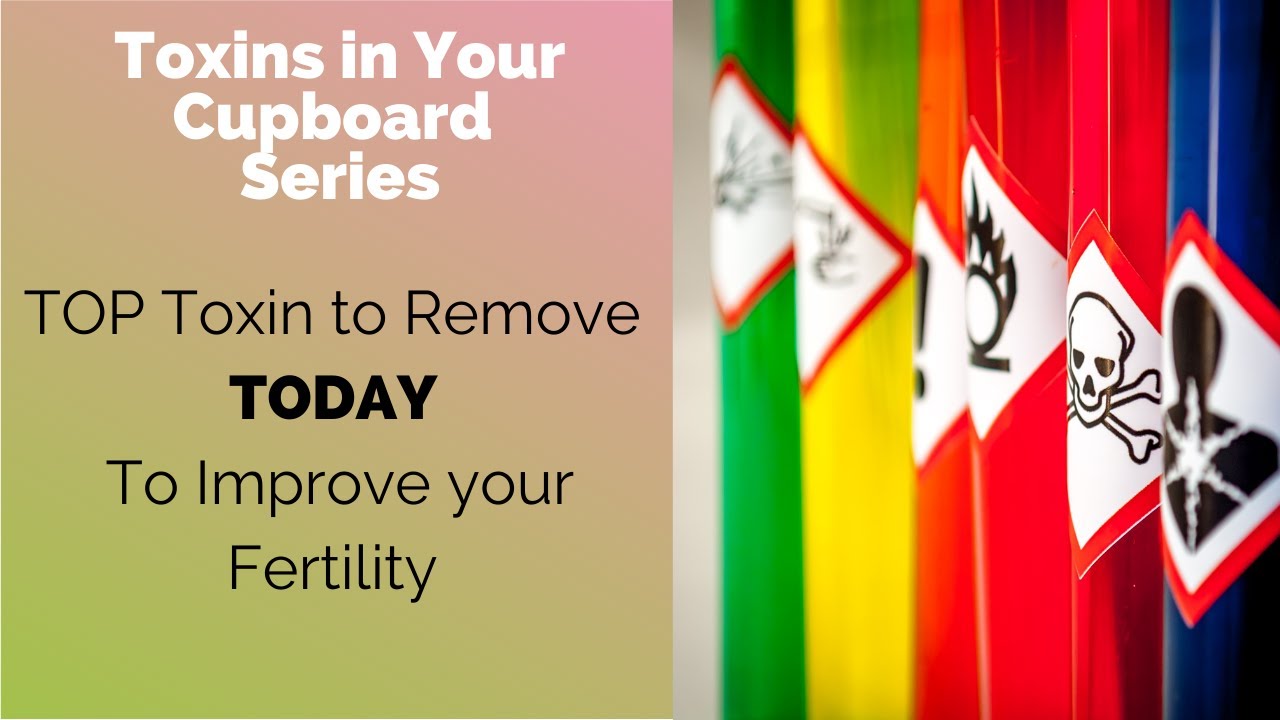
This content was created by Erica Hoke. This content was uploaded by Erica Hoke. This is a YouTube video titled "Toxins, Skin and Infertility" (published 2021-04-21). It is a single-speaker informational monologue in English in which the presenter discusses how chemicals in household and personal-care products (e.g., formaldehyde, sodium lauryl sulfate, parabens, phthalates, triclosan, VOCs, synthetic fragrances, oxybenzone, quats) act as endocrine and hormone disruptors that can harm fertility and thyroid function. The speaker shares a personal infertility story (told she had <1% chance of conceiving without donor eggs, later had four sons after age 35) and attributes success to diet, lifestyle, and changing skincare/household products. Practical advice includes switching laundry products, avoiding dryer sheets and fabric softeners, using wool dryer balls, and checking EWG ratings. The video also promotes a Facebook group (Flourishing Through Infertility), asks viewers to like/subscribe, and promises follow-up videos on specific chemicals.
Chapters
If you are watching this, then you probably know that I talk a lot about infertility and all the things that could be affecting it that the doctors are missing out on, or that frankly they just don't, uh, are not educated on, um, how they can affect your fertility. So if you're spending lots of money on infertility treatments, on IVF, on IVI, UI, or like me, you're not even a candidate, we couldn't do IVF, and you're not paying attention to what you're putting on your skin and what you're exposing your body to, you guys, you're missing out big time. So what we're talking about today is we are talking about toxins in your cupboard, things that are around your house, in your makeup bag, in your shower, underneath your sink. Right? So all of these things affect your fertility in a huge, huge way because they are endocrine and hormone disruptors. So they disrupt your thyroid function and your reproductive system, right? And so we don't want that, not when we're trying to make a baby, right? We don't want any of that interfering. And this is all completely in your control. So let me just list, I wrote some of them down so I wouldn't forget. So we're talking about things like formaldehyde, sodium lauryl sulfate, parabens, phthalates, triclosan, I'm gonna look now, VOCs, fragrance, which I'm gonna just do a pause right here and let's just put the fragrance thing on the table. Unless it has the Latin name for the essential oil, if it says natural fragrance, if it says essential oil, It is synthetic fragrance. What that means is that synthetic fragrance can actually contain up to 1,300 individual chemicals. 1,300 individual chemicals. Couldn't say that right. So I really wish that I had fully understood when I was trying to get pregnant how much this really, really could be impacting my health and my efforts. So fragrance can contain up to 13,000, not thousand, 1,300 different chemicals. So most of those are banned in the European Union, but they're here in the United States. Oxybenzone, which it's coming up for most of us. I live someplace that's sunny, so it's almost year round. But oxybenzone is a big component, big no-no in sunscreen. Huge hormone disruptor. It's actually what's killing the reefs too. So if you're watching this later, it's right around Earth Day now. And if you wanna save the planet, find a sunscreen that is oxybenzone-free. And quats. And there's a few other ones, okay? We're gonna talk about this week a few other ones, what they do, how they affect your fertility, why they affect your fertility, how to get rid of them, all the things. Okay, so the thing that I thought that I was doing right was I thought that the FDA approved all the chemicals that I was putting on my skin. I thought it went through some kind of screening process. My makeup, my lotions, my body washes, my hair care products. I thought all that was screened by the FDA. That is not true. Don't trust me, please. I want you to do your research for yourself. I want you to feel empowered. It is not regulated by the FDA. Cosmetic— the cosmetic industry is not regulated by the FDA in any way, shape, or form. So my story is, if you've seen anything about me, is that we struggled with infertility. We were told that we had less than 1% chance of conceiving without donor eggs. We were both older, past 35. All my children are— all 4 of my boys, spoiler alert, all 4 of my boys were conceived after 35. My last, I birthed 7 years after I was told that we had less than a 1% chance. And him specifically, I 100% believe that he would not be here had I not made those changes. To my diet and my lifestyle. I believe because I made those huge shifts in what I was putting on my skin that he was able to come into this world. So that's why we're talking about this, right? Everything that you put on your skin is in your bloodstream in 2 minutes. 2 minutes, you guys. So all these chemicals, and I'm gonna tell you what my biggest, My biggest tip for the day is to switch out your laundry products. If you are still using what's called conventional laundry products, things that you can pull off your shelf at your grocery store or at Walmart or Target, maybe you've even been trying to use some of the greener brands, right? What, like Seventh Generation, Mrs. Meyer's Method. I did all that too. I was trying to make good choices. I was trying to be green. I didn't know I was being greenwashed. Maybe you don't know you're being greenwashed anyway, um, also. So if you're watching this and you've been greenwashed, if you are buying products, um, paying for marketing budgets to tell you it's green when in fact it's not green, drop me a comment below. Okay, no shame in this game. Like, you know better, you do better, right? So the one thing I would want you to change would be your laundry products. Throw out your dryer sheets Okay, if you have to have some scent in your life, which no judgment, I get it, get some wool dryer balls, something like that. Throw them in your dryer. I use them. They actually cut down on your drying time. So that's a win, right? They pay for the cost of investing in the dryer balls. And throw out your fabric softener. Fabric softeners, According to EWG, so it's ewg.org, they just coat your clothes. They just coat your clothes in like a slimy layer. That's what that softness is that you feel. Gross, right? So EWG ranks the conventional products that you can buy, and I used to buy off the shelf, 85% of them get a D or an F rating. Okay, I need a drink. A D or an F rating, you guys. That is some pretty serious stuff. So the reason that the laundry products are so important is because, uh, you're in your clothes or on your sheets 23.5 hours a day. So you're— those products, as they're breaking down, as they're providing that fresh scent as you're wearing them, you're sleeping on them, they are actually breaking down in order to provide that fragrance. And that's where the quats come in. And we can talk about that. We're gonna talk about that later this week in more detail. Hey, speaking of that, if you want to know more about this stuff, if you're interested, in getting all the lowdown on these chemicals that I'm talking about. I'm doing a series in my group Flourishing Through Infertility on Facebook. If you're watching on Instagram, hit me up on Facebook. Um, and hey, if you're watching right now, hit the like and subscribe button. And when I go live the rest of this week about the toxins in your cupboard, then you'll get notification. Also, if you're watching on Facebook and you want to catch more of this information, Facebook's not great at notifications, so go over to, um, go over to YouTube and search my first and last name and, uh, get my— get your subscription there so you get notified when I go live again. All right, so if you're spending money on IUIs, IVF, if you've been told like me that you cannot do those things— we were not candidates for IVF— and you're not taking personal responsibility for what you're putting on your skin, you're doing yourself a huge disservice. So before you freak out and you're like, "Well, I can't just throw everything away." This has been a 15-year journey for me. This has been a journey of learning and understanding and making changes, so don't feel like you have to go empty out your cabinets. You can, I'm not telling you not to, 'cause a little bit of poison is still poison. But just pick the area. Some people are really, really, really attached to their laundry detergent. If that is you and you have to have whatever that smell is, whatever that brand is, don't start there. Find something else that you can switch out for a healthier, cleaner product so that these things do not continue to bombard your body and create a huge biological load on your system. And remember, we're, we're talking about this because it's hormone and endocrine disruptors. Okay, I am over time, and if you have any questions, just drop them in the comments. Let me know if you've been greenwashed, and, um, I will catch you tomorrow. I'll be right back here talking about, um, some individual chemicals like formaldehyde and the quats. Which is just kind of fun to say. Anyway, health and blessings to you guys. Have a great day. Bye-bye.