CRM for Contractors: Erick Vargas on Scaling Sales Systems | e-verse
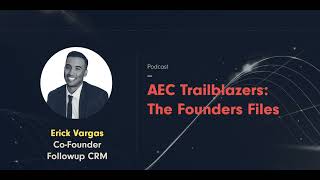
Erick Vargas, president of Follow Up CRM, explains why construction firms need project-centric CRM systems instead of spreadsheets and paper. Firms that implement CRM see an average 18% lift in closing ratios in the first year, but success requires clean data and company-wide adoption, not just siloed contacts.
Chapters
Buckle up for EEC trailblazers, the Founder's Files, where we crack open the stories of the brightest minds in the AEC startup scene. Forget institutional pitches. We're diving deep into the real personal journeys of these industry disruptors. Get ready for some casual chats firsthand.
Hello, hello and welcome everybody, to another episode of the Academy Trade Blazers podcast where we interviewed the most amazing founders of the ac. Today with us we have Eric Vargas. He's the president of Follow up CRM, where he combines his passion for technology and businesses with a commitment to helping construction professionals succeed. With a background in business administration and years of experience in the tech industry, Eric brings both technical expertise and a customer focused mindset to his leadership. His goal is to simplify client management for construction firms, enabling them to grow and thrive. Eric's Hansson's approach and dedication to making a real impact has been key to follow up CRM's success. Erik, welcome to the show.
Thanks for having me. Excited to be here.
I'm excited to have another. Another neighbor from Florida on the podcast.
It's gonna be hot here in a couple weeks.
It is, but as long as it's not rainy, I'm good with Florida weather.
Me too. You just go to the beach, go to the pool, hang out, you know.
Yeah, it's just perfect.
So.
But anyway, tell us a little bit about yourself. You always live in Florida? You were born, raised here or.
Yeah. So South Florida native. Grew up down here in Broward county, the Fort Lauderdale area. Actually, Fort Lauderdale is becoming very popular spring break wise now. So it's kind of crazy over here, but yeah, beautiful beaches, love South Florida. Wouldn't go anywhere else. And. Yeah, just grew up down here. I went to school at Liberty University, which is in Virginia, in the mountains, in the country, and then came back home because I couldn't do the cold and got started in kind of the tech industry.
Interesting. Your first step was to go into the construction industry or how you ended up in the ac.
Yeah, great question. So at first I started implementing Salesforce at a large software company down here called Citrix. That's where I got my career started. If, you know Zoom, they use the. Before Zoom existed, there was another product called GoToMeeting that we used to use. Right. And so I used to sell that and, you know, with that I used Salesforce. And we all know Salesforce is the industry leader in CRM. And so I got to know what CRN is and, you know, from the best of the best. And then from there I met my mentor and friend Greg Wallach, who ran a large construction company here in South Florida called Best Roofing. And through my relationship with him together we have brought this CRM to the construction industry.
Really interesting. And for me it's always, it's great to hear why people end up in our industry because it's not an easy industry. It's huge, but margins are thin and it's hard. Why do you decided to do it anyway? Do you think there's a big problem on the sales side of the industry?
Yeah. So especially in the AEC world. You know what I like to, I like to say that, you know, we're behind when it comes to technology. Right. And so most construction companies, architecture, engineering, you know, aren't the most advanced when it comes to technology. Right. And because of that, you know, they're not using Salesforce or much of the industry leading technology that helps those profitability of a firm.
Right.
And so we're really just getting started in a lot of these construction companies. So I'm hoping to serve this industry and give it the care and the attention that it deserves that the big companies like Salesforce just they're focused on other kinds of industries. Right. And so that's the value that we add to the space.
Interesting. And you know, aac, sometimes speaking about AC is a little bit unfair because players are so different. Right. Architects are, the work they do is completely different to what general contractors do or subcontractors. Right.
And right.
You would think these, I don't know, difficulties to deal with. I think I broke up for a little second. I don't know.
Yeah, you're back. You're back.
Okay. Anyway, so let me start from the beginning. So speaking about ac, it's a little bit unfair just using the term because you know, architects do a complete different job than general contractors or subcontractors or even engineers. And each of them work on different phases of a project. You think this difficulty to implement technology and specifically during the sales process or the bidding process, they all have the same difficulties or do you feel that maybe architects are doing a better job than general contractors? I don't know.
I think the whole industry is just kind of getting started with technology because it's really relationship based. 20 years ago, whenever you needed an architect or an engineer year because you're doing a new project, you just call the people that you know. Right. But now technology has infiltrated every industry. Right. So what we're seeing is that, you know, these firms and these companies, they can't survive without implementing technology. So we are sometimes where the first software any company is using. So yeah, you maybe you're using an accounting software or something like that, but then a CRM is probably the next technology that you're using.
So.
Most of the companies that we work with are still on paper, they're on spreadsheets, you know, or they might have like, you know, all the contacts in their cell phone still.
Right.
And so we are helping them take the next step to bring tech into their company.
Interesting. But do you think this applies to any size of a company in the AEC or you think this is more often on smaller companies than, I don't know, the big ones?
Yeah. So I would say if you're a really, really big AEC firm, then you might have something in place. But even then we just onboarded a company that had 10 different locations and 100 users everywhere. So the big companies don't have something in place like this. Right. But we also have companies down to one user. Right. So it's really about increasing productivity and putting the data in so that there's one place for everything you all the relationships of the company to go to.
I feel that's a great advice because something that typically happens right. When you're just. I'm an architect, right. So when I started my career I didn't want to spend any money or anything. Right. Because I was right just my, myself it wasn't a studio, it was just by myself. So you, you would even think it's worth it to like if it's a uni personal studio and, and one guy is worth it the investment.
It is for some companies. Right. So how much does, how much money do you make on winning one more job? That's the question you have to ask yourself. Right. And most CRMs in most companies that we work with, if we help you win one more job, it more than pays for itself. So that's the question you have to ask is the ROI there? Right. So if you're a one stop shop, then you know, maybe you say, you know, I know my book of business and that's okay. But as soon as you start managing a team of others, bidding and estimating, then you probably need something to manage the team.
No, that makes total sense. And something that for me it's really interesting circling back to what you said about our industry being a relationship based industry which nowadays still part of it, it's true. But do you think also the patterns on the industry are changing given the fact that it's getting more competitive out there and it's not enough with just the people, you know, but you need to go one step further.
Totally. So things in the construction industry used to be 100% relationship, but now not so much. Right. But that's what CRM is all about. If you don't know what CRM stands for, it stands for Customer Relationship Management.
Right.
And so it's funny, I had a leak in my house, in my roof last year. And you know, I got excited because I called for roofers to come and give me a quote, right. And I know like five roofers in South Florida. So I just wanted to see, okay, what is their process like, are they professional? And all the roofers that I called over to my house, they all gave me a quote, they all gave me an estimate. Guess how many followed up with me?
Zero.
Right. And so, you know, you're right, it's not relationship based sometimes, but if one of them would have called me, I probably would have went with them. Right. Because what does that do as a customer? It shows me that you have your stuff together and you have your business together and that I'll trust you, you know, to be at my home, where my family is and to do a good job.
Oh, absolutely. You bring a really valuable point about the importance of the sales process. And it's not only about follow ups. Right. It's also about the time it takes for you to provide a quote. Like, and Sometimes it takes 2, 3 weeks for a company to provide a quote. And it's just insane. You might just lose the project because, you know, took us too much. Took you too much time to provide that quote or the requirements. Sometimes companies ask for so much information to provide a quote and that might lead you to the, to losing the project. So I think it's, it's a lot of variables. And if I may ask you that you have a lot of experience with implementing this with companies. What do you think are the most common mistakes or they make? Like the one you, you, you said like not following up. It's, it's great. But what are the most common ones that you see with companies that you're starting to work on?
The most common mistake is not doing something.
Right.
And what I mean is having all your contacts in your email and in your cell phone that is just not going to work anymore because, you know, if you want to sell the company one day, you have to hand those relationships and customer lists off.
Right.
And if they're in somebody's email or phone, what happens when that person leaves the company? Right. The average Tenure at a company is only 18 months on average, Right. So a lot of times they take those relationships with them, right? They take that and it's really company information at the end of the day.
Right.
So that's a huge mistake. So what I say is, if you don't want to invest in a CRM, do a shared spreadsheet and put all the information in there, like that's free, you know, and at least there's something. Right? So most of the time here. You know, it's funny, a lot of the small companies that we might work with, they might not be doing anything, but then they want AI at the same time, right?
Yeah, yeah.
And.
But the funny thing is, so we have AI in our, in our CRM, and, but the, but AI is only as good as the data you train it on, right? And so if you want to use AI, you need to have data to train on.
Right?
And so that's what a CRM provides you with, is the data so that you can actually work smarter. Right. And not harder. But if you don't have anything, you're not going to get anywhere.
No, absolutely. I mean, we see that every day as well. Like they hear the word AI and they want to implement it, but you don't have data. There is no way you can use AI. No, no, absolutely. But I take on your suggestion that companies at least need to create spreadsheets. But I typically feel that even when you're doing spreadsheets, which for sure it's free, but the problem is that especially don't force you to have an order and having a structure on, hey, I'm going to add a new contact or a new company. Well, you need to add a contact. And if you add the contact, you must add the name, last name, and, I don't know, email. Otherwise you cannot create the contact. And it enforces you on a structure, on a process that spreadsheets will never be able to do.
Exactly. And so the structure and the format, you know, is really critical for data quality. Right. And the way I say is garbage in, garbage out. Right? So guess what? To run a business requires work, right? That's why they call it work. And you know, I always laugh when somebody, when I'm doing a demo with somebody and they say, how do I like, do I need to type any information in? Of course you have to type information. That's how software works, Right. It's not. I wish we could have a neural link into your brain, but we're not there yet. Maybe in 10 years we're waiting on Elon Musk for that, so.
Yeah, hopefully. Hopefully. Imagine not trying, not needing to feel information anymore. That would be amazing.
Yeah. The closest we get to that right now is speech to text. So in our app, you can do speech to text and just put the notes and say, hey, I met with Jim and he said, follow up next week. That's it.
That's a lot. That's a lot to say because you could be driving or like, it changes it all. It's much more faster and that's really interesting. And based on that, let's say you implement your tool on a company typically, what's the average on? I don't know, changes on the percentage of more deals gain or, I don't know, more EBITDA or however you want to measure it. What, what are the changes that you typically see on.
On average, our average customer in the first year sees an increase of 18% in their closing ratio.
That's huge.
Yeah, no, it's huge. And, and, and I attribute it probably to one thing. Following up. That's it. Because like I said in my roofing story, no one's following up. The bar is so low that if you're just following up a few times, you know you're going to win more business, guaranteed.
True. And do you think that applies also because it makes sense when you're dealing with customers like yourself, like you're the owner of a house and you get, you want to get your roof repaired? Absolutely. But you think the same applies when you're dealing with a bid process, when you're. Because other companies are competing with you and it's a more formal process. It's not just about showing up. There are specific dates and there are specific requirements. Do you think it also applies to those specific cases when you're trying to win a much bigger project?
Yeah. Really great question. So let's say there's a bid date for, you know, April 1, for, you know, and, you know, big construction project downtown, and you send it in on April 3rd and your competitor sends it in on April 1st, the due date. Right. Who do you think is going to have a better reputation in front of the board, who's making the decision?
Right.
So it really does show professionalism. Right. Because we all know in our industry when, you know, things happen, things happen and projects take longer than expected and we want to make sure the people we are partnering with are quality people and are committed to actually seeing the project through and getting it done.
No, absolutely. And I think it's common in Our industry to never, never hit dates. Like, you do a planning schedule and you never end up hitting the dates that you were a planner on the first place. So it's something that, again, I think it's going to change in our industry. We're improving at that. Like, not only on the bidding process. Right. We're improving on technology, on, like, prefab everything and quality of suppliers and supply chain and everything. It's going to lead to a more professional industry. But indeed, if you don't win deals, you win projects, who cares about the rest? Right?
Right.
And that's something that typically. It's something that I hear over and over. I have a lot of friends are like, subcontractors or general contractors, and they think they're. I don't know if I ever heard the phrase hunting in a zoo, but they think, like, I already have all the job I want. I don't have to care about sales. I'm going to be making a lot of money anyway. And I don't think that's true. You cannot, you know, just stay and not do anything.
Yeah, I totally agree. Sorry.
Are you okay? You want to. You take. Take, take one minute, you're gonna die. I don't want you to die in a. On the podcast.
So, yeah, me either.
You're gonna get. And go and get a glass of water or something. Yeah, yeah. Just take our time, man. There's no rush.
I have one right here. But then you know my voice. Okay.
That's the AC man. ACs are. They're always too cold. In. In.
I know, right?
Oh, yeah. Just insane.
Okay, so finish your point and we'll go back.
Okay. So typically, what I think is that even when companies like general contractors, subcontractors, or whoever think that they have all the work they need, they want, I think maybe in this specific point of time, they have all the work they want or they need. But that's going to change. You cannot stop doing sales because you think you have work guaranteed. That's going to change. I don't know if you hear that as well when you're trying to implement a CRM and people say, I don't need that because I already have all the work I need.
Yeah, you have that right now.
Right.
But what happens if the market crashes? You know, everybody remembers 2008 when all the projects stopped.
Right.
It's funny. Our business grew a lot in 2008, because then they're like, I have no. I have no work. Right. So then they try to implement a CRM, but by then it's too late.
Yeah, and that's, that's also a great point. It's, it's not something that is going to happen overnight. For sure. If you implement a CRM and a process, you're going to start increasing your sales, but it's not going to be magic that from one day to the next. So people need to understand that they need to start that when on, on the good times, not on the bad times.
Right. And it's not only about having enough work, but it's having the quality and the right kind of profitable work.
Right.
Because what if you have a, you know, a big backlog and it's low margin.
Right.
What if like, let's say you had 10 jobs in your backlog and there was one or two that are higher profit. Maybe you want to work on getting your business development and your sales team focused on getting more high margin jobs instead of whatever comes my way.
Yeah, no, I think what you just said is great because it's a typical thing when you hear architects or because we are the ones who complain the most in the industry or even subcontractors that their margins are too thin. And I always ask them, it's like, why do not find a different type of job? Why do not add value doing a different service or look for different clients so you can get better margins instead of trying to get more jobs still having thin margins and then the risk is huge because suddenly you have a lot of people, margins are really thin and then you're just relying on quantity and not quality. And that's dangerous.
Yeah. It's better to be the high end luxury provider with higher margins and make 30% on a job depending on what you're doing. Right. But then doing a job at 2%, you know.
Yeah, yeah. I think there are even niches that you can exploit all over the place. It's not only premium, for sure, we know that that's guaranteed. Right. You're gonna get better margins there. But sometimes studios, they end up doing work that does not a lot of value but takes a lot of work and because they're desperate for money, they end up doing it anyway. And I think that if you're, you have your confidence that it's going to give you a process that you know you're going to get clients on a reliable way, you can do it. Right. You can, you can be confident and say, you know what, I'm just going to throw away all the stuff that is not adding a lot of value and it's just Typically it's like you get 80% of the revenue out of 20% of your clients. Right. So, yep.
So my mentor, he used to do government jobs and bids and all this kind of stuff. And he's like, I'm pretty much working for free, you know what I mean? And so what he decided to do is open up a large service division and what the service division allowed him to do is to, you know, service customers in an emergency situation. But after you do that for two, three, four, five years, whenever the big project comes along, guess who they're going to go to? Their service provider. Right. Even though they might have to get three or four different bids, they're going to be like, I have a relationship with this company. We're going to continue to go with this company and I don't care if it's, you know, 10% more because I know they're going to do a good job because they've done a good job in the past.
Yeah, absolutely. I think that what you just said, it's a sweet spot between, you know, relationship based projects and sales. A good sales process.
Right.
Because it's like you're always going to trust people that, you know, but things happen. Those companies might be out of business or they might stop doing a, a good job and then you want to find a different provider or you want to diversify. So it's a really dynamic landscape out, out there. And, and there is, there are always so many opportunities that I feel companies are not exploiting them.
Yeah, I agree. And you know, as they say, the riches are in the niches. Right. So we have another company based in South Florida where they do H Vac. They, but they only focus on high rise commercial H Vac. That's all they do. Now I talked to the owner, he's like, yeah, we could do residential. Yeah. We can do warehouses. We can do all, we could do all of it. But our highest margin are the high, are the high end residential conto. Residential condos. And so they become the expert at that area and they actually brand themselves that way and market themselves that way so that, you know, if, like, for example, if you just, if you, if you're on the board of this, you know, high rise, like the Porsche Tower is a really cool one. Right. That he did. And you know, they brand themselves as the H Vac for high rise luxury condos versus, you know, chucking a truck that can do the job. Right, but who are you going to choose? Right? You're going to choose the one where.
They specialize no, yeah, yeah, absolutely. And I, I think that's really important, like, for you to, when you're doing sales, you need to have a clear objective on who's your buyer Persona and what you're trying to sell. It's something that, when you present yourself, it's just going to be, yeah, I can do whatever you want, or I just do this. I have done it a thousand times and I have the best at it. And it, it changes completely how you, you pitch to a potential customer.
Oh, yeah, you nailed it. I mean, just think about the doctor. Let's say you're having brain surgery, right? And do you want the, do you want the general practitioner that comes in and says, yeah, you know, I do this, I do this, I do this. Or do you want the neurosurgeon that comes in, has done the thing a thousand times and does a good job. Right. So are you going to pay more for that? For sure. But you're going to get it done, right?
Absolutely. And I think that's a great example in changing gears a little bit. Something that, for me, it's, you know, I'm just curious, when you have, I don't know, services, like, let's say, online services, right? You're an architect and you can do drawings for our design for anybody out there, right. You can just be in California and do the design for a building in Miami. Right? Who cares? But when you're a general contractor or a subcontractor, you have a limitation, right? You cannot, you cannot take a job in, I don't know, Virginia if you're based in Miami, because. Right. You need to physically be there. So. And that limits out, you know, the, the amount of people you can reach when you're doing your sales pitch. What, what do you think changes, given the fact that we have architects and we have general contractors and their, I feel their sales process is different. What do you think it changes from one to the other on how they can approach clients or add more value in the way they, they sell to either a whole broad market or specific communities like the cases of general contractors and subcontractors?
Yeah, I think, you know, and this is happening with, you know, the whole world is that if it can be remote, then the best people to do the job are going to get the work.
Right.
But if it's a local company that has to execute the work, you know, you're constrained by your locality, right. And so what you're going to find is you're going to have the local contractor work with the engineers all over the country. Right. And you know, that's what's going to happen more and more and more.
No, absolutely. But I feel that, let's say you're a subcontractor, right? And you have a really limited, not really limited, but a limited amount of projects. Right. If I'm like the one you mentioned, like that is doing HBXC for high rises, right? Like luxury high rises. So the only clients are the, I don't know, 50 buildings that are being built in, that's a lot. But the ones that are being built in Miami. Right. So you can focus there on just those 50 buildings and put more quality on the process compared to, let's say I'm an architect that I can work for any state.
Right.
The amount of projects that I can do is not 50, it might be 5,000 or 10,000. Should I, should, what should I do? Should I just pursue more with less quality in terms of the sales process and do it faster but try to approach a bigger amount of deals compared to what the general contractor is supplied to do? Right. They have a limited amount or being an architect, I can just, who cares if I have a lot of deals? Just focus on a few and put a really good quality on that process.
Yeah, that's a good question. I would say there's probably room in the industry for both. Right. There's going to be the people that don't care and then just do whatever jobs anywhere and then there's going to be the specialty ones that focus on a region or a location or a niche that, and you know, it depends on what kind of business do you want to build, right? Do you want to build the Amazon that reaches everybody or do you want to be the boutique, high quality, high end, you know, service for the, for the location? And that comes with different challenges. And so that's the question you have to ask is what challenge do I want to solve and what kind of company do I want to have?
Absolutely, absolutely. And that can variate so much. But it's interesting and something that it's also for me curious after working on many architectural firms and working with owners as well, is that sometimes when you implement a CRM, the ones who end up using it is just sales. And I don't know if you agree or not, but for me it's a mistake because when you're in production, it also adds a lot of value to see how the pipeline is or what the pipeline looks and the type of clients we're getting and also be able to provide feedback on those specific clients, on when the sales are going to approach that client again, they have feedback and it's more useful for the sales pitch. But typically that never happens. Do you think that's right? Do you agree or you don't agree?
Yeah, no, that's a huge problem in the industry. And so what we see is that there's a disconnect between the front of the house and the back of the house.
Right.
And our CRM, we actually integrate with a lot of the major ERP and accounting systems for the construction industry. Like, you know, Procore, you probably heard of, or Viewpoint or Sage, all of those, we integrate with them and what that does is allows us to see the data in that system and pull it in so that we can connect, you know, the sales and marketing and business development team to actually what's going on. Right. Because maybe you bid a project and you think it's going to come in at 10% and then it comes in at 4% and you're like, what happened?
Right.
Or maybe they don't pay on time or maybe, you know, there's a whole bunch of things. But closing the gap is really important in the construction industry so we can, you know, make profitable work interesting.
Do you have any, I don't know, tips and tricks on how to accomplish that?
Yeah. So it's all about teamwork, right? So that's why whenever somebody rolls out the CRM, just a sales team, I'm like, it's not, you get, imagine the whole world had one telephone. Who's going to use the phone? Nobody. Because there's no one to call. Right. And so the CRM is the same way. The whole company needs to be using the CRM because that's where the value comes in. Because if you have 10 people working on a project together and all the notes of the project of those 10 people are on the same page, then everybody's working together.
Oh, great advice. And what about you guys? Like you mentioned that you're using AI, so that's great. But what about the future? What are you planning on the next steps for follow up CRM?
Yeah, so we're excited because we're rolling out so many features and we're bringing the industry up. Right. And we're professionalizing the industry. So what we're doing is we're serving the really big companies that want, you know, that want AI. They want the reporting, they want the analytics, but we're also serving the smaller guys who just want to get started. So that's what we're Excited about is our integrations and taking every excuse of why we don't have a CRM off the table. Right. So that's what we're focused on, is making a CRM for the construction industry that they will actually use. Right. And so because what I like to say, if it's not easy, no one uses it.
No, absolutely. Absolutely. I agree on that. And if I may ask a mean question, and don't hate me, but let's say I'm a, I don't know, big general contractor and there is Salesforce or HubSpot out there. And then follow up CRM. Yeah. Why would I choose? Aside from the fact that you're specifically for the ac, why would you tell me to convince me that I need to go with follow up CRM and not with the most common options?
Great question. So the reason why follow up exists in the first place is because we are built around projects. So we help you win more projects. And Salesforce is about opportunities. Right. And so the problem with Salesforce is, I call it a one to many problem.
Right.
So when. And you described it, whenever there's a project, you have the architect, you have the engineer, you have the general contractor, you have many people working together on the one project. Follow up brings everybody together to work on the project together. Salesforce doesn't allow you to do that. Right. So that's why it doesn't work for most construction companies. So that's why we're different. And then also the integrations and all that other stuff that we built on. Many features specific to the construction industry. But at the end of the day, we give you one page to look at the project and look at everybody that you're working with so that you can bring it all together and get the overview of the project.
Great, great answer. Great answer.
I actually we, we really like the. We, we like Salesforce. We like HubSpot. They're great, great companies, but they're just not specific to construction. So, you know, we'll help out our, our people.
No, absolutely. And I, I do think that maybe you could use HubSpot or Salesforce for some, you know, services that you could do anywhere. I don't know some specific. But in general, our industry is much more complex and it has so many specifics that you cannot go with something as generic as Salesforce or HubSpot. That's absolutely true. All right, I know you're a busy guy, so I don't want to take a lot more of your time. But before we wrap this up, can I Ask you a couple of ping pong questions.
Go for it.
All right. What do you think is the next big trend in the AC AI Always AI frame everywhere, man. That's just insane. Like every week there is a new model. It's just insane. Next one is, if you could collaborate with any person in history, which person would you choose?
Great question. Probably, probably Elon Musk even. Not even in history. And today, because he's making history.
The only problem is that you might end up learning a lot or you might end up dying out of stress.
I know here it's hard to work for him.
No, it's just insane. The amount of hours you work. It's just insane all the time. But it's interesting for sure. And then last but not least, what's your favorite building in the world and have you ever visited it?
My favorite building in the world. That's a great question. I really think the. Let me see here. My favorite building in the world probably has to be the Porsche Tower. Actually that I already mentioned it once, but it's in Hollandale beach because a couple of reasons. I have a friend that actually built it and so I got to see kind of the inside of that and see the journey from all. Actually all the way from the beginning, all the way to today. And then actually my second favorite building is probably the guitar hotel that we have here in Fort Lauderdale. So that's a crazy bill. That's a crazy building.
The Hard Rock, right?
Yeah, yeah, the Hard Rock.
Yeah, it's, it's. I don't know. Both buildings are really interesting.
Yeah. So crazy.
Good, good. Quite good choices. All right. And before we say goodbye to each other, can you tell everybody where they can know more, learn more about follow up CRM and contact you as well?
Yeah, so you can reach out to me on LinkedIn or you can just go to follow up CRM.com and check us out.
All right, thanks so much for your time, Eric. I love what you guys are doing and sure the industry needs you guys. So thanks for what you do for the industry and I hope to learn more of follow up.
Thanks to our listeners. If you like this content you can find fast and upcoming episodes in asuworlds.ebirds.com and on all of our evers social media. We love to hear from you and recommendations for new content. So leave us a DM and we'll make sure to catch you.