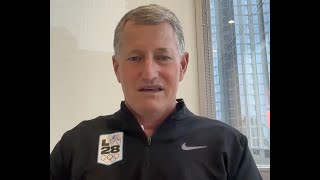
In this interview, John Slusher, senior executive for LA28, explains the unprecedented scale of the upcoming Los Angeles Olympic and Paralympic Games, describing it as the largest sporting event ever with about 14 million tickets sold, 36 world‑championship events over 17 days, and an additional 23 Paralympic championships. He emphasizes that the Games’ legacy will be privately funded, aiming to leave a lasting reputation for Los Angeles as a premier global‑event host and to create a fund that provides sport access to under‑served youth for decades. Slusher outlines inclusion strategies, notably a community‑ticketing program that will offer affordable seats alongside premium options, ensuring the Games feel like everyone’s. Reflecting on his 26‑year tenure at Nike, he shares two core leadership lessons: the shift from being a doer to a leader requires a different skill set, and cultivating authentic relationships—both internal and external—is essential for effective leadership. Throughout, he conveys enthusiasm for the complexity, responsibility, and lasting impact of LA28.
Chapters
So, John, you've spent decades negotiating groundbreaking partnerships, first at Nike and now leading one of the most complex global events in history. Most of us watch the opening ceremony and see the magic, but few of us understand what it takes to get there. What is one thing that most people don't understand about organizing an Olympic Games?
Thanks for having me. First of all, and really great question. I think the complexity and enormity of the Olympic Games is something it's truly hard to understand. I've been involved in the Olympic Games my entire life, from as a kid, as a fan, and then at Nike, working on, I think other than Covid, I was at every one for the last 25 years or so and obviously now here. And I think I still didn't really appreciate the, the enormity of it and the complexity of it until I got here into this role, helping lead all the business side at LA28. And we talk about seven Super Bowls a day for 17 days, plus a Paralympics right afterwards. But I think just some of the numbers that put it in perspective and one of the things I tell people, it's the LA28 is going to be the largest sporting event in the history of the world. And think about that for a second. The world's been around a pretty long time and this will be by far the largest sporting event in the history of the world. We'll sell something like 14 million tickets. You know, a really good season for an NFL team is 600,000 seats. So just think of what that means. And it's all at the exact same time. So 36 World Championships happening over 17 days in the same city at the same time. And then yet another 23 for the Paralympics. So again, just the complexity and the enormity of all of that. And you think about the sponsorships we're going to be doing, the tickets we're going to be selling, and across the board, it's really cool to be such part of such an incredibly complex and exciting adventure.
You've said LA28 is not just about sports, it's about legacy. And you've been clear that LA28 isn't just about two weeks of competition. It's about shaping something that lasts for generations. What do you want the legacy of LA28 to be for the city of Los Angeles?
I think there's hopefully several legacies that are going to be really important. I think first and foremost from both the Olympics and the Paralympics. Obviously first, hosting the greatest Olympics and Paralympics in the history of the world will be really exciting. We Talk about it being the biggest and the best. And I think by far both the Olympics and Paralympics will be the biggest events in the history of the world, but also, I think, by far the best. And when we think about legacies, we are privately funded. So a big part of our legacy is giving back to the city. So I think leaving the city with an amazing reputation for hosting global events is super important for the future of the city, but also doing so in a responsible manner where, you know, we are committed to having our revenues exceed our costs, and leaving a fund for the city of Los Angeles to make sure that kids have access to sport who may not otherwise have something for, you know, decades to come, not just years to come. And so I think it's both putting on the biggest event ever, doing it in an amazing fashion. But I think one of the true legacies will be doing so privately funded in a way that gives back to the city both from a reputational standpoint. Everyone saying, wow, I want to get back to Los Angeles, or I wish I went to Los Angeles. But in addition, the idea that we can, you know, for decades and decades to come, allow kids who may not have access to sport to have access to sport is something I think pretty powerful that we're all really excited about.
I'm excited. Okay, go to the next one. From your time at Nike to now leading LA28, you've championed access and inclusion, ensuring that sports reaches people in every community. With the world's eyes on Los Angeles, how are you making sure LA28 feels like everyone's Olympics and not just for a select group of people?
Yes, it is really important to us that it is a games for everyone, both for everyone in the city of Los Angeles, everyone in California, everyone in the United States, but really everyone in the world. So being incredibly welcoming and working with the government to make sure there's the right access to, to the United States and to the Games. But from a ticket standpoint, I think is a great example. We are going through huge efforts and we're going to be announcing them shortly to make sure that everyone has access to the game. So we're going to be putting together a community ticketing program. There's lots of talk, obviously, about expensive tickets to events like super bowl and Olympics. And of course we will have expensive seats. That's how you pay the bills. But they're also going to be incredible accessible seats. So I'm super excited about how accessible our events will be for everyone. First, the most events ever, 36 world championships at the same time, over 800 events. So there's going to be a huge selection, depending on what your interest level is, and at different parts of Los Angeles and even in Oklahoma City to experience the Olympics and then the Paralympics.
You spent 26 years at Nike. You were the executive vice president of global sports marketing, working alongside some of the most visionary leaders in sports and business. That is a unique leadership laboratory. What's the most powerful leadership lesson you learned from your time at Nike?
Thanks. Yes. I mean, I was, you know, very privileged, very blessed to be at Nike for so long. And, you know, we'll be forever thankful to Mr. Knight and all the Mark Parker and all the executives there for such an amazing, amazing career opportunity and amazing life opportunity. Truly an incredible 26 years. I think from a leadership standpoint, I had the benefit of working, you know, for and around, you know, several great leaders. And I think I learned a lot. And you learn a lot over your career, I think, from what you think you do to. To going on. And I think I'd say there's a few leadership lessons. One is just leading is really a different skill set than doing. And so I think some people are great doers, some people may be better leaders than doers. And there's a transition phase, and not everyone can make that transition, but I think it's a, you know, leading people takes time, it takes effort, and I think really thinking hard about, you know, what you want to do is important in that area. And I think the other piece is just the importance of people in those individual relationships. I think there's a saying that goes, you know, you come for a job and you leave because of your manager. And. And I think there's a lot of truth to that in a lot of companies. I think I found I was in a role that really valued external relationships, and I always thought it was interesting. I would have no problem flying to Europe for a dinner or flying to New York for an important lunch. Yet maybe I wouldn't walk 15 minutes across campus for a meeting with somebody or have a cup of coffee with them. Instead, just give them a phone call. And I think the light bulb went on to me at some point about the importance of relationships internally as well as externally. And I think when you're leading, having that great relationship with the people who work for you and being authentic, not just your direct reports, but kind of anywhere in the organization is definitely super important. So I think that's something I definitely learned, is the power of relationships and the power of having a great relationship with the people you work for. And I think you have to be authentic to who you are as well.
I love that. That's great, John. I personally am trying to. This is not going to be in the clip, but I am trying to work on being a great teammate as well. That hammers home for me. So I appreciate that you've been in the room with legends from Olympic champions to global superstars, seeing firsthand what drives them at the highest level, what separates good athletes from great ones.
Yeah, that's a great question. I actually get asked that a lot and it's always a little tough. And I have had, you know, the benefit of getting to spend times with. And it's funny, all the ones you hear by one name, right? Whether it's Serena, Roger, Kobe, LeBron, MJ and I've probably missed a few. But yes, it's been a pleasure to be in, to get to know so many of them firsthand. And I would say there's really two things I think that's in common with most of them, and a lot of them do things differently. But one is the incredible hard work that they all put in. I think sometimes people forget that, but these athletes that are so incredible work so incredibly hard day in, day out. I think the stories of Kobe, you know, getting up at 5am with Team USA in the off season, to work out before, you know, before practices and to lift after practice and. And to do everything. I think a lot of these athletes, you think about the off season and how hard they work during the season, and they routinely think about what do I need to improve? And then, you know, work their tail off in the off season, I think about LeBron and he'll come up to Nike for meetings and like, while he's there, he's, you know, if we're meetings from 9 to 5, he's at the gym at 6:30, working out from 6:30, 8:30. And I think the other thing people don't realize is they may have an entourage of folks, which is not just friends to hang out with, it's quite the opposite. But they invest millions of doll in their health, whether it's having dietitians, trainers, people to stretch them, all those kinds of things, working on their body. And they're continually working, whether it's hydration, whether it's nutrition, whether it's working on their back. But I think a minute doesn't go by where these superstars aren't investing in improving their. Improving their bodies, improving their minds, improving their skills. So I think sometimes people don't realize how much work they put in, how much money they invest, and kind of a 7 24, 365 mentality on that. So that's definitely one piece. The other piece would be the fierce competitiveness. I don't think there's any of them that aren't unbelievably competitive, maybe to a next level of, you know, when they take the court, they want to win, and they want to win bad. And for most of them, you see that come across, you know, with Kobe, it's on the tennis court with LeBron playing cards or doing a board game or something like that. I think it's that competitiveness that takes them to be great. I think you see across their personality.