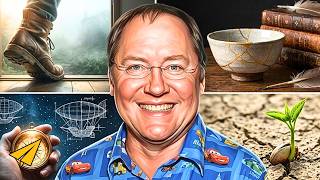
In this Believe Nation "Espresso" segment, host Evan Carmichael welcomes guest John Lasseter and viewer Tuan to discuss the power of taking risks and embracing failure. John opens by describing his daily espresso ritual and frames creativity as a responsibility to do something new, emphasizing that failure is a learning opportunity essential for growth. Tuan shares personal resonance, noting how confronting fear and taking risks creates shared wisdom and memorable experiences. Evan highlights everyday chances to say "yes" to scary opportunities, using Tuan’s decision to join the video as an example. The conversation then shifts to John’s advice for aspiring animators: master the fundamentals of drawing, design, storytelling, and film grammar, because software alone cannot make a film compelling. John recounts his own risk‑taking journey—advocating computer animation at Disney, being fired, joining Lucasfilm’s computer graphics group, and co‑founding Pixar with Ed Catmull and Steve Jobs, leading to the groundbreaking release of Toy Story. He outlines Pixar’s storytelling process: compelling, unpredictable narratives, memorable characters, and believable (not realistic) worlds, supported by extensive storyboard and sculptural work. The segment concludes with a call‑to‑action for viewers to declare the risk they will take in 2017, reinforcing the episode’s central message that daring, purposeful risk fuels creativity and success.
Chapters
Good morning, Believe Nation. Today's message is take risks.
Over to you, John Lasseter.
I wake up every morning with espresso. Keep me going. To create something that connects with people, that moves people, is the most fulfilling and satisfying work there is. For an artist, it is a— is truly a privilege to do this for a living. But with that privilege comes responsibility, and the privilege and responsibility are one in the same: to do something new. I say that it is a responsibility because to really truly be creative You have to be willing to take risks. You have to put yourself out there. You have to be willing to fail. Failure has such a negative connotation in our society, and I think this is totally unfair, because what failure really is, is the opportunity to learn. If we never failed, it would never occur to us to do things differently. You would just keep doing the same thing because it would always work. But the world changes, people change, and so we have to change. We have to fail in order to succeed.
So what do you think?
I thought it was really interesting because I resonate with it so well, just having going through tons of challenges myself. He talks about failure, and the only way I feel you could reach failure is is to take the risk. The funny thing is, when he said people are afraid of failure, the interesting thing I found is when I connect with friends and when I see people connecting with each other, they seem to connect through the lessons they've learned from their failures. And just by the virtue of that, I think it's so important to take that risk and embark on a journey where failure could be a wonderful step. You can create a memory and share with other people and grow and build wisdom.
I think we have opportunities every day to push our boundaries a little bit to say yes to something that we are afraid of. So as an example, even you being here right now, you know, Tuan bought 10 copies of my book, he's in town from Ottawa, has a whole day planned, and part of it is being here. And initially it was just come and get a book signed and say hi and continue on. I said, hey, why don't we make a video together? And it was a risk. It was a risk.
He was scared to do it, but you know what, I'm gonna do it.
And so you have chances every single day to say yes to an opportunity that may be scary, that may push some boundaries, that may make you, you know, a little fearful. Hayden's gonna jump. Yay!
And the interesting thing here is that, you know, I'm new into this world, so if you guys are kind of thinking about something that you're not familiar with, this is something I'm completely new to in terms of reaching out to influencers and really cool people that have inspired me like Evan. And all I wanted was, hey, why don't just ask for an autograph? That's all I was looking for, and who would have known that taking that risk gave me the opportunity to be here on the Expresso. This is sick, like, this is crazy, like, it's amazing.
A lot of people say no, a lot of people are too afraid, right? A lot of people turn down the opportunity, a lot of people don't even bother reaching out to say, "Hey, I'm coming to town, can I stop by for 5 minutes to sign a book, to have a book signed?" Right? A lot of people don't take that risk because they're just afraid of being rejected, and so, uh, Kudos to you. Thank you. For coming out and sharing a great—
Thank you.
You did a good job. That was a great job. And for you guys watching, you know, the next time you have that thought of something you want to do and that voice then comes to mind and says, "Hmm, maybe I shouldn't do it," stomp that other voice out and just give it a shot and see how it turns out.
So the question of the day today is: What risk are you going to take in 2017?
I love it. Leave it down in the comments below and we're going to join in the discussion. So thank you guys so much for watching. We believe in you and hope you continue to believe in yourself and whatever your one word is. Much love, and we'll see you again tomorrow morning for another shot of espresso.
I wake up every morning, espresso keep me going.
Guys, we're also looking at doing a top 10 on John Lasseter. Here is a sneak peek at some of the clips that are to come.
I hope you enjoy.
The thing I always tell students that really want to work in animation, or work in film for that matter, is do not forget to study the basics. Basic drawing, even for computer animation, you should know how to draw. Basic design, basic fundamentals of animation, where you learn the principles of animation. Film grammar, how do you stage things, you know, the— you know, how they do it in live-action filmmaking. Story writing, 3-act story structure is so vital to this. And you've, you've gotta learn all these basics because this is kind of like eating vegetables, you know. A lot of people don't want to do it. They just get on to the more flashy stuff of using all the latest software. But the thing is, is through your career, the software will change. It will always evolve and get better. What's important, and remember this, software never makes a movie entertaining. It's what you do with the software, and what you do with the software will be, will be, you know, you'll learn that from the basic fundamentals. You know, I rely on these, the basic fundamentals of art and design and filmmaking and animation and storytelling. You know, every single day of my career, it's something that just is a part of you. It's the foundation in which you work, and without those, you know, you won't go anywhere. So it's really important to get the fundamentals down. Loved animation.
I knew it was not just for kids. Walt Disney never made his movies just for kids. He made them for everybody. Chuck Jones made his cartoons to show in theaters in front of Warner Brothers movies for adults. But I felt it had to be done for today's audience. It had to be done in a new way. I found the answer when I was working at Disney, computer animation. I knew this was it. I knew this was the future. You see, one of the things that I always admired about Walt Disney was his innovative spirit. Walt had been a great advocate of the new, and many groundbreaking developments of film technology had their origins at his studio. I threw myself into suggesting projects that would show how the computer could be used to take Disney, Disney Animation to the next level. I even did a test. I kept getting the answers, "No, that's not how it's done. Is it cheaper? Is it faster?
Then no.
Just do what you're told." No one was willing to take risks, but that didn't stop me. I kept trying. I just couldn't let go of the idea that computer animation was something Disney should be doing because I knew it would make the studio and its films better. Then one day, the manager of the animation department, Mr. No himself, called me into his office and fired me. To be fired from the place of your dreams was so painful and embarrassing for me that it took decades before I could actually tell people about it. I made this kind of excuse up that I followed my dream somewhere else. Even as I got married, it took me a long time to tell Nancy, my wife, I had actually gotten fired. But as fate would have it, I met Ed Catmull of the Lucasfilm computer division. He and his group were doing the most innovative research in the world in computer graphics. And unlike the Disney just fired me. Ed was so excited about what I was trying to do, to combine classic animation principles to computer animation. I finally found someone who could see the future as I saw it. He invited me to come work with him. Then in 1986, Steve Jobs entered our lives. He was so excited about what he what we were trying to do that he bought our group from Lucasfilm, and we formed a new company called Pixar. He really pushed us to do what no one else had ever done before. The result, in 1995, we released the first computer-animated feature film ever made. We released Toy Story. Toy Story. To make a great film, I believe you have to do 3 things really well. Tell a compelling story that is unpredictable, keeps the audience on the edge of their seat. You populate that story with really appealing and memorable characters and put that story and those characters in a believable world. Believable for the story you're telling. Not realistic. We're not interested in reproducing reality. It's a believable world. So those three components are kind of the guiding structure of this exhibit. You see the development of the story through our storyboards. At Pixar, we, we We develop the story on the written word, on the script, but just in the very beginning. And then we go into creating the storyboards of the story. It's like a comic book version of the story. And that's where our story is developed. You see lots of that artwork. It's very quick and very rough, but it tells the story. It's amazing. You know, when you know our films, you look up there and you go, Oh, that's, that's the movie. It's a fantastic— developing the character design goes hand in hand with developing the story, and you see many, many versions of certain characters. We really do tremendous amount of experimentation in this, this way. So it's very interesting, and we produce three-dimensional sculptures. Of our characters. Because we always start with a two-dimensional drawing, but our final product is truly three-dimensional within the computer. And then the worlds that we create have to be so believable, and we do a tremendous amount of research for whatever worlds we're creating, but we want you to believe that these worlds exist on the final screen. So you will see some unbelievable art, landscape paintings, drawings, from tiny details because in our world, character and computer animation, you get nothing for free. You can't go on location and shoot a computer animated film. Everything is created by the artists at Pixar. So you'll see artwork from all of those three categories.