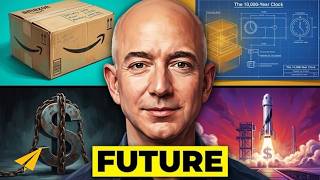
In this 14‑minute Mentor Me interview, host Evan Carmichael and interviewer Charlie Rose explore Jeff Bezos’s journey from the inception of Amazon (originally Cadabra.com) to its present‑day philosophy. Bezos recounts the 1994 web‑growth statistic that sparked the idea, his personal decision‑making framework – the Regret Minimization Principle – that led him to quit a stable job, and the practical steps of writing a 30‑page business plan on a cross‑country drive. He describes early financing from his parents, the odds he gave himself, and the importance of being stubborn about vision while staying flexible on execution. Bezos emphasizes the role of bold, experimental bets (AWS, Kindle, Prime, third‑party marketplace) and the necessity of embracing failure, noting billions in losses that funded later successes. He contrasts Amazon’s long‑term horizon (5‑8 years) with competitors’ short‑term pressure, and outlines the deep customer‑centric culture that he likens to hosting a party for guests. The conversation also touches on external perceptions – investors, rivals like Sears, Barnes & Noble, Walmart – and Bezos’s leadership mindset of waking up “petrified and afraid” to stay vigilant. The interview closes with a call to viewers to apply these lessons to their own lives and businesses.
Chapters
What's up, Believe Nation? It's Evan. My one word is believe, and I believe in you. I believe in your potential, and I want to see it be unleashed into the world to create something special for you, your family, and the world. And so to help you on your journey, I started the Mentor Me series to try to learn from people who've done a lot more than us, who've reached for the stars. And if we can learn about their mindset, their mentality, how they approach life, hopefully some of that seeps into us to help us become the best version of ourselves. So today we're gonna learn from Jeff Bezos and the Amazon journey. Mentor me, Jeff. And as always, guys, as you're watching, if you hear something that really resonates with you, please leave it down in the comments below and put it in quotes so other people can be inspired. And when you write it down, it's much more likely to stick with yourself as well. Enjoy.
The wake-up call was finding this startling statistic that web usage in the spring of 1994 was growing at 2,300% a year. You know, things just don't grow that fast. It's highly unusual. And that set me about thinking what, you know, what kind of business plan might make sense in the context of that growth. I started this most incredible journey called Amazon.com. Actually, at that time, it wasn't even called Amazon.com. It was called Cadabra.com. Cadabra Inc., as in abracadabra. That was the original name of the company. And I had phoned a lawyer on the way to Seattle from a cell phone. And he said, well, what do you— to incorporate the company. He said, what do you want the company to be called? And I said, Cadabra. And he said, cadaver? And I knew that was a bad name. We changed it a few months later. How did you go through making the decision to drop what was a very good job and take this chance? It all seems very obvious now, right? This many years later that it paid off, but at the time it was not obvious.
No, it wasn't, and I did do a lot of soul searching. I went to my boss at the time, and I really liked my job, and I told my boss I was gonna go do this thing, start an internet bookstore, and my wife, I'd already told my wife, and she's like, "Great, let's go." And I said to my boss, I was gonna do this. He's like, this is a good idea. He said, I think this is a good idea, but it would be an even better idea for somebody who didn't already have a good job. And that sort of made some logical sense to me, and he convinced me to think about it for a couple days, so I went away. I was really trying to get my head around how to think about this. And I think, for me, the right way to make that kind of very personal decision, 'cause those decisions are personal, they're not like, data-driven business decisions. They are, you know, what does your heart say? And for me, it was— I could— the best way to think about it was to project myself forward to age 80 and say, look, when I'm 80 years old, I want to have minimized the number of regrets that I have. I don't want to be 80 years old in a quiet moment of reflection thinking back over my life and cataloging a bunch of major regrets. And I think that regrets, our biggest regrets in most cases— you can murder somebody, Okay, you'd regret that. But in most cases, our biggest regrets turn out to be acts of omission. It's paths not taken, and they haunt us. We wonder, what would have happened? I loved that person, and I never told them, and then they married somebody else. I didn't do this. And so that's the frame of mind that I put myself in, and once I did that, once I thought about it that way, it was immediately obvious to me. I knew that when I'm 80, I would never regret trying this thing that I was super excited about and failing. If it failed, fine. I would be very proud of the fact when I'm 80 that I tried. And I also knew that it would always haunt me if I didn't try. And so that would be a regret. It would be a 100% chance of a regret if I didn't try and— basically a 0% chance of regret if I tried and failed. So I think that's a useful metric for any important life decision.
That blank sheet of paper stage is one of the hardest stages, and one of the reasons it's hard is because there's, at that stage, there's nobody counting on you but yourself. You know, one of the things that is very motivating, I mean, today it's easy because we've got, you know, millions of customers counting on us and, you know, thousands of investors counting on us and then thousands of employees all counting on each other. But in that beginning stage, It's really just you. And you can quit any time. Nobody's gonna care. And so you set about doing the simple things first. So you wanna start a company. Well, the first thing you do is you should write a business plan. And so I did that. I wrote about a 30-page business plan. I wrote a first draft. In fact, I wrote the first draft on the car trip from, you know, from the East Coast to the West Coast. That was, that is very helpful. Now the business plan won't survive its first encounters with reality. It will always be different. The reality will never be the plan. But the discipline of writing the plan forces you to think through some of the issues and to get sort of mentally comfortable in the space. I mean, then you sort of, you start to understand, you know, if you push on this knob, this will move over here and so on. And so that's the first step, writing the business plan, the initial hiring, getting the company incorporated. Uh, uh, uh, all these are, you know, they're very, in a way, they're sort of, you know, simple, almost pedestrian tasks, but that's how you start, one step at a time. It's easy to have ideas. It's very hard to turn an idea into a successful product. There are a lot of steps in between, and it takes Persistence, relentlessness. So I always tell people who are, you know, who think they want to be entrepreneurs, it's you need a combination of stubborn relentlessness and flexibility, and you have to know when to be which. And basically you need to be stubborn on your vision because otherwise it'll be too easy to give up, but you need to be very flexible on the details, because as you go along pursuing your vision, you'll find that some of your preconceptions were wrong, and you're going to need to be able to change those things. So I think taking an idea successfully all the way to the market and turning it into a real product that people care about and that really improves people's lives is a lot of hard work. The first sort of initial startup capital for Amazon.com came primarily from my parents, and they invested a large fraction of their life savings in what became Amazon.com. And that is a— was a very bold and trusting thing for them to do because they didn't— my dad's first question was, "What's the internet?" So he wasn't making a bet on this company or this concept. He was making a bet on his son, as was my mother. So, and I told them that I thought there was a 70% chance that they would lose their whole investment, which was a few hundred thousand dollars. And they did it anyway. And, you know, and I thought I was giving myself triple the normal odds because, you know, there's really, you know, if you look at the odds of a startup company succeeding at all, it's only about 10%. Here I was giving myself a 30% chance. My job, one of my jobs as the leader of Amazon, is to encourage people to be bold. And people love to focus on things that aren't yet working.
And that's good.
It's human nature. That kind of divine discontent can be very helpful. But you really, you know, it's incredibly hard to get people to take bold bets and you need to encourage that.
And if you're going to take bold bets, they're going to be experiments.
And if they're experiments, you don't know ahead of time whether they're going to work. Experiments are by their very nature prone to failure. But big successes, a few big successes compensate for dozens and dozens of things that didn't work. So, you know, bold bets, AWS, Kindle, Amazon Prime, our third-party seller business, all of those things are examples of bold bets that did work, and they pay for a lot of experiments. I've made billions of dollars of failures at Amazon.com, literally billions of dollars of failures. And, you know, you might remember Pets.com or Cosmo, or, you know, give myself a root canal with no anesthesia very easily.
None of those things are fun, But they also, they don't matter.
What really matters is companies that don't continue to experiment, companies that don't embrace failure, they eventually get in a desperate position where they, the only thing they can do is make a kind of Hail Mary bet at the very end of their corporate existence. Whereas companies that are, you know, making bets all along, even, you know, Big bets, but not bet the company bets. I don't believe in bet the company bets. That's when you're desperate. That's the last thing you can do. What has worked at Amazon is focusing on the customer, being very— putting the customer first, which is easy to say but difficult to do. If you really are customer-centric, it's like being the host of a party. You're holding the party for your guests. Sometimes the host of the party is holding the party for the host of the party. And that leads to a different kind of party. What we have always wanted to do is raise the standard for what it means to be customer-centric to such a degree that other organizations, whether they be other companies or whether they be hospitals or government agencies, whatever the organization is, they should look at Amazon as a role model and say, how can we be as customer-centric as Amazon? Even competitors, I imagine, right? Hopefully competitors as well. But if we could make, you know, if that could be our legacy, that we kind of raised the general idea of what it means to be customer-centric, that would be a huge accomplishment. It would be accomplishing a mission that's much bigger than ourselves.
You have to back up and find the right time horizon for what you're trying to do, but, you know, at Amazon we probably do most of our things, we expect to get some results in sort of 5, 6, 7, 8 years. But we find a lot of our, you know, other companies that compete against us in various ways, they're often trying to get things done in, you know, 2 or 3 years. And so we can do things that, you know, if everything has to work in 2 to 3 years, then that limits what you can do. If you give yourself the, the breathing room to say, okay, I'm okay if it takes 7 years, all of a sudden you have way more opportunities.
And Wall Street isn't concerned that Amazon has never made a profit, not a dime. In fact, it lost $125 million last year. The company says it's investing for the future. Skeptics say it would have to sell every book being sold in the world today to justify its stock price. I think my generation grew up with Sears, and Amazon is worth 20% more than Sears is worth in market capitalization. How do you view that phenomenon that Amazon today is worth more than Sears? Investors are focused on the future. Amazon has growth potential that Sears doesn't. A couple of geeks who sketched out some software could destroy Sears Roebuck. That's the beauty of technology. It's getting really nasty out there, it seems to me. The online bookstore, the Barnes Noble bookstore, is so big it makes Amazon.com look tiny. Seems to me that this is almost a declaration of war.
Well, it's not just Barnes Noble, but one of the things—
Walmart is suing you?
That's right.
And you're surrounded by enemies. People want to get you. Establishment is big and powerful. Do you ever get scared?
Well, I I tell people around here to wake up petrified and afraid every morning.
Do you?
I do.
A lot of small book publishers and other smaller companies worry that the power of Amazon gives them no chance.
You gotta earn your keep in this world. When you invent something new, if customers come to the party, it's disruptive to the old way.
Yeah, but I mean, there are areas where your power's so great and your margin, you're prepared to make it so thin that you can drive people out of business and you have that kind of strength. And people worried, is Amazon ruthless in their pursuit of market share?
The internet is disrupting every media industry, Charlie. You know, people can complain about that, but complaining is not a strategy. Amazon is not happening to bookselling. The future is happening to bookselling.
Thank you guys so much for watching. I hope you enjoyed. I'd love to know what did you take from this video? What are you going to immediately apply somehow to your life or to your business? Please leave your thoughts down in the comments below. I look forward to hearing what you have to say. I also want to give a quick shout out to Brandon Hood. Brandon, thank you so much for picking up a copy of my book, Your One Word, and doing the review on your channel. I really, really appreciate the support, man, and I'm so glad you enjoyed the book. Today we have a special guest, Evan Carmichael. So thank you guys so much for watching. I believe in you. I hope you continue to believe in yourself and whatever your one word is. Much love, guys. I'll see you soon.
So let me give you the one word secret to happiness. One word. This is all you need to be happy. It's the most important word ever. If you had to think of one word that's most important to you or that sums you up or that would be kind of like a little beacon.
Hey, Believe Nation. If you want to know what the most important one word is for Tony Robbins, Gary Vaynerchuk, Oprah Winfrey, will.i.am, and Howard Schultz, I have a very special secret video for you. Check the description for details.