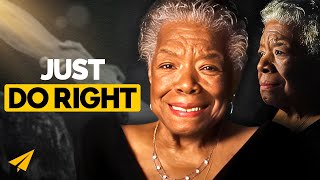
In this 20‑minute video, host Evan Carmichael introduces Maya Angelou and presents her "top 10 rules for success" through a series of candid, unscripted reflections. Angelou repeatedly emphasizes courage as the foundational virtue that enables all other virtues, and she expands on self‑love, the importance of community, and the responsibility to protect one’s innate talent. She shares a harrowing personal story of being raped at age seven, the subsequent five‑year muteness, and how intensive reading and spiritual listening transformed that trauma into a reservoir of knowledge and resilience. Angelou uses vivid metaphors—paintings of her grandmother’s prayer group, rainbows in clouds, and being a "rainbow in somebody else’s cloud"—to illustrate how we can draw strength from our ancestors and become blessings to others. She also discusses the role of humor as a defense against cruelty, the universality of talent, and the vision of a world where even 1 % of people live complaint‑free, imagining the end of war and universal kindness. Throughout, Carmichael frames the content with calls to action, encouraging viewers to comment, share favorite quotes, and support his channel. The video blends biographical storytelling, philosophical guidance, and motivational exhortation, offering concrete principles (courage, self‑love, community, talent stewardship, humor, and compassionate action) that Angelou believes can change lives and, collectively, the world.
Chapters
If your name is mentioned and people say, "Oh, hell. Oh, damn," I think you're doing something wrong. Courage is the most important of all the virtues, because without courage, you can't practice any other virtue. There's an African saying which is, "Be careful when a naked person offers you a shirt." I thought that I had caused the man's death. —because I had spoken his name.
She was an American poet and civil rights activist. She's best known for her series of 7 autobiographies which focuses on her childhood and early adult experiences. She was respected as a spokesperson for Black people and women, and her works were considered as a defense of Black culture. She's Maya Angelou, and here's my take on her top 10 rules for success. Rule number 1 was my personal favorite, and make sure to stick around all the way to the end for some special bonus clips. Also, as she's talking, if there's something she says that really resonates with you, please write it down in the comments and put quotes around it so that other people can be inspired as well.
I have a painting by Phoebe of a group that she calls Sister Suki's Funeral, and they're all the women— there are about 9 women— and they, they all look like women in my grandmother's prayer meeting group. So whenever I'm obliged to do something, I take that painting And I look at that painting, there's an empty chair, and I think, now what would Grandma do? What would she say? I can almost hear her voice say, "Now sister, you know what's right. Just do right. You don't really have to ask anybody." The truth is, right may not be expedient, it may not be profitable, but it will satisfy your soul. It brings you the kind of protection that bodyguards can't give you. Try to be all you can be, to be the best human being you can be. Try to be that in your church, in your temple. Try to be that in your classroom. Do it because it is right to do. You see, people will know you, and they will add their prayers to your— life, they'll wish you well. I think if your name is mentioned and people say, "Oh, hell. Oh, damn," I think you're doing something wrong. But if your name is mentioned and people say, "Oh, she's so sweet. He's so nice. Oh, I love— Oh, God bless her," there you are. So try to live your life in a way that you will not regret years of useless virtue and inertia and timidity Take up the battle. Take it up. It's yours. This is your life. This is your world. I'll be leaving it long before you under the ordinary set of circumstances. You make your own choices. You can decide life isn't worth living, and that would be the worst thing you can do. How do you know? So far. Try it. See. So pick it up. Pick up the— battle and, and make it a better world. Just where you are. Yes, and it can be better, and it must be better, but it is up to us. I mentioned courage, and I would, I would like to say something else about that— finding courage in the leaders and in you who will become leaders. Courage is the most important of all the virtues, because without courage you can't practice any other virtue consistently. You see, you can't be consistently kind or fair or humane or generous, not without courage, because if you don't have it, sooner or later you'll stop and say, ah, the threat is too much, the difficulty is too too high. The challenge is too great. You know, I believe that self-love is very important. If you read my work, you know I'm always talking about loving oneself. I never trust anybody who tells me he or she loves me if the person doesn't love herself or himself. There's an African saying which is, be careful when a naked person offered you a shirt. I mean, if he had something, he'd cover himself first, right? So I like to look at self-love. It is very important that it comes from within, that you have a sense of yourself, so that when you walk into an office, you don't go alone. Bring your people with you. Bring everybody who has loved you with you. Say, "Grandma, come on, let's go." "Great-grandpa, you've been dead all this time, come on, let's go." "I have to go in here and have an interview. Come on, Auntie." "Come on, my friends. Come, let's go." And when you walk in, people don't know what it is about you. They can't take their eyes off you. You may not be cute in the given sense. You may not be fashion model size in that particular sense. You may not be any of those things, but they can't take their eyes off you. And they say of you, in this incredible way, which I don't understand, they say, "I don't know, but she has charisma." No, what you have is all those people around you. So think of that. Anytime you have anything to do, bring everybody with you that you can remember. Who has loved you. And then you have that sense of having been paid for. And when you walk in, people will say, "Now, I think you're overqualified." If you don't laugh, you will die. You know, you really must laugh. And if every human being in the world would admit it, he or she is the funniest person you've ever met. And the truth is, I mean, some people just rather be a little stodgy and boring and, you know, But the truth is they themselves know that they are very funny. The sense of humor is in self-defense against those who have, pretend not to have any sense of humor, and against the cruelties of life. One must laugh. There's an African-American song, 19th Century, which is so great. It says, When it looked like the sun wasn't gonna shine anymore, God put a rainbow in the clouds. Imagine. And I've had so many rainbows in my clouds. I had a lot of clouds. But I have had so many rainbows. And one of the things I do when I step up on a stage, when I stand up, to translate, when I go to teach my classes, when I go to direct a movie, I bring everyone who has ever been kind to me with me. Black, white, Asian, Spanish-speaking, Native American, gay, straight, everybody. I say, "Come with me. I'm going on the stage. Come with me. I need you now." Long dead, you see? So I don't ever feel I have no help. I've had rainbows in my clouds. And the thing to do, it seems to me, is to prepare yourself so that you can be a rainbow in somebody else's cloud. Somebody who may not look like you, may not call God the same name you call God, if they call God at all, you see, and may not eat the same dishes prepared the way you do. May not dance your dances or speak your language, but be a blessing to somebody. When I was 7 and a half, I was raped. I won't say severely raped. All rape is severe. The rapist was a person very well known to my family. I was hospitalized. The rapist was let out of jail and was found dead that night, and the police suggested that the rapist had been kicked to death. I was 7 and a half. I thought that I had caused the man's death because I had spoken his name. That was my 7 and a half year old logic. So I stopped talking for 5 years. Now to show you again how out of evil there can come good. In those 5 years, I read every book in the Black school library. I read all the books I could get from the white school library. I memorized James Weldon Johnson, Paul Laurence Dunbar, Countee Cullen, and Langston Hughes. I memorized Shakespeare, whole plays, 50 sonnets. I memorized Edgar Allan Poe, all the poetry. Never having heard it, I memorized it. I had Longfellow, I had Guy de Maupassant, I had Balzac. Ah, Rudyard Kipling. I mean, it was Catholic kind of reading and Catholic kind of story. When I decided to speak, I had a lot to say and many ways in which to say what I had to say. I listened to the Black minister. I listened to the melody of the preachers. And I could tell when they would start up on that kind of thing, when we know they mean to take our souls straight to heaven, or whether they meant to dash us straight to hell. I understood it. So out of this evil, which was a dire kind of evil, because rape on the body of a young person, more often than not, introduces cynicism. And there is nothing quite so tragic as a young cynic, because it means the person has gone from knowing nothing to believing nothing. In my case, I was saved in that muteness, you see, in the surada. I was saved. And I was able to draw from human thought human disappointments and triumphs enough to triumph myself. We don't understand talent. We don't understand electricity. We probably use 1 billionth of 1 billionth percentage, a less— I mean, a degree so infinitesimal that we couldn't even say how little it is. You can plug into two holes in the wall, you can light up a cathedral, you can light up a synagogue, you can light up a temple, right? You can light up a surgery, or you can electrocute a person strapped in a chair. Electricity makes no demands. It says, I'm here. If you are stupid, you will ill-use me. If you're intelligent, you will use me for the for the furtherance of your kind. Well, I think talent is like that. We don't know what it is, but a painter, maybe he or she is born with the eyesight to see depth and you understand, to have— but that's physical. Maybe she is born with the throat that makes her sound like a Bird, you know, a coloratura lyric soprano, baritone. But singing has very little to do with voice. It is okay, but if it really was about voice, Ray Charles and Willie Nelson wouldn't be mentioned. That's true.
And I, you know, I just did a story on autism, and it was, uh, the people who couldn't write, couldn't express themselves, but sang in pitch. In pitch.
And beautifully. And can compute 40 columns of 3 numbers each. That's talent.
Right. How do they do that? That's talent. That's talent.
I don't know it. I mean, I thank God I have it, but I think every person born is born with talent. There's a place in you that you must keep inviolate. You must keep it pristine, clean, so that nobody has the right to curse you or treat you badly. Nobody. No mother, father, no wife, no husband, no— nobody. Because that may be the place you go to when you meet God. You have to have a place that you say, "Stop it. Back up." not hear it once. You must not. No. No. Absolutely. And that's one I told you 25 years ago. Yes. Say no when it's no. Yeah. Say so. Back it up. Because that place has to remain clean and clear. And that has to be a place within yourself. Yes, ma'am. Yeah.
When you're writing poetry, are you writing to express your experiences or or do you write to inspire other people?
No, I write to, to try to say what I see, what I've seen. And of course I hope that it's inspirational.
When you were writing Phenomenal Woman, did you realize how many millions of women would be inspired by that?
No, I don't realize any of that. I just, I just do the best I can. You may write me down in history with your bitter twisted lies. You may trod me in the very dirt, but still like dust I'll rise. Does my sassiness upset you? Why are you beset with gloom? Just 'cause I walk as if I have oil wells pumping in my living room. Just like moons and like suns with the The uncertainty of tides, just like hope springing high. Still I rise. Did you want to see me broken, bowed head and lowered eyes, shoulders falling down like teardrops, weakened by my soulful cries? Does my sassiness upset you? Hahaha! Don't take it so hard just 'cause I laugh. As if I have gold mines digging in my own backyard. You can shoot me with your words, you can cut me with your lies, you can kill me with your hatefulness, but just like life, I rise. Does my sexiness offend you? Oh. Does it come as a surprise that I dance? As if I have diamonds at the meeting of my thighs. Out of the huts of history's shame I rise. Up from a past rooted in pain I rise. A black ocean leaping and wide, welling and swelling and bearing in the tide. Leaving behind nights of terror, Terror and fear, I rise. Into a daybreak miraculously clear, I rise. Bringing the gifts that my ancestors gave, I am the hope and the dream of the slave and self. Wow. There I go.
Thank you guys so much for watching. I made this video because Kayla Maroon asked me to. So if there's a famous entrepreneur that you want me to profile next, leave in the comments below and I'll see what I can do. I'd also love to know what you thought of the video. What clips resonated the most with you? What, what did you learn that's going to change your business or your life? Leave it in the comments and I will join in the discussion. Finally, I want to give a quick shout out to Philip Norton. Philip, thank you so much for buying a copy of my book. Really means a lot to me. Those of you guys watching, if you want your chance at a shout out in a future video, make sure to pick up a copy of the book and email in your receipt so we can keep track. Thank you guys so much for watching. Continue to believe, or whatever your one word is, and I'll see you soon.
If we've been able to stay alive at all, alive and future-thinking, alive and having enough courage to care for each other, enough courage to love, and know that we are probably 1% free. I mean, let's— what, 1% of 60 million free of complaints. Imagine Who would we be? Who would we be if we were 1% of 600 million? 6 billion? What would happen? I tell you one thing, I think war would be laughed out of the room. I think the very word, if somebody said war, another person would say, "You mean am I supposed to kill somebody because he doesn't agree with me?" Ahh! I don't think so. Just imagine, people would speak kinder, more kindly to each other. Courtesy would be invited back into the living room, into the bedroom, into the children's room, into the kitchen. If 1% of our world was completely complaint-free, we would care more about the children and realize that every child is our child. The black one and the white one, the pretty one and the plain one, the Asian and the Muslim, the Japanese and the Jewish. Everyone is our child. If we were just 1% free of complaint, imagine that we would stop blaming other people for our mistakes and hating them because they caused the mistake in our minds. Just imagine if we laughed more frequently, if we had the unmitigated courage to touch each other. It would be just the beginning of paradise in now. Thank you.