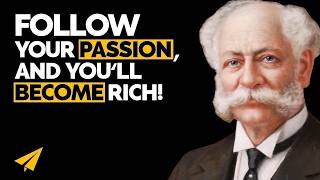
In this episode of Modeling the Masters, Evan Carmichael narrates the life of Henry J. Heinz, the son of German immigrants who defied his parents' wish for him to become a preacher and built the H.J. Heinz Company into a food‑production empire. The video outlines Heinz’s early entrepreneurial activities—making horseradish sauce at age nine, expanding his garden, and earning $2,400 a year by age seventeen—followed by his growth into a multi‑plant, 6,500‑employee corporation. Carmichael distills three actionable lessons for modern entrepreneurs: (1) craft a memorable slogan, illustrated by Heinz’s spontaneous creation of the “57 Varieties” tagline; (2) use bold, unique promotions, exemplified by the 1900 six‑story electric pickle sign and the pioneering factory‑tour concept; and (3) prioritize product quality and transparent packaging, highlighted by Heinz’s clear glass bottles and emphasis on purity. The narrative also recounts Heinz’s 1875 bankruptcy, underscoring his resolve to never rely on others again. The video closes with a favorite anecdote and quotes, and a call‑to‑action for viewers.
Chapters
Hi, I'm Evan Carmichael and welcome to another edition of Modeling the Masters. Today we're going to look at how the son of immigrant laborers went against his parents' dreams of him becoming a preacher and built one of the most successful companies in the food production business. This is the story of Henry Heinz and the top 3 lessons that you can learn from his success.
Henry John Heinz was an American businessman who founded the H.J. Heinz Company. He was the first of 8 children born to German immigrant parents who wanted him to become a preacher. Heinz, however, had other plans. His passion was helping his mother bottle and sell the pickles she grew in their yard, and he saw his future in food production. By the time he was just 9 years old, Heinz was growing, grinding, bottling, and selling his own brand of horseradish sauce. At 10, Heinz was given 3/4 of an acre of land to tend his own garden. At 12, he had graduated to 3.5 acres of land and was using a horse and cart to make his deliveries to grocery stores. By the time he reached 17 years old, Heinz was making $2,400 a year from his produce, close to $60,000 in today's dollars. Heinz eventually expanded his business by focusing on making new product lines including pickles and ketchup. Heinz stayed on as president of the company he had founded until his death at age 74. By that time, the H.J. Heinz Company had more than 25 food processing plants, 40,000 acres of land under cultivation, and over 6,500 employees.
By following his passion and by working hard, Heinz was eventually able to make his parents proud and dominate his industry. To help you dominate your industry, here are 3 action items that you can learn from Henry Heinz.
Action Item #1: Create a catchy slogan. Whatever industry you're in, you probably have many competitors. How can you stand out from everyone else? A great way to cut through the clutter is to create a catchy slogan that highlights what you're really good at. Heinz was looking for a slogan while riding on a streetcar in New York one day in 1896. He then saw an advertisement for a shoe store that read "21 styles." According to Heinz, "I said to myself, 'We don't have styles of products, but we do have varieties of products.' Counting up how many we had, I counted well beyond 57." But 57 kept coming back to my mind. Seven. Seven. There are so many illustrations of the psychological influence of that figure and of its alluring significance to people of all ages and races that 58 Varieties or 59 Varieties didn't appeal to me as being equally strong. With that, Heinz immediately jumped off the streetcar, went down to the print shop, and drafted up a card with the new 57 Varieties slogan. Reflecting back, Heinz acknowledged, I myself did not realize how highly successful a slogan it was going to be. Action Item #2: Be Unique with Your Promotions. Another great way to cut through the clutter and have potential customers pay attention to you is to be unique with your promotional campaigns. No tactic was too flashy or gaudy for Heinz. He wanted his products to stand out and shine—literally. In 1900, Heinz decided to erect the first ever electric sign in New York City. On the corner of Fifth Avenue and 23rd Street in Manhattan. Standing 6 stories tall, the sign was a large electric-lit pickle that bore the Heinz name and its "57 Varieties" slogan. In the display room below the sign, Heinz employees could be seen packing miniature pickles into bottles. The sign took 1,200 light bulbs to build and cost the company some $90 every night, but for Heinz, it was all worth it. For years, this electric pickle impressed shoppers along the famous New York Strip and served as invaluable advertising. Heinz was a master promoter and was even responsible for pioneering one of the major trends in the industry. Obsessed with quality, freshness, and cleanliness, Heinz invented the concept of the factory tour. Anyone who was interested in seeing how Heinz produced and packaged his products was now allowed to witness the product firsthand. He was confident in his operations and believed opening it up to the public would help build confidence and trust in his company. The move sparked an outburst of positive publicity, not to mention a wave of copycats. Action Item #3: Have a quality product and be proud of it. Most of the famous entrepreneurs achieved success not because they were trying to make a lot of money, but because they created a product or service that was good quality and that they were proud to make and promote. Heinz was very proud of all of his products. In addition to allowing the public access to his factories, he also opened up his products to them. Literally, he was one of the first to ever package his products in clear glass bottles. Heinz's competitors would often use filler ingredients to pump up the volume of their products and then conceal the fact by using opaque colored containers. Heinz wanted his customers to see exactly what they were buying. He was proud of his product's quality and offered transparent bottles to ensure customers that they were getting their money's worth. Heinz's biographer Robert C. Alberts claimed that Heinz had hit on one of the most important and shaping business ideas of his time: that a pure article of superior quality could find a ready market through its intrinsic value, so long as it was packaged and promoted properly.
So remember, create a catchy slogan, be unique with your promotions, and have a quality product and be proud of it. To finish up this video, I wanted to share one of my favorite true stories about Henry Heinz and some of his best quotes.
In the banking panic of 1875, a young Heinz found himself overextended and bankrupt. He had tried unsuccessfully to turn for help to the grocers he had been supplying with produce over the past few years. They, however, turned their backs on him too. He couldn't even get enough credit to feed his family. With that, Heinz decided that he would never again be placed in a situation where he had to depend on others to survive. He made a decision to be successful and never looked back.
Thank you for joining me for another edition of Modeling the Masters. If you enjoyed, please give the video a thumbs up below. I'd also love to hear your feedback if you want to leave a comment, and stay tuned for the next episode.