ALL OF THE STOCK MARKET Explained in 20 Minutes
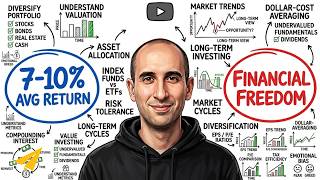
In this 20‑minute video Evan Carmichael demystifies the stock market for beginners, arguing that it is not a casino but a tool for building long‑term wealth through ownership of real businesses. He opens with warnings from Warren Buffett and other investors about the dangers of treating stocks like gambling, then tells the inspiring story of Ronald Read – a gas‑station attendant and janitor who amassed an $8 million fortune by consistently buying dividend‑paying blue‑chip stocks, reinvesting dividends, and letting compounding work over decades. Carmichael explains the fundamentals of what a share represents, how market capitalization is calculated, and how companies go public via IPOs. He describes the role of stock exchanges (NYSE, Nasdaq) and how prices are set by supply and demand through the order book’s bid and ask. The video clarifies market moods (bull, bear, sideways) and stresses that short‑term price swings are emotional, while long‑term trends follow business earnings. He differentiates investing from gambling, emphasizing patience, ownership, and diversification. Indexes such as the S&P 500 and Dow Jones are introduced as simple ways to own a broad slice of the market, and the power of dividends and compounding is highlighted. Historical data shows the market’s average 10 % annual return despite wars, depressions, and crashes, reinforcing the idea that humanity’s continual innovation drives growth. Finally, Carmichael gives three actionable steps: open a zero‑fee brokerage account, buy an S&P 500 index fund or ETF, and use dollar‑cost averaging to invest regularly, while maintaining emotional discipline to avoid greed and fear. The video ends with a call to action to download a free worksheet and continue the journey toward financial freedom.
Chapters
The stock market isn't a casino, and believing that it is might be the most expensive mistake you ever make.
Stocks are not lottery tickets. There's a company behind every stock. If a company does well, the stock does well. It's not that complicated.
I have never had less than 80% of my money in American business. You can call them stocks. I don't want to own anything else.
62% of Americans already own stock, according to Gallup in 2025. Yet most of them couldn't explain what they actually own or how it really works.
The single, single most important thing to me The key in the stock market for anyone is to know what you own. I'm amazed how many people own stocks, they would not be able to tell you why they own it. If you can't explain, I'm serious, if you can't explain to a 10-year-old in 2 minutes or less why you own a stock, you shouldn't own it.
90% of the people that buy stocks don't think of them the right way. They think about something that they hope goes up next week. And they think about the market as something they hope goes up. And if it's down, they feel worse. I feel better.
So it's not even about stocks at all. It's about whether you spend the next 40 years trading your time for a paycheck, or you finally get your money working harder than you do.
You can't wait till you have a ton of money to start investing and think, I'm not an investor. What you gotta do is say, rather than my Apple phone, let me own Apple stock. Let me own a piece of all the best companies, not just Apple. I've gotta become an owner, or I'll always be in scarcity.
Longer-term, stock market's been the best place to be. Last 10 years, last 30 years, last 130 years. But if you need the money in 1 or 2 years, you shouldn't be buying stocks.
The first rule in investment is don't lose. And the second rule in investment is don't forget the first rule. And that's all the rules there are. I mean, if you buy things for far below what they're worth and you buy a group of them, you basically don't lose money.
Let me tell you about a man named Ronald Read. He wasn't a tech founder. He didn't invent an app. He wasn't born into money. Ronald pumped gas and fixed cars at a service station in Vermont for 25 years, and then he worked as a janitor at a JCPenney store for another 17 years. He wore old flannel shirts and a worn coat he held together with a safety pin. He drove a secondhand car. He gathered fallen branches for his own firewood and ate simple breakfast at the local diner. Everyone in his small town assumed he was just barely getting by. Then in 2014, Ronald passed away at 92 years old, and the entire town was stunned because this quiet janitor left behind an estate worth almost $8 million. He gave $1.2 million to the local library and $4.8 to the local hospital. People could not believe it. How does a gas station attendant die with $8 million in the bank? He didn't win the lottery. He didn't have some secret inheritance. Here's what he did. He read the Wall Street Journal every single day. He spent far less than he earned, and he quietly invested the difference into blue chip stocks, household names that you already know. Then he reinvested every dividend they paid him, and he waited for decades while his neighbors bought the shiny new cars to look successful to their friends. Ronald was busy actually becoming wealthy. He understood something most people never figure out their entire lives. Looking rich and being rich are two completely different things. And the stock market was the simple tool that turned a janitor's small paycheck into a fortune. Now, maybe you think this only works for other people, right? You might be thinking you don't earn enough to invest or that the market is just way too risky right now and you'll lose whatever you put in because honestly, it feels like rolling the dice in a casino in a game that you don't understand, right? I hear you, and I think all progress begins with telling the truth. So here's the truth. Ronald Read was never rich when he started. He was pumping gas. He never once earned a big salary in his life. What he had wasn't money. It was understanding. The only reason the market might feel like a casino to you is that nobody ever sat down and explained the rules of the game. And you can't win a game when you don't even know how it's played. So give me the next few minutes. Forget everything that's ever confused you about the stock market, and I'm going to explain the entire stock market to you like you're brand new but very smart. And by the end, you'll see it the exact same way Ronald did. If you've been here before, drop a hashtag #believe in the comments below so I can feature you here in a future video. And if you're new, welcome to Believe Nation, the only channel that helps you believe in yourself daily, one video at a time.
Believe.
A share of stock is a real piece of a real business. So let's start at the very beginning because this is where most people get lost. When you buy a share of a stock, you are not buying a lottery ticket or a magic number on some screen. You're buying a tiny piece of an actual company. You become a part owner of that business. If you own one share of Apple, you own a real slice of every iPhone they sell, every store they run, every dollar of profit they make. That's it. That's the whole idea. And it's simpler than anyone makes it sound. Now, here's a quick way to see how big a company really is. You take the price of one share and you multiply it by the total number of shares that exist. That number is called the market capitalization, and it's just what the public has decided the entire company is worth. Right now. So when you hear that a company is worth $2 trillion, all that means is it has a lot of shares, each one owned by people just like you. Understand this and everything else starts to click into place. You are not just gambling on numbers. You're buying ownership in real businesses that make real things and earn real money. And as those businesses grow over the years, the value of your little piece grows right alongside them. That's the entire engine of building wealth in the stock market. How a company even gets on the market. So how does a company's stock end up sitting in your app available to buy? It goes through something called an IPO, which stands for initial public offering. That's the day a private company decides to sell pieces of itself to the public for the very first time. And to pull it off, the company hires an investment banker that studies the business. They set a starting price and then they offer those shares to investors. It's not quick and it's not cheap. A typical IPO takes 6 to 9 months from start to finish, and it can cost the company around 10% of all the money it raises just in legal accounting and banking fees. That's how big a deal going public really is. And once the company is public, its stock trades on a stock exchange. An exchange is just a giant, heavily regulated marketplace that connects people who want to buy with people who want to sell. So in the US, two giants run the show. It's the New York Stock Exchange was founded all the way back in 1792 and has more than 2,800 mostly large established blue chip companies. And then the Nasdaq came along in 1971 as the world's first fully electronic market. And lists over 3,300 companies packed with tech names like Apple and Microsoft. So when you tap that buy button, your order shoots over to one of these exchanges and gets matched with a seller in a fraction of a second. You don't need to yell on a trading floor to buy it. What actually makes a price go up and down? So here's the part that confuses almost everyone, so stay with me. A stock's price is not set by some boss sitting in a back room deciding what it should be. It's set by supply and demand, by real people deciding to buy and sell the share. Every exchange Each exchange keeps a running list called an order book. The highest price a buyer is willing to pay is called the bid, and the lowest price a seller is willing to accept is called the ask. When more people want to buy than sell, those eager buyers snap up the available shares and have to offer a little more to win them. So the price goes up. When more people want to sell, sellers start accepting lower and lower offers just to get out, and the price slides down. That's it. That's the whole machine. So what gets people excited to buy or scared to sell? News and numbers. Strong company earnings, good economic reports, and exciting new products, those bring buyers running in. A weak quarter, scary headlines, bad economy, those send people rushing for the exits. You'll hear 3 nicknames for this mood. A bull market is when prices keep rising and everyone feels optimistic. A bear market is when prices keep falling and fear takes over. And a flat or sideways market is when price just drifts and nothing dramatic happens. But here is the one sentence that you can tattoo on your brain. In the short term, prices swing on emotion, but in the long term, prices follow how much money the business actually earns. Remember that and you'll stay calm when everyone else is panicking. Investing is not the same as gambling. So let me clear up the biggest myth of all, because it's the one that keeps a lot of people stuck on the sidelines. There is a huge difference between investing and gambling, even though they can look similar. When you look at it from the outside. Gambling is betting on a quick outcome that you can't control, like a coin flip or a hot tip that your cousin swears by. The day trader glued to his screen, buying and selling in minutes, trying to guess what the next little bit of wiggle room is— that person is much closer to a gambler, and the research shows the vast majority of them actually lose money over time. Investing is the complete opposite. Investing is buying real ownership in great businesses and then giving them years to grow. One is a sprint based on luck. The other is a marathon based on patience. Ronald Read never day traded a single time in his life. He bought, he held, and he let the years do the heavy lifting. So the next time someone tells you the market is just gambling, now you know the real truth. It's only gambling if you choose to treat it that way. Treat it like ownership. Give it time and the odds swing massively in your favor. Also, if you want to take real action after this video, I made a free worksheet just for you. It covers the top lessons from today, gives you space to write your biggest takeaways. And helps you build a simple action plan. It's 100% free. Just click the link in description below to go grab it and I'll see you there. Why you keep hearing about the S&P 500. Now there are thousands of stocks out there and trying to watch every single one would drive anybody absolutely crazy. So years ago, smart people built indexes, which are really just scoreboards that track a big group of stocks all at once. The most famous one in the world is the S&P 500. It follows 500 of the largest companies in America and it's weighted weighted by size, which means the bigger the company, the more it pushes the score up or down. In fact, just the 10 biggest companies now make up about 38% of the entire S&P 500. So when a news anchor says the market was up today, they almost always mean this one index moved up. You probably also heard of the Dow Jones. It tracks just 30 big blue chip companies, and it's older and a little quirky because it's weighted by share price instead of company size. But here is why indexes matter so much to you personally. And this might be the most important point in this entire video. Instead of trying to guess which single company is going to win, you can simply own a tiny piece of all of them at the same time. When the American economy grows over the years, and historically it has, you grow right along with it. You stop betting on one horse and you start owning the whole race. When you understand it that way, it changes everything you think about investing. Getting paid just for holding. Now, here's a simple piece that almost nobody explains to beginners, and it's, I think, genuinely beautiful. Some companies will actually pay you just for owning their stock. When a strong, mature company makes more cash than it needs to keep growing, its board of directors can send that extra money straight back to you, the shareholder. That payment is called a dividend, and it lands in your bank account whether the stock went up that day or not. There's a number called the dividend yield, which is just the yearly dividend divided by the share price, and it It tells you how much you're going to get paid just to hold the stock. That's exactly how Ronald Read, the quiet janitor, built his $8 million fortune. He bought companies that paid dividends, and instead of spending that money, he used it to buy even more shares. Those new shares then paid him even more dividends, which bought him even more shares again. That snowball effect is called compounding, and it's the closest thing to magic that money has ever offered. A small snowball pushed down a long enough hill becomes an avalanche. You do not need to be a genius to use it. You just need to be patient and let time do the heavy lifting for you. That's a great start for anyone, no matter how small that very first dollar feels. Why the market keeps climbing over the years. Now, you might be wondering, if prices bounce around on emotion every single day, how does anybody actually make money? So here's an honest answer that hopefully changes everything. Zoom out far enough and the stock market has marched steadily upward for its entire history. Over the long run, the S&P 500 has returned about 10% per year on average. Not every year. Some years are scary and deep in the red, but on average, decade after decade after decade. Now think about what that really means. There's been a Great Depression. There's been two world wars. There's been oil shocks, the dot-com crash, the 2008 financial meltdown, global pandemics. And through every single one of those disasters, the market eventually climbed all the way back to brand new highs. Every crash in history so far has turned out to be temporary. Every new high has turned out to be permanent. Why? Because the whole thing is powered by human beings waking up every morning trying to build, create, sell, and grow. As long as people keep innovating, the businesses you own keep getting more valuable. So when you own a piece of the entire market, you are betting that humanity keeps moving forward. And I think that's the safest bet I know of. And it's paid off well for over 100 years. The simplest way to actually start today. Okay, now you know all this. What do you do with it without having a finance degree? It comes down to 3 simple steps, and they're easier today than they've ever been in history. Step 1 is you open a brokerage account. So think of it like a bank account, except this one is built for buying investments. And most of them now charge you $0 in trading fees with no minimum balance to begin. You can open one right now on your phone in about 10 minutes. Step 2: Do not try to pick the next hot stock. Instead, buy a simple index fund or ETF that holds the entire S&P 500. With one single purchase, you instantly own a little piece of the 500 biggest companies in America. If one of them stumbles, the other 499 carry you forward. That's real diversification with one click, and it's exactly what protects regular people from disaster. And step 3: Use something called dollar cost averaging. That fancy term just means you invest the same set amount on a regular schedule, like $100 every month. No matter what the market is doing that week. When prices are high, your $100 buys a little less. When prices drop, your $100 automatically buys more shares when they're on sale. You stop trying to perfectly time the market, which nobody on earth can do anyway, and you simply start owning more of it every single month. And here's the part that hopefully will get you fired up. If you invested just $200 a month for the next 30 years at the market's long-term average, you could end up with more than $400,000, even though you only put up around $72,000 of your own money. The rest is the market doing the heavy lifting while you sleep. So don't wait until you feel ready. Now's the time to learn. You already know when the best time to start is right now. How about right now? The one thing that separates winners from quitters. This last one has nothing to do with numbers. The number one reason people lose money in the stock market isn't a bad pick or bad luck. It's their own emotions. They get greedy and buy when everyone's excited and prices are sky high. Then they get scared and sell when prices drop and the headlines turn all ugly. They do the exact opposite of what builds wealth over and over again. There's an image I love. A bird sitting on a branch is never afraid of the branch breaking because her trust isn't in the branch. The trust is in her own wings. The market will shake. It always has and always will. But if your trust is in your own understanding and your long-term plan, those scary drops stop frightening you and starts looking like a sale. While everyone else runs for the door, the calm owner quietly buys more. Being the kind of investor who stays steady is what leads to actually doing the steady things that make you rich. So stop chasing, stop panicking, and start owning. You now have the ability to understand this game, and if you can, then you must put it to work. You already understand more than most investors alive. Here's what I really need you to hear before you go. In just a few minutes, you learn what keeps most people scared, confused, and broke their entire lives. You are not behind, you're early. And a quiet janitor from Vermont already proved that an ordinary paycheck plus patience can quietly beat almost anyone. And congratulations, you're one video closer to who you're meant to be.
Believe.
If you want to learn how to be financially free and consistent every day, check the video right there next to me. I think you'll love it. Continue to believe, and I'll see you there. You don't need more time. You need a stronger mind.
The body is very important, but the mind is more important than the body.
More from Evan




How the Biggest Mistake in History Created A Trillion-Dollar Empire | Sergey Brin



9 Machiavelli Principles That Force People To Respect You | Machiavellian Philosophy



The First 10 Words That Instantly Ruin A Sales Conversation | Vanessa Van Edwards