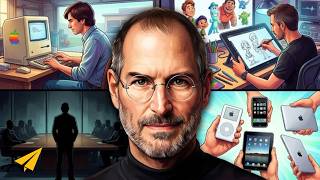
In this segment, Steve Jobs explains Apple’s strategic approach to technology adoption, emphasizing the careful selection of emerging technologies—what he calls “the right horses”—to focus the company’s resources. He outlines Apple’s history of pioneering moves such as transitioning from 5‑inch to 3.5‑inch floppy disks, eliminating floppy drives, serial/parallel ports, and optical drives, and being an early adopter of USB. Jobs argues that removing legacy hardware, even when critics label the decisions as “crazy,” allows Apple to concentrate on technologies in their growth phase, delivering superior products. He stresses that market feedback guides these choices, and that Apple’s willingness to endure criticism stems from a commitment to creating the best products for customers. The segment concludes with a brief entrepreneurial tip from a second speaker, who advises aspiring entrepreneurs to take humble jobs (e.g., busboy) until they discover a genuine passion, underscoring the importance of real‑world experience before launching a venture.
Chapters
Apple is a company that has— doesn't have the most resources of everybody in the world. And the way we've succeeded is by choosing what horses to ride really carefully. Technically, we try to look for these technical vectors that, that have a future and that are headed up. And, you know, technology different pieces of technology kind of go in cycles. They have their springs and summers and autumns, and then they, you know, go to the graveyard of technology. And so we try to pick things that are in their springs. And if you choose wisely, you can save yourself an enormous amount of work versus trying to do everything. And you can really put energy into making those new emerging technologies be great on your platform rather than just okay because you're spreading yourself too thin. So we have a history of doing that. As an example, we went from the 5-inch floppy disk to the 3.5-inch floppy disk with the Mac. Before other people, right? We were the first to do that. We made the 3.5-inch floppy disk popular. Sony invented it and we put it in the first products. And there were some good reasons we did that. We got rid of the floppy disk altogether in 1998 with the first iMac. We also got rid of these things called serial and parallel ports, and we were the first to adopt USB, even though Intel had invented it. You first saw it in mass on iMacs. And so we have gotten rid of things. We were one of the first to get rid of optical drives with the MacBook Air. And I think things are moving in that direction as well. And sometimes when we get rid of things like the floppy disk drive on the original iMac, people call us crazy. Or at least premature, maybe. No, they call us crazy. Oh, okay. And, but sometimes you just have to pick the things that look like they're gonna be the right horses to ride going forward. And what if people say, you know, the iPad is crippled in this respect? Well, you know, well, I'd say two things. Number one, things are packages of emphasis. Some things are emphasized in a product, some things are not done as well in a product, some things are chosen not to be done at all in a product. And so different people make different choices. And if the market tells us we're making the wrong choices, we listen to the market. We're just people running this company. We're trying to make great products for people. And so we have at least the courage of our convictions to say, "We don't think this is part of what makes a great product. We're going to leave it out." Some people are going to not like that. They're going to call us names. It's not going to be in certain companies' vested interests that we do that, but we're going to take the heat 'cause we want to make the best product in the world for customers. And we're going to instead focus our energy on these technologies, which we think are in their ascendancy and we think are going to be the right technologies for customers. And you know what? They're paying us to make those choices. That's what a lot of customers pay us to do, is to try to make the best products we can. And if we succeed, they'll buy them. And if we don't, they won't. And it'll all work itself out. If you want to get some Steve Jobs motivation, check out the video right there next to me. I think you'll love it. Continue to believe, and I'll see you there.
A lot of people come to me, they say, well, I want to be an entrepreneur. And I go, oh, that's great. What's your idea? And they go, well, I don't have one yet. And I say, well, I think you should go get a job as a busboy or something until you find something you're really passionate about, because