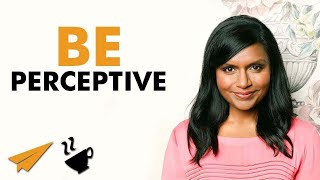
In this short motivational clip, host Evan Carmichael introduces the theme “Be Perceptive” and hands the floor to actress‑author Mindy Kaling. Mindy argues that while expressive confidence is often praised, young people especially benefit from being perceptive—listening, developing social IQ, and observing others—citing her own childhood silence as a foundation for her writing skill. Evan and the announcer (Speaker B) expand on the idea, relating it to entrepreneurship: perceptiveness helps founders understand customers, staff, and market trends, yet they wrestle with whether to invest in improving this skill or double‑down on existing strengths. Speaker B reinforces the lesson by urging a “watch the masters” approach, sharing a personal anecdote about learning values from his grandfather’s 1950s business. The conversation circles back to Evan’s conflicted stance and ends with a call for viewers to share their thoughts in the comments. The clip blends personal storytelling, practical advice, and reflective questioning about balancing strengths with growth.
Chapters
Good morning, Believe Nation.
Today's message is: Be Perceptive. Over to you, Mindy Kaling.
It is very important to be expressive, insomuch that no one should ever be stopping you from saying what you need to say, or you should never have that fear. However, I think as a young person, it's equally important, if not more important, to be perceptive and to be sensitive. And I feel like we don't talk about that a lot because we feel like the only way to show that we're empowered is by speaking it. And I think that when I was growing up, I really thought that what my parents taught me was like, I didn't talk until I was like 15 years old. I was pretty much silent, which no one believes. And it's because I just, was like listening and paying attention to what everyone was saying and, you know, trying to have like a good social IQ, which I think helped me become a really— which helped me later to become a good writer. And I think that that is the one biggest thing is to really, you know, to listen to others more than necessarily putting such a premium on being able to say what you feel.
So what do you think?
First, I love Mindy. I love her story. I love where she comes from. I know people who've read her books and we always talk about what a smart person she is. and I think she's a fantastic young female role model. So, so what I'm going to say comes from all of that stuff, but I think, I think her point is, is so valid today because when I think about my kids— I have 4 kids ranging from like 9 down— when I think of them being a teenager, when I think of them in their 20s and all of the social pressures, I think we just spend so much time feeling like we need to prove ourselves to others. Like, like if we do certain things, if we live a certain lifestyle, if we live the lifestyle that we think that we need to live for Facebook, that we'll be happy. And what I took away from it is just give yourself permission to watch others, to listen to others, to spend time. Take the time to just watch what's going on in the world around you and learning from others before you hit the ground running trying to show everyone what you can do. That may not have been her message, but that's That's what I took away from it.
I'm a little conflicted. I mean, I think obviously the message of be perceptive is something that can help you as an entrepreneur if you understand yourself, to know your strengths and weaknesses and create a business around that. If you understand your customers and what they're looking to do, why they're buying your product, what they care about, listening to them, create great products. You know, great salespeople are the best listeners. To understand your staff and build a culture that they want to be a part of and understand what their needs are. I think all of that helps tie in. Here's the conflict I have is if you're not perceptive, then what do you do? Is it that I want to try to get more perceptive? Because my instinct tells me, you know what, don't worry about it. Go all in on what you're good at. You know, like if I am— if my passion is, you know, for cars and I'm a great race car driver and that's what I want to be at, and I can just be the best race car driver ever and I'm not great at dealing with people, and I'm not great at, uh, you know, maybe building a team, do I want to work on those things? Or do I want to work on just like being the best race car driver ever? Right, here's the thing, right? So like, I feel it helps. It can help you as an entrepreneur, as a person. But if I'm not that, do I want to work on that to be better at it, or just go in on my strengths? Because my default advice would be go in on what you're really good at and forget about it.
The point is To take the time and give yourself permission and take the months or years to watch others and learn from others, not worry about sitting down, taking notes, quick download everything, and then I'm gonna go run off on tactical things, I'm gonna go run off on action, I'm gonna go run off and start putting things into place. And so, so if you want to be the best race car driver, the best thing to do is to watch, you know, model the masters, watch how the best race car drivers live, how they eat, what their fitness is, you know, and learn all of those things and involve yourself into that world if that's what you want. And when I think back in terms of my, my personal background, you know, my grandfather, who's in his late 80s now, started a business with 4 partners in 1950. And watching him live his life, going on walks, hearing stories, all of those things shaped the very values that I bring to my business, I have these flashes in my mind where I'm like, ah, that's where I learned this from this person. This is where I learned this from my mother, or so on. And I think being aware of those moments as they're happening and holding onto them and giving yourself permission to not just take it, run with it, and go off and start doing tactical things is the lesson. And I think that it's not obvious. I think a lot of people are worried about getting going.
I mean, I love the message. I try to apply it to my life. I see it totally in terms of building a team and projects and customers and media and suppliers. It fits well with who I am. I'm just thinking the people who aren't, uh, is it worth going all in on trying to improve yourself on that versus doing what you're good at, focusing on that, even though you may be totally clueless to how the rest of the world works and you don't pay attention to your team or the, you know, maybe you don't have a team or, you know, I don't know. I just— it's okay. I'm conflicted. I'm conflicted.
It's not extraordinary is what he's saying.
Yeah, I'm conflicted on this point. I don't know. That's it. So the question of the day today is, what do you think?
Evan was kind of like, it's okay. I was like, and I love this clip. Do you agree with him?
Do you agree with me?
Do you have your own thoughts? Let us know in the comments below.
Cool. I'm really excited to see what you guys write. So that's it. Thank you guys so much for watching. Have an amazing day. Continue to believe, and I'll see you again tomorrow morning for another shot of espresso. I wake up every morning, espresso keeps me going.