Become a Powerful Leader in 22 Minutes | Robin Sharma’s Leadership Formula
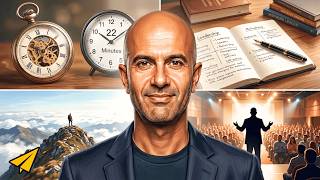
In this 22‑minute Mentor Me episode, host Evan Carmichael introduces leadership expert Robin Sharma, who delivers a motivational masterclass on modern leadership. Sharma argues that leadership is a mindset, not a title, and presents a series of actionable frameworks: the "Lead Without a Title" mindset, the "10x Value Obsession" (delivering ten times the expected value to customers), the "3 I’s" of Inspiration, Influence, and Impact, and the principle of being "deep versus light" in work. He contrasts the old scarcity‑based economy with a new generosity‑driven economy, emphasizes hiring and developing A‑level performers, and stresses the power of language—shifting from victim‑centric vocabulary to leadership‑centric language. Practical habits such as journaling, the 5 AM Club, and deliberate habit installation are recommended to embed these mindsets. Throughout, Sharma’s tone is inspirational and persuasive, urging listeners to adopt these habits to become world‑class leaders in any role.
Chapters
Hello, Believe Nation. I'm Evan Carmichael. My one word is believe, and I believe that entrepreneurs are going to solve all of the world's major problems. I started the Mentor Me series with the goal to try to learn from people who've done a lot more than us, people who have done amazing things, that by spending a little bit more time with them, hopefully some of their values, their belief systems, their way of thinking seeps into us to help us become the best version of ourselves. So to help you on your journey today, we're gonna learn from Robin Sharma and some of his best leadership motivation. Mentor me, Robin. And as always, guys, as you're watching, if you hear something that really resonates with you, please leave it down in the comments below and put quotes around it so other people can be inspired as well. And when you write it down, it's much more likely to stick with yourself too. Enjoy.
I've spent so much of the past 20 years of my life evangelizing a message that leadership is not about a title. Leadership is not about the size of your office. Leadership is not about having formal authority. Leadership is a mindset. Leadership is a way of operating through your days. Leadership is a heart set. Leadership is a way of being. And I think, you know, we're now in Leadership 2.0. The old model of leadership said you need to have a lot of money, or you need to be a prime minister or president, you need to be a CEO or managing director in order to be a leader. Leadership 2.0 is fundamentally different. Leadership 2.0 simply says if you can breathe, if you are alive, you not only have the opportunity, you have the responsibility to show leadership. Not only in your work, not only in your creativity, not only in your impact, not only in your influence, but even in your personal life. So let's get right to the first tactic for you to be an even better leader. Install the lead without a title mindset. And again, that's just a way of thinking, it's an approach. So what I'm really suggesting is no matter what you do, no matter what your station in life is, start thinking like a leader. Because you really have a choice when you go out in the world every day. You can be a victim or you can be a leader, but you can't do both. And so the more you practice showing leadership in your work, showing leadership with your family, showing leadership in your community, showing leadership in your private self, practice drives performance. And the more you practice it, the more you start to step into the mindset of a leader without a title. Our world says that if you are a leader, in many ways it's about what you get. What I'm gonna suggest to you with deep respect, being a leader is about what you give. And it's a paradox because as you give more, you actually receive more. But again, society has sold us this methodology and this philosophy that if we get from the world, if we get more income, if we get more from our clients, if we get more from our employees, if we get more from our sectors, if we get more from society, we will feel happy We will be successful, we will be at the top of the mountain, we will live these epic, awesome, and fulfilling lives. And I don't believe that's the case, and I haven't experienced that to be the case at all. To me, if you give and you are a humble instrument of service, everything just falls into place. And so what I wanted to do is really start off by talking about the new economy. The old economy was an economy of scarcity. It was like, there's not enough in the world, so how can I get as much as possible before it's all gone? The new economy that we do business in and that we live life in is one not of scarcity, but it's about generosity. And I think the person who gives the most wins. And that's just the world we live in right now, whether you believe this or not. So what I'm gonna challenge you to do is simply, I'm gonna walk you through some insights right now But start thinking about this. What if Robin is right? The strangest paradox of leadership is not about what I give. The strangest paradox of leadership is as I serve more and help more people, I not only become more, I actually receive more. The first insight I want to offer to you, and I call it the 10x value obsession. Just make a brain tattoo, sort of a psychological wiring that that you practice until the point it's unconscious and automatic, which is this: How can I give my customers 10 times the value that they have any right to expect? So, whatever it is, whatever product you pour into the world, how can that product give them 10 times the value that they're expecting? That dominant mindset and way of being has colossal consequences. You see, Most people can talk the talk, they don't walk it. They talk the talk, "Yeah, I want to give, I want to wow my customers. I want to give great products. I want to give a great user experience, great customer service." Maybe even to their friends. They talk a good game, but there's a misalignment between their vocabulary that they're expressing publicly and their actual internal intent. And when there is a misalignment with what you say and what you truly feel, even if what you truly feel is subconscious, you don't even know it. People feel it. So the first idea on this 10x value obsession, you really want to come from a place where you actually feel, I need to be an instrument of service. Robin is right, I want to be a giver versus a taker. I want to give these people who put food on my table that I call my customers 10 times the value they have any right to expect. And once that becomes your emotional and your dominant way of being, people feel it. And it changes your behavior, and it changes your performance. You actually go the extra mile. You actually start to wow. Your products are not mediocre, your products are masterful. Your team is not average, your team becomes iconic. Why? Because you're coming from that deep emotional passionate place that is far more powerful than the cold, the hard logic of, let us make our numbers so that we satisfy our shareholders. Number 3, I call it the 3 I practice. The 3 I practice. If you want to be a better leader, understand and then practice these 3 I's. Number 1, inspiration. The job of a leader really is to inspire other people. If you look at Steve Jobs, you look at Elon Musk, you look at Nelson Mandela, you look at Sergey Brin of Google, you look at a Rembrandt or a Picasso, these people were incredibly inspired. They were not only incredibly inspired, they were inspirational to other people. I mean, there's that incredible story of Steve Jobs, and a lot of people say Steve Jobs wasn't a nice person, and yet if you were to poll the former employees of Apple, they would say, my years at Apple working with Steve Jobs were the single best years of my entire career. And you say, why? And they say, because he was inspirational. I mean, when Steve Jobs was a young man, or a young kid, you know, his father said, go out and paint the fence outside of their house. And Steve Jobs said, no problem. He went out and he started painting the outside of the fence. A few hours later, his father comes out and says, Steve, did you paint the fence? Steve says, I did, Dad. Steve Jobs' father inspects the fence and he says, Steve, you did a great job painting the outside of the fence, but you didn't paint the inside of the fence. And Steve Jobs looks up at his father and says, but Dad, no one's going to see the inside of the fence. And his father looks at him and says, but son, we will. Now it's many decades later and Steve Jobs is running Apple and they're ready to launch, or ready to develop rather, the first Apple Macintosh. And he looked at his design team and he said, here's your deliverable. I want the outside of the computer to look so simple and so elegant, like a piece of art. But here's the real mission. Make the inside so beautiful that it'll bring tears to our eyes. And his design team looked at him and said, but Steve, no one's gonna see the inside of the Apple Macintosh. Macintosh. And Steve Jobs looked at his team and said, but we will. That's inspiration. I think the only title that really matters is CIO, Chief Inspirational Officer. So no matter what you do, whether you're a teacher or firefighter, an astronaut or an entrepreneur, maybe you're a managing director, maybe you're a mother or a father, be the CIO, the Chief Inspirational Officer of all you do. The second I of the 3 I practice to that make you an amazing leader is influence. Influence. You want to be so good at what you do that you influence other people. You want to use the words and the language of leadership versus victim speak. You want to influence people by your mindset, by your heartset. You want to influence people by your thinking patterns. You want to influence people by your productivity. So, you want to influence people, and that's the job of a leader. And then the third I of the third I practice, impact. Less talk, more do. No matter what your title is, you know you're leading, you know you're winning when you are creating impact. You know, a lot of people in the world, and victims love to do this, they talk about what they're going to do. Here's the project I'm going to launch. Here's the mission. Here's the marathon I'm gonna run. Here's the life I'm going to craft. But they don't execute. Impact is about translating your ideas to execution. And so the fourth leadership lesson is be deep versus be light. Be deep. I mean, this is a gorgeous opportunity to build a monopoly of mastery within your industry. I mean, you want to be so good at what you do that when we watch you in action, Tears come to our eyes. People rise to their feet and applaud you. And how do you do that? Well, you separate yourself from the way most people operate in business and in life. You go deep. We live in a world that is really suffering from the cult of superficiality. Everything is fast, everything is quick, everything is light. Imagine you resolve today, I will be deep when I do work, when I work on a project, when I build build a client relationship, when I work with a personal relationship, when I install a new habit, it's not gonna be light. I'm not gonna be superficial. I'm gonna go deep. I'm gonna bring rigor to my game. Let's say you're installing a new habit. Let's say it's my famous 5 AM Club. You start reading all the literature on the neurobiology of early rising. You actually read all of the books on habit installation. You actually find a coach, let's say, to help you install the 5 AM routine. You actually build out a protocol to mark your progress. I'm just saying, could you imagine rather than going very wide in your work or very wide in your personal life, you dial it in with a monomaniacal focus to be genius level at just a few things? That's rigor. And rigor is really an approach. I was in Luzern, Switzerland a few months ago, and I was working on my new book, and someone delivered some tea, and I'd asked for some fresh lemon. And what I noticed is whoever had sliced the lemons took the time to de-seed the lemon wedges. And that's really your metaphor for this podcast. You know, that's what You know, this lesson is all about, the 4th leadership lesson, be deep versus be light. It's about de-seeding the lemon wedges on the areas of focus that are most important to you. Anyone can just cut the lemon wedges and hand them to you, but this producer had the discipline, the bravery, the acumen, the commitment, the devotion to actually take the time to de-seed the lemon wedges. There is incredible and indelible influence and imprinting going on on your philosophy and on in your mind when you read a book. So you have a conversation with someone, and I'm sure you've had a conversation, maybe it's with a chef or a great entrepreneur or a wise human being, and that maybe, it was just one conversation, but that person in that 10-minute conversation or hour-long conversation said something to you that formed your philosophy that changed the rest of your life. Well, that's what you can get in a book. You can have a conversation tonight with Kanye. You can have a conversation the next night with Edison. You can have a conversation two nights from now with Nelson Mandela. You can read the biography that I recently read of Elon Musk. You can read about Steve Jobs. You can read about Vincent van Gogh's life. You can read about Martin Luther King Jr.'s life. You can read about the titans of industry and what they went through and how they innovated and how they dealt with struggles and how they dealt with wealth. You can read books on productivity from the most productive people on the planet. You can learn how people who built companies like IKEA and Red Bull, how they did it. They took a small idea and built it into an empire. So what I'm suggesting to you with great love and respect, as I always do in these Mastery Sessions, is reading a book is nothing more than having a conversation with the author. And you can spend your evenings or mornings or afternoons or lunchtimes connecting with the greatest minds who have ever graced the planet. You cannot put a price tag on that. If you hire C-level people, please don't be surprised if you have a D-level company. If you truly want an iconic business, one that stands the test of the generations, one where you build what I call a globally cherished brand, then you absolutely must make it your dominant obsession to hire and manage and retain and engage only A-level performers. The best leaders on the planet grow other leaders. So if you're not growing leaders faster than your peers, you're not leading, you're following. I'm gonna repeat that again. The job of the leader is to grow more leaders. So yes, do your work. Yes, become more creative. Yes, innovate. Yes, optimize your personal life. And yet at the same time, make the time to develop leaders around you. What that might look like at the office— celebrating a teammate. At the office, that might look like modeling mastery. At the office, it might look like collaborating with someone who needs some collaboration. At home, what does growing leaders look like? Well, it might be mentoring your children, exposing them to art, giving them great books. It might mean being a positive force in your home life. So the job of the leader is to grow more leaders. One of the things I observe is simply this: a lot of people are very careless with their language. And so, you know, there's a huge shift. You can either be a victim or you can be a leader, but you can't be both. And if you look at someone who is a victim, a lot of their victimhood comes down to the words they use. I mean, the words you use either lift up your energy, the words you use either make you more creative, the words you use either allow you to do world-class things, or the words you use deny your talents. The words you use could reduce your energy. The words you use could hurt your leadership. So you have a choice every day at work and at home and out on the streets with strangers. You can develop a victim vocabulary or the language of leadership. And in this Mastery Session, I want to walk you through some my insights on those. Well, words are powerful. I mean, words have destroyed nations. I mean, think about the great dictators. Their words of hatred, their words of toxicity, their words of breakdown caused the people around them to do sometimes incredibly terrifying acts. And then you look at people like Nelson Mandela or Martin Luther King Jr. Or Mother Teresa. You look at the great business builders, you look at humanitarians, you look at a lot of the great artists, and they were so careful with their words, and their words lifted people up. And that's really what great leaders do. They use the language of leadership. You look at a victim, and they say things like, "This is a problem. I've got a problem right here." Or, "I'm really scared about this." Or, "I hate that client." or "I hate this work," or "I'm sick of this day," or "I'm exhausted," or "I don't like that," or "She never likes me." It's literally the language of toxicity. And the words you use really are like a context or a framework or a stained glass window on the way you see the world. I mean, here's a game-changing insight: you see the world not as it is. You see the world as you are. You see the world through a lens, and your language forms that lens of belief. I mean, your lens of belief and your personal filter on reality is not really a true filter on reality. It's just the filter on reality that has formed as a result of all the words you've picked up from the moment you were born. So when you were a little baby, Your mom and your dad use the language that they were taught when they were kids to use. And if they use the language of victimitis, and if they use the language of victimhood, like, well, you know, you can't do this, I hate this, I'm tired of this, money doesn't grow on trees, be ordinary, if you're successful you'll be hated. All that messaging that we pick up from our parents and the media and the world around us and our peers, the little kids that we used to play with in the playground, or the friends that we had as teenagers, that will either lift us up or tear us down. So I guess what I'm trying to say, and hopefully I'm making the point clearly for you, but we see the world through this personal filter. And a lot of this personal filter that drives our performance and our behavior is really constructed from the words that we've picked up, and then the words we are taught to use. And so the right angle turn for you to create exponential energy, mindset, productivity, creativity, results in the world, results in your life, comes down to, in part, a really intelligent use of your words. And like I said at the beginning of this Mastery Session, most people are really unconscious about their words. And that's why most people are not getting rare air results. So what are some of the words I encourage you to shift from? Well, don't talk about what you hate to do, talk about what you love to do. Don't talk about problems, talk about opportunities. Don't talk about what makes you tired, talk about what makes you inspired. Don't talk about your past, talk about your future. Don't talk about what broke your heart, talk about Talk about what opens your heart. Don't talk about what dispirits you. Talk about what you are fueled by. Don't talk about the things within your life that are not working. Talk about the things in your life that are working. Don't talk about your pain. Talk about your pleasure. And you know, if I were sitting with you right now coaching you, I mean, I am coaching you, And what I would encourage you to do as soon as I finish this mastery session is pull out your journal. And if you're not journaling, please start journaling because journaling is a ritual you want to install into your days. Joan Didion said this: "I don't know what I think until I write it down." Think about that. "I don't know what I think until I write it down." And so in your journal after this mastery session, Pull out a fresh page and draw a line down the center of the page and write about the language of victimhood and the language of leadership. And start to write down all the words you use and the sentences you employ that really are speaking, that are really victim speak. And then in the other column, I want you to start writing down the language of leadership. The language that as of today you will be committed to using so that you start to use the language of someone who is world-class. And I've given you some examples, but doing that exercise will make it really clear. And as you know, clarity breeds mastery. Bottom line is this: you are built to be a leader. You are not constructed to be a victim. And once you get your words right, you are going to start noticing daily shifts in your energy, your focus, your momentum, your confidence, and your output. And when you start getting those words right, you start lifting your professional life, your personal life, to a whole new level of wow. And guess what? That is what you are meant to do.
Thank you guys so much for watching. I hope you enjoyed. I'd love to know, what did you take from this video that you're going to immediately apply some somehow to your life or to your business? Leave it down in the comments below. I'm super curious to find out. I also wanted to give a quick shout out to Clark Kegley. Clark, thank you so much for picking up a copy of my book, Your One Word, and doing that interview on your channel. I really, really, really appreciate the support, man, and I'm so glad that you enjoyed the book. About his new book, Your One Word. So thank you guys again for watching. I believe in you. I hope you continue to believe in yourself and whatever your one word is. Much love. I'll see you soon.
More from Evan




How the Biggest Mistake in History Created A Trillion-Dollar Empire | Sergey Brin



9 Machiavelli Principles That Force People To Respect You | Machiavellian Philosophy



The First 10 Words That Instantly Ruin A Sales Conversation | Vanessa Van Edwards