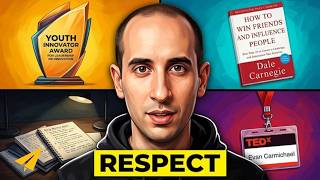
In this Lunch & Earn segment, Evan Carmichael answers a question from a 14‑year‑old (Kamala) about how to be taken seriously despite his age. He and Rich Man discuss that credibility starts with taking yourself seriously and believing in the value you provide. Carmichael shares personal anecdotes of selling scientific software at 19 to older PhDs, emphasizing that confidence, self‑respect, and commanding respect are essential. He cites Nelson Mandela’s insistence on being called “Mr. Mandela” as an example of demanding respect. The conversation shifts to how to cultivate the right mindset: surrounding yourself with an environment that stretches you, consuming empowering content, and consistently practicing. Rich Man highlights the importance of overcoming camera shyness by repeatedly appearing on video, turning discomfort into familiarity. Overall, the dialogue stresses that content quality, self‑belief, confidence, and a supportive environment enable young creators to command respect and be taken seriously.
Chapters
Kamala is asking, how do you get people to take me seriously when he's 14 years old?
I think don't even worry about it. Just make the videos with whatever it is you want to make them about and put them out there. And if, if it— if the content is serious and worthy of being taken seriously, they'll take you seriously. I think it's, you know, content is king.
Yeah, I think the biggest thing for me, I found being— I was that young entrepreneur, I was 19 and I was selling to guys 3 times my age and feeling like, why would they talk to me? I'm 19. These guys have PhDs, they're professors, you know, they've done— well, I don't have a background. I'm a scientist. I'm going to sell this scientific software to scientists when I'm not a scientist? Uh, it starts with taking yourself seriously, right? Like, I am good at what I do. I can add value to the world, and I believe that to my core. Right? If you don't actually believe it, there's no way you're going to convince somebody else, right? I remember a story about Nelson Mandela who went into prison when he was jailed, and he refused to be called anything besides Mr. Mandela. He would— he just refused. He commanded respect, right? This is a prisoner. He's a prisoner, dude. He's in jail. And they had to call him Mr. Mandela to get anything done. And so like, you gotta command respect. If you provide value, people will listen to you and they'll get a sense quickly, like even walking into the room, right? Are you like this? Are you confident? Are you high? Are you the lion? Are you about to take on the world? Or are you like, oh, I'm like, I'm this 14-year-old kid and I don't, you know, please give me a deal, right? Like already, Already you set the tone for what's going to happen that day, right? So it starts with you taking yourself seriously. Yeah, that's a big like mental twist that took me a while to figure out, but you get your head around that, unstoppable, man, unstoppable.
That sounds pretty powerful, but how do you have access to that?
How do you have access to what?
To making that paradigm shift.
It's back to like everything we've been talking about in the past calls, right? The environment that you have around you, your belief system, you know, what do you consume on a daily basis that makes you want to be something bigger than yourself and believe that you can? Because all of us, we have these moments of boldness, right? You have a day when you like wake up at 2 in the morning, like, oh, I got this great idea, this is going to be amazing. And then Where does it go? Like, you wake up the next day and it's gone. Yeah, right. You've killed yourself. Like, it wasn't that the idea sucks now, it's just you don't believe in it anymore because it was too bold. It made you step out too far, and then you're gonna retreat back. So it's consistently having things in your environment that stretch you and force you to go out and do something bigger. Like, you won video, man. You last year refused to do any video. Like, no, I'm the guy behind the camera, my friends on Facebook, we don't will laugh at me, whatever, right? Like, you were in this shell that you refused to come out of, no matter how much I like, "Rich Man, come on, you got this," right? Whatever, you know, your wife was supporting you, right? And then finally, like, I forced you on camera, and this now opened up your shell. And now it's— now, now for you, being in front of a camera at your home is no big deal. Like, you're used to it, you're getting used to it. We're doing our Hangouts, you're fine, you're being a little open and honest. Now the next step is like going out and doing it in public or in the backyard or like— I get it, I was there, right? There's still times when I feel uncomfortable and nervous, like any new situation you're going to get in that. But what always helps me is understanding that, hey, I'm good at what I do. I can provide value to these people that I'm going to work with. And once I acknowledge that and believe that, the rest takes care of itself. Like you've set yourself up for failure before you even walked into that room because you don't have the confidence in yourself.