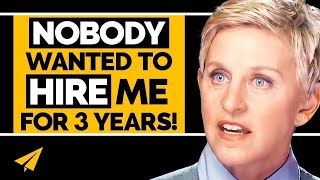
In this interview‑style video, host Evan Carmichael profiles Ellen DeGeneres, weaving together clips of Ellen’s own words with commentary. Ellen describes herself as an introvert who pursued comedy to make people happy, recounts the personal and professional fallout after publicly coming out in 1997—losing her sitcom, advertisers, and three years of offers—and explains how that painful period forced her to confront who she is without fame or money. She reframes her definition of success from fame, cars, and groupies to living with integrity, compassion, and authenticity. Ellen emphasizes the unique energy she feels from her audience, likening the studio to a church where the crowd is part of the show, and highlights her love of dancing as a spontaneous, liberating act that encourages viewers to let go and feel like kids again. Throughout, she shares core advice: be true to yourself, follow your passion, ignore unsolicited advice, and understand that honesty saved her career. The video concludes with Evan inviting viewers to discuss Ellen’s “top 10 rules for success” and suggesting future entrepreneur profiles.
Chapters
I'm an introvert for sure. I have a career despite myself. When I grow up, I want to be famous. I want to be a star. I want to be in movies. When I grow up, I want to see the world, drive nice cars. I want to have groupies. It's why I started out as a comedian. I started out to make people happy and make people feel good. Every single day that I do my show, it is an energy that is like no other energy. Never follow someone else's path unless you're in the woods and you're lost and you see a path, then by all means you should follow that. Nobody wanted to hire me. For 3 years, I didn't have any offers.
She's an American comedian, TV host, writer, and producer. She starred in the popular sitcom Ellen and hosted The Ellen DeGeneres Show. She's won 13 Emmys and 14 People's Choice Awards. She's Ellen DeGeneres, and here is my take on her top 10 rules for success. Rule number 1 is my personal favorite, and I'm curious to figure out which one you guys like the best too.
I get the distinct impression that while you may be this famous talk show host, you You are a private person, maybe even shy.
I'm an introvert for sure, as I have a career despite myself. I really am awkward socially. I hate going to big events. I hate having to do small talk. I don't like a lot of attention.
It's bold of you, being an introvert, to not only do this show but to also put yourself out there, realizing that not everybody's gonna like it.
If it costs me you know, some viewers, and if it costs me some money, I'd rather talk about what I think is important than just be, you know, vanilla and, and try to be liked by everybody.
That honesty has cost her, especially in 1997 when she famously came out of the closet.
I'm gay.
Only to have Hollywood shut the door. Advertisers pulled out. Within a year, her sitcom was canceled. Her career stopped cold.
I don't think it was a failure, but it certainly gave me a lot of free time for 3 years to sit still and go, okay, who am I without a career? Who am I without people loving me?
Did you feel that you had made a mistake in coming out?
No, absolutely not. Why? Because I'm, I am free. I'm completely able to be exactly who I am. To have to hide anything is just a horrible way to live. When I was younger, I thought success, uh, was something different. I thought, when I grow up, I want to be famous, I want to be a star, I want to be in movies. When I grow up, I want to see the world, drive nice cars, I want to have groupies, to quote the Pussycat Dolls. How many people thought it was boobies, by the way? It's not, it's groupies. But my idea of success is different today, and as you grow, you'll realize definition of success changes. For many of you to you today, success is being able to hold down 20 shots of tequila. For me, the most important thing in your life is to live your life with integrity and not to give in to peer pressure to try to be something that you're not. To live your life as an honest and compassionate person, to contribute in some way. This energy, I mean, you can feel it in here. And you've talked to— people come from very, very far away. They fly here. They make plans. This is their vacation or their trip, and they come come in here and bring this positive energy and this love and this joy. And I get to feel that every single day. It's the most amazing feeling that that energy is coming at me every day. And I hope I give it back to them, and I hope they get that. And I think if I do that every single day, and I keep— I feel like I have a purpose. I feel like I am— it's why I started out as a comedian. I started out to make people happy and make people feel good. I'm doing it on a larger scale, and I think if— I hope I can do this for a long, long, long time. You're in front of an audience all the time. This is a big deal. It's the Oscars. What's the difference? Oh, there's a big difference. That audience comes to see me, and they travel from— and God bless them— they travel from all over the world to come to a taping, and they wait for a year for tickets. They're my core group of people that get me, know me, and love me. And I feel that. And I, you know, that room is like church. I mean, really, every single day that I do my show, it is an energy that is like no other energy. [FOREIGN LANGUAGE] The way you are with your audience is unlike, I think, anything I've ever seen. I mean, they really feel that they are a part of the show. Yeah. Yeah, they are. I mean, this is our 11th season, and when we started building the studio, it was really important that the audience was comfortable, and it was really important that they were not in the dark, that they were lit, because they're part of the show. It's not a spotlight on me. Of course, my lighting is better. I'm a CoverGirl. I have to look good. But it's still bright enough that they're part of it.
You know, you did a very successful sitcom. You then came out, and then it was cancelled. Has this— show sort of saved you, do you think, in a way?
I think what saved me is me being honest, and I think I somehow had the courage to do something and say something that I knew would possibly end my career. And instead of making business more important, I made my soul and my life more important. And I think by by being truthful and by being honest, that saved me. And then I was given the opportunity to do something where I could actually just be myself and people could see who I am. And if they respond to it, great. And if they don't, great. And they've responded. Follow your passion. Stay true to yourself. Never follow someone else's path unless you're in the woods and you're lost and you see a path. Then by all means, you should follow that. Don't give advice. It'll come back and bite you in the ass. Don't take anyone's advice. So my advice to you is to— Be true to yourself and everything will be fine. And I know that a lot of you are concerned about your future, but there's no need to worry. The economy is booming, the job market is wide open, the planet is just fine. It's gonna be great. You've already survived a hurricane. What else can happen to you? And as I mentioned before, some of the most devastating things that happen to you will teach you the most. And now you know the right— what— the right questions to ask for your first job interview, like, is it above sea level? So to conclude my conclusion that I previously concluded in the common cement speech, I guess what I'm trying to say is life is like one big Mardi Gras. But instead of showing your boobs, show people your brain. And if they like what they see, you'll have more beads than you know what to do with.
Do you carry any resentment from that time?
I'm furious.
You were cranky at the time, though.
Oh, I was furious at the time. You know, because when you're new, when you all of a sudden are like, you know, I just felt like I was— it was my own fault. I kind of felt like I was stuck, you know, living my life the way, and then if I, you know, how dare they not like me anymore just because I suddenly revealed the truth of, you know, who I am in one aspect of my life. Not, you know, it's just I'm just saying I'm gay. That's all I was saying. And I was so mad. I was so mad that I lost, you know, my show. I lost not just my show, but nobody wanted to hire me. For 3 years, I didn't have any offers. No one. I mean, literally, the phone did not ring for 3 years. And I had no money. I was out of money. I was just so— that tends to make people cranky. And then I just kind of— and it was good. It was actually— I'm very grateful for that time. I'm very grateful that I got to experience— it gave me more compassion. I know what it feels like to be out of money. I know what it feels like to be— up and high and like, you know, I was in a top-rated sitcom and very successful and people treated me very well. And then all of a sudden, just because of one revelation, I just was— I was the joke. Every— you know, I was the punchline of every late-night talk show. I was made fun of in magazines. I was— it was— and it felt horrible at the time. And now I look back and I'm so grateful for it because it really gave me a chance to examine myself and say, who are you without fame? Who are you without success? Who are you without money? And I kind of found different parts of me that would not have grown had I not experienced that. Most comedy is based on getting a laugh at somebody else's expense, and I find that that's just a form of bullying in a major way. So I want to be an example that you can be funny and be kind. And make people laugh without hurting somebody else's feelings. The big breakthrough was in 1986. You were on with Johnny Carson. First time with Johnny Carson, and he loved you. And you did a routine about calling God on the phone. Right. I think he put you on hold, didn't he? Well, it was a big place. You know, people talk about praying and talking to God all the time, but I just thought it would be great if you could have a phone conversation, if you could actually just reach God somehow. If you could just pick up the phone and call God. If you were calling God today, what would you say? Thank you. Oh, Ellen. Just, I got nothing but gratitude. My whole life, my whole life is just, I'm so blessed. I'm so lucky. And I feel it every day.
I was talking to some of your audience before the show today, and I asked them what they love about you. And what they said unanimously was, your energy, and your dancing. Where did the dancing start?
It really started as such a ridiculous accident. It was kind of, you know, when I, even when I did my sitcom, when I was introduced to the audience before we would tape the show, I just have always loved music and I always loved to dance. I mean, how do you not dance when you hear music? That's just sort of who I am. When I hear music, I dance. And then it became where I would dance into the audience and And then it just kind of— I saw the audience respond to it in a way that it freed them up to just dance with me. And I think people come here almost— it doesn't really matter who's on the show. It's just a place to let go and be free. And I mean, everyone in this audience is a stranger to the other. People are from all over the world. And they come here. It's daytime. You know, it's not dark in here. They're not drunk as far as I know. They may be. I don't know. But— and they're all dancing. Man, oh, man. That dance made me thirsty. Oh, look. You got a little dance. And you know, people just stop dancing. I think people grow up, and they stop playing games. They stop playing hide and seek. They stop, you know, we just grow up and we get so serious and stop playing and we stop dancing and, you know, we get busy with our lives and the only time we dance is maybe at a wedding and maybe if we're drunk and maybe if there's 20 other people out there and, you know, nobody goes to clubs anymore and so it's a place to just, you know, and to me dancing represents just freedom and letting go and having fun and being a kid again. So I think that's why they respond to it and that's why I do it.
Thank you so much for watching. I made this video because Julia Cole asked me to. So if there's a famous entrepreneur that you want me to profile next, leave it in the comments below and I'll see what I can do. I'd also love to know which of Ellen's top 10 rules had the biggest impact on you and why. Leave it in the comments. I will join in the discussion. Thank you again for watching. Continue to believe, or whatever your one word is, and I'll see you soon.