Feel the POWER! of Tom's Top 10 Tips
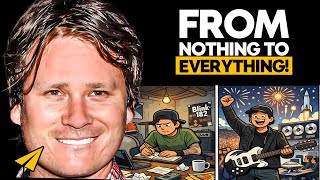
The video is an interview‑style profile where host Evan Carmichael presents Tom DeLonge’s personal "top 10 rules of success" while interweaving extensive anecdotes from Tom’s life. Tom recounts growing up with nothing, taking his first jobs at age 13, discovering punk music and an electric guitar in a friend’s room, and how that sparked his lifelong passion for music. He describes the relentless work ethic forged by early hardship, the need to constantly reinvent himself in a band, and the importance of leading a group to feel something together. Tom explains his innovative sound‑design process—using everyday objects, tape recordings, and cinematic inspiration to create songs like “The Adventure.” He expands on his multidisciplinary pursuits: fascination with space, writing books, making documentaries, and building businesses, emphasizing that creativity can cross media. Throughout, he stresses authenticity, the value of skateboarding as personal freedom, the necessity of honest feedback from trusted peers, and the power of believing in oneself. The video also includes historical context about Blink‑182’s grassroots beginnings (Lou’s Records, flyer‑dropping), and ends with Tom urging viewers to follow their passions, work hard, and seek collaborative, respectful relationships.
Chapters
We're gonna make a song that makes you feel like you can conquer the world.
Because I had nothing when I was a kid.
Nothing.
I'd been working at my first job when I was 13.
You're not gonna see me do things that are the easy play. It's just not gonna happen, you know? You're gonna see me do things that I have no business doing.
Hello, Believe Nation! My name is Evan Carmichael. My one word is believe, and I believe that entrepreneurs will solve all of the world's major problems. So to help you on your journey today, we're gonna learn from singer, songwriter, producer, and entrepreneur Tom DeLonge and my take on his top 10 rules of success. Rule number 6 is my personal favorite, and I'd love to know which one you guys like the best. And as always, as you're watching, if you hear something that really resonates with you, please leave it in the comments below. Put quotes around it so other people can be inspired. You might win a prize as well. And also, when you write it down, it's much more likely to stick for yourself as well.
Enjoy. When I was in the 7th grade, my buddy moved away to Oregon. There was a week where I went up to go visit him in Portland. I flew up there by myself, go to his house, and the whole thing was, hey, he's going to be in school on some of these days this week, so you can shadow him to school or "Or you can hang out until he gets out of school." I shouted at him one day and I was like, "This is fucking weird. I'm gonna stay at your house and wait." But in his room, there were 4 things that were very important. A Stiff Little Fingers record, there was an All record, there was a Dinosaur Jr. record, and there was an electric guitar. So what I did was I would play those 3 albums on vinyl and I would go over and pick up this guitar to keep myself entertained throughout the day for those 3 or 4 days that he would be at school until he'd come back and we'd skate at night and do whatever. That changed my life, you know, changed my life. The hearing punk rock music and picking up the guitar, something clicked where it's almost like there's a bunch of gasoline on the ground and someone flicks a cigarette, it just ignites. You know, it's just, it was a chemical reaction that just flipped on a switch that, Nothing could take that guitar out of my hand from that point forward.
Being in a band, you have to constantly reinvent yourself. You have to constantly be reminded, you know, how there's someone better than you every other weekend, and you have to constantly— you're constantly reminded how you would have nothing without your fans, you know? So you have to take into account what they're thinking and what they're interested in. And all those things matter. But it doesn't matter what art you do. It doesn't matter if it's making an album or a movie or a book or whatever. You have to think— thinking about all those types of things is important. The hard work involved. I mean, if you want to have, like, a casual life and you don't want to be in a band, I mean, you never sleep. It's really, really hard work, you know, and you're exhausted all the time, and you're almost always sick, and you're fighting with your business partners all day long, and it's just how it is. But I have a very, very strong work ethic because I had nothing when I was a kid.
Nothing.
I had my first job when I was 13. I had 2 jobs when I was 16, you know? But I think a lot of it's probably because I'm extraordinarily fearful about having to do what someone tells me to do. So I'd rather be doing everything because at least no one's telling me to do that. I don't know.
I think when you grow up as a kid, you know, you're always looking for your voice. You're always looking for your independence. You're always looking to find out who you are. With skateboarding, It was a means of transportation first and foremost. As a kid, you have a skateboard and you can get out and you can go somewhere. You can't drive yet, you know. So it's kind of like this is your tool, your vehicle to leave. And they were kind of going, okay, well, it's my freedom. But it expanded from just transportation. It's something you do on your own. You don't need a whole team to play it with you.
You just do it with you and you can go skate by yourself.
And I think that music did a lot of the same kind of stuff. I think that when you're, when you're joining, you know, a band for the first time, you're trying to find your voice. You're trying to find that freedom to get in a van and get out of town. You're trying to figure out who you are by defining it through your music, the way you dress, and who you hang out with. It was funny, Bono once said that they didn't even know to start the band U2 until they saw the Ramones and realized you don't have to shred at your instruments to be in a band, you know.
Uh, you can get the emotion across in a different way.
It was kind of more of what you're saying and how you're living, is not as much as your solos, you know, and on guitar. So what I learned from being in a punk rock band was really really these ethics of getting out there and doing things yourself.
I've always been fascinated with space. I always tell people this because it's one of my favorite quotes. If space is infinite, like there's no end, there's no fucking end to space, then it's infinite the possibility. Anything you think of right now could be happening because it's that big. And that was always really exciting to me because I'm kind of wired to be an optimist. When I started playing guitar with these types of rhythmic trance-like echoes, I started to feel that way. I started to feel like I was floating through space. First thing I did is I set up the studio in my house so I could be at home for the first time. And then I put up these big television screens and I was playing all science fiction films like Blade Runner or 2001 or like anything that was visually stunning. But then I also had these Stephen Ambrose books, these big coffee table books, World War II pictures. And I kept going over there looking at the space movie and then looking back down at the World War II photos and back to the space movie, and I was like, wow, that juxtaposition's gnarly. You know, like, here's like the Earth horizon and the sun coming up and it's so beautiful, and then here's guys in a ditch and bodies everywhere, and I'm kind of going, is that the same place? You know, Earth does both those things? And I said, "What would it sound like with marching coming into the song?" Or, "What would it sound like if it sounded like a battalion of tanks rolling in as the song starts?" And Critter, which was my engineer and copilot on all this stuff, he pointed to a file cabinet. And he's all, "Let's just slam that file cabinet shut, open and shut." And I was like, "Alright," and so he grabs a mic and does it, and it's just, and you just hear the mechanics and this kind of grinding, like, metallic noise with a slam, and he put it in there, and he did his thing to it, pitched it down, and the next thing you know, when it's happening in a rhythm, it just sounded like a million troops stomping on your face, and I was like, "Oh my God." You know, I've never heard something like that in a song. And next thing you know, we were doing that on all the songs. We found something that was unique to do, which was, you know, it's sound design. You see it in movies all the time. It's sound design, but sound design crafted into a song. And 4 songs into that writing, we wrote a song called "The Adventure." And that just, that was, that was a life-changing moment for me. We put some rocks in a shoebox, and we rolled the shoebox around with all these pebbles. You know, and then we grabbed that and created a rhythm out of it. And so, when we added some stomps and this rolling box of rocks, it created this grindy kind of rhythm, and then we added a riff to it that was a very simple riff, kind of sad sounding. But I didn't know what I was going to play for the main song, you know. So we started with the rhythm, then put a riff, and I was like, okay, so where does it go from here? So I stomped on the pedal in time, and I was for hours straight sitting at the computer. I think there's footage of this, of the documentary we made. Maybe you can show it right here.
I can bring in some rhythms underneath that thing, but it's what happens right here is what's throwing me for a loop.
Right. If we go into some other kind of— I'm sitting at the computer, and it just kind of starts to happen. Here, it's a little dry. On the song in the moment, it was something that gave you the chills up and down your arms. And I remember stopping and looking at Critter and I was like, holy shit, holy shit, we got something. I remember during writing the words, actually, because I had a friend whose wife left him Um, just figured that she could find something better, and he loved her. I remember him saying, "I don't know if you'll ever know what it's like to love somebody so much more than they will ever love you," is what he said to me. So I remember feeling so beat up from everything I was going through with the whole Blink situation and trying to find a new identity and all that kind of stuff. And then my friend says that to me, and I was like, "Well, fuck then. We're gonna make a song that makes you feel like you can conquer the world." That night, after I sang it, Um, I remember sitting in the studio at 2 AM. It was at my house, my family's asleep, and I was listening to this thing. And about halfway through this song, I had these tears in my eyes, and I was just— I felt like there was something magical happening. That happens to me every once in a while where I'm a part of something artistically where I get kind of overwhelmed emotionally and feel like I'm really on to something that's important. Not that I think it's like great or better than anything else, or that it's going to be something giant or big, it's because I feel like it touches on something that's important to me.
And it's—
and it like grabbed a hold of like a nerve and it's just gripping it and I could feel it. And it's like electric waves through your body. It doesn't happen on every single thing, but it happens every so often. And you kind of go, wow, this is what I was meant to do, was this one little thing, you know? And, um, that song was one of them.
I think I learned over the past handful of years that what I really enjoyed about a band wasn't being on stage, it was just the idea that I'm involved somehow in leading a group of people to feel something at the same time. I thought that was really cool. That's what I kind of dissected, 'cause I was doing a lot of things. I was equally interested in a lot of different things besides just music. And so a lot of people are wondering, why would you not wanna be on a big stage doing all this stuff? I just, oh God, do I Instagram this? Am I supposed to go on Instagram and tell you all these things that I feel about? I don't. But really what it boils down to is I have a pretty wild imagination and I have a few set of skills that I've developed, not only inspiring artists or leading people or putting business models to things or being entrepreneurial. And also understanding I'm not really good at any one thing, but I'm decently good at a bunch of different things. And I kind of figure, I said, you know what, it might be a really good place for me to sit in the middle of a bunch of artists that come together that can do something a bit more revolutionary than each artist doing one thing on their own. And that's where that came from.
[MUSIC] [Speaker:EVAN CARMICHAEL] Lose Records is a very important place. It was the most famous record store in San Diego and one of the most famous in the country. When Blink first started, I drove around about a 20-mile radius from the store and I broke into every high school at night and I made Blink flyers and I put them in every single locker at all these high schools that we were playing at the club downtown. At that point in time, everyone in San Diego wanted to support their local bands. It was just a really big scene. So because I put those those flyers in those lockers, we ended up having our first show at a big club. All the people came, and we had enough people that watched us that the guy that owned the club invited us the following week to play on the big stage. So what we did is not only played that show, we rushed and made a really quick recording, and it was our first recording with a little Buddha statue on it. People commonly refer to that record as Buddha. We made that to sell here in this store. So we would put 5 tapes in at a time. It was in the time where tapes were selling. And every week we would call up and they're all, they're gone. And we're like, oh my gosh, we put 5 more, they're gone. So then we gave them 10, they're gone. And then we gave them 20.
Next thing you know, we sold thousands of these tape cassettes out of Lou's Records.
And then we got our start. Um, it was a, you know, little suburban kids. We had a dream. To be in the punk rock section. And I'm here now looking at all these things I grew up on, and it's just so insanely important to me.
My inspiration usually comes from—
once the music for the song is more or less closer being completed, I'll just try and find an emotional current in it that makes sense. I'll either identify with it and write exactly like it or try and write the opposite. It's a good question, 'cause I think it's different for every artist.
You know, they always say, "I write the words first." But not for myself.
I like to write the music first, 'cause that, to me, is like the foundation of the building.
You build on top of it. How much have you changed as a creative person?
Oh, a lot.
Well, I'm learning so much. I mean, I'm learning so much.
We're doing—
When I come up with a good idea, I stick with it. That's the difference.
I can come up with a lot of ideas, but anyone can.
You know, when I come up with something, I go, you know what, this is something that's capable of me growing and I still will like this. This is something that's big enough and ambitious enough that in 4 years from now, if I really want to become a space engineer and build spaceships, I could probably put those spaceships in the movie or the book or something, you know? That's kind of how I think. Come up with projects that can last a long time and grow, and then as I grow, I'm still interested in what I've created. So I, yeah, but I plan for that. I plan for my evolving ideas.
I think my biggest issue is I don't actively go out and search for admiration from people or to explain what I'm thinking to people or to validate my actions. So I think what, what, it's the first rule in politics. You're supposed to define the other candidate for them before they can define define themselves. And what happens to me is that the fans, the good and the bad, and the good and the bad press, they have to define me before I go out there and do it. And what's happened is, is they've defined me in such a way, probably in many places, that is inaccurate. Uh, you know, I don't think people know that I listen to scholars every single night before I go to bed. I put it on my nightstand and I don't think people know that I read books on physics. I don't think people know that I'm totally still fascinated by jokes, even though I'm doing some of those things, you know. I don't think people know that my favorite thing in the world, outside of being with my family, is sitting with my Great Dane and my German Shepherd at Dog Beach, you know, and looking at the sunset. I don't think people know that I'm still completely fascinated with skateboarding. And my son is so into baseball that my way of relating to both is wearing Nike SB, which is Nike skateboarding. I don't think people know that's why I'm wearing Nike in certain Instagram posts, because it's a way for me to connect with my boy, but also still have a foot in the skateboarding world from which I came. I don't think people know that I'm completely I'm immersed in trying to understand ancient religions and, you know, why we are the way we are and why we're warring with each other. And they probably don't know that I think I have a fucking solution. I'm one of those guys that likes to look at the biggest thing ever and go, "I bet you I have a way to fix it," which is the biggest joke ever, but that's how my brain thinks. The only thing that takes me away from my maddening thoughts is if I'm learning something. For me, what I do is I learn something and how do I turn that into an art project? So it's a nonfiction book or it's a documentary or it's a lecture, and what does that look like as an animation? What does that look like as a song? What does that look like as a feature film? What does that look like as a story that has all those things in it? That's a challenge, and that keeps my mind at ease. I used to tell Mark in Blink that I admired him because he was always, satisfied with Blink. It satisfied him that it was an incredible thing and we were given such an incredible thing and we were so lucky to have it and all these different things.
And I agreed with all those things.
But for some reason, it's not stopping my desire to go out and learn more and try more and push myself more and be surrounded by other people that I find are completely fascinating. You know, you're not gonna see me do things that are the easy play. It's just not gonna happen, you know. You're gonna see me do things that I have no business doing. And sometimes it's music, sometimes it's novels, sometimes it's feature films or animations or whatever. Sometimes it's all those things. But at the end of the day, I'm still just I'm a very normal kid from a broken family in a shitty little suburban town, and that should just prove to everybody that they can do it too.
When it comes to tattooing, there's definitely been a learning curve. I didn't start out a master of my craft. Between a tattoo artist and his client, communication is essential.
All right, man, it's all done.
Check it out.
I wanted a shit. Oh, with a P.
This is with a T.
This is shit. It's more you. Some people compare me to Monet, some to Manet, some to Picasso, but I think I've developed a style all on my own. All right, tell me what you think of this one here.
What the fuck?
Art is a journey, not a destination. I'd never want to be perfect. That's a dead-end street. All right, we're all done.
Take a look at that.
Tell me what you think.
Pinko 182, I'll see you in hell! Thank you guys so much for watching. I made this video because HyperSpree asked me to. So if there's a famous entrepreneur that you are going to profile next, check out the link in the description and you can go and cast your vote. I also love to know which clip resonated the most with you. What lesson are you going to take from this video and immediately apply to your life or to your business somehow? Leave it down in the comments below. I'm really curious to find out what you have to say. I also want to give a quick shout out to Jason Fonseca and Yuki. Thank you guys so much for picking up a copy of my book at the bookstore and posting that picture to your social channels. I really appreciate the support, and I'm really glad that you enjoyed the read too. Thank you guys so much for watching. I believe in you. I hope you continue to believe in yourself and whatever your one word is. Much love. I'll see you soon.
You should follow your passions, you know, and you should make sure you do something you love. That's all I've learned is that if you're doing something you love, you'll work harder at it and make it happen. I promise you that.
I actually take feedback really well, I think, but it has to be from— you have to be with people you respect and that you really genuinely think that they make good decisions, you know. It's so much easier when you can trust the person. Go, man, yeah, when that person looks me in the eye and says like, it kind of sucks what you just did, you go, he means it. And it's like, you know, I agree with him, you know. Um, and that's where it works. So you have to, you know, right, uh, you have to get people that you really respect, that you've built up the trust, and, and you empower each other, and you tr— and, and you can, can really, really get it done. And strong debate is a part of it, but, uh If you have, you know, if you have intelligent individuals, it's not hard.
Yeah.
More from Evan




How the Biggest Mistake in History Created A Trillion-Dollar Empire | Sergey Brin



9 Machiavelli Principles That Force People To Respect You | Machiavellian Philosophy



The First 10 Words That Instantly Ruin A Sales Conversation | Vanessa Van Edwards