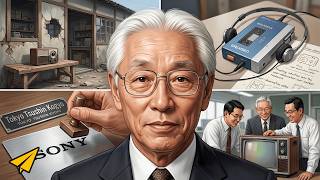
In this episode of Modeling the Masters, Evan Carmichael profiles Akio Morita, co‑founder of Sony, and extracts three practical lessons for entrepreneurs. He outlines Morita’s early life—born into a 15‑generation sake‑brewing family, educated in mathematics and physics, and eventually leaving the family trade to start a consumer‑electronics company with Masaru Ibuka in a bomb‑damaged shop in post‑war Japan with just $350 in capital. The video highlights Sony’s rise from a low‑quality‑product stigma to a global brand, noting milestones such as the Walkman’s launch, Sony’s listing on the New York Stock Exchange, and a 1998 Harris survey that placed Sony ahead of Coca‑Cola and GE in American brand perception. Carmichael then presents three actionable take‑aways drawn from Morita’s career: (1) Trust your gut – Morita ignored market research that warned against a non‑recording portable cassette player, leading to the Walkman’s massive success; (2) Choose strong, memorable company and product names – the rebranding from a cumbersome Japanese name to “Sony” and the insistence on the “Walkman” name despite internal objections; (3) Look after your people – Morita’s belief that employee satisfaction, teamwork, and a family‑like corporate culture are as vital as compensation. The video concludes with a personal anecdote about Morita’s upbringing in the sake business and his decision to pursue his true passion, reinforcing the broader message that following intuition and personal strengths can drive transformative success.
Chapters
Hi, I'm Evan Carmichael, and welcome to another edition of Modeling the Masters, where we look at how you can model the successful strategies of famous entrepreneurs. Today we're going to look at Akio Morita, a man who turned a bombed-out department store in Japan into one of the most successful consumer electronics companies in the world, Sony.
Akio Morita was a Japanese businessman and co-founder of Sony Corporation along with Masaru Ibuka. Ibuka was 38 years old and Morita was 25 when they started the company. Founded just after World War II and based in Nagoya, Japan, the company was established with initial capital of just $350 in a bombed-out shop that had been abandoned. Japan at the time was known for making low-quality products and Morita was determined to reverse that stigma. He is often cited as the man who increased the value of the words "Made in Japan." Supported by innovative product launches like the Walkman, Sony became the first Japanese company to ever be listed on the New York Exchange and has revenues in the trillions of dollars. Morita helped put his country back on the map while building his own reputation across the world. In 1998, a Harris survey revealed that Sony was ranked the number one brand name American consumers ahead of Coca-Cola and General Electric.
So the next question is, how can you model the success of Acción Morita? Here are 3 action items that you could put to use into your business today.
Action Item #1: Trust your gut. There's never enough information to make a decision that you can be 100% sure of. By the time the information becomes fully available, it'll be too late. Either someone else would have scooped the idea from you, or the window of opportunity will have closed. As entrepreneurs, we have to trust our gut when making decisions using the best information that we have available. In 1978, Sony developed a prototype product that would allow people to listen to cassette tapes while they were on long flights. The project was put on hold as market research indicated that no consumer would buy a tape recorder that did not have the capacity to record, and that earphones would hold the product back as they were seen to be irritating and potentially associated with hearing loss. Despite the advice given to him by his marketing department, Morita chose instead to trust his gut. He told Sony staff that they were going to create a worldwide culture of headphone wearers, and in 1979, Sony released the Walkman. It went on to sell over 330 million units. Morita then gave the following advice for business owners: Carefully watch how people live. Get an intuitive sense as to what they might want, and then go with it. Don't do market research. Action Item #2: Find a good company name and product name. The names you choose for your company and products are what people remember you by. If they're too hard to pronounce, difficult to spell, or not easy to recall, then you lose out on the opportunity of having customers talk about you to their friends and coming back as repeat buyers. Sony's original company name was Tokyo Chushin Kokyo Kabushiki Kaisha. Long and difficult to remember in English, the company decided it would need to change its name to better serve the North American market. Trying to find a new name, Morita found that "sonus" is the Latin word for sound. He thought its meaning was appropriate considering their industry. However, he didn't think that it was catchy enough. Morita decided to combine "sonus" was "Sunny," a nickname that had become popular amongst American kids. Morita thought "Sunny" would help portray the image of the company as a youthful one with lots of energy and bright future ahead. With that, the Sony Corporation was formed. Similarly, when Sony first released the Walkman, Sony's US division considered the name "Walkman" to be improper English and changed the product to the "Sound About" for the American market. Other divisions also began using different names until Morita put his foot down and insisted that everyone use the same name. Walkman became such a success that it's listed as a word in almost every major dictionary. Action Item #3: Look after your people. If you're building a company beyond yourself, you'll quickly realize how important it is to have the right people in place and to look after them. Money is important to them, but don't forget that people want to feel appreciated, challenged, and be a part of a team that's working on important problems. Here's Akio Morita's advice: "The most important mission for a manager is to develop a healthy relationship with his employees, to create a family feeling within the corporation, a feeling that employees and managers share the same fate. We will try to create conditions where persons could come together in a spirit of teamwork and exercise to their heart's desire the technological capacity. I believe people work for satisfaction. I believe it is a big mistake to think that money is the only way to compensate a person for his work." People need money, but they also want to be happy in their work and proud of it.
So remember, trust your gut, find a good company name and product name, and look after your people. I wanted to end the video today by sharing one of my favorite true stories about Akio Morita.
Akio Morita was born into a family that had been in the sake brewing business for over 15 generations. From his childhood, it had always been assumed that Morita would continue the family tradition of making sake. He had begun being groomed to take over the family business by the age of 10, at which time his father even made him attend all of the company's board meetings. In just a few years, Morita had become an expert on everything from monitoring the brewing process to evaluating quality of the sake that their factories were producing to managing their workers. But while Morita was learning the ins and outs of the family business, So too did he discover that his interest was not in sake after all. Morita realized that he was not destined to keep the family tradition alive, much to the disappointment of his father, and followed his true passion for mathematics and physics, which led him to founding Sony.
Thank you for joining me for another edition of Modeling the Masters. I hope you enjoyed. I'd love to hear your thoughts if you want to leave a comment below, and stay tuned for the next episode.