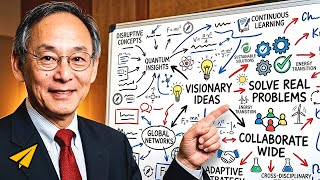
In this motivational video, host Evan Carmichael introduces Nobel laureate and former U.S. Secretary of Energy Steven Chu, who shares his personal "top 10 rules for success." Chu emphasizes doing work that matters beyond personal gain, anticipating future technological directions (the "skate to where the puck will be" analogy), learning how to learn from teachers, providing honest constructive feedback, embracing rapid failure and perseverance, diversifying the energy mix (fossil, nuclear, renewables), communicating science clearly at any audience level, and protecting future generations and the planet. He weaves personal anecdotes—from a high‑school physics teacher’s marginal note to his ARPA‑E experience—to illustrate each principle, concluding with a reminder of Earth’s fragility (the "pale blue dot") and a call for stewardship. The video ends with Carmichael inviting viewers to discuss which rule resonated most.
He's a physicist and is an advocate for renewable energy and nuclear power. He served as the 12th United States Secretary of Energy. He won the Nobel Prize in Physics in 1997. He's Steven Chu, and here are his top 10 rules for success.
Life is too short to go through it without caring deeply about something. Do something that matters. Do something that Matters beyond your immediate world. And when you're old and gray and look back on your life, you'll want to be proud of what you've done. The source of that pride won't be the things you've acquired or the recognition you've received. It will be the lives you've touched and the difference you have made. I think when I look at both what I've done, you know, it's certain to say what Evan's done, with a number of people, you cast around and you look for areas that you begin to see either a glimmer of a new breakthrough type of thinking, or some technology in this sector has been left alone and not applied to that sector, or there's just a need based on an emerging market. And those are the things that actually are can be real drivers for success and innovation. I used to, when I was Secretary of Energy, I used to try to explain to people using analogy with Wayne Gretzky, the great hockey player. Yes. Really arguably one of the best hockey players there ever was, and he was a pretty skinny person, right? But fast. And you say, how, you know, what made you different than all the others? And he said, I skate to where the puck's going to be, not where it's been. And I tried to explain, and I think it got some partial traction, look what's happening with the technology, look what's happening. You want to position yourself to see this is where the world is going, this is what science and technology is going to give us. Not, "I wish it were like it was 50 years ago and 100 years ago." When I got the Nobel Prize, I was asked to write an autobiography of our life and our intellectual development. And in writing that, I remembered vividly the profound impact that my high school physics teacher, Mr. Miner, played in my intellectual development. In the 12th grade, it was in the final exam, I kind of flubbed a question. And then he'd written in the margin, "I'm disappointed." He wasn't trying to teach us facts. He was actually trying to teach us a learning process. Learning whether you understand something or not was probably the most important thing I began to learn in his class. That lesson I took with me not only through college and graduate school, but for my entire career as a physicist. I'm Steven Chu. I'm the U.S. Secretary of Energy. We need a new generation of teachers to join those already in the classroom. Invest in the future. Inspire a generation of children. Teach. When you look at new technologies and you look at— there could be, you know, think of wild claims, but you think, what are the, quote, theoretical limitations? But not theoretical à la Heisenberg uncertainty principle. You know, there's a lower theory that says beyond this it's not going to make it. And then where is the technology? And then you say how much space is there between that that realistically you can get there in 5 years? Okay. And that actually helps define things and focuses the mind on what you should be thinking about, what you shouldn't be thinking about. So there are many things like that that I think successful innovators do all the time. The constructive feedback, the honest feedback is exactly what we were establishing in ARPA-E that's now being, in fact, in the rest of the Department of Energy. If you hear an idea that you don't really agree with, instead of politely sitting there and being polite, you say, "No, I don't think that's right. This is why. You're wrong." And then you sit at a table and you talk about it. And that's where you figure out, are you right, are you wrong? And then you have a deeper understanding of what's going on. Be really excited in what you're doing, love what you're doing, and don't get discouraged if things don't work. Most of the time things don't work, but pick yourself up. Don't— you've got— you expect to fail, but fail quickly and move on. Don't keep banging your head against the same wall repeatedly, but Really be excited in what you're doing and know that it will be important. We do not want to put all our eggs in one basket. You know, when the president said all of the above, he really meant it. We have fossil, we have nuclear, we have renewables. We need all these things. We've got to get some of these cleaned up a little bit, but it's all this mix. I think if you talk to any utility company executive, to say you're hanging it all on a— in your business where reliability and delivery is so important, you can't just say it's all here. You've got to diversify that supply. If you think you can make a difference, it requires commitment. It requires a thick skin. It requires an inner compass that I would recommend it. You also, as a scientist, one would have to be able to explain things at any level. Yeah. And not sound like you're being condescending. That doesn't work. But having done that, some of the best scientists I know can explain the science truthfully and accurately at any level. From the deepest experts to people who are not really scientists or may not even have an interest in science, but to show them that, you know, why do we think what we do, how can that be useful to society. I was a professor for many, many years, and my attitude always— and when I was working at Bell Labs, sometimes I would have an idea, and management I'd go and talk to them. I want to do this. They kind of look at me. No. And my reaction was constantly, OK, not, oh, I'm smarter than they, therefore, what's going on? They'd say, OK. I went back and said, hmm, what didn't I explain right? And then you would go back and say, OK, this is what I think. Now, once I went back 3 times and My then boss's boss kind of looked at me and he says, "Steve, if you're going to make me argue about wanting to do that experiment, I got better things to do." He actually let me do it, but never mind. He wasn't thrilled, but I always come in with the attitude that if you don't succeed the first time, try again. Or they can try to convince you they're right. That's part of this discussion. You know, I could be wrong. The world is deeply interwoven in space and in time. As Martin Luther King wrote in his letter from a Birmingham jail 48 years ago, he said, "We are tied in a single garment of destiny. Whatever affects one directly affects all indirectly." Above all, We must value and protect the most innocent members of our society, the children of the world yet to be born. I end my remarks with an as— from— with the astrophysicist Carl Sagan. And he wrote of an image taken by Voyager 1 as it was leaving our solar system. In this picture, Earth appears as a pale blue dot of light embedded in a rainbow. He says, "Look again at that dot. That's here. That's home. That's us. On it, everyone you love, everyone you know, everyone you ever heard of, every human being who ever was lived on this mote of dust suspended in a sunbeam." The Earth is the only world known so far to harbor life. Like it or not, this is where we make our stand. This distant image of our tiny world underscores our responsibility to deal more kindly with one another and to preserve and cherish the pale blue dot, the only home we've ever known. To this message, I add an ancient Native American saying, treat the Earth well. It was not given to you by your parents. It was loaned to you by your children.
Thank you guys so much for watching. I made this video because Barry Miller asked me to. So if there's a famous entrepreneur that you want me to profile next, leave it in the comments below and I'll see what I can do. I'd also love to know which of Stephen Chu's top 10 rules you like the best. Leave it in the comments. Let me know what you think. I'm going to join in the discussion. Thank you guys so much for watching. Continue to believe, and I'll see you soon.