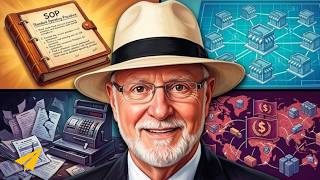
In this interview, Evan Carmichael introduces Michael Gerber, author of The E‑Myth, who outlines his ten core rules for building scalable, successful businesses. Gerber emphasizes that the most extraordinary companies are "best‑way" firms that constantly seek a better way to differentiate themselves by giving customers a sense of control, exemplified by Disney’s relentless focus on cleanliness. He identifies the universal business development system of lead generation, lead conversion, and client fulfillment, and stresses that mindset—living in the present with a "beginner's mind"—is the foundation for building effective systems. Gerber argues that the system, not the product or people, delivers the customer’s desired control, citing Ray Kroc’s McDonald’s model and the importance of replicable, consistent experiences. He critiques the common mistake of technicians starting businesses for the wrong reasons, turning a venture into a personal job rather than a scalable enterprise. To cultivate true entrepreneurship, Gerber lists five essential skills: concentration, discrimination, organization, innovation, and communication. He shares personal anecdotes about his own awakening to the "entrepreneur within," the challenges of pursuing the unknown, and stories of iconic companies—McDonald’s, Disney, and IBM—illustrating how vision, disciplined people, and treating a small business as if it were already a large, fully formed organization enable massive growth. The talk concludes with a call for viewers to reflect on which of Gerber’s rules resonates most.
Chapters
He's an American author and business skills training consultant. Inc. magazine named him the world's number one small business guru. He's the author of the mega bestseller, "The E-Myth." He's Michael Gerber, and here are his top 10 rules for success.
The most extraordinary businesses in the world are focused on finding a better way. They're what I call best way companies. They're constantly trying to find a better way. To do what? To do what they do. To do what? To differentiate themselves from everybody else. How? By giving the customer the sense of control in our business that they don't have anyplace else. The clean workings of Disneyland. You know, you ask people, "What do you remember about the park?" and what they all say is, "It's clean." Now think about it. They don't talk about Mickey. They don't talk about Pluto. They don't talk about Dumbo. They say it's clean. Now why in the world would that matter to people? Because everyplace else is so dirty. How did Walt Disney They do that. Every night at Disneyland, they steam clean the entire park, and they've been doing that in Anaheim for over 35 years. Think about that. To do what? To create this sense of order in the mind of the consumer, which instantly differentiates them from everybody else. Every place else is dirty, our place is not.
The core business development system in any company, in every company, sitting here, no matter what kind of company it is, is lead generation, lead conversion, client fulfillment. How many people do you attract to your door? How do you convert a larger and larger percentage of those people to become customers? And how do you convert the largest percentage of those customers to become clients? And the ballgame of that is mindset. It's truly the paradigm through which you approach the building of the systems through which leadership and entrepreneurship becomes a reality every single day in the company. Most important thing you can learn about being an entrepreneur is a blank piece of paper and beginner's mind. Everything begins right now. Everything. Now is the most important word you can begin to practice. Now. Not before, not later, but now. And being present now is the art of mastering your human capability right now, like a martial artist on the mat. Right now. Be here. Now. And begin it.
The system is the solution, not people, not the product. The system is the solution. Because Ray Kroc and Tom Watson and Walt Disney and the founder of Midas Muffler and the founders of Supercuts, every single one of them knew identically the same thing. The one thing the consumer wants more than anything else, the one product that is true of every great business, that every entrepreneur is there to create in that business, the one word that describes what you're selling in your business is control. C-O-N-T-R-O-L. The consumer's control over their experience when they come to buy from you. And if you can give that customer what they want the very first time, and you can replicate it faithfully every single time from that point on, that customer will continually choose to come back. And that's the business Ray Kroc was in. And he realized that if it was up to his franchisee, he'd be out of business. Because the franchisee, being a technician, would go and do it, do it, do it, do it, and destroy it in the process. Ray Kroc realized that McDonald's wasn't in the restaurant business. It was in the fuel business. Fill me up. You got it. Fill me up. You got it. And he did it every single time in identically the same way. And it was his ability to do it every single time in identically the same way, in a clean, organized, shining, colorful environment that differentiated McDonald's from every other restaurant around.
I want to do something I've never done before, and I don't know how, but I can imagine it. I want to engage in the unknown. I truthfully want to pursue the unknown, and in the pursuit of the unknown, something comes to realization, and I'm never prepared for it. So when I set out to do what I set out to do, I set out to do the impossible. Everybody told me, "You're nuts. You can't do that. You can't do that." And that's also consistent with all entrepreneurs. There's always a legion of people who will tell them, "You can't do that, and even if you could, why would you? There's so many better things to do other than that that you can make so much more money from." But money was really a very, very narrow part of what I was really setting out to do. Of course, I had to make a living. Of course I had to do this, of course I wanted to, you know, produce something great, but it was really the result that I could intuit that in fact that people who are struggling don't have to. That they're struggling so hard is simply a sign that something's missing in this picture. And so the question always has been, and I believe this to be the true entrepreneurial driver? What's missing in this picture? What's missing in this picture? It's always a question. It's never an answer. What's missing in this picture? And as I begin to ask that question, something begins to come alive to give me the food I need to nurture this passion I've got that I can't apply. And it enables me to see things I never saw before.
You get the first one right. You get your sales system right when you're small. You get your, um, lead generation system right when you're small. You get your lead conversion system right when you're small, knowing that you're going to be big. And that because you're going to be big, it's absolutely critical that you've gotten it right so that you can replicate it tens of thousands of times.
The attorney opens up a legal practice. The doctor opens up a medical practice. The graphics designer opens up a graphics design business, each and every one of them believing, because I understand how to do the technical work of a business, I understand how to run a business that does that technical work. And it's 180 degrees from the truth. Knowing how to do the work in a business has nothing to do with creating a business that works. And it is the fatal assumption behind the failure of almost every single business you walk into. Every single business around. Because the owner of that business, the founder of that business, does not start a business as an entrepreneur would. The founder of that business starts a business for absolutely the wrong reason. They start a business to get rid of the boss. They start a business to get rid of the boss because they're working for somebody else. They're doing it, doing it, doing it day in and day out. A master technician, a master auto mechanic, a master pool poodle clipper, and they're sitting there saying to themselves, "Why am I doing this for this guy? I could be doing this for me. Hell, any dummy can run a business," you said. "I'm working for one." And knowing that, you decide, "I could do this as well as this guy," and you start a business to get rid of the boss and instantly do what you never should have done. Create a job. So what I'm gonna suggest, ladies and gentlemen, for the purpose of this meeting, that most businesses you walk into aren't businesses at all. They're a job for the person who started it, and he's created the worst job of all. Working 12 hours a day, 7 days a week, doing it, doing it, doing it, doing it, based upon one presupposition that sweat equity is what every little business is about. Who came up with that word but a technician who's accustomed to working it, working it, working it, working it, doing it, doing it, doing it, doing it, hasn't the faintest idea of how to create a business that works, simply creates a job that depends upon himself or herself and continues to do it over and over and over and over and over again until they don't want to do it anymore. Most businesses imprison the person who creates it.
The most important thing I can say to you about growing and about creating and about learning how to bring the entrepreneur within you to life and to manifest your ideas in the world is to truly become an incredible student. You truly have to learn how to develop the capability and capacity to create in the world. In order to do that, there are really 5 essential skills you need to develop. The first is the skill of concentration. You need to be able to focus your attention. The second is discrimination. You need to be able to choose what's most important as opposed to what's least important. The third is organization. You really have to turn chaos into order, and you can find a way to do that where you live, in your school, at home, at work, um, with your peers, and so forth. The fourth skill is innovation. That's the best way. In other words, it's trying to discover a better way to do everything that needs to be done, and you can learn how to do that in everything you're doing today. So you have the opportunity to innovate all around you with everyone you know and to begin to practice innovation as a way of life. And finally, and absolutely essential, is communication. You have to learn how to connect with other people. You can't simply sit all alone in your home. You can't simply use Facebook and Twitter. You gotta be able to communicate live in person and learn how to do that. And you learn how to do that by practicing how to do that. So find a great communicator and say to that individual, "How did you learn how to communicate?" And that person will in fact begin to teach you. How to communicate. So concentration, discrimination, organization, innovation, communication, and you're on your way.
It's like a voice awakens inside of you. That's what I call the entrepreneur within, which is the subject of my latest book. It awakens. It either awakens or it doesn't. And if it does, what most of us do is put it to sleep because it's dangerous. I mean, essentially it's saying fly against all of the odds, do something that you don't know how to do, create something that you've never created before, pursue a path that's impossible to pursue, look at how many fail, look at how few ever make it, and then what? Well, that called me, and I've always been called by the impossible. So I never worked for anybody else. I was never on the job, so to speak. The only job I was really on, my very first job, was when I was going to school and I worked in a Ford plant and I was a janitor. And I was working at night, obviously, to support myself going to school. And I was changing a light bulb and I'll never forget it. The boss came up to me and he said, you don't look too happy, Gerber. And I said, "I didn't know I was supposed to be." And he said, "No, you have to be happy here. That's part of the game we play." And I said, "Yeah, but I'm doing the job." And he said, "Not good enough. Unless you're happy, you gotta be gone." And that was my last night there. And I never had a job since. I've always worked for myself.
I am my business, everyone says. If it weren't for me, there wouldn't be a business, they say proudly. But what happens when you don't want to do it anymore? You're out of business. I want to talk about a man who I'm sure most people are familiar with, at least the company he created most people are familiar with, and that's Tom Watson, the founder of IBM. You know, when I talk about IBM to small business people, they think to themselves, well, What is he talking about IBM for? I mean, you know, I'm not IBM. I don't want to be IBM. But just think about it for the moment. I think you've got to agree with me IBM is a relatively successful company. Last year IBM did $59 billion. Last year. Do you know what $59 billion— do you know what a billion dollars is? A billion dollars, ladies and gentlemen, is $1,000 a day for 3,000 years. In small unmarked bills. Think about that. 59 times that last year. Can you see it? How did you do that, Tom? I mean, you gotta wonder, what did the guy know that most people— IBM is bigger than most countries. IBM is, if not the, one of the most profitable businesses in the entire world. In the history of mankind, nobody has created anything to match it. Well, you gotta ask yourself, what did the guy know? Well, somebody asked him the question, and Tom Watson was purported to respond in the following way. He said, "I did something at IBM that most people don't do. Three things." The critical thing— 3 things, he said, that differentiate IBM from everybody else. He said the first thing is I had a picture of what IBM would look like when it was finally done before I even started the business. I had a vision of what the business would look like when it was finished. You know, we talk about visionaries. What is a visionary? A visionary is someone who can see something. Where? Out there? No, in his head. He had a vision in his head a picture of how the business would look when it was finally done. He saw this extraordinary organization, this extraordinary company, this monument, this testament to, to order, to control, to discipline, to integrity. The most extraordinary service business in the world is what he imagined he was about to create. "Once I had a picture of what the business needed to look like when it was finally done," he said, "the second thing I did was to get a picture of how our people would look." the people that would be in IBM to produce that vision that I had in my mind. And he said, I saw this extraordinary army of people in their dark suits and their white crisp shirts and their black shining shoes. Missionaries. This army of missionaries out there in the world communicating to the world in a way that nobody had ever communicated to it before. And he said that were— that was the— the IBM man, he called it then. Excuse me, ladies. He said, finally, the third thing we did at IBM that nobody else did, he said, once I had a picture of what the business would look like when it was finally done, once I had a picture of how our people needed to look in order to bring that vision to the rest of the world, he said, the third thing I realized is that there is absolutely no difference between a big business and a small business. A big business is simply a small business, Tom Watson said, that did the right things. A big business is a small business that did the right things. He said, if we were to start our business in the right way and do it as though it were the biggest business in the world, if we're able to act in the beginning as though this business were already complete, Only then would we be able to do that. So we said we didn't go to work in IBM, we went to work on IBM to replicate the picture I had in my mind.
Thank you so much for watching. I made this video because Mike Watkins asked me to. So if there's a famous entrepreneur that you want me to profile next, leave it in the comments below and I'll see what I can do. I'd also love to know which of Michael Gerber's top 10 rules meant the most to you, leave it in the comments and I will join in the discussion. Thank you so much for watching. Continue to believe, and I'll see you soon.