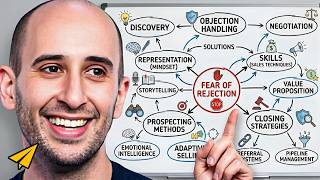
In this Ask Evan episode, Evan Carmichael answers a viewer’s question about overcoming the fear of rejection in sales. He shares three practical strategies. First, he stresses the importance of truly believing that your product or service will help the prospect, because genuine conviction reduces anxiety and makes the sales conversation feel like helping rather than pushing. Second, he recommends positioning yourself as a resource: focus on understanding the prospect’s challenges, offer a relevant solution (such as his paid mastermind group), and if it’s not a fit, refer the prospect to a more suitable provider (e.g., a business coach). This resource‑first mindset eases fear of rejection by shifting the goal from closing a deal to providing value. Third, he introduces “negative reverse selling,” where you deliberately frame a statement negatively or set a limiting condition, prompting the prospect to respond positively to counter the negativity. He illustrates this with examples from his mastermind pitch and corporate sales calls, showing how a subtle negative cue can elicit affirmative responses and lower the seller’s fear of a “no.” The video concludes with a call to like, comment, and stay tuned for future episodes.
Chapters
Hi, I'm Evan Carmichael, and welcome to another edition of Ask Evan. In this video, I'm going to answer a question from one of my readers, Sold Lab, who asks, "How do you overcome the fear of rejection while selling?" So I'm going to share with you a couple of strategies that I use, and hopefully you can learn from that and put it to use in your business as well. The first is you have to know that the product or service that you have is actually going to be helpful and useful for the person you're talking to. And that may seem like common sense, but a lot of times, you know, you may not actually believe in your product or service that much, and it's then harder to be convincing and make a good sales case when you're talking to your prospect. For me, most of the sales I do are pretty standard, and you know, I'm in the groove, and it's pretty comfortable. But every now and then, as I'm growing my business, I'll get more and more corporate interest and bigger deals that are coming to me. And every time I'm on the phone with a client that could be, you know, my new biggest deal yet, there's a little bit of nervousness and a little bit of excitement. And I'll always calm down by reminding myself that what I'm offering them is really, really going to help them. And that's what I focus on. So I'm not focused on, you know, trying to be nervous or trying to really sell them. I'm just trying to help them out as much as I can. The second thing is try to be a resource. And sometimes you don't get the sale and you give customers away. So one of the things that I'll sell is a mastermind group, and that's a group where we'll connect entrepreneurs together every month and we talk about our businesses and try to help each other out. And that's a paid membership that I'll make some money from. And when I'm talking about that group, it's never a hard sale. It's more trying to find out about the challenges that my prospect is going through and seeing if it's going to be a good fit for me or not, and a good fit for them as well. And most of the time it is, but sometimes it may not be what they're looking for. And in that case, I'll pass them on to somebody else that might be a better fit. So, as an example, sometimes I pass people on to a business coach where they maybe need a little bit more intense system to work with, so working with a business coach makes sense instead of joining a peer group that we have in the Mastermind group. So if you're open and honest and you know that you're trying to help them out as much as possible, I find that really eases the fear of going into that initial meeting. The last strategy that I use is something called negative reverse selling, and that's when— if you think about when somebody tries to sell you and they're saying, "You gotta buy this, buy this, buy this," your likely reaction is going to be, "I'm not buying that," and you're going to back away. So the approach that you want to take is the opposite, and sometimes if you go negative on it, people have a tendency to want to take the opposite view and go positive. So a couple quick examples: after I'm doing a presentation, so if we're talking about the Mastermind Groups, for example, I might say, you know, talk about all the different benefits of it, and then at the end say something like, "Does that make sense to you?" or coming out of left field. And usually they'll say something like, "Oh no, it makes sense, it's great, it's exactly what I wanted." And so by going a little bit negative, it makes them go positive. Or if I said at the end, "Yo, this is the best thing ever, you really need to buy it," they're probably going to take a more defensive stance. So people like going the opposite of what you're doing. Another example is if I'm selling to a bigger corporate client, I might say something like, "You know, we've been able to help out a lot of different corporations, but it only really works, we can only help if you're targeting the entrepreneur community. If you're not targeting entrepreneurs, then, you know, I don't think we're going to be able to help you. And that's the truth. You know, if somebody's trying to target managers at banks or a different target audience, I'm not going to really be able to help them. But if they're targeting entrepreneurs, I can. And by saying statements like that, they always come back and say, "No, no, we're targeting entrepreneurs. This is our market exactly. We're looking forward to learning a little bit more about what you do." And so it gets them saying yes and gets them involved. And by me going negative, it also reduces the fear of them saying no. So I hope that helps. Some of those strategies might be useful for you. If you guys like the video, please give it a thumbs up. I'd also love to hear your thoughts and feedback if you want to leave a comment below the video. And stay tuned for the next episode.