Jim Carrey Reveals the Secret to Staying Motivated - You Won't Believe His Journey!
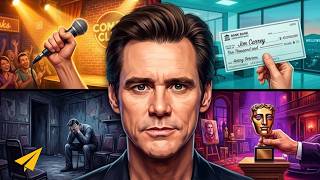
In this Mentor Me episode, host Evan Carmichael interviews Jim Carrey to uncover the mindsets and practices that have kept him motivated throughout his career. Carrey recounts his early love of silliness, dropping out of school, and driving long distances to perform for free at comedy clubs. He describes the harsh feedback he faced at venues like Yuk Yuk’s and The Comedy Store, explaining how those experiences forged a thick skin and a willingness to keep showing up. Carrey shares his spiritual outlook, describing himself as a blend of Buddhist, Muslim, Christian, and other traditions, and emphasizes that intention is the engine of all achievement. He details a concrete visualization technique: writing a $10 million check to himself for “acting services rendered,” carrying it for years, and later seeing that amount materialize with his role in The Mask. Carrey also talks about his purpose‑driven generosity—leaving $20 bills with “Have a nice day” messages, creating the Better You initiative, and viewing compassion as true wealth. He frames failure as a necessary step, noting that doing what he didn’t want to do often led to breakthroughs, and that compromise can open unexpected doors. Throughout, he urges viewers to identify their own “one word,” stay aligned with intention, and apply these lessons to their personal and business lives.
Chapters
What's up, Believe Nation? I started the Mentor Me series with the goal to try to learn from people who've done a lot more than us, hang around them a little bit longer, and by being in their environment, hopefully some of their mindsets, their beliefs, their way of thinking seep into us to help us become the best version of ourselves. So today we're gonna learn from Jim Carrey on staying motivated. Mentor me, Jim. And as always, guys, as you're watching the clip, if you hear something that really, really resonates with you, Please leave it down in the comments below and put quotes around it so other people can be inspired. And also, when you write it down, you're much more likely to lock it in for yourself too.
Enjoy! Silliness has been with Jim Carrey since he was a baby, born with a crooked hat. His faces never failed to get a laugh at family parties or at school, where he says being the class clown helped him to make friends. But Jim dropped out of school in grade 9 to mold his act. 2 years later, his first TV appearance. The impressions were there, but the nuances weren't.
Thank you very much. My name is Jimmy Carter, and I am the President of the United States of America. Thank you. Thank you very much.
Though the nuances are here now, they did not come easily.
And I used to be—
Jim struggled trying to perfect his impression. He usually performed at a popular comedy club in Toronto.
That's a fact.
I used to drive like 50 miles back and forth from Jackson's Point every every second night or every night to do a set at Yuk Yuk's for free. No pay.
Not even a gas stub or anything. Nothing.
And I used to do that and did that for the longest time and just kept working until people started to take notice, you know?
And the rest was history.
At one point, or not at one point, because I hear you still do, you would be in front of a mirror and just make faces all the time.
Yeah, for me it was so much fun to me to sit in my room and make faces and talk to myself in different voices and things. And I'd go, "That looks like Sammy. Yeah, it is like Sammy, you know? Yeah, he does that." And I'd just sit for hours doing that, and my parents were so worried they would say, my mother tried to scare me with the, the spiritual thing, you know, just like, "If you don't stop doing that, you're gonna see the devil," you know, that kind of thing. And I, of course, that, you know, that just made me do it more. I mean, I got a lot of support from my parents. That's the one thing that I always appreciated, was that they didn't tell me I was being stupid. They told me I was being funny. That was the difference.
When you were 15, your father took you to a comedy club to perform.
Yeah, my mother dresses me in a polyester suit tells me, you know, this is what all the boys are wearing, and sends me down there. My father helped me write my act, and I went down to the comedy club, and the owner of the club had this little thing that he liked to do where he would stand backstage with a microphone and all kinds of fun effects and, you know, heckle new comedians. And so when I got up there, it was just horrendous. He was like backstage going, totally boring, totally boring, totally boring. They were playing excerpts from Jesus Christ Superstar, like, you know, "Crucify him, crucify him, crucify him," that kind of thing. So, you know, when you go through a few of those experiences, you kind of develop a thick skin when it comes to being ridiculed or whatever.
Why didn't you give it up?
I couldn't. I mean, I don't have a trade. This is my spot. This is the center of the universe. This is where I hang out with Buddha and Krishna and, you know, all those guys. Are you a Buddhist? Jesus. I'm a Buddhist, I'm a Muslim, I'm a Christian, I'm whatever you want me to be. You know, it all comes down to the same thing. You're in a loving place or you're in an unloving place. If you're with me right now, you cannot be unhappy. It's not possible. It's not possible. Just try. His faith is profound. Personal and mystical. He believes that miracles will come true if you just believe in them, and he has his life and his career to prove it. But he does think that people who express strong feelings about spirituality run the risk of being labeled a kook. You know, what the hell, what the hell, you know, whatever. I just want to be myself. If I lose a few fringe people who can't deal with the fact that, you know, that there's other forces in the world That's okay with me.
When I was a kid, I brought relief to my family by taking their painful concerns and alchemizing them into comedy. And they enjoyed watching me play, most of the time. Later, my career in show business blossomed after I made the conscious decision to serve the audience what I thought they really needed to see. Someone who's carefree in the world and treats it all with a healthy dose of irreverence. Yes, that's how I meant to say it. Since very early in my memory, the real thrill in my life wasn't personal recognition as much as knowing that I could affect people in a positive way and have fun doing it. Before I had money, I used to write "Have a nice day" on $20 bills and leave them where I knew people in need would find them. I didn't wait around to see their smiles. I just was satisfied knowing that for one brief moment they might feel a little bit lucky. As time passed, my interest in people's welfare has grown. But for me, living in this world will always be a game, the object of which is to create as much goodwill as possible. I realize now more than ever that the most valuable commodity in life is the feeling you get when you give. Compassion is the currency that leads to true wealth. I created Better You so I could continue to expand my awareness of what people need to relieve or prevent suffering wherever possible, and to offer a kind of assistance that allows people to grow towards independence and self-actualization. And a healthy dose of irreverence. A better you means a better universe.
Anything that doesn't work out, any show that I might not get, any, any, uh, show that I might do that doesn't turn out well and gets pulled off or something like that, I always think of as this is the way it was supposed to be. That's the way it was supposed to happen because there's something bigger down the road. There's something better down the road and this is happening because I'm not ready. And it's always happened that way. I mean, the first time I ever went to Yuk Yuk's when I was 15 years old, I went to Church Street. The old Yuk Yuk's, it was two lanes of a bowling alley. And I went there And I was not good. I was all right. I mean, I was—
You were 15.
I was 15. I had a white polyester suit on my mom put on me. I went down there with Dad and got up on stage. And I was doing all right, really. But the owner of the club got on the mic backstage and started going, "Totally boring," and all this stuff. It wasn't hip enough for them. So I was pretty shattered. And I didn't go back for 2 years. Then my father said, when I was 17, I started doing little shows here and there again, and he said, "Why don't you go back to Yak Yuk's?" I said, "No way, I don't want to go back there." He said, "Well, you really, you know, you should get over it. I mean, if you're going to go into the business and you want to do it seriously, you can't have those barriers." I went back and I did great, and I became a regular and a headliner, and it built from there. Then when I went down to Los Angeles, the same thing happened. I went to the Comedy Store. I did alright, but not good enough to become a regular. And I became totally discouraged with the Comedy Store. I came back to Toronto like everybody who doesn't do well down there comes back going, "Oh, I hate Los Angeles. It's such a crummy place. Oh, really? You can't raise kids there." And all that stuff. And the Comedy Store is a rat race.
It's a rat race.
But then 2 years later, again, my father, he says to me, Well, you should try and get into The Comedy Store. And my manager set up a showcase there. I went in and I did well and became a regular there, and everything has happened from there since. It's just, it's been incredible, and it always goes in stages like that. So I accept the fact that I fail, you know, because I know that that's the way it's supposed to be.
I have no education. I had no high school diploma. I didn't even have a GED. I quit high school halfway through grade 10. I didn't have a lot of options. I would be a dishwasher or a waiter or custodial work of some sort. So I decided I might as well go and do something creative. I decided to go to The Comedy Store, to Laugh Factory, and The Improv, you know, all of those clubs every night and make my $25 a pop a set. It was my version of being a waiter. It was a compromise I decided to make. And out of that came In Living Color, and out of that came touring auditoriums, 5,000 seaters. It was a really creative time. I was able to prove that I didn't have to be an impressionist, that I had a personality of my own, however abrasive it might be from time to time. But long story short, all of it came from that compromise, from that deciding to do what I didn't want to do. Things you can't do, or the things you're not allowed to do. Like if the executives come in and say, come and say you can't do that, whatever it is, it's too expensive. You get angry, you get out of your mind about it because you've been clinging to this concept and this image that you have of how it should be done. And invariably, most times, after that storm has passed and you actually sit down and go, okay, we can't do it that way, how can we do it? You end up with something even better than what was there before. And you go, that's the universe, that's how it works. Just like relationships, like everything. The thing that is taken away, that you're clinging to and you're trying to fix and you're trying to secure it and make sure it doesn't go away. You think your life will be destroyed, everything will be ruined. And it's just the universe going, "No, I have something better for you. Just have faith." Sometimes compromise is actually the way to get to what you want. Doing what you don't want is the way to what you do want. Um, on occasion. I would never have made it without going back I kept doing what I didn't want to do.
Jim, I wanted to ask you, some years ago you wrote yourself a check.
Yes, I did.
I guess it's like 6, 7 years ago now. I wrote a check out to myself for $10 million for acting services rendered. And, uh, in 1995, Thanksgiving 1995, uh, and I put it in my wallet and I carried it for that many years. And what happened was basically a few months ago we did the deal for The Mask for $10 million.
$10 million payment for doing The Mask.
Right.
Payment for doing The Mask 2. And so it's very surreal for me. It's strange. And I used to go up to Mulholland Drive every night, sit on the side of the road look out at the lights and go, you know, I'm a popular actor. I'm, you know, every director wants to work with me. And I used to like open my arms and imagine things, you know, things that I wanted coming my way and stuff. And what I would do, it was a way of dealing with, you know, being completely out of work. I would stay up there until I actually believed that I had all these things, and then I would drive down the mountain feeling like the biggest star in Hollywood, like I was working all the time, like the best people wanted to work with me, and I had my thing in my pocket, my little check in my pocket.
You know, it's our intention. Our intention is everything. Nothing happens on this planet without it. Not one single thing has ever been accomplished without intention. So I started thinking about my life, and I started thinking about this conference and what we're about, and And I looked back and I thought, well, I was two people my whole life. I was in the living room entertaining people, being a monkey, weee, weee, weee, you know, doing my thing for the company and trying to relieve my mother who was suffering. She had rheumatoid arthritis and phlebitis and everything under the sun that was nagging at her. And she was depressed. And I wanted her I wanted her to be free. And I wanted her to realize that her life was worth something because she gave birth to someone who was worth something. And then I would go into my room and I would sit with a legal pad. I was a little kid. And I would sit there. And I would try to figure out what it meant, what it was all about. Why are we here? What is this? And one day I read something from Buddha that said that all spirituality is about relieving suffering. And I suddenly realized, that's what I'm doing in the other room. And I'm aligned. You know, this— my purpose is aligned with this. So I felt incredibly lucky. I lose sight of that all the time. I get caught up in different concerns and ego concerns. But I'm so lucky to be a part of this community and to do something that is of value. And I really cherish that. And we are all one thing. It really is true. Now, fear is going to be a player in your life, but you get to decide how much. You can spend your whole life imagining ghosts, worrying about the pathway to the future, but all there will ever be is what's happening here and the decisions we make in this moment, which are based in either love or fear. So many of us choose our path out of fear disguised as practicality. What we really want seems impossibly out of reach and ridiculous to expect, so we never dare to ask the universe for it. I'm saying I'm the proof that you can ask the universe for it. My father could have been a great comedian, but he didn't believe that that was possible for him, and so he made a conservative choice. Instead, he got a safe job as an accountant, and when I was 12 years old, he was let go from that safe job. And our family had to do whatever we could to survive. I learned many great lessons from my father, not the least of which was that you can fail at what you don't want, so you might as well take a chance on doing what you love.
So thank you guys so much for watching. I'd love to know what did you learn from this video, what clip spoke to you the most, and what are you going to take from these clips and immediately apply to your life or to your business somehow, leave it down in the comments below. I'm super curious to find out. Finally, I want to give a quick shout out to Insight Junkie. Thank you so much for picking up a copy of my book, Your One Word, and making that awesome YouTube video on it as well. I'm really, really glad that you enjoyed the book and I appreciate your support.
If you knew how to start your business or how to make more money, this book may just be the answer that you're looking for. Today we're talking about Your One Word by Evan Carmichael.
So thank you guys so much for watching. I believe in you. I hope you continue to believe in yourself and whatever your one word is. Much love.
I'll see you soon.
More from Evan




How the Biggest Mistake in History Created A Trillion-Dollar Empire | Sergey Brin



9 Machiavelli Principles That Force People To Respect You | Machiavellian Philosophy



The First 10 Words That Instantly Ruin A Sales Conversation | Vanessa Van Edwards