Linus Torvalds: 99% Of Innovation Is Meaningless – Here’s Why Linus Torvalds Focuses On Work!
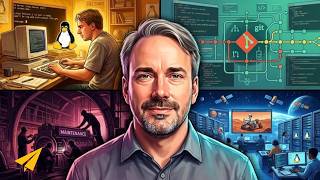
In this YouTube interview, host Evan Carmichael frames a motivational "Top 10" list based on Linus Torvalds' own philosophy of work and success. Linus repeatedly emphasizes that most so‑called innovation is hype; the real value lies in doing the work (the 99% perspiration, 1% inspiration). He outlines ten practical rules: (1) Get the work done – focus on execution over flashy ideas; (2) Do not let go – stay stubbornly committed to a project; (3) Have passion – love the daily process more than distant visions; (4) Start small – solve personal problems first and let solutions grow organically; (5) Learn through trial and error – open‑source development is an evolutionary, experimental process; (6) Embrace your uniqueness – recognize personal strengths and limits, and collaborate with complementary people; (7) Find your motivation – community interaction, debate, and even cursing fuel his drive; (8) Be brutally honest – call out bad hardware partners (e.g., NVIDIA) and speak bluntly; (9) Create for yourself – build tools (Linux, Git) that solve his own needs, which later benefit others; (10) Optimize your working environment – walking desk, clean space, regular hours, and a setup that automatically triggers motivation. Throughout, Linus shares anecdotes about his childhood nerdiness, long tenure at a single Silicon Valley company, his dislike for UI work, and his belief that respect must be earned. Evan adds motivational commentary, urging viewers to design their own environment, stay consistent, and apply these principles to entrepreneurship.
Chapters
If you're looking for ways to find your motivation, optimize your working environment, and get work done, then this video is for you.
Don't do this big think different, don't do these big innovation thing. Screw that, it's meaningless. Even though I'm a geek, I actually really enjoy the social interaction. I'm I enjoy cursing at people when they make mistakes. It's set at a very slow speed. I call it my zombie shuffling desk.
Need motivation? Watch a top 10 of Believe Nation! What's up, it's Evan, my one word is believe, and I believe in you. I believe in that amazing thing you have inside you that I want to see burst out into the world. So let's get your motivation to a 10 and have you believing in you. Grab a snack and chew on today's lessons from a man who went from being named after a Nobel Prize-winning scientist to being the principal developer developer of Linux. He's Linus Torvalds, and here's my take on his top 10 rules of success. Enjoy! All right, let's kick things off with rule number 1: get the work done.
I'm a huge believer in Just the 99% sweat, 1%— oh, well, 99% perspiration, 1% inspiration thing. Any technology project, the innovation that this industry talks about so much is bullshit. Innovation— anybody can innovate. Don't do this big think different. Don't do these big innovation thing. Screw that. It's meaningless. Like, 99% of it is get the work done, right? And there are— I actually— that's my least favorite part of the technology news cycle is this constant innovation and new ideas and this will revolutionize. All that hype is— that's not where the real work is. The real work is in the details. And I'm obviously one of those people who just— I like to concentrate on one project. I don't like flitting from one idea to another. And you need the people who just flutter about and come up with ideas, but they're not the really useful ones. They're the ones who— they end up being the ones who maybe give ideas to the people who then Do the work.
I love this message, and so often you hear people say, you gotta work smart, you gotta work smart. Yeah, you gotta work smart, but you also have to work hard. Anybody who's achieved anything at the top, they worked insanely hard as well as working smart to get there. Great point, I love it. Kicking us off, number 1. Let's get to number 2, do not let go.
You mentioned that you've been programming since you were like 10 or 11, half your life. Were you this sort of computer genius, you know, uber nerd? Were you the star at school who could do everything? What were you like as a kid? Yeah, I think I was the prototypical nerd. I mean, I was not a people person back then. That's my younger brother. I was clearly more interested in the Rubik's Cube than my younger brother, right? I was a geek. I was into computers, I was into math, I was into physics. I was good at that. I don't think I was particularly exceptional. Apparently, my sister said that my biggest exceptional quality was that I would not let go. Right? I would just— OK, so let's go there, because that's interesting. You would not let go. So that's not about being a geek and being smart. That's about being stubborn? That's about being stubborn. That's about, like, just saying— starting something and not saying, OK, I'm done, let's do something else. Look shiny. And I noticed that in many other parts in my life too, that I lived in Silicon Valley for 7 years, and I worked for the same company in Silicon Valley for the whole time. That is unheard of, right? That's not how Silicon Valley works. The whole point of Silicon Valley is that people jump between jobs to kind of, mix up the pot, and, and it's not the kind of person I am.
Another super important point, and you'll see it across all the successful entrepreneurs, the consistency, the dependability, the reliability. Every day just getting up and doing it. You'll have people who are less smart, less talented, less capable who win because they just are more consistent and they show up every single day compared to the people who might be geniuses, might have great ideas, but they don't do anything on it.
Love it.
Okay, rule number 3: have passion.
Having vision may be what gets you past the problem. My argument has often been that if you, like, look at the stars all the time, you will stumble over the pothole in the ground because you're not looking where you're walking. I believe more in having passion. I think really caring about what you do is way more important. Than, than having this mental vision of this golden future that you want to reach.
And this is another one that, guys, comes up over and over and over again. You have to have passion. You have to love the work. You have to love the process. Yes, have a big goal for where you want to go and enjoy the daily work of what you're actually doing. That's how you'll be successful. Next, rule number 4: start small.
The most important thing you should keep in mind when building something new is to not think you're going to change the world and not overdesign and not make it something huge and big and completely different from what has gone before. It's nice to think that somebody has one great big idea and will apply that idea to make the world a better place, and that's not how the world actually works. I mean, I've been involved in many projects, but all of them have started from very pedestrian roots, trying to solve a particular problem I had. And some of them never got any further. But the successful ones, when I had solved my problem, somebody else came around and said, hey, that almost solves my problem too. And they grew from the fact that they started small, but the roots and the basics were good enough that they could grow. But don't try to aim for the moon. I mean, I did not start Linux thinking I would take over the world, but we're almost there now.
So this one is interesting. I don't think there's anything wrong with aiming for the moon. I think it could actually help you stay motivated, stay driven, drive forward every single day because you have this guiding thing that's that's directing you. I think the most important part from this for me is that you still need to start. You still need to start small, right? It's for me thinking big and starting small, doing something that might be really pedestrian every single day, and that eventually comes closer to that big vision you have for yourself. So that's my take, but let's move on to rule number 5: learn through trial and error.
How— in addition to how do you process so much code, how do you understand what requirements are out there, what features and functionality you want to integrate in? Well, I mean, that's the real advantage of open source, I think, is that if you want to do something new, something that really is pushing the envelope, the only way you can really— I mean, nobody can really say, "This is the way to do it." So what you need to do is just a lot of trial and error. And I often compare software development to biological processes, where it really is evolution. I mean, it is not intelligent design. I'm there in the middle of the thing, and I can tell you, it is absolutely not intelligent design, whatever you want to think. You have to have— I mean, you have a lot of people who have their ideas of where things need to go. And then you need to have a marketplace where you can try them out. And that's where open source allows all these different groups to just go off, do their own thing, and then come back and say, "Hey, look, I did this and it actually worked." I think it's really important to learn through trial and error.
I think if you look at whoever has the most success that you look up to, who had the biggest wins, they also had the most failures. You cannot play your life so small that you don't even try because you're afraid of failing. You will fail, you learn from it, and you get better. It's a message again that's repeated over and over and over again. Let's move on to rule number 6: embrace your uniqueness.
Going back to the "I'm not a people person," sometimes I'm also, shall we say, myopic when it comes to other people's feelings. And that sometimes makes you say things that hurt other people. And I'm not proud of that, right? But at the same time, it's— I get people who tell me that I should be nice. And then when I try to explain to them that maybe you're nice, maybe you should be more aggressive. They see that as me being not nice. And I—
we're all—
what I'm trying to say is we are different. I'm not a people person. It's not something I'm particularly proud of, but it's part of me. Coming back to the point where I said earlier that I was afraid of commercial people taking advantage of your work, it turned out, and very quickly turned out, that those commercial people were lovely, lovely people, and they did all the things that I was not I was not at all interested in doing, and they had completely different goals, and they used open source in ways that I just did not want to go, but because it was open source, they could do it, and it actually works really beautifully together. And I actually think it works the same way. You need to have the people people, the communicators, the warm and friendly people who, like, really want to hug you and get you into the community, But that's not everybody, and that's not me, right? I care about the technology. There are people who care about the UI. I can't do UI to save my life. I mean, if I was stranded on an island and the only way to get off that island was to make a pretty UI, I'd die there, right? So there's different kinds of people.
I love this point, and I think it's really, really, really important to have the self-awareness to understand who you are, what you're great at, and spend as much time doing that as possible. You have Michael Jordan level talent and skill at something, spend your time there. If you spend your time doing all the crap that you hate and you're no good at, you're never gonna be able to build something amazing. Get the people who love doing that stuff and let them go wild with it so you can focus on what you are a natural genius at. Let's move on to rule number 7: find your motivation.
What keeps me motivated is I used to start out as a pure programmer and actually writing the code myself. And that is still fun, and I still do it on the smaller projects. But it turns out that even though I'm a geek, I actually really enjoy the social interaction. I enjoy cursing at people when they make mistakes. I like the back and forth. I like the arguments. It really motivates me to be part of a very vocal community we have. We have a lot of engineers with a lot of ego, and it's really exciting to just participate in that. So we do have technical discussions, and not all of them are cursing, but that kind of does add spice to your life.
So it's still the communities, the people who are—
It is the communities. It's the communication, yes.
My biggest takeaway from this is that you get to create the environment that you want to help you thrive and succeed. So if you want certain kinds of people around you who have certain values, certain belief systems, certain skills, certain understandings, then surround yourself with those people. If you like to be isolated and alone for stretches of time, then do that. If you have an office that you walk into that you're excited to see, do that. Wearing clothing, do that. Reading books, do that. The thing that makes you come alive, that gets you motivated on a consistent daily basis so you don't have to think about it, you have to wake up every day and think about it, you can actually just go into your environment and it gets you motivated, that's when the magic starts to happen. Let's keep it going to rule number 8: be brutally honest.
NVIDIA has been one of the worst trouble spots we've had with hardware manufacturers, and that is really sad because NVIDIA tries to sell chips, a lot of chips, into the Android market, and NVIDIA has been the single single worst company we've ever dealt with. So NVIDIA, fuck you. Don't get me wrong, I'm not saying that other companies are perfect either. We have had companies that just don't care. We've had companies that felt that Linux wasn't a big enough market. We've had situations like that. At the same time, there's a lot of companies that have been very helpful since very early days. And I think it's very sad when you sell hardware and you actually use Linux and you're being really difficult about it. And I really, yes, I'm sad when it happens. We can't do anything about it. It's life. I wish everybody was as nice as I am. I like being outrageous at times. It's amusing to see. I guarantee you, if you make that video available on the internet, there will be thousands of people who are really upset and I— you know, and offended. I like offending people because I think people who get offended should be offended.
So that's an interesting perspective, an interesting clip. I think the thing that I take away most from this is just being yourself. And if you have an idea that you want to express, that you want to share, share something, you have to get out, then don't just sit on it, don't just wait on it, don't just worry about what other people are gonna think or say. Doesn't mean you have to necessarily go out and offend people just to offend people, but if there's something that's inside you that you want to get out and something that you might regret not doing, this idea you have that if you don't act on it you may regret, then actually just get out there and do it. And the more that you are yourself and you express that, the more people are gonna relate to you as opposed to just thinking you're this corporation, you're this robot that they can't connect with. Moving on, point number 9 is create for yourself.
There are whole projects that do only source code maintenance, and CVS is the one that used to be the most commonly used, and I hated CVS with a passion and refused to touch it and tried something else that was radical and interesting and everybody else hated. And we were in this bad spot where we had thousands of people who wanted to participate, but in many ways, I was the kind of breakpoint where I could not scale to the point where I could work on it with thousands of people. So Git is my second big project, which is only created for me to maintain my first big project. Right? And this is literally how I work, I don't code for— well, I do code for fun, but I want to code for something meaningful, so every single project I've ever done has been something I needed. So really, both Linux and Git kind of arose almost as an unintended consequence of your desire not to have to work with too many people? Absolutely, yes. No, no. That's amazing.
I think this is the main reason why most entrepreneurs fail. They create a product or service or company just trying to make money, just trying to chase an opportunity, as opposed to actually creating something that you enjoy, that you love, that you have a passion for. And so when you design something that solves a personal problem of your own, like I did for these top 10 videos— I love that you guys love them, but I made it for me because I want to be surrounded by genius and greatness every single day. I made it selfishly for me. That's why the passion comes out, and I make something hopefully amazing every day for you guys, and I'm able to share it. And so if you start with that, your own personal passion, a problem that you're facing that you desperately want to solve, then you go off and share it with the world. That's the seeds of successful business. All right. And rule number 10, the last one is optimize your working environment.
So this is my working space. I've been using a walking desk for the last 3 or 4 months now. I'm not sure how much it does for me, but, um, I'm sure it's healthier than just sitting down. I'm also trying to keep my desk clean. Because if you pan over to my old desk, which I don't actually use anymore because it got so filled with crap. I don't know what to do about this anymore. I need to burn it down someday. I used to work nighttime. But then I got kids. And the kids go to school. And that means that we had to wake up at 7:30 or so to take the kids to school. It's not exactly a 9-to-5 job, but it is actually fairly close. And you can see that in the commit logs. It's interesting, I sometimes do statistics of which time zones people are and what time people are working at. And these days you can definitely tell that a lot of people are actually keeping pretty regular hours. I'm not the only one with kids, clearly. It's set at a very slow speed. I call it my zombie shuffling desk because if I put it any faster than 1 mile an hour, my mouse movements get very erratic and I no longer can close my windows.
So I'm a huge fan of designing your work environment to support you, whatever that looks like. He's using the walking desk on a treadmill, I'm on a trampoline. I've been using a stand-up desk for a number of years. I love the trampoline as an adjustment, but everything from your desk, your environment, what's on the walls, you know, what's on your table, what's in front of you, what you wear, like, you want to design it again so that when you wake up and you go to your office, instantly you're in an environment that motivates you to want to work hard and get hustling instead of you having to think about it. Super important, understand what drives you and then create create the environment to make that automatic for you. Thank you guys so much for watching. I would say that rule number 2, do not let go, is my personal favorite. I'd love to know which one is yours and why. Leave it down in the comments below. I'm looking forward to hearing what you have to say. I made this video because HB asked me to, so if there's a famous entrepreneur that you would like me to profile next, check out the link in the description and you can go and cast your vote the request line video. So thank you guys again for watching. I believe in you. I hope you continue to believe in yourself and whatever your one word is. Much love. I'll see you soon.
So was there a moment when you saw what was being built and it suddenly started taking off and you thought, wait a sec, this actually could be something huge, not just a personal project that I'm getting nice feedback on, but a kind of of an explosive development in the whole technology world? Not really. I mean, the big point for me really was not when it was becoming huge, it was when it was becoming little, right? The big point for me was not being alone and having 10, maybe 100 people being involved. That was a big point. Then everything else was very gradual. Going from 100 people to a million people is not a big deal to me. Well, I mean, maybe it is if you want to sell your result. It's a huge deal, don't get me wrong. But if you're interested in the technology and you're interested in the project, the big part was getting the community. Then the community grew gradually, and there's actually not a single point where I went like, "Wow, that just took off," because it— I mean, it took a long time, relatively. The thing I really enjoy about programming is just the fact that you really can tell the computer exactly what to do and it will do what you tell it and nothing more. I don't know, maybe I'm autistic or something, or borderline, but that doesn't happen in normal life. You see code, you don't have to even think about it. You look at something and you know what it does. If you're not a programmer, you would think it's almost noise, but if you've been doing it a long time, you can read it like any other language. You can write code that looks beautiful but just doesn't actually solve the problem, which is why I'm still doing the same project 25 years later. Because it's hard to write good code. I'm sorry to ask this question almost, but it's something that I think is a little bit important. How do you think it affects the culture of a community, of a project, when the leader is on that project's public mailing list telling people in response to patch reviews that they should be retroactively aborted? Right. And maybe that you're surprised that they're still alive because they should have starved to death when they were children. Because they're too stupid to find a tit to suck on. I agree that some people might be put off by that. But on the other hand, you know what, in the end, I don't care. I care about technology. And I've actually seen projects that took the whole political correctness so far that the project no longer is about the technology. I grew up in a culture that I think is not quite as politically correct as the culture, especially in the US today. Like, when I say something like, "I wonder how he grew to be an adult when he's so stupid that he— I don't expect him to find food," some people might realize that it's kind of hyperbole and joking. I'm not saying something bad that, you know, it's not politically correct or whatever, although certainly I would understand if people do say this. It's more about treating other people with respect and maybe saying technical— You know what? I mean, you can applaud everything you want, but I don't respect people unless I think they deserve the respect. There are people who think that respect is something that should be given, and I happen to be one of the people who am perfectly happy saying no. Respect should be earned, and without being earned, you don't get it, right? It's really that simple. And I— not everybody agrees, and that's fine too. Raise your standard. Apple, at the core, its core value is that we believe that people with passion can change the world for the better. Now, One drop of my self-worth depends on your acceptance of me. I don't ever give up. I'd have to be dead or completely incapacitated. Hey, Believe Nation!
If you want to see my all-time favorite top 10 rules of success, I have a very special secret video for you. These are the individual clips that I have personally learned the most from and applied to my life and my business. Check the link in the description for details.
More from Evan




How the Biggest Mistake in History Created A Trillion-Dollar Empire | Sergey Brin



9 Machiavelli Principles That Force People To Respect You | Machiavellian Philosophy



The First 10 Words That Instantly Ruin A Sales Conversation | Vanessa Van Edwards