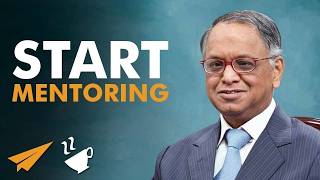
In this motivational YouTube video, Evan Carmichael opens with a brief introduction and then plays a clip of Infosys founder Narayana Murthy discussing the importance of mentoring for creating successive generations of leaders. Building on Murthy’s insight, Evan explains why mentorship is crucial for entrepreneurs both as a way to develop team members and to give back to their communities. He then outlines a three‑step framework for finding mentors: (1) aspirational mentors—figures like Bill Gates, Steve Jobs, or historical leaders whom you may never meet but can study; (2) online mentors—YouTube channels, bloggers, social media personalities, and other digital voices you can follow regularly; (3) local mentors—successful people in your geographic area who you can approach for a brief coffee chat or phone call. Evan stresses practical tactics for initiating contact, such as requesting a short, informal conversation rather than a formal “will you be my mentor?” request. Throughout, he stresses the dual responsibility of entrepreneurs to be both mentors and perpetual learners, noting that most problems have already been solved by others. The video ends with a call‑to‑action asking viewers to comment on their biggest mentors, encouraging community discussion.
Good morning, Believe Nation! Today's message is Start Mentoring. Over to you, Narayana Murthy. I wake up every morning with espresso, keep me going.
The primary objective of every leader is to ensure that there is successive generation of leaders. And one of the instruments for doing that is mentoring. Mentoring is a private relationship, it's a voluntary relationship, the mentee chooses the mentor at Infosys, so it's an honest one, it's one where the moral dilemma, the value system, etc., etc., can be discussed openly and honestly, and hopefully the mentor will use his or her experiential base to give some solutions.
So mentorship is a super important topic. And in this clip, he's talking about how you need to mentor and give back. And I think that that's a really important message, whether you are bringing somebody new onto your team and trying to mentor. And you may not be thinking kind of multi-generational yet, right? You may not be thinking, how do I sell my business or how do I make sure it continues beyond my existence. Right now, a lot of you are probably thinking, how do I just get my business up and running? How do I make it sustainable? How do I provide an income for myself? And so I think mentorship can play two important roles. One, I think, yes, you should be a mentor. You should be a mentor to people who you're bringing up in your organization, to new hires that you're bringing on board. You should dedicate time to making them better, understanding what their interests are, and having, having them feel like they're learning. Because if they are not learning, they're gonna leave and go do something else. I think as well entrepreneurs have a responsibility to mentor the people around them, right? To build up and lift your community, to make your community rise up, right? I want Toronto entrepreneurs to be better. I want global entrepreneurs to be better. But I do a lot of work in my local community because I believe it's a responsibility that you have as an entrepreneur to give back and help others. Now let's flip the other side around. It's not talked about in the clip, but I think it's really important in that you need to find mentors yourself. Right? You need to find people who you can talk to one-on-one, who are in your local community. You need to find people who are online, who you may not have met before, watching these videos as an example. And what I call aspirational mentors. These are people who you look up to, who you want to be like, who you could learn something from even though you may never meet them. They may be dead, right? My first real mentor was Bill Gates. My family were great mentors. My parents were mentors in that they taught me my belief system, my value system, but they're not entrepreneurs. My first entrepreneurial mentor was Bill Gates. I looked at how did he get started, how did he build his business. And I've never met Bill Gates, I may one day, but other mentors of mine have been E.P. Giannini, who started Bank of America, and Steve Jobs, and these guys have passed away and I'll never get the chance to meet them, but I can learn a lot from them. And so I would start looking at, you know, whatever problem you have right now, it has already been solved. People have already solved the problem that you are currently facing over and over and over and over and over again. And instead of you trying to come up with genius ideas every time, you can look to who has already solved this and how can I model their success. And so if you can connect with aspirational mentors, right, find people who you look up to inside your industry and outside your industry, look at how they got started. I guarantee you, you'll find ideas in how you can apply that to your business. Second, I look at people online, YouTube channels, bloggers that you follow, reporters that you like, entrepreneurs on Twitter or social media. That you look up to, that you respect. If you're watching Shark Tank, or you're watching The Prophet, or you're watching these YouTube channels, make that a habit, make that consistent so you can start to expand your awareness and not just be locked into your day-to-day life and the people who are around you. And then 3, look at people who might be in your local community who have had success. If you see somebody speaking at an event that's close to you and you want to learn from them, go, reach out, try to connect with them. You don't go up and ask someone, "Hey, will you be my mentor?" because that is a little creepy and it involves a long-term relationship. But just asking somebody out for coffee, just asking to pick their brain with a 10-minute phone call is a lot easier to get a yes and that can build an ongoing relationship. So two sides of it. One, be a mentor, help others, help people in your organization, help people in your community. And then two, be a mentee. Always be learning and try to reach out and sponge off of other people because whatever problem that you're facing right now has already been solved many, many, many times. So the question of the day today is, I'm curious who some of your biggest mentors have been. Who's some of the biggest mentors, and maybe you've met, maybe you haven't met, but who are the people right now who you look up to and why? And leave that in the comments below. I'm really genuinely curious to find out who your mentors are, so leave it below. I will join the discussion. Thank you so much for watching. Have an amazing day. Continue to believe, and we'll see you again tomorrow morning for another shot of espresso. I wake up every morning. Espresso keep me going.