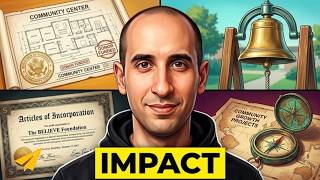
In this video, entrepreneur Evan Carmichael answers a viewer’s question about whether his advice to start a for‑profit company instead of a nonprofit would change if the nonprofit secured a government grant. He reiterates his core belief that, when someone is undecided between the two structures, a for‑profit offers greater control over revenue, reduces dependence on unpredictable grants and donations, and therefore enables a larger, more sustainable impact. Carmichael acknowledges that nonprofits can achieve impressive results but highlights the chronic funding uncertainty they face—grant cycles can disappear, donations can dry up, and bureaucratic hurdles can delay cash flow. He illustrates his point with Elon Musk’s trajectory: Musk used proceeds from a for‑profit exit (PayPal) to fund mission‑driven companies like Tesla and SpaceX, openly sharing patents to accelerate societal change. While congratulating the viewer for obtaining a grant, Carmichael advises that if the founder’s passion lies in nonprofit work they should pursue it, but for those on the fence, the for‑profit route is more advantageous for impact and financial autonomy. The video ends with a call for viewers to comment on profit vs. nonprofit, subscribe, and support his channel.
Chapters
Should you start a nonprofit? So a while ago I made a video talking about nonprofits versus for-profit organizations, and my advice— if you're indifferent between the two, you don't know if you should start nonprofit or for-profit— I advise going for the profit company instead of a nonprofit organization. The reason is I think you can have a lot more impact in the world if if you start a for-profit company. You can be in a lot more control of your revenue stream and not be constantly dependent on government grants and donations to support your organization. One of my YouTube viewers write in, love you guys, Nathan, who asked, "Would your opinion about starting a nonprofit change if you were able to secure grant money from the government?" So first of all, let me say before all the haters and the little man, sprout up. I love nonprofits and I do a lot of investing and help with nonprofit organizations. I just think you can have a greater impact if you are in the for-profit business, and that opinion doesn't change if you get a government grant, because that's how nonprofits support themselves, right? It's government grants and people and corporations giving donations. And there is, there's a tax incentive to support nonprofits in that way. The problem that I don't like with nonprofits, if you're not in control of your revenue stream, you're always dependent on somebody being nice and giving you money. And that government grant may disappear next year, right? So you get this grant, you go out, you hire people, you start doing projects, and then what do you do if that money's not there next year? What, you're going to fire everybody? What are you going to do? Your mission stops, right? I like being in control of my own destiny, and you can do that by having a company and then using the proceeds to support whatever initiatives you want, right? And the more money you make with your business, the more you can support any initiative that you want to do yourself. A great example is Elon Musk, who was one of the founders of PayPal and used the money from his sale to start off his own private enterprises with Tesla and SpaceX. And with Tesla, he's revolutionizing the way cars are built in America and hopefully around the world. He's trying to move a country from being so dependent on gas to using electricity. And he's, he's so adamant about this that all of his patents he put out open to say, hey Ford, you can use my patents. Hey GM, use my patents. I want to get these gas-guzzling cars off the street. I want everybody to be driving electric cars. That's his, that's his mission, and he's done it by building companies, and he's having a major impact on the country, on the world. Now, it's not that a nonprofit can't have an impact. They can. Nonprofits have an amazing impact all around the world. It's just harder because you're constantly depending on people being nice and giving you their money and donations, and those things dry up. They may not be there next year, and I just don't like the uncertainty. So if you're Nathan, you're starting this nonprofit, you got a government grant, that's awesome, congratulations. You know, dealing with the government can be a huge pain. You're waiting so long to get your money, the application process is ridiculous, But congratulations on getting that grant. And if your passion is to start a nonprofit, then do the nonprofit. My advice is for people who are on the fence, they're not sure what they want to do, I think you have a greater impact going the for-profit route where you have control over your revenue stream, over how you spend your money, and you can do what you want with it to have a positive impact in the world. That's my advice. Believe. For those of you watching, I'd love to know what you think. Profit? Nonprofit? Leave it in the comment section below. I want to hear from you. If you like this video, click on the link in the description to support me and click on my face, subscribe to the channel. Thank you so much. I'll see you soon.