Novak Djokovic Advice in 23 Minutes | How to Fix Self-Doubt and Build a Champion Mindset
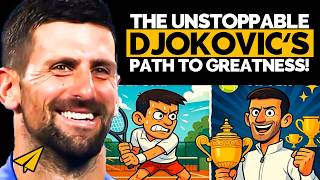
Novak Djokovic shares 10 rules for building a champion mindset, covering kindness, testing your limits, mindfulness, and overcoming self-doubt. He discusses managing ego, discipline, and the importance of belief in your work. Tom Brady makes a brief appearance.
Chapters
Novak Djokovic is a Serbian tennis player who has won a record 24 Grand Slam men's singles titles, 40 ATP Masters 1000 titles, and been ranked world number 1 for 428 weeks, an all-time record. He went from growing up in war-torn Serbia, often sheltering from bombings, and his father borrowing money from a loan shark at 15 to 30% interest per month to fund tennis training, to becoming one of the greatest tennis players of all time with a net worth estimated at around $240 million. If you've been here before, drop a hashtag #Believe in a comment so I can feature you here in a future video. And if you're new, welcome to Believe Nation, the only channel that helps you believe in yourself daily, one video at a time. Need motivation? Watch the top 10 with Believe Nation. Okay, let's kick it off with rule number 1: Be kind.
The biggest lesson that I've learned is, is probably that I should be always kind to anyone and everyone. No matter what experience they go through, because you never know. You never know what one person goes through. And you just always be kind because there is something, you know, that we call God, universe, angels. There is this higher force above and here on this planet that is going to help us to live a prosperous life, to be happy, to be healthy, to be joyful, to have that peace in if we truly respect and appreciate ourselves and others in that process as well.
Rule number 2 is test your limits.
Do you feel like in your career you've achieved everything you set out to as a tennis player? Yes, and more than that. And at the same time, I still want to do more. And I know that that comes in a big part from a good place, meaning from a place of purpose, inspiration, motivation, love for the sport, passion for the sport, passion to make people happy when they watch me. If I'm doing that, and I have a feeling that I am by still actively being on the tennis tour and having my tennis career, active tennis career, I'm still spreading that light by playing tennis and inspiring younger generations, that's something that comes from a good heart, a good place. But what comes from maybe, I'd say, not necessarily a bad place, but less of a good place, I have identified that as well, is my feeling of not being enough. And that goes back to my very, very beginning of my life and my relationship, particularly with my father. And not doing enough, not being good enough, et cetera, et cetera. So now that I'm talking about it, I kind of get emotional about it because it's still deep inside of me. And it's kind of the battle that I also go through often because a lot of people, even closest people in my life, ask me, what more do you want? You have achieved everything. What do you want? Why do you keep going? And I tell them the good part that I told you, that I still really strongly feel it's inside of me. And I feel like As long as I have the capacity or ability to compete for the biggest titles in my sport, I want to keep going. And also, partly, the part that I didn't mention that inspires me to keep going is to test my limits mentally and physically. Because when I was starting to break through into professional tennis, I remember when you reach your 30s, you start counting your days to your retirement. Like after 30, you know, that's it pretty much. Even though there were some exceptions, like Jimmy Connors, the legend of our game, he played, I think, semifinals or finals of US Open when he was 40, and, you know, still, still, you know, dominating the tour. So there were very, but very few exceptions. Nowadays it's different. Why? Because I think the care for the body has improved so much. I mean, now not only top 10 or 15 guys or girls on the tour have multiple people in their squad to take care of them, you have top 50 people that are taking care of them. It's due to the improvement, of course, of the conditions for the players. And we earn more across the board, so it allows you to hire more people that would take care of your body. And I think that It's also a kind of a curiosity from my side. How far can I go? I'm 38 this year. How long can I push my own limits? And I don't feel like I do have limits. And I feel like the limits are normally constructs in our mind.
Rule number 3 is practice mindfulness.
I practice a lot of mindfulness. So meditation, journaling, talking with my team, with my parents, with my wife, with with everybody who is around me trying to address certain, with my, of course, life coaches that I have, spiritual guides that I have as well that help me address certain emotional issues or traumas or whatever it is that tend to appear on the court, so when it appears on a breakpoint, when I'm facing a match point or breakpoint or clutch moments, they do tend to surface, but I manage to gain the control over them much quicker, and I manage to impose my positive affirmation and positive feeling. Or if that doesn't happen, then I just try to be conscious that I have to accept that moment, that that's going to happen, but I focus on my breathing and I focus on being in the moment and what needs to be done next moment, which is playing the right shot, positioning myself well on the court, and just focusing on executing the point right. And that's easier, much easier said than it's done. And I think anyone who plays the sport at the highest level will understand that. It just takes years of devoted practice mentally, not just physically. And you have to do it. You can't expect others to really fix your emotional or mental issues. They can encourage you and they can empower you and they can understand you and they can give you tools, but you have to use those tools. And do it the right way.
Rule number 4 is overcome doubts.
One of my first Grand Slams in Australian Open in January 2008, and I was 20 years old. Wow. And it was a dream come true.
The whole—
I mean, I was very successful in junior days and everything. It was just, I had this upward kind of spiral and trajectory in my tennis career, in my life, and everything was great doing— you know, everything was great. And, um, and then all of a sudden I had this period of 2.5, 3 years where I didn't win a slam.
Really?
I was, I was managing to be, you know, 3, 4 in the world, but I just, I struggled a lot. And, and then, and for me, being number 3 of the world wasn't enough. I just, I was not satisfied with that. And, uh, and I just, I always go back, say, wait, okay, when I, when I was, you know 7, 8 years old, my dream and life goal was always to be number one and win Wimbledon. That's it, you know. And I need to achieve that no matter what.
Yeah.
And so, but then I reached, I reached the kind of mentally low point in my career. Um, I think it was after Roland Garros, you know, one of the four slams. And, uh, I lost. I was 2 sets to love up. I lost in 5 sets in quarterfinals against a guy called Jurgen Melzer. He was top 10 in the world, very good player. But I had him, I mean, I had a match and I just lost. And I had and just, I just had a breakdown. And I remember, I remember going first to my parents and, and, and, you know, so, you know, talking about this and that. And I just, I cried and I like, I don't know if this is worth it. I don't know if I should keep going. And, and they're like, uh, and my father was like, tough enough, tough enough, you know, no, no, no, you know, like these kind of things. And, and I'm like, okay, but it was, it wasn't enough.
Like, I felt I felt I needed, I needed, I needed to think about it more.
I felt I needed to share more. So, um, so I went to, to my coach at that time, Marian Vajda, and, and my, uh, my, one of my best friends in life and my former physiotherapist, Milan. And I was in their room and I remember sitting on the floor and, uh, and I just, again, I had another breakdown and I was saying, I don't know, you know, and they're like, and they were like, okay you know, take your time and, and just let's, let's first, okay, breathe and let's calm down, and then let's, let's look back, you know. And, and then they were really, really wise for telling me, like, let's go look back first, you know. Um, you know, why did you start playing this sport and, and the whole thing, you know? And do you, do you love it? You know, do you still feel, you know, leave aside what you want to achieve. Yeah, what you want to do, passion for it, you know. But let's— do you, do you really like holding racket in your hand? And then I'm like Actually, I do. I really, I love holding a racket in my hand, whether it's a Grand Slam, you know, center court finals, whatever, or it's just a normal, you know, public court. I still love it, like playing for the sake of playing. They're like, well, that's your source. That's what you need to tap into. And it takes a little bit of time. And literally, you know, they thought it's going to take a few weeks. Next day I'm like, okay, I'm back on track. Let's go, let's keep going.
Also, if you want to take real action after this video, I made a free worksheet just for you. It from today gives you space to write down your biggest takeaways and helps you build a simple action plan. It's 100% free. Just click the link in the description below to go grab it. Let's start building some real momentum in your life and your business. Rule number 5 is keep your ego in check.
When I was at the peak of my career and, you know, I felt like I'm unbeatable and I feel like I could do anything, you know, I kind of walking on the water. We all experience that in our own lives in a certain way. And it's a great feeling. But then the ego takes you places where it's hard to come back from, and maybe you shouldn't come back from that. Maybe you're trying to find a balance, find the optimal measure that really works for you. But it took me time to really accept the fact that what I have learned, what I have mastered, and what I'm doing on a daily basis for the last 20 years or more is not necessarily a guarantee that I'll always find a way and that will always work for me in this particular time of my life and circumstances that I'm facing. So that's a huge revelation for me because— and I'm still trying to get a grasp on it and understand all of these factors that are in play that are challenging me on a daily basis. And when I talk from this perspective, it's a beautiful journey that I'm trying to embrace. But when you are immersed in the dark moment, it's kind of hard to really get out of that.
Rule number 6: Have discipline.
Whatever in life you, you know, you envision to do, you got to be disciplined, you know, disciplined spiritually, different discipline in sports, in, in whatever, in your family, in your relationships. So, um, so very early, I think, um, uh, and, and my parents and my tennis mother, Jana Gencic, they've, uh, you know, deeply ingrained that discipline in me. And then I, I knew I mean, already 7, 8, I was like, okay, I, you know, this is what I'm going to do for the rest of my life. I, I knew it was very clear. And, and what is strange about it is that, you know, if you take in consideration all the, the circumstances in, in which I've grown up as, um, you know, as, as a child, it was very odd. And there was many people, it was many people that were laughing at it. And it's just, it was, uh, my parents, uh, I mean, my father had to You know, he went through so much. I'm internally grateful to both my parents. And my father has borrowed money from people that were chasing him in car. I mean, you would not imagine the experiences that he had and we had in order for me to travel to United States, for example, for the first time in my life. And during those '90s, I mean, and because of embargo and all the things, the criminal rate raised. So there was a lot of, you know, kidnapping and, you know, different stuff. And it was— it's not, it's not even close like that now. Now it's great, it's, it's fantastic, it's safe, and it's all fine. But, but, but during those, those 7, 8 years, it was really tough, you know. People were scraping and people were, you know, fighting for their lives, basically surviving, you know. It's a matter of like, if you take one bread or two breads, it makes a difference. You need to stay in line, and God knows if you're gonna have a bread in a week time, you know. So it was literally that kind of survival mode for everyone. You know, and so I think from very early stages of my life, I knew what I wanted to do. But not just what I wanted to do, but what I wanted to achieve. What is going to be my accomplishment in what I do.
Rule number 7: Believe.
It's incredible how the excitement is rising as you approach any Grand Slam. And especially for me here in Paris, the one that I didn't win. It's a completely different feeling coming to Paris and preparing for Roland-Garros than any other event, really. Not in terms of pressure and expectations, but just in terms of excitement and getting on the court and competing and trying to see how far I can get. But that's something I look forward to, really. I mean, I've been building up and winning a lot of matches and putting myself in a position that that maybe I never had before, prior to Roland-Garros. Hopefully this is the year. I can't guarantee anything, I can't predict anything, I can't say how the tournament is going to go, but I'm going to try to give myself a reason to believe I can make it through an everyday commitment, discipline, and things that I can influence.
Rule number 8 is have a mentor.
I've been blessed and really lucky in a certain way to be surrounded with certain people at the very early stages of my career and my life that have directed me into this direction of self-care, of holistic approach, of multidisciplinary approach to the preparation, to the prevention, to the recovery. Both physical, mental, emotional. And at that time, because I was so young, I didn't understand that. And it didn't need to be explained to me in depth at that point. I trusted my tennis mother, as I like to call her. She passed away 13 years ago, but she was the one that really introduced this holistic concept to me. I was going, obviously, to school, and then I was only 9 years old, 9, 10, and I was training with her maybe 2 or 3 times a week individually. Tennis, and then I would have group sessions. And my parents were, you know, were trusting her enough to allow her to participate directly into my upbringing, basically. So she also educated me off the tennis court as well. So she took me very often, at least 2 times per week, to her house where we would look at the tapes of all the greats, both male and female tennis players. That's where my impersonation started, you know. People, you know, still to this day ask me, you know, when are you gonna do the imitation imitations, impersonations. And, you know, I haven't done it. I've done it early in my career and it was fun, it was viral, and people liked it. And then I received a little bit of evil looks in the locker room and I kind of felt like, you know, maybe I'm stepping over the line. So that's why I stopped. But that's where it started. And I was like, I was really trying to adapt all of the great things that I could see. And I have a kind of a photogenic memory and I'm a very visual person. And that was something that was kind of expected. That is kind of common as well, what you do with kids, you know, or with young athletes, You watch videotapes, you try to analyze, you try to talk. But then she had me listen to classical music, and she said, "It's very important that you do that almost on a daily basis. Listen to classical music while you are writing your journal, while you are preparing for bed, or any time of the day, but particularly those times." And I liked it. I didn't understand the purpose of it, but I liked it. And so we would look at the tapes and we would listen to this music. Music, and then we would read poetry, and then we would do a visualization practice. At that time, it was not presented to me as such, but she would just say in a very simple way that would be understood by a boy, a 10-year-old boy, just close your eyes and think about how you want to play tennis and think about when you're at your happiest. And so it started at a very early age, and I'm so eternally grateful to her for instilling this in me and teaching me how to see life, basically, and understand that tennis is not— as an individual sport, of course, it's also different because you don't have anyone to replace you if something goes bad during the match. You have to figure out a way. So I think it requires more responsibility from you on a daily basis to prepare yourself for the biggest battle internally and also externally, of course, with your opponent and with everything that is happening around. But, you know, so it taught me to really understand that tennis is not only about hitting a tennis ball over the net and counting score and dreaming about these achievements of winning Wimbledon as our holy grail of tennis, but it's more than that. And I can use tennis as a platform to evolve into a better human being. At that point, I didn't understand that. But then as I was growing older and becoming more mature, I started to understand the importance of doing all of these practices. And I started to expand on each of these topics that I was going through with her. And then I started going into yoga. I started going into the movement, into Christianity, Orthodox Christian. I'm very proud of my religion, but at the same time, I am very open to embrace anything that can teach me from other religions and from the spirituality as a whole. So I'm very curious by nature. So I was really always looking looking for new ways to improve myself and improve my life on this planet, you know? And I was very lucky to basically have that space also from my parents.
Rule number 9 is fall in love with what you do.
You were coached by the famed Coach Jencik. By 6, you're already thinking you can be number 1 in the world.
Why?
I fell in love with it when I was 4. You know, my dad bought me a tennis racket and they were making 3 tennis courts in front of the restaurant. Which were run by my parents back in a mountain resort here in Serbia. And we used to spend a lot of time there. And me and my dad, my uncle, and my aunt, they were all competitive skiers. And my father used to play soccer as well. And my mom graduated from the University of Sports. So there is an athletic gene in the family that runs. And so it's no accident that I ended up playing sport, but it is a little bit odd that I started playing tennis, which was quite unknown in my family. But I think it was a sign of destiny, 3 tennis courts being built when I started watching tennis on the TV. It was the Wimbledon finals. And Jelena Gencic showed up very, very soon after that with her camps. And my parents, I'm very grateful that they, you know, first of all, supported me and my wish to play tennis.
And number 10, the last one before a very special bonus clip, is have a winning mindset.
Something you said there, you're reaching your peak. Do you think, though, you can still take it to another level, or do you think this is as good as it's going to get for you?
Well, I like to use one quote that the limitations exist only in our minds.
And if you start using imagination, then your, your possibilities become limitless. So that's, that's kind of a mindset that I have.
I use my imagination. I do see myself achieving more. I'm hoping, I'm working hard on it, not only myself but the entire team around me. If you see the football players when they win a big title, Champions League for example, a lot of them, they fall to the ground. It's just that that there's so many emotions going through your mind, through your body. Undoubtedly, there is a huge pressure and expectations and the importance of that moment, and you're aware of that. You can't put it aside and say, okay, I'm gonna ignore it. No, it becomes a part of you, consumes you. Now it's on you if you are able to If you are able to overcome that obstacle, to face that, I would say, big sensation of mix of doubts, fears, excitement, you know, pressure or so forth, and if you are able to become one with it, and then it allows you to get to where you want to be.
And congratulations, you're one video closer to who you're meant to be. Believe. For 10 more amazing rules from Tom Brady and Patrick Mahomes, check the video right there next to me. I think you'll love it. Continue to believe, and I'll see you there.
My response is that I'll support them in any of their dreams. Whatever makes them happy makes me happy. I would encourage everyone to play football for the simple reason that it is hard.
More from Evan




How the Biggest Mistake in History Created A Trillion-Dollar Empire | Sergey Brin



9 Machiavelli Principles That Force People To Respect You | Machiavellian Philosophy



The First 10 Words That Instantly Ruin A Sales Conversation | Vanessa Van Edwards