Steal These 7 Morning Habits That Made Billionaires Insanely Rich
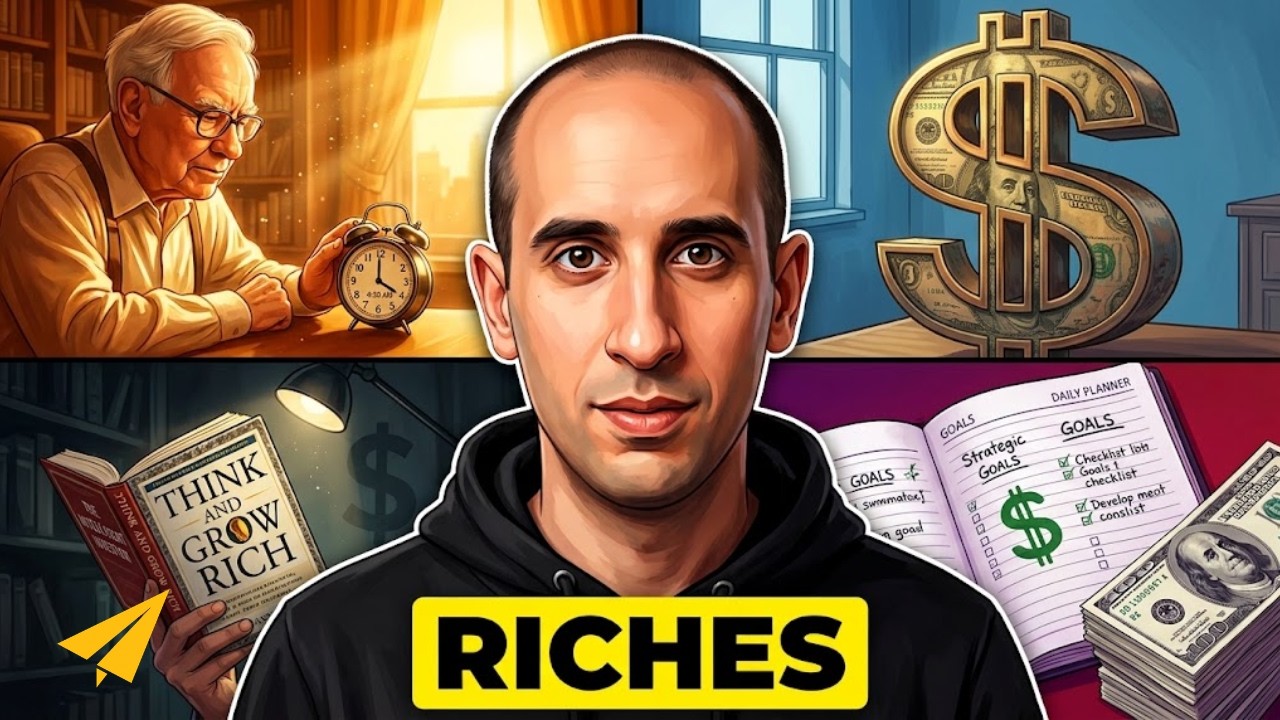
In this 13‑minute YouTube video, Evan Carmichael distills the morning routines of several billionaires into seven actionable habits that anyone can adopt without waking up at 4 am. He opens with the premise that half of our daily actions are habitual and can be deliberately chosen. He then walks through concrete examples – Sara Blakely’s “fake commute,” Richard Branson’s outdoor exercise, Jeff Bezos’s 8‑hour sleep and high‑IQ meetings, Tim Cook and Warren Buffett’s early‑morning reading, Bill Gates’s treadmill‑learning, and Ray Dalio’s meditation – to illustrate each habit. The core habits are: (1) get outside within 15 minutes of waking, no phone; (2) plan three priority tasks the night before and start with the most important one; (3) consume high‑value knowledge (reading, audiobooks, lectures) during routine activities; (4) protect a block of uninterrupted thinking time each day; (5) limit daily goals to a handful (the 5‑goal rule/25‑5 rule); (6) practice daily meditation or quiet reflection; (7) use a simple daily scorecard to track wins and build momentum. Carmichael emphasizes that these habits can be layered onto existing routines, that consistency beats intensity, and that habit formation takes about 66 days. He also provides a free worksheet, encourages viewers to comment, and ends with a call to belief and action.
Chapters
You can copy a billionaire's morning without setting a 4 AM alarm. It's a walk before you touch your phone, reading before anybody gets your time, and 3 tasks you pick the night before. Well, looking after yourself is obviously absolutely key to everything else. I generally do it through sport. I can get up early in the morning, I'll play a very hard game of singles tennis against somebody who's better than me. I'll then go kitesurfing, maybe go surfing, and then have breakfast, and the day begins. I'm grounded In wanting to learn, I run on the treadmill and I watch the lectures, and so I'm doing 2 fun things at once. Researchers at Texas A&M tracked people's everyday behavior and found that 43% of what you do is pure habit repeated in the same place almost every single day. I just read and read and read. I probably read 5 to 6 hours a day. I go to bed early, I get up early. I like to putter in the mornings. I like to read the newspaper, I like to have coffee, I like to have breakfast with my kids before they go to school. So I have my kind of puttering time is very important to me. And so that's why I set my first meeting for 10 o'clock. I need 8 hours of sleep. I think better, I have more energy, my mood is better, all these things. So almost half your day is already decided before you even wake up. And every billionaire on this list choose their half on purpose. I meditate probably 60 or 70% of the days. And so To allow yourself the 20 minutes twice a day, or the best you can do, but to allow yourself that is going to be to release that creativity as well as to get you centered. It's changed my life. It's the big— the biggest influence in whatever success I've had in life. I live 5 miles away from the office, but I saw it as a benefit because I would wake up I would do my meditation, I would have my coffee, I would check my phone, and then at 7:30 I just walk. And some days I listen to nothing, some days I listen to podcasts, audiobooks. I always know when I get into the office that I started the day with a win because I walked 5 miles. So here's how to steal the morning habits that made billionaires insanely rich. Sara Blakely built Spanx into a billion-dollar company, and she still gets up an hour early to drive absolutely nowhere. She does it because she figured out exactly where her best thinking happens. So let's go back to 1998. Blakely is 27 years old. She's just moved to Atlanta. She's selling fax machines door-to-door for a company called Danca. She does this all day, and at night she works on an idea that nobody wants to hear about. She spent 2 years and $5,000 of her own savings on it, and that was every dollar she had saved. The product came from cutting the feet off a pair of pantyhose so she can wear them under white pants. She wrote the patent application herself out of a book she bought at Barnes& Noble because a lawyer wanted $3,000 to do it for her and she wasn't spending that. In 2012, Forbes named her the youngest self-made female billionaire in the world. She was 41. Blikely lives really close to the Spanx office, so her drive to work is almost nothing. And then she noticed her ideas had stopped coming to her. In her words, where does your mind wander? For me, it's in the car. The drive was where the ideas came from, and she only found that out once the drive was gone. So she put it back in. She said it like this. I have purposely created what my friends call a fake commute. She gets up an hour early before she's supposed to be at Spanx and drives around Atlanta with no destination so that thoughts can come to her. I live 6 minutes from Spanx, but I will wake up an hour earlier, or I will leave my house an hour earlier and drive around town aimlessly just to get in my best think time. A billionaire with a company to run and a calendar full of people who are it for her time driving around Atlanta, going nowhere on purpose every single morning. Her best ideas come to her while she was driving, so she keeps that hour and she won't give it up to anybody else. So right now you might be looking at your own morning and thinking there's no free hour in there. You've got kids to get out the door, you've got a job that starts at 8, you got a commute that is already real. And I understand. So look at what Blakely actually changed. All she did was move an hour to the start of her day and decide what she would use it for With intention. So every habit in this video, it works the same way. None of them needs a 4 AM alarm or anything that you have to buy for $20,000. You already walk somewhere, you already read something, and you already decide what to do first. These habits just move all of that to the front of your day, and 43% of your habits already run on their own that you never sat down to choose. So here are these 7 morning habits that made billionaires insanely rich and how to run every one of them on the schedule that you already have. If you've been here before, drop a hashtag believe in the comments below so I can feature you here in a future video. And if you're new, welcome to Believe Nation, the only channel that helps you believe in yourself daily, one video at a time. Believe. Get outside before you get online. Let's start with Richard Branson. He wakes up at around 5 AM and the first thing he does is he goes outside. Tennis, a walk, a run, the bike, kitesurfing when there's enough wind. Then white tea, the sunrise, and breakfast with his family. Business comes after all of that. He said that staying fit gives him an extra four hours of productive energy every single day—not four hours of free time, four hours where his head actually works. There's no phone in that list. He's outside and moving before anyone on earth can reach him. He is 76 years old and still runs a virgin group, and this is what the first hour of his day looks like. I like to do my own version of this. It's the most important habit that I keep above all the other ones. I call it my believe walk. So brush your teeth, go to the bathroom, get out the door. No email, no Slack, no DMs, no texts. The second you open that phone, you've handed your first hour to whoever needs something from you overnight. And then you spend the rest of your morning, the rest of your day answering other people's ideas instead of doing your own work. So put a stopwatch on it first thing in the morning. From the moment your feet hit the floor to the moment you're outside should be under 15 minutes. Time it tomorrow and you'll find out how many of those minutes that you have been spending on the edge of the bed with a screen in your face instead of being productive. Next, walk for 15 to 20 minutes. Freezing rain, snow, doesn't matter. You go anyway because the walking is what changes your physiology and your energy. The phone comes with you. It has one job, and that job is to put on audio. Put on a YouTube video, a podcast, a book of somebody who's done the thing that you're trying to do. So interview, podcast, talk. On the mornings you wake up doubting yourself, and there will be many days when you doubt yourself, you borrow the people's belief you're listening to until yours starts to show up. Leave the phone charging in the bathroom or the kitchen overnight instead of right beside your bed. That one move does more for this habit than any amount of willpower will do, because at 6 AM you want to check your phone and you don't want to have to go and walk to another room to go get it. And build a playlist tonight, not tomorrow at 6 AM. Cue up 3 things before bed so tomorrow all you have to do is press play and go out the door. Guard your first 3 hours. Let's look at Jeff Bezos. He wakes up without an alarm around 7 AM and he protects 8 hours of sleep so that he can— then he does almost nothing that looks like work at the beginning. He makes coffee, he reads an actual paper newspaper, he has a slow breakfast with his Doesn't use screens, no inboxes, no emergencies popping up. His first meeting starts at 10:00 AM. He calls those his high IQ meetings, and every hard decision goes inside that window while his head is the most open, most creative, most clear. If something complicated lands on him at 5:00 PM, he doesn't look at it. He pushes it to tomorrow at 10:00 AM. He also said that his job is to make 3 good decisions a day, not 300 emails answered, 3 calls that actually move the company forward. Now, you're not running Amazon, neither am I, so shrink it to your own size. Open your calendar. Look at your calendar for tomorrow and find the hardest thing on it, the one that you keep sliding into an afternoon and then into next week and next month. Move it to your first working block before you open your inbox. Then take the decision that you've been going back and forth on all week and give it the 10:00 AM spot. Stop making it 9:00 PM when you're fried and you just want the day to be over. Run that for one week and watch the quality of your decisions change. All progress begins with telling the truth, and the truth is you've been making your biggest calls at the worst hour of your day. Read your own numbers first. Now let's look to Tim Cook from Apple. He gets up at 3:45 AM. Now you don't have to, but what matters is what he does with the first hour, which is read sales reports and customer emails before a single human being gets access to him. Warren Buffett does the same thing but with a different stack. He reads 5 newspapers a day and he says he spends as much as 80% of his working day reading. When he talks to students about it, he tells 'em to read 500 pages a day because that's how knowledge builds. It builds like compound interest. Both of them are doing one thing. They read the raw facts before anyone else's opinion reaches them, influences them. By the time someone tells them what's happening, they already know. Now you have your numbers too. It could be money in the bank. It could be the sales this week. It could be ad spend, calls made, people who replied. You know roughly where all those numbers are, but roughly is what lets a bad month run for 3 weeks before you notice it, that you can stop it in the first week. So tomorrow, before you open a single message, Open the one number that decides whether your business is alive or not and look at it for 5 minutes. Write today's figure, put it in a notebook. Do that every day for 30 days and you will be holding a chart in your own handwriting that tells you the truth about your business better than any dashboard ever will. And if you have a job instead of a business, you still have a number. What's in your checking account? How much do you owe? What did you save last month? How many people have you reached out to to talk about the thing that you actually want to be doing? It's the same rule. It's the same 5 minutes. It's the same notebook. Also, if you want to take real action after this video, I made a free worksheet just for you. It covers the top lessons from today, gives you space to write your biggest takeaways, and helps you build a simple action plan. It's 100% free. Just click the link in the description below and I'll see you there. Stack learning onto something you already do. So Bill Gates spends an hour on a treadmill, and that hour isn't only exercise. He runs while watching filmed university lecture courses from the great courses on geology, meteorology, oceanography, US history. He gets fitter and smarter inside the same 60 minutes. One of the richest people alive treats an hour of learning a day like it's a really important meeting that he can't move. He reads around 50 books a year on top of it, which works out to about one book every single week. You already have time for this every morning, and you, you're probably not using it as effectively as you could. The shower, the drive, making breakfast, folding laundry, walking the dog. Your hands are busy and your ears are free, so you can learn through all of it without adding one minute to your day. So, Pick one thing that you do every single morning without fail and attach one thing that's worth learning to it. I do it in my Believe Walk, right? I get outside and I listen to something. It could be an audiobook while you get dressed, a 12-minute video while you're making coffee, one video from someone who is 10 years ahead while you eat. Add a year of that up, 30 minutes a day, 5 days a week is 130 hours. That's more class time than a full university course. And it happens inside of a day that you're already living without adding any extra time. You won't feel most of it happening on a single day, but you feel it 6 months later when you catch yourself explaining something to somebody else that you didn't know 3 3 months ago. So set it up tonight so tomorrow's version is already loaded, right? Download the audiobook now, not at 7:00 AM while you're still looking for your keys and you're really tired. Manufacture your thinking hour. So this is Blakely's fake commute, and she's not the only one doing it. Jack Dorsey ran 2 multi-billion dollar companies at the same time for years, and every morning he walked to work over an hour on foot with audio in his ears before he sat down at a desk. Both of those mornings have the same 3 things missing. There's no screen, there's nobody talking to them, and there's nothing that has to be Your best ideas don't arrive while you're busy answering emails. They arrive in the shower, on a walk, in your car. You've experienced that 100 times and never once put it on the calendar in your structure so that it happens more consistently. So put it on the calendar, block 30 minutes tomorrow morning and give it a real title. My walking time, I believe walk, because an unblocked title will get stolen by the first person who wants to meet with you. So whether you're walking, driving, sitting on a bench, bringing a notebook instead of having a laptop, and go in with one question instead of zero. If you ask yourself, how do I get 10 more clients? This month. That beats you just staring out a windshield with nothing to think about. So go in with a question so you can get more clarity out of that session. If 30 minutes sounds impossible, start at 10 minutes. Set the timer, leave the phone in another room, and just go and think. You'll hate the first 3 days because you'll want something to do or read or listen to. And around day 10, you'll start getting ideas at that same time every single morning. Sit still before anybody reaches you. Oprah Winfrey wakes up without an alarm, walks her 5 dogs, and then sits for 20 minutes of quiet before the day starts. Ray Dalio built Bridgewater into the biggest hedge fund in the world out of a 2-bedroom apartment. He does 20 minutes of meditation in the morning and 20 more minutes before dinner, and he's called that habit the single biggest reason for his success. That is a man who moves billions of dollars saying the most valuable thing he does is meditate sitting in a chair. Now, you don't have to call it meditation. Call it 20 minutes where nobody can reach you. Sitting on the back step with a coffee and no phone counts too. The point is the order. You get to own your head before the world gets to it. So the first voice you hear all day is yours. And this is the one that people often quit the fastest because for the first week it feels like you're doing nothing. Ray Dalio has done it for 50 years. Judge it at day 30, not on day 3. Start at 5 minutes, set a timer, put the phone in another room and just sit there. You'll hate the first 3 days again 'cause you feel you're not doing anything. And then you'll start to feel it work on day 10 and then walk up the time to 20 minutes. Pick tomorrow's 3 tonight. Ken Chenault ran American Express for 17 years from 2001 through the September 11th attacks and the 2008 financial crisis. His habit takes 5 minutes and it happens the night before. He writes down the 3 things that have to happen tomorrow, have to happen. And in the morning, he starts on number 1 immediately. He never spends a minute of fresh morning brain deciding what to work on because that got settled last night by a version of him who wasn't tired and just getting started. That's the same idea as Bezos and his 3 decisions. Small number. Choose it early, defend it all day. Two of the richest people in the world landed on three, which should tell you something about how many things actually matter in a day. So tonight, before you close your laptop, write three lines on a piece of paper and leave it on your keyboard where you can't miss it in the next morning. Not twelve things, three. If everything on the list is urgent, then nothing on it is important, and you'll spend tomorrow being busy and then staying broke. And make them specific enough that you'll know by dinner whether you did it or not. So work on the website could mean anything, so it never actually gets done. Write the 3 headlines for the homepage. That can be done by 9:40 tomorrow morning, and you can see that it's actually done. Then in the morning, do number 1 first. Not email, not the group chat, not the small, easy things that it feels like you're making progress. Number 1. You'll get more real work done before 10:00 AM than you did all day yesterday, and you'll feel that difference in your body because you're actually making progress. Your first hour is the one nobody can take. So all this comes down to 1 hour that belongs to you before the world starts demanding your time. Being leads to doing. You decide who you are first, and the actions fall out of that decision on their own. Blakely drives around a city going nowhere. Bezos reads a newspaper. Gates runs on a treadmill. Not one of them is doing something that you can't start tomorrow. These do not require tons of money. So pick one habit off this list, just one. Run it for seven days and let it prove itself to you. And congratulations, you're one video closer to who you're meant to be. Believe. Now let's learn from Warren Buffett and the three things that successful people do every day. Your busy calendar might be a I just flipped through it and, you know, there's, there's practically nothing in it. You've got to keep control of your time, and, and you won't keep control of your time unless you can say no. I think it's the secret to all of my success. I have calendar anorexia. I want as little in my calendar as possible. I'm meticulous about it. You got to be very careful if you're somebody who feels like you're busy all the time to understand That busyness can become a habit and busyness can become your biggest excuse. Warren Buffett creates massive wealth because he uses 3 completely different daily habits to protect his focus and reject 99% of requests. Focus has always been a strong part of my personality. When he came to Columbia and spoke to the business school, the very last question that was posed to him was what his secret was. And he had this I'll never forget it. He had this giant pile of paper and he pulled it out. It was a complete hodgepodge and said that he reads 500 pages a week. And anyone can do it. And, you know, it's like compound knowledge. If you start today, it would just build over time. I just read and read and read. I probably read 5 to 6 hours a day. I like things quiet. I shut the door actually at the office because I don't want to hear anybody talking outside. I still probably spend 5 or 6 hours a day reading. If you don't aggressively take control of your time right now, you'll become a prisoner to other people's priorities and never build the empire that you deserve. I buy anything I want, basically, but I can't buy time. And so to have time is the most precious thing you can have. I better be careful with it. There's no way I will be able to buy more time. You have to prioritize your time really carefully. Your time is limited, so don't waste it. Don't waste it living someone else's life. Years ago, Bill Gates thought being productive meant packing his schedule. He booked his calendar down to the minute. Then he looked at Warren Buffett's personal pocket calendar and was shocked. I also remember Warren showing me his calendar and— Oh, I love this. You know, I had every minute packed and I thought that was the only way you could do things. And, you know, the fact that he He is so careful about his time. Can I show this to the audience? Yeah, for days. That there's nothing on. This is the week of April, of which there are only 3 entries for a week. Warren explained that you control your time, and sitting down just to read and think is far more valuable than rushing to another meeting. He built a $130 billion fortune mostly by sitting in a quiet room, completely ignoring the busy culture everyone else falls for. Now, right now you might be saying, hey, well, that's easy for Warren Buffett to have a blank calendar. You think you got to hustle 15 hours a day to keep your head just above the water. You feel like if you stop grinding, you'll lose everything. But constantly grinding is exactly what keeps you stuck. Buffett didn't buy his freedom after he got rich. He acted like his time was priceless long before he made his first million. I'm going to show you the 3 exact things he does every single day that you can start doing right now to take back your time. The 25/5 focus method. Okay, you want to be successful. You've got massive goals for your life. You have a huge list of projects that you are trying to complete. You're trying to build a business. You're trying to grow your YouTube channel. You're trying to get in shape. You're trying to invest your money. You think that working on 25 different things at once makes you a hard worker. You think juggling all these priorities Proves that you're dedicated. Warren Buffett completely disagrees with you. He believes that chasing too many things is exactly why you're failing. He uses a strategy called the 25/5 rule. The story goes that Buffett was talking to his personal pilot. He told the pilot to write down his top 25 career goals. The pilot made his list. Then Buffett told him to circle his top 5 most important goals. The pilot circled his top 5. He told Buffett that he would focus his main energy on the top 5. He said he would work on the other 20 goals when he had some spare time. Buffett looked at him and said, no. He said, those 20 goals are now your avoid-at-all-costs list. If you don't completely ignore those 20 goals, they'll destroy your chances of success. They'll steal your time. They'll drain your energy. You'll never achieve the 5 things that actually matter. You're probably doing this right now. You're spreading your energy so thin that nothing gets your full attention. You have a massive vision for your life, but you're getting zero results because you refuse to focus. So you have to realize that good is the enemy of great. You might have 20 good ideas, but pursuing those good ideas is exactly what stops you from executing your 5 great ideas. So you have to cut away the distractions. You have to be willing to ignore things that you do care about just so you can win the things you care about the most. Your brain, it's going to tell you that you're missing out. Your brain will give you really smart reasons why you need to keep all your options open. But all that happens is you stay stuck. You have to learn how to say no. If you don't ruthlessly cut your goals down, you'll always be average. You'll never reach your full potential. You'll watch other people pass you by because they had discipline to focus. So you have to stop treating your focus like it's inevitable, like it's a cheap commodity. It's the most valuable asset that you own. If you want to know exactly how to do this, you need to build your avoid-at-all-costs list. Building your avoid-at-all-costs list. List. Okay, so how do you actually do this? You have to write down your list today. Write down every single project that you're working on. Write down every goal that you have for the next 5 years. Look at that list. It's probably huge. Now force yourself to pick just 5. This is gonna hurt. You want to pick 10. You're gonna try to negotiate with yourself. Don't do it. Warren Buffett says don't do it. Pick exactly 5. Take the rest of your list and put it in a drawer. You aren't allowed to look at it or touch it until you succeed at the top 5. You have to protect your attention like it's your most valuable asset. The wealthiest people in the world are extremely aggressive about what they ignore. If you want to make millions of dollars, you must ignore almost everything. You have to cancel projects. You have to say no to people. Every time you say yes to a distraction, you're delaying your ultimate success. Your 6th most important goal is your biggest enemy. You like it just enough to spend time on it, but it won't ever give you the massive success of the top 5. When I joined my first software company at 19 years old, I was struggling. I didn't know what I had to focus entirely on modeling success. I studied how Bill Gates started Microsoft. I applied his exact strategy to my business. It landed me my first deal for $13,500. It only worked because I ignored everything else. I focused on one specific model and put all my energy into it. You have to do the same thing. Find your top priority, commit to it completely. People will invite you out. They'll pitch you new business ideas. They'll ask you to join their exciting new startup, right? You have to tell them no. It's going to feel uncomfortable. People might even get mad at you. Let them be mad. You can't let other people dictate where your time goes. If you don't take control of your schedule, somebody else will happily take it from you. You're built to serve a specific purpose, and you can't do that if you're constantly distracted. So you have to stay laser-focused on your top five. But focus alone won't make you rich. You need to know exactly how to compound your value, which brings us directly to Warren Buffett's second daily habit. The 500-page knowledge habit. Once you have your focus, you need to execute. Warren Buffett spends up to 80% of his day reading. When a student asked him how to prepare for an investing career, Buffett held up a stack of paper. He said to read 500 pages like this every day. He said knowledge builds up like compound interest. Everyone can do it, but he guaranteed very few actually will. Now you might think you don't have time to read 500 pages. That's not the point. The point is that you must aggressively consume knowledge about your specific focus. Most people consume garbage. You wake up, you immediately scroll through negative news. You look at social media and compare yourself to people who are faking their success. You load your brain with all sorts of distractions. You have to change your environment. If you want to be great, you have to put greatness into your mind every single day. So start your morning by listening to someone who inspires you. Put on a video of a successful entrepreneur, Listen to the greats. When you surround yourself with massive thinkers, your own problems start to look small. You begin to believe that you can overcome your current struggles. You borrow the belief from them. If you aren't learning every day, you're falling behind. Your competitors, they're studying, they're getting ready, they're getting better. You have to make learning a non-negotiable part of your daily routine, and ideally first thing in the morning. So I go for a walk every morning. I call it my believe walk. It's my dedicated time to clear my head and find my focus. And while I walk, I listen to videos and interviews of successful entrepreneurs. I want the greatest minds in history speaking into my ear. I want their belief to transfer into me. You can do the same. Find the authors, the speakers, the leaders who've already accomplished your goals. Consume their content relentlessly, right? Let their knowledge compound inside of your brain. It's the highest return on investment you will get. But consuming information is only half the battle. If you don't know how to translate that knowledge into real-world action, you're just wasting your time, which is exactly what we're going to fix right now. Turning knowledge into action. Reading and learning are completely useless if you don't take action. Watching this video is useless if you don't take action. You can read 100 books a year. If you don't change your behavior, you just wasted your time. You're just trying to feel productive without actually doing the work. So you need to implement what you learn, and when immediately you have to start taking risks. Your fear of failure is the number one thing holding you back. You want everything to be perfect before you launch. I get it. You want the perfect website, the perfect camera, the perfect plan. Perfectionism is really just fear. It's a mask for fear. You have to expect to suck at the beginning. When I started my YouTube channel, I was terrible. You can go back and watch the videos. I hated my first 350 videos. I couldn't even watch them because I was so embarrassed by myself. And it took me 700 videos before I actually felt a little bit proud of my work. But I kept posting. I kept learning. I took the knowledge I had and I put it into action. And you can get there faster. You can do the same. Make the messy video, send the awkward email, launch the ugly product. Just get it out there. The market will tell you what works. You will learn far more from 10 days of taking action than you will from 10 months of just reading books. Every time you test a new idea, you're gathering new data. You're figuring out what works and what doesn't work. So stop overthinking your next move. Stop waiting for the perfect moment. The perfect moment, it doesn't exist. You just have to start where you are with what you have. Action builds confidence. When you combine massive knowledge with massive action, you become incredibly dangerous to your competition. But to make sure that you're taking the right actions, you have to master the 3rd habit the ultra-rich. It's a habit that almost every entrepreneur completely ignores. Scheduled thinking time. The 3rd habit is the most difficult for entrepreneurs to master. It's the habit of sitting in a quiet room and simply thinking. Warren Buffett doesn't just read, he schedules large blocks of time to just think. Bill Gates used to schedule every minute of his day, then he saw Buffett's calendar and And realized it was mostly blank. You think that being busy means you're being productive. You fill your calendar with meetings and calls and emails. You pride yourself on working 15 hours a day, but you're running on a treadmill a lot of times. You're moving fast but going nowhere. If you don't schedule time to think, you'll never solve your biggest problems. You'll just keep reacting to fires. You have to pull yourself out of the daily grind. You need time to step back and look at the board, the bigger picture. I call it CEO time. You have to ask yourself the hard questions. Are you actually moving closer to your ultimate goal or not? Are you spending your time on those top 5 priorities that we identified earlier, or are you slipping back into your old habits? You have to protect your thinking time. Treat it like the most important meeting of your week. Turn off your phone, close your laptop, sit with a blank piece of paper and a pen. Let your mind wander. The best ideas come when you give your brain the space to breathe. Most people are terrified of silence. You constantly need a podcast, a song, a video playing in the background. You're afraid to be alone with your own thoughts, but your thoughts are where the million-dollar ideas live. You have to practice being bored. You have to force yourself to sit and strategize. This isn't wasted time. It's the most profitable time of your entire week. But to make this actually work, you have to ruthlessly engineer your physical and mental space Which is what we're going to cover next. Designing your daily environment. To make thinking time work, you have to ruthlessly control your environment. Your environment right now, it's perfectly designed to keep you exactly where you are. If you want to change your life, you have to change what surrounds you. You have to limit access to negativity. You have to shut down the voices that tell you that your ideas are crazy. Sometimes those voices are your friends and family. Sometimes the loudest negative voice is in your own head. You have to fight back by engineering your surroundings. When you sit down to think, you can't be in a place full of distractions. You need a dedicated space. You need a place where your brain knows it's time to work. So you need to find your version of that. Maybe it's a quiet corner in your house. Maybe it's a park bench. It doesn't matter where it is. It only matters that you guard it fiercely. If you let other people interrupt your thinking time, you're telling them that their priorities are more important than your future. So stop doing that. You have to value your own mind enough to give it the silence it needs. So when I'm creating something new, that's when I feel the most free. You need to give yourself permission to explore your ideas without judgment. So don't worry if the idea sounds stupid at first. Let it develop. Write it down. Look at the different angles. You'll have these moments where you doubt yourself. You'll wonder if you're sitting there wasting your time. You'll want to go back to checking emails because it feels easier. You get that dopamine hit. Don't give in to that urge. Push through the discomfort of deep thinking. When you create an environment that supports deep focus, your productivity will absolutely skyrocket. You'll start seeing opportunities that were totally blind to you before. You'll finally have the clarity you need to push forward. But there's one final piece of the puzzle that ties all of this together. Building unstoppable momentum. Okay, you now know the three habits. You need to ruthlessly focus on your top five goals. You need to aggressively consume knowledge about those goals. You need to schedule quiet time to think and strategize. Knowing this is not enough. The only thing you're missing right now is momentum. You don't need a massive breakthrough. You don't need a viral moment. You just need to take one small step today, and then another small step tomorrow. Momentum is created by doing the boring, repetitive tasks every single day, even when you don't feel like it. You're going to wake up tomorrow and you won't want to execute. You're going to feel tired. You might feel overwhelmed. That's the exact moment that defines your entire life. Are you going to give in to the comfort or are you going to push through and do the work? You have to believe that the work you're doing today will eventually pay off. The results will not show up immediately. Immediately. You'll put in massive effort and see zero results for a long time. That's the test. That's the filter that removes the weak. You have to keep pushing until the momentum takes over, and when it does, you'll become unstoppable. You'll look back at your life and realize that mastering these 3 daily habits changed absolutely everything. Lack of belief is the biggest problem in the world today. That's what I think. You have to believe in your own potential before anyone else will. You have to trust that if you put in the daily reps, the compound interest of your effort will eventually explode. So stop waiting for someone to come and rescue you. Stop waiting for permission from anybody else. Give yourself the green light right now. Protect your focus, expand your knowledge, and guard your thinking time. Everything you want is on the other side of that consistency. Your next step. Your dreams aren't impossible. They're just waiting for you to actually commit to them. You have everything you need right now to start making a massive impact. So trust your vision and take the very next step today. Now let's learn how to get ahead of 99% of people starting today. You are one boring habit away from being ahead of almost everyone that you know. You can have any habits, any patterns of behavior that you wish. It's simply a question of which you decide. Gallup found that Only 20% of employees worldwide were actually engaged in their work in 2025, the lowest level they've measured since 2020. Concerning trend we're seeing across the U.S. and some parts of the global workforce, where employees' overall satisfaction with their employer has dropped to record lows. It's through repetition that you program your subjective mind, and it's your subjective mind that controls your behavior. Right now, you're probably in the 80% that isn't engaged, and. Which side you end up on changes what you earn this year and what your kids watch you do with the rest of your life. All problems or dreams are figureoutable. The secret of this whole thing is stay engaged. Learn from people who've already been there. In June 1966, a guy with a fresh Harvard MBA took a job counting securities by hand in a bank vault. The room was called the cage. The pay was $9,000 a year. His name was Michael Bloomberg. Both of them made me an offer. One offered $14,000 a year, the other $9,000 a year. I liked the people at the $9,000 one better, just who I happened to meet that day. Counting securities by hand, that was the job. A Harvard MBA in a basement moving paper around at the bottom of the building for 15 straight years while the people around him went home. He went from the cage to general partner. Then in 1981, Salomon Brothers merged and Michael Bloomberg got let 15 years and they handed him $10 million severance and showed him the door at 39 years old. Well, I got fired after 15 years. I'll let him say that. People always are afraid to say that. I don't know, I, I can just tell you it should happen to every one of you. Uh, it was the best thing that ever happened to me, and I did have my share of the value of the company which we were selling at the time, and that was the nest egg that I used I chose to start my company. He started his own company almost immediately. It was called Innovative Market Systems. You know it today as Bloomberg LP, and the terminal it makes sits on the desks of nearly every serious trader on Earth. So here's the lesson in that. The job that made him was the one in the vault, the one he'd left off of his resume. I was at Salomon Brothers for 15, 16 years. It was a phenomenal experience. I looked forward to going in every day. I've always looked forward to going in every day. Even the day there, I knew I was going to get fired. Everything he learned, how the money actually moves, he learned in the room nobody wanted, doing the tasks nobody respected, showing up while everyone else was already home. They could take away his title. They could take away his desk. They couldn't take back 15 years of showing up every day. Now, you might be thinking, okay, 12 hours a day, 6 days a week for 15 years. I've got a job. I've got kids. I'm running on 5 hours sleep. I'm already exhausted. That's just not available to me. And you're right, that version isn't available to you. And I'm not going to tell you to go, you know, wreck your health just to try to catch up. But let's look at the actual mechanism again, because the hours are the least important part of the story. What you can't copy isn't the hours. It's that he pointed 15 straight years at the same thing without stopping. And duration is something that you can have starting today, no matter how tired you are, because duration doesn't require A giant chunk of free time. It just requires that you don't quit in month 4. That's the whole game. You are surrounded by talented people who start and stop constantly, start and stop, start and stop. New idea in January, dead by March. Different new idea in June. If you keep going in one direction for 3 years while that happens around you, you will pass almost every one of them without having a single dramatic day. And a bird sitting on a branch isn't afraid of the branch breaking because her trust isn't in the branch, it's in her wings. So it's time to trust yourself more. And let me give you exactly what to do starting today. When you're the worst in the room, win on volume. When you're the least skilled person in the building, you have exactly one weapon and it's volume. It's not about clever positioning, just volume. That was me at an agency years ago, bottom of the list skill-wise. Everybody else was out there making one video a week. So I made 3 a day, morning, lunch, dinner. Then I applied every note I got to the very next one instead of saying I'll do another one next month. If you do the math on that, one video a week is 52 a year. Three a day is over a thousand. So in 12 months, I had more reps than somebody with 15 years of one-a-week experience. I got better for one reason: I got 20 more chances to be wrong, and I took every single one of them. So that's the move you make when you're green, right? Talent, taste, connections—they take years to build, and you haven't had those years yet. Reps—you can start collecting right now, and nobody can stop you from doing it. But this is the part that makes reps. Anders Ericsson's research on deliberate practice found that elite performers can only hold truly focused practice for about an hour at a time and top out around 4 to 5 hours a day. So if you're new, you'll get 15 to 20 minutes of full concentration before your brain is just done. So stop trying to find a 4-hour block that doesn't exist in your life. Find 20 focused minutes and make it a real rep with a real output that a real person could see and critique. 20 minutes a day, 6 days a week is 100 hours a year of deliberate work on one skill. That is not nothing. Find the one book and stop reading the other 99. So I used to read a lot of books a year, and I'll be honest with you that it got to me. 99 out of every 100 of those books did nothing for my business. They felt productive. I finished one, I feel smart. I'd highlight some passages, I'd tell people what I was reading, and my business would be exactly the same as it was the week before. I was reading because it was easier than picking up the phone and selling. So here's what's actually moved my life. Every so often I'd hit one book That landed directly on the bottleneck that I was stuck on at the moment, and when that happened, I stopped hunting for the next book and just did what that one book said to do. So if we flip that around, don't ask what should I read this year? Ask what is the single thing blocking me right now? Try to write that down in one sentence. Then go find the one book, the one YouTube channel, the video, or the person that solved exactly that. Then go through the one thing three times. And execute it before you allow yourself to go open anything else that's new. And skip the courses that you sign up for so you can feel busy instead of actually just starting. Formal training is usually a year or 2 behind what's actually working, and it feels like you're making progress because somebody hands you a certificate at the end. But the people who get ahead, they teach themselves. They go find the answers on YouTube, in a book, in a forum, from somebody who did it last month, and they run it that same night. Being leads to doing. Decide you are the kind of person who figures things out, and then the figuring out starts happening on its own. Give the new thing 20% of your week and nothing more. Now let me solve the problem that you actually have, which is that you actually already have a life. So there are 2 ways that people handle this, and both of them usually fail. The first is do nothing new, right? You keep exactly everything as it is. You tell yourself you'll start when things calm down, and guess what? Things never calm down. So 4 years go by and you're still in the same chair. The second is 0 to 100. You get fired You wake up on a Tuesday, quit the job, burn the savings, give yourself 90 days to make things work. And 90 days is nowhere near enough runway for anything real. So you end up back in a job with less money and just more fear than when you started. Here's a version that works: 80/20 until you're 20/80. So right now, 80% of your working time goes to whatever pays your bills today. Protect that. It's what's buying you your future runway. The other 20% goes to the new thing. So if you work 50 hours a week, right, that's 10 hours a week. If you've got a job and 2 kids and 6 hours is all you got, then use all 6. 6 hours a week is enough to build something real. Put those 6 hours in the calendar as an actual block with time. Time you haven't booked goes to then whoever asks for it first. And then you run that split until the new thing starts producing actual money, not just attention, not just compliments, money from a stranger more than once. Then you move the ratio, right? The new thing gets 40%, then 60%, and eventually it's carrying 80% of your time because it's carrying your bills. So you never have to take a giant leap. You had a slow, boring handover and you never once had to put your family at risk. So one more thing about time, and this one is free. The last 3 weeks of December, everybody in your industry takes the foot off the gas. Inboxes go quiet. Senior people are suddenly answering their own emails. That's the cheapest access to important people you'll get all year. While everyone else is coasting, you send the thoughtful note, you record the video, you get the meeting that would've taken 6 weeks in March. Now, I don't like decisions that make me feel weak. Quitting with no plan makes me feel weak. Waiting forever makes me feel weak. 20% a week. Protected every week makes me feel strong, and it adds up to whether you feel it or not. Eliminate, automate, delegate in that exact order. So here's where the hours you say you don't have are hiding. Take everything that you did last week and run it through 3 filters in this order. Eliminate first. So look at every recurring task and ask a genuinely uncomfortable question. Do I actually need to do this at all? Not how do I do this faster, but does this even need to exist? Because a big chunk of what fills your week is there because you did it once and then never questioned it again. The report that nobody reads, the meeting that could have been 3 sentences, the 40 minutes a day you spend reorganizing things instead of shipping things, right? Kill it and see if anybody notices. Usually nobody does. Automate second and only second. So software, AI can take an enormous amount of repetitive work off your plate right now and it costs almost nothing, but never automate a process you haven't proven by hand first because all you'll do is make a broken process run faster And have more breaks in more places. Delegate third. This is where you'll resist because you'll tell yourself you can't afford it to hire somebody, but you can start at 5 to 10 hours a week of help. That's it. Somebody to handle your scheduling, the editing, the inbox, the invoicing. What you're really buying back is your best thinking hours so they land on the one thing that only you can do. Most of what's crushing you right now, you assigned to yourself. And so now you get to unassign it. Being the best doesn't matter if you're a secret. So you can be generally the most skilled person in your field and still lose to someone worse than you who happens to be more well-known. That's not fair, but it isn't going to change. Better known beats best every time, and complaining about it doesn't move you forward at all. So the work is to become known on purpose. Educate your market at scale. Take the questions that you answer one at a time on the phone for free all week and answer them publicly instead. One video, one post, one talk that reaches 500 people is 500 conversations that you didn't have to schedule. And show that you care more than the person next to you. When someone watches you explain something for real, for free, in depth, holding nothing back, they conclude 2 things without you having to say either one. This person knows what they're doing. This person isn't trying to squeeze me. That's the whole sale made before you even meet. The paper airplane on my logo means entrepreneurship because a paper airplane, which breaks the sound barrier in videos, is impossible. And doing the impossible is the entire job description, right? Nobody's going to go and hand you a jet. You get paper and you throw it every single day and it goes further than anyone expected because you Score the day, not the year. Now, the 2 habits that hold all this together. The first one takes 15 minutes a day. Wake up and get outside within 15 minutes. Go for a 15-minute walk. Don't look at your phone. Listen to something that fills you with belief instead of something that just fills you with other people's panic. And that's it. That's the whole thing. And it's the single most important daily habit that I have because whatever goes into your head first is what you think about for the rest of the day. Then you can build a scorecard. So write down the 5 things that would make today the best day of your life. Today a win. Publish something, talk to a buyer, 20 focused minutes on a skill, the walk, 10 pages of the book. Give yourself a point for each. At the end of the day, you get a score out of 5, and that score is the only performance review that matters. So keep it on paper, not in an app. An app turns into a project you maintain instead of a habit that you actually go off and keep. And why does this work? Filippa Lalla's research at University College London found it takes an average of 66 days for a new behavior to become automatic. And depending on the behavior, it can take anywhere from 18 days to 254 days. So when day 12 feels like it's not sticking, that's not a sign that you're failing. That's just day 12. So many people quit at week 3 while the process was working exactly as designed. Benjamin Franklin did a version of this every single day of his adult life with 2 key questions. So in the morning he asked, what shall I do this day? And at night he said, what good have I done today? That's 300 years old and it's still better than every productivity app on your phone. So don't wait to feel ready before you start scoring. Ready isn't real and it never arrives when you want it to. Do more than you were asked on purpose. And last one, it's your cheapest competitive advantage on this entire list. Do more than what you were asked for, not vaguely, but specifically. So before meeting with someone who matters, spend 30 minutes actually studying them. Watch their talk, read what they wrote when they launched their company, find something that they actually built that isn't in their bio and bring that up instead of their most famous project. Nobody does this, nobody. And when you show up having genuinely done a little bit of homework, the person across from you feels something they almost never feel in business, which is that somebody paid attention to them. Then in the conversation, talk 30% of the time and let them talk 70%. Ask better questions than they were braced for. Repeat their exact words back to them when you respond, because that's how a person knows for certain that you were listening instead You're just waiting for your turn to interrupt them and talk. That's it. That's the whole technique. And it works on clients, on partners, on bosses, on anybody. Almost nobody listens. If you do, they'll remember you. You're closer than you think. You don't need a dramatic year. You need 20 focused minutes, 1 book, 5 points on a scorecard, and the willingness to be doing it in month 4 when it stops being exciting. That's a good start. Now go make it 10 times bigger than you were planning to. To learn the Japanese art of getting rich on a low salary, check the video right there next to me. I think you'll love it. Continue to believe, and I'll see you there. How rich you become has almost nothing to do with how much you earn. The Federal Reserve found that nearly 4 in 10 American adults couldn't cover a surprise $400 expense with cash, and plenty of the people in that group earn very good money.
More from Evan




How the Biggest Mistake in History Created A Trillion-Dollar Empire | Sergey Brin



9 Machiavelli Principles That Force People To Respect You | Machiavellian Philosophy



The First 10 Words That Instantly Ruin A Sales Conversation | Vanessa Van Edwards