Steve Wynn's Billionaire Mindset: Top 10 Rules for Success in Business and Life!
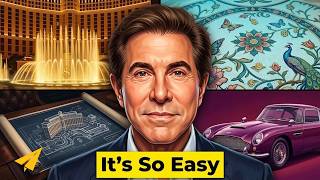
In this interview‑style video, Evan Carmichael profiles casino magnate Steve Wynn and extracts his "Top 10 Rules for Success." Wynn emphasizes that true success stems from loving the process of building, embracing calculated discomfort, and creating a culture where employees feel instantly gratified through storytelling and recognition. He explains how a bullet‑proof capital structure, relentless focus on guest experience, and learning from past projects enable his resorts to become record‑breaking revenue generators. Wynn shares vivid anecdotes—such as the rescue of a diabetic guest’s medicine and a conversation with Michael Jackson—to illustrate the power of personal responsibility, risk management, and employee empowerment. Throughout, he stresses that a family‑like staff culture, global appeal, and humility (admitting he can’t be right all the time) are essential ingredients for sustained wealth and personal fulfillment.
Chapters
You can't wait to get the building finished so you can have the cash flow.
I can't promise to be right all the time.
Oh my God, Herbie, I forgot the medicine bag.
You know, each one of these places exists because of the things we learned before. Forget all about the movies and the Hollywood and the eye in the sky and the security. You got to be able to do it up or down. Wow, I love that idea. It's fun to build hotels, make money, be successful, get lucky, but it has kept me happy happy person. We're in the top 3. Now that's a kicky thing to be able to do.
He's an American business magnate. He's best known for his involvement in the luxury casino and hotel industries. In 2015, Forbes estimated his net worth at $2.4 billion. He's Steve Wynn, and here are his top 10 rules for success.
People that build great things in any business, anywhere, they all have one thing in common. They love the process. If you start a building or a company because it's money, you can't wait to get the building finished so you can have the cash flow. You'll get the building finished and you'll probably have the cash flow. But if you love the idea of creating a building, you love the process of solving the problems, of digging into the details, of tearing up the paper and over and over again revisiting a room, a lobby, a restaurant to get it so that it really feels good. If you've got a passion for process, you're the kind of a person, if you're surrounded by good colleagues, then that's a team that produces superior projects. And all of us at Wynn Resorts, we share that passion for the process of creating these places. And so although we love the idea that they end up being profitable for our shareholders and it's given us all a good life, and I'm thankful for that. I'm really thankful for the idea that I'm standing here today to walk you through another project that we're dying to build in a fancy city like Boston. Entrepreneurs have an appetite for living uncomfortably that is a bit unusual. Truly living uncomfortably, because when you get a close-up look at running your own business, it's scary. However, having said that, I will also say that entrepreneurs who survive long enough to be interviewed by you are entrepreneurs who are not guys that fly without a net. It's one thing to be able to sustain risk and to live with a certain degree of uncertainty, to rely on your judgment. It's quite another thing to be reckless. When Michael Jackson asked me in an interview he did with me once— when I introduced him to Siegfried and Roy, he wanted to do an illusion for his Thriller tour, and I introduced him to SNR. I had shown him a tour of the Mirage just before it opened. Right.
He was amazed.
He said, "Do you get scared?" I said, "No." "But how, with all that, that thing that you're building?" I said, "Look, Michael, before we broke ground, we developed a business plan. We examined, reexamined, reexamined again and again our fundamentals." I said, "We raised $525 million with some of the toughest people in the world." because our story was convincing. By the time we broke ground, Michael, we were so sure of what we were doing that we did not think we were flying without a net or being a huge risk taker. And I said, I think, in answer to your question, I think at the end of the day, you can live with the discomfort, but you're also self-critical. And I, speaking for myself and my colleagues, we never risk the farm. Never at risk of harm. My responsibility to my employees, my stockholders is such that I can't promise to be right all the time. No one can. You make calls, sometimes they're right, sometimes they're wrong, but capital structure allows you to survive the inevitable cycles of business which go up and down as surely as sunrise and sunset, except we don't know the timing. They allow you to survive your own miscalculation. Capital structure, I learned at a young age, thanks to Mike Milken who taught me this story. Capital structure is everything, and I've always had a capital structure that was bulletproof.
I know that if something is instantly gratifying, it will be repeated. All of us as adolescents remember that to be true. Anything that's immediately gratifying will be repeated. And the strongest force in the earth is something that affects your self-esteem. If you can make someone feel good about themselves, they will love you for it.
They will be loyal to you.
You talk about plugging into the energy in interpersonal dynamics. You get to be responsible for another person feeling better about themselves, and you've hit the jackpot. That's a dead-on bullseye in human relations. So I said to myself, that idea is clear and self-evident to every one of you in this room. Okay, if I accept and you accept the idea that anything that's instantly gratifying will be repeated, I say to myself, in the context of this building, if I could get my employees one at a time to reach out and talk and engage guests on a very personal level, not a dealer talking to a blackjack player, but Annie talking to Mr. Jones. How are you today, Mr. Jones?
Nice to see you again.
Is there anything I can do for you? You feel like playing blackjack this morning? How's your wife? All of a sudden, forget the crystal chandeliers and the hand-woven carpets and the marble. It means nothing. All of a sudden, you're engaged with someone who cares about you. If I could arrange for my employees to find that gratifying and rewarding and increasing of their self-esteem, I would have plugged into the magic of business. And I finally, with the help of some other people, figured it out 4, 5, 6 years ago. And it changed my business and changed my life. It was a subject that I'm going to explain to you called storytelling. We took 900 supervisors at Wynn and put them in school. It took about 3 or 4 hours of training with some people from England, and we explained to them that we had a structure in the company that was very convenient. In every part of the hotel, which runs, as you know, 24 hours a day, we have a pre-shift meeting. If it's a restaurant, just before the restaurant opens, the maître d' or the manager meets with the waiters and has a 10-minute session. The chef in the kitchen meets with his cooking line and has a session. Housekeepers on each floor meet with the inspectresses that are the supervisors on each floor of the hotel. Department by department, public area, porters, there are collections of 12 to 15 people, or maybe as few as 7, with a line supervisor who gives them whatever it is they need to learn that day before they start their shift. We had a structure in place in the hotel that was very convenient, but instead of giving them inane or ordinary or mundane information, we change the program to this. The supervisor said to the group of 8 or 10 or 12 people, "Has anybody got a story of something that happened yesterday or in the past week special with a guest?" And now I'm going to give you a true example. Bellman says that a bell captain Yeah, yesterday I checked in a man and his wife, older couple from California, and the bags came in and I asked them to check and see if all the bags were there. And the woman let out a hoot, "Oh my God, Herbie, I forgot the medicine bag." And that was a small handcase in which his medicine— he was a diabetic— and her medicine— they were in their 70s— were contained. Oh my God, Herbie, your insulin is in the bag. I left it on the front hall table when we got in the car. Oh my God, what are we gonna do? We'll have to go back. I'll call the airport. Bellman tells the bell captain, I told him, just a minute, ma'am, where do you live? Pacific Palisades. Is there anybody at home at your house? Well, our housekeeper's there. I have a brother that lives in Encino. It's a Latino bellman. My brother Herve lives in Encino. Why don't I give him a call? He can go over to your house and pick up the bag, and we'll manage to get it here for you. When do you need the medicine? It was 3 o'clock in the afternoon. She says, "By 7 AM." He says, "Don't you worry. If you can get that lady on the phone, tell her that Hervé Méndez is coming, and we'll get it here at 7 o'clock in the morning." "You can do that?" "Yes, ma'am." She calls, he waits. She calls, tells the housekeeper, "Is the bag there?" "Yes, you left it on the front hall table." "Hervé is coming to get it. Let him have it." Within the next hour. Okay, bye. You sure you can do it? Please, lady, enjoy dinner, have a good time. Everything's going to be fine, I promise. Kid goes downstairs, tells the bellman on duty, his supervisor, that he's got to go get the bag, jumps into his car, drives 5 hours to his brother's house, picks up the bag, turns around, and gets back to Las Vegas at 4 in the morning. Takes the bag to the bellman and says, "Make sure this gets to room 10-0," whatever it was, "by 7:00 AM. It's got the lady's medicine." I'm not done with the story. The relevance of this story: there's 1,000 of those a month. The supervisor's been trained. Everybody in the room says, "Wow." That's great, Mendez. We have an internet loop, a special internet thing in the hotel for the employees, and we have a sign shop and we make signs for the back of the house. Immediately a picture is taken of that Bellman Mendez. His story is encapsulated in large print. We make paper signs and we decorate the back of the house. We publish Mendez's picture and story on the internet, and it's all over the employee staff dining room, and everybody is reading about this bellman who's now a local hero. And his chest is out to here, and he's taken a bow, and he feels great because of the recognition he's getting from his peer group. Now everybody else in the room with that bellman is looking for a story so they can tell it the next day. We found a key. We found a key to making a single employee acting with a single guest instantly gratifying and increasing of their self-esteem. Now every employee in the hotel is looking for a story. The dealers are on their way down the hall to take a break at the staff dining room. And they see a lady and a man looking a little confused, and they walk over on break and say, you look like you're looking for something, can I help you?
And the lady says, well, we're looking for a meeting room called Lafitte.
Oh, that's our ballroom. You're standing here by the B-Bar. You have to go down past Wing Lei, the Chinese restaurant. Wait a minute, come on with me. I'll take you. And the dealer makes a detour for 5 minutes and takes this couple and shows them the Lafitte Room. You think that that hotel is ever gonna be the same again to those two people, or that lady and her husband with the insulin? Hell, screw the chandeliers and the hand-woven fabrics and the onyx and the marble. It means nothing. They're gonna tell their friends what an incredible place my hotel is. We've taken storytelling 24 hours a day, 7 days a week, every day of the year to a great discipline in our company, giving people recognition for doing the one thing that creates a franchise that's strong— stronger than anything I know about. That applies to your business. You've gotta find those ideas that lift your staff, make them feel great about themselves in the context of your business. You do that, and I tell you that the results will astound you. First an idea, and then a program. First an idea, and then a building. It works every time.
You know, each one of these places exists because of the things we've learned before. You could not have had a Bellagio without a Mirage, or a Wynn without a Bellagio, or an Encore without a Wynn. We, we try new ideas. We creep along doing new things, testing them out. You know, when we didn't put everything around the casino at Wynn, I was a little nervous before opening because at Bellagio everything was around the casino. You walked out of every restaurant into the slot machines. Here at Wynn, we didn't do that. We let people go discover the country club, discover Alex, discover Okada. Well, they did, and they appreciated the fact that not everything was around the casino, that each place, because of the mountain, had its own environment, not disturbed by the outside views. Here at Encore, we have taken advantage of that very same mentality and gone further. In using natural light and gardens and plants. Every hotel I've ever built has been the highest-grossing casino in any city we've ever been, period. The largest amount of money ever won by a licensed casino in the state of Nevada when I built it was Mirage. That record was broken when we built Bellagio, and then the current record is held by Wynn Las Vegas, $770 million in casino revenue last year. That was more than anybody else in the history of the state. $170-odd million was slot machines, $600 million was tables. Of the $600 million in tables, 52% of it was from Asia, 24% was from Latin America, 24% was from the United States. Interesting, huh? 450 million out of 600 million was from outside the United States. Why? Our people from São Paulo, Brazil; Rio de Janeiro; Buenos Aires; Bogotá, Colombia; Monterrey, Mexico; Mexico City— these are where we have offices— Hong Kong; Taiwan; Seoul, Korea; Tokyo; and all over mainland China Why do they get on airplanes, fly over other casinos to come to Las Vegas? Because of the atmosphere, because of wonderful service, because of a great hotel staff, because it's fun to be there whether you gamble or you don't. And although we broke the record at $770 million for casino revenue for any licensee in the history of Nevada, The non-casino revenue was $860 million. Over half. Yup. And it's the $860 that made it possible for the $770. I'm going through all this with you all to explain to you our attitude, why we do what we do, and what really matters in our business. And it's two words, and everything else is baloney. Forget all about the movies and the Hollywood and the eye in the sky and the security. One thing, one thing matters to the state of Massachusetts if it cares about revenue and jobs: guest experience. If people have a good time, if they're well served, if they're in an atmosphere that's exciting and stimulating, they come back again, they're willing to pay more money next year, a little more than they paid this year, so that we can cover the increasing cost of doing business. Unions need increases, people want to get paid more money, cost of living goes up. You get a franchise because people have a good experience. And when you give people a good experience, they come from outside the region into the region. And if you want to get people from over there to come over here, you better build something here that's better than there. I don't want to minimize the impact of economic business cycles on Las Vegas because there certainly is an impact, no question about it. We're like the rest of the United States. If there's a recession, we feel it. If there's a boom, we feel it. But if you're a business executive and a manager like myself and my colleagues are, that's not really our issue. Our issue is to run the business, to lead the staff, good times or bad. That's what we get paid for. And to a certain extent, you can look upon these kinds of economic cycles as exercises. You got to be able to do it up or down, you know, in the bright sunshine or a little in the shade. You got to be able to do this. The skills that we've developed and our ambitions are irrelevant to the economic conditions outside. We have to react perhaps, you know, we'll try, You know, when it's really booming, we enjoy higher levels of revenue. We can— maybe we're a little bit freer with the payroll than we would be when times are tight. But basically, I don't really care about short-term business cycles. That doesn't mean that I'm insensitive to them, but that's not my primary responsibility. It's to my guests through my staff. So we'll open the hotel exactly the way we would if this was the World's Fair boom period. Exactly the same way. We've got to be consistent with our staff and we've got to be consistent with the public. What keeps you hustling? Because I'm one of those rarely fortunate, really lucky people who's doing what he loves. Consequently, I've never worked a day in my life. I love what I'm doing. I'm a student of creating spaces where people go, "Whoa.
Ah.
Wow. I love that idea." And I've never been able to do it perfectly. Excuse me, I always think I have to do one more hotel because maybe, just maybe, I'll get it right the next time. And that quest to keep doing it. Being a student of something that you love is the most fun a guy can have. And I've been given the privilege of chasing this star to my heart's content. You know, it's fun to build hotels, make money, be successful, get lucky in life. But let's face it, I have a friend, the Dalai Lama, and he said to me, He said to me, he was visiting and we were together, and he said, "You know, Steve, you'll find, not as a moral imperative, but as an observation as you live long enough and learn, that the only true happiness in this life will be the certainty that you have made a better life for other people." Now I don't, in the Dalai Lama's words, in his epistemology, It's not a moral imperative like you're your brother's keeper. It's an observation after the fact. The true happiness and fulfillment comes only with the certainty that you've helped other people lead a happy life. My dad taught me that what you want to do is stick to simple ideas. And I don't know why, Tony, I don't know where or when, but ever since I was a kid, the idea of building something that would make people go, wow, has struck me as just about the coolest thing in the world to do. Now, it's not saving lives in the real sense or doing something really noteworthy, but it has kept me a happy, happy person. The newspaper hired an outside consulting firm to find out who— the Review-Journal— who was the best employer in town. And they did this big interviews, and they did a special Sunday section, and we won. And they— and I didn't know what was going on until Mike Weaver called me up and told me. And read me what the employees said. Oh, it was ecstasy. This is the greatest place to work because they listen to you here. If you've got a good idea, they'll listen to you. This is a great place to work because they're sensitive to your family problems. They work with you when you have those problems. This is the best job I've ever had in my life. We're the best. This is the coolest place. There was this deep pride at belonging to the family here. In other words, it wasn't just the onyx or the marble or the hand-woven carpets or the fancy chandeliers and reflected ceiling plans that are so expensive. It was the living organism that is the family of staff.
And if you get all those things going at one time—
listen, last thing I got to say. By definition, on this planet, from Asia to Europe, from Latin America to Canada, there has to be a best hotel place in the world to stay. Why can't it be here? Maybe we're the best hotel in the world. Maybe. Not for me to say. But you know what? From what I understand from anybody that's ever taken and reviewed this objectively, if we're not it, We're in the top 3. Now that's a kicky thing to be able to do.
Thank you so much for watching. I made this video because Fernando Vermeulen asked me to. I hope I pronounced that properly. So if there's a famous entrepreneur that you want me to profile next, leave it in the comments below and I'll see what I can do. I'd also love to know which of Steve Wynn's top 10 rules meant the most to you. Leave it in the comments and I'll join the discussion. Thank you so much for watching. Continue to believe, and I'll see you soon.
More from Evan




How the Biggest Mistake in History Created A Trillion-Dollar Empire | Sergey Brin



9 Machiavelli Principles That Force People To Respect You | Machiavellian Philosophy



The First 10 Words That Instantly Ruin A Sales Conversation | Vanessa Van Edwards