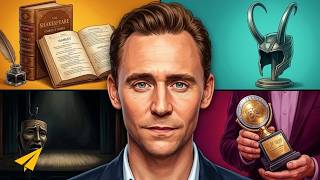
In this YouTube segment, Evan Carmichael introduces a profile of actor Tom Hiddleston, presenting what he calls Hiddleston’s top ten rules for success. Hiddleston shares personal philosophies and practical advice drawn from his acting career, emphasizing gut instinct, obsessive focus, punctuality, thorough preparation, authenticity, resilience to rejection, relentless learning, compassion for characters, and the importance of connecting with audiences. He illustrates these principles with anecdotes about auditioning (including a Dairy Milk commercial), early career struggles, memorable theatrical experiences (e.g., seeing Paul Scofield in John Gabriel Borkman and the impact of One Flew Over the Cuckoo’s Nest), and a spontaneous dance moment in Seoul. Throughout, Hiddleston uses musical metaphors—comparing acting to playing an 88‑key piano—to convey the breadth of human experience he seeks to explore. Evan frames the clip with motivational calls to belief, audience engagement, and a request for viewer comments and future profile suggestions, concluding with a thank‑you and shout‑out to supporters.
Chapters
When I go for something, I go for it at the expense of everything else. I always trust my gut. That's all I have. Everything is possible and nothing is guaranteed.
Hello, Believe Nation! It's Evan. My one word is believe, and I believe in people more than they believe in themselves. And my sincere hope is that if you see in yourself what I see in you, you'll be able to change the planet. So to help you on your journey today, we're going to learn from actor and producer Tom Hiddleston and my take on his top 10 rules for success. Rule number 2 is my personal favorite, and I'd love to know which one you guys like the best. Also, as you're watching, if you hear something that really resonates with you, please leave it down in the comments below and put quotes around it so other people can be inspired by it as well. And if you leave it within the first couple hours of this video going live, you have a chance to win one of 2 daily prizes.
I don't know that I've ever been able to do anything. I say it as a sort of— because I'm aware that it can be a strength, but it can also be a weakness because the focus is obsessive. And so when I go for something, I go for it at the expense of everything else. And I love what I do. Simply. And I feel so lucky that I'm allowed to do it and that I get to do it for a living. And cinema and theatre have had such a profound effect on me in my life. It's, you know, it's just a gut feeling. I think I always trust my gut. That's all I have. Even when I'm working and you're thinking about the shape of a scene and how it should be played and And your head can often get in the way, and you've got to trust your gut. And I— it's just if I'm inspired, if my curiosity is piqued, and I want to chase this possibility down that I see in front of me on my desk, you know, it's— some of you may have heard me say this before, but— and I always— I'm embarrassed to say I always speak in metaphors. I don't know how to speak I can't speak in any other way. And for me, acting is kind of like playing the piano. And if the piano is the human condition, and we all have every single note on that 88-key board within us, and for me, every role, I want to be able to play every note. And sometimes, If a character or a story seems to stretch me in some way, seems to offer up an experience that is new, that is a different chord or a different tune, that is real and true and human and accessible, and no matter how joyous or loving or warm or how dark or painful, if it seems like an interesting shape to inhabit, I'm running— I know if I'm running towards it already. Okay, a couple of basic things: be on time. Never underestimate the importance of punctuality. Be prepared. You can never be overprepared. And be true to yourself. And if you have something that you want to say, that you've been burning to say, don't ever let anyone tell you that you can't say it. Everything is possible and nothing is guaranteed. And you start auditioning, and if you're lucky enough, you have an agent, and you start auditioning, and they send you everything from period drama to casualty to Dairy Milk commercials. Yep, I went up for a Dairy Milk commercial when I was 24. And you are thrown into the business and thrown into it at the deep end, and there's no time for doubt or failure, except routinely that's what happens to all of us. And I was so— I perhaps was too careful in auditioning, and I would always get close to landing roles and to booking jobs, and I would never quite get there. And it's— I mean, this is a universal experience for all creative people, certainly actors, is that the constant rejection at the beginning, and you have to get used to it, and you have to get thick-skinned about it. And I was so exhausted by— I was trying to sort of— because at first you take it very personally, and I thought, well, no one's gonna help me get there. The only person who can do this is me. And I started preparing in a different way, and I sort of stepped up to the plate a little better, I think. Because I could feel time sliding away, and I wasn't getting on with life. I just was sort of stuck in this rut of neither acting nor doing anything else. And the experience of being in your 20s is so energetic, and I felt so stagnant, actually. So I just— kind of changed everything up, and it worked. I think a myth in the business is that we all have everything to choose from, is that we don't, you know. I know I'm not like top of everybody's list. It's— no, but that's not it. I mean, it's just you have to earn that place. Like Matt Damon always used to say every script that he got, he knew it had Brad Pitt's fingertips all over it. And, you know, mine just happened to be Michael Fassbender's. That's okay. No, listen, he's an amazing actor. Really, truly gifted. And that was kind of a joke. Every actor is completely different. But, you know, sometimes you might read something and think— I have read things and gone, "Wow, this is amazing." and I've chased it down and knocked on the door, and people have said, "It's not you, Tom, we're thinking of someone different." And then my job is to keep knocking on the door and say, "Well, you've got to, you know, let me see if I can change your mind." I think the most enjoyable thing about acting for me is when I sense that in pushing myself and challenging myself to explore new territory. I— when you make a connection with people, when people tell you that they've been moved by something or that they related to something, it's just— it is about connection. And I find it really stems from my own passion as an audience member, is I remember I remember my world being changed, the way I saw the world. I remember it being changed by films and by theater. The day that I saw "One Flew Over the Cuckoo's Nest," I woke up and I couldn't stop thinking about it for weeks. And I think cinema and theater— and the same is true of— I told this story before, but I went to see a production of John Gabriel Borkman at the National Theatre when I was 14. And it's the last time that Paul Scofield was on stage, and he was with Vanessa Redgrave and Eileen Atkins. And I saw— I was very conscious of an audience of strangers arriving at the National Theatre after a day of doing whatever they were doing, doing their job, coming from all quarters of the city to London, to this— the home of the theatre on the South Bank, having a drink, catching up. Rushing in, taking their seats, the lights going down, and 3 hours later, the entire theater sobbing, wiping away the same tears in recognition of the same grief, which is universal, and feeling like Paul Scofield particularly had spoken to my experience, and I had never met him, and I will always be grateful to him for that. Uh, and so I— that's what I love about it really, is that As I say, acting connects people. That's what I enjoy. And so I always, every time a new script or a new role comes along, I'm motivated by the thought that I won't forgive myself if I don't give it everything. But I do try to choose different kinds of things because I'm interested in the— diversity of people and the complexity of people and the multiplicity we contain within us. I really think the thing that unites us all in the world is that we are constantly inconstant, and that inconstancy and that contradiction is something that I've always tried to explore with my characters because I think we do things that, um, that contradict— we contradict ourselves all the time. There's a The Walt Whitman poem, "The Song of Myself": "I am large, I contain multitudes, I contradict myself." Learning. Learning is the legwork. Anyone who's been in anything, a play or a film, like, that's our job. We have to get these words into our head. And it's— I can't sit down. I can't, literally, I can't sit down and— read something and just learn it by rote. I have to be on the move, so I tend to just like— I'm the deranged guy in London who's like walking around pretending he's on the phone, but actually like I'm speaking in iambic pentameter because I'm learning Shakespeare. And it's just, it's literally just repetition, repetition, repetition. You kind of drill it into yourself. It's like learning— I always say that you have to know the thing that you're— the the text as well as you know "Happy Birthday." Like, if someone asks you to sing, you know, a jazzy version of "Happy Birthday," you'd know because you know that you know how "Happy Birthday" goes. Or if they ask you to do it like Beethoven, you'd be able to do that. And it has to be in your body with as much kind of confidence as that, so it's just repetition, really. Compassion is about understanding. Compassion is without ego, if that's possible for actors. I don't know. As an actor, to have compassion as an actor is to have compassion for the characters that I play. That's what it means to me. And that whatever they're going through, whatever their predicaments, I have to suffer with them. I have to understand, I have to not judge it, I have to be forgiving of it, whether it's a circumstance or their true nature. To have compassion for another human being is— to have compassion for a character is no different from having compassion for another human being. It was an event in Seoul in South Korea, and I was there with the film. And we were— there was a big event and there were 7,000 people there in a big shopping center called Times Square. And I was taking some questions on stage and somebody asked, "In what body part are you most confident in?" Which I thought was a new question, one that I hadn't been asked before. And so I thought the most innocuous answer was to say my feet, because without my feet I couldn't run and I love running. And also I couldn't dance and I love dancing. So then they said, "Well, now we have to see you dance." So I thought, "Oh my God, I've walked right into this." But it was fun, you know. Hit the beat. I had someone tell me about it. I was like, "Oh no, what's he done?" He's a really good dancer. It's incredible. Was that rehearsed? That was not an improvised dance, that one. Check it out. I'd like to see that. He's amazing. He's really got it. He's really got it. He's adorable.
Thank you guys so much for watching. I made this video because Telling It Like It Is 2000 asked me to. If there's someone you'd like me to profile in a future top 10, please check out the link down in the description below and you can cast your vote on on who we should do next. I also wanna give a quick shout out to Tori. Tori, thank you so much for picking up one of my t-shirts, the Rebel t-shirt. It looks great on you and I hope you're enjoying wearing it out. Thank you for sharing the picture on Instagram for me and to your audience as well. I really appreciate the support. Thank you guys again for watching. I believe in you. I hope you continue to believe in yourself and whatever your one word is.
Much love, I'll see you soon. Jack, we love you right now. Don't miss this. Does this still work? Does this work out here? It's okay.