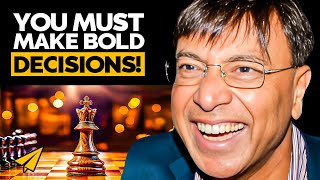
In this interview‑style video, Evan Carmichael presents Lakshmi Mittal, the Indian‑born steel magnate and CEO of ArcelorMittal, sharing his personal "top 10 rules" for success. Mittal emphasizes the importance of commitment, dedication, and passion, recounting how his determination to prove a skeptical principal at St. Xavier's shaped his work ethic. He stresses that bold, transformative decisions—taken after careful risk analysis—are essential for growth, especially during crises, and that acquisitions are a faster path to scale than building new plants. Mittal advocates for constantly shifting goalposts, setting small incremental targets, and avoiding addictions that distract focus. He highlights responsibility to safety and the environment, noting cost benefits from CO2‑reduction initiatives and the need for zero‑accident workplaces. Throughout, he frames business growth as a blend of science and art, requiring experience, confidence, and a willingness to act quickly. The video concludes with a call to action for viewers to suggest other entrepreneurs for similar videos.
Chapters
So there is so much of knowledge available today, instantly.
Bold decisions are not free of risk, so they should analyze the risk very carefully. Being responsible is vital to a company's long-term success.
My goalpost keeps on changing as we move forward in life.
During the crisis and post-crisis, always there has been and there will be exciting opportunities.
First of all, you have to have a commitment, dedication, and passion for what you are doing. One day I realized that I am getting addicted to golf.
We could be born with the baldness. Not with the boldness, and this is not only tragic but not acceptable.
If you have to grow, you have to do something differently than what everyone else has been doing.
He's an Indian steel magnate based in the United Kingdom.
He's the chairman and CEO of the world's largest steelmaking company.
As of December 2015, he was listed by Forbes to have a net worth of $9.5 billion.
He's Lakshmi Mittal, and here are his top 10 rules for success.
So there is so much of knowledge available today, on instantly, and knowledge is the key. If you have the knowledge, if you have ambition, if you are determined, if you are focused, if you are committed, use this knowledge to grow. Everyone can do it, and this is what I would like to say to all young men in India.
I say bold decisions have to be very transformative, and it has to succeed. And bold decisions are not easy to take, so these young people have to have lot of experience, they have to have determination, they have to have a commitment, and they have to think through those issues very carefully. Bold decisions are not free of risk, so they should analyze the risk very carefully, but definitely bold decisions could be a very transformative decision in the business and what they are. I would encourage young people to continue to analyze their situation and take bold decisions, because otherwise you cannot make a step change in your career. Being responsible is vital to a company's long-term success. I have always believed this, because being responsible not only has benefits for society, it has clear benefits for the business. Let me give you two examples. First, our success in reducing our own CO2 emissions has cost benefits. Secondly, in developing new and innovative products to help our customers improve their environmental performance and we maintain our market-leading position.
Did you ever foresee the kind of success you've had? When you were in Indonesia and things were in that state, did you ever foresee it?
I never expected that we would reach here. And I'm not a person who sets very high goal.
You don't set high goals.
My goalpost keeps on changing as we move forward in the life. Then you're not very disappointed if you don't succeed.
It's always been one step forward.
Yeah, always make a small step forward and you become stronger and you gain confidence. Then you change your goalposts. So it gives you more pleasure than setting up a very high goal and you don't reach them.
I don't think we ever thought forward more than a year ahead. Is that right?
For the last couple of years, we have been thinking more 5-year strategy or 10-year strategy.
I'm talking of those days.
Yeah, in the beginning, we were looking very short-term view.
This challenging time gives us a lot of experience. There are two kinds of situations. One, What are the bold decisions we could have taken during the crisis? A lot of companies took the opportunity of taking bold decisions during the crisis and reshaped their business model for the future. They have stripped off some of the assets, they have reduced their cost, they have flexibilized their fixed cost and expenses, they have started spending a lot of money on innovation and for the future. They started diversifying to emerging markets. So there has been a lot of bold decisions taken during the crisis. And post-crisis, I see that companies need to take bold decisions to design their business model for the next 20 years, looking at the growth areas, looking at the opportunities. So I believe that during the crisis and post-crisis, always there has been and there will be exciting opportunities.
Story goes back to when I was 16 years old. I passed my Hindi medium school in Kolkata and then applied for admission in St. Xavier's. Since I came from Hindi medium school, Father Joris at the time, who was a principal, felt that I would not be able to fit in in an English medium college. Though I was top in my class in school, I got admission in other colleges, but I really wanted to study in St. Xavier's, so I kept on knocking his door every day, and finally he gave it up. And I promised him that I'll be a good student, which I did. And how did this experience sort of shape you as a businessperson? I mean, you're breaking down doors, breaking ceilings. Is that something that you learned at St. Xavier's? It was a challenge for me to prove Father Joris wrong, that coming from Hindi medium school cannot do well in an English medium college. And that challenge really gave me a lot of learnings. I determined myself that I would prove him wrong, and I really dedicated myself, committed to myself that I have to accept this challenge and continue to work hard, focus on the studies. And this is a great learning in the business life, that first of all, you have to have a commitment, dedication, and passion for what you are doing. As I said, everyone works hard, but something needs to differentiate yourself with some others is to focus, dedicate, commit, and continue to work hard. I don't like to get addicted to any one hobby.
Okay.
Now, for example, I started playing golf. I liked it. I liked it a lot. Every day in the morning, I would go and practice. One day I realized that I am getting addicted to golf. So one day in the morning I was driving to the golf course and suddenly I realized that this is not right.
Turned around.
So I turned back the car and since then I have never played again.
So you don't have any addictions?
I don't like addiction. I think it could distract me from my focus.
We are not born with the boldness. We could be born with the baldness. Not with the boldness. It is not that something you learn only from education. Education is only one enabler, but you have to have experience. You have to have experience of success, which means you gain some confidence, and then you have to have your small goals. Small goals set up in your life, and if you succeed, and if you think that you are more confident than before, you want to take bold decisions in the future. But I will always be concerned about health and safety until we reached a place of zero accidents and zero fatalities. There were a number of fatalities again in 2012, and this is not only tragic but not acceptable. We have to remain dedicated to addressing this problem. I want our senior leaders to lead by example. That's why I have asked my colleagues on GMB and MMC to spend more time on the shop floor and promote increased training and awareness for both our employees and our contractors. This is how we will drive further improvement.
I was in Tokyo with one of the businessmen from India, and when I was talking to him, I realized that acquisition is a way to grow. I realized that life is very short, and if you have to really do something, you have to do very quickly. If you have to grow, you have to do something differently than what everyone else has been doing. So I started thinking that if I start building a steel plant, it would take years. And how many steel plants, how many companies you can build? And if I have to succeed in my life, I have to find a formula which is different and which keeps me ahead of my competition and my colleagues. That's how I thought that we should acquire companies merge, consolidate them, reduce their cost, make them very efficient.
And it became like a turnaround became a science.
I wouldn't say that, yeah, it's not a science or art, it is a mix of science and art because every company has a different issue. It's not that there is a formula which you apply on everyone. Yeah, it is not H2O, it's to water here.
But the pattern, you established this pattern and you applied it in different countries, different markets.
Yes.
And that was the genesis of your empire.
Yes.
Thank you so much for watching.
We made this video because John Simon asked us to. Now, if you have a famous entrepreneur you'd like a video made of, leave a comment below.
I'd also love to know which of the top 10 rules meant the most to you, will have the biggest impact on you today. Leave in the comments, we'll join the discussion. Thank you so much for watching. Continue to believe, and we'll see you soon.