The Motivation Formula Anthony Hopkins Swears By | Be Bold!
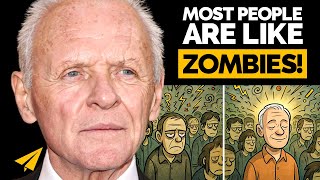
The video, presented by entrepreneur Evan Carmichael, compiles interview clips of Sir Anthony Hopkins discussing his personal philosophy and "top 10 rules to success." Hopkins emphasizes leaving the comfort zone, boldness, continual learning, discipline, and the power of belief. He shares anecdotes about taking on challenging roles (e.g., playing Nixon), his approach to preparation, the role of ego, and his view of life as a magical, ever‑changing process. Carmichael frames each insight as a rule, invites viewers to reflect and comment, and ties the lessons to personal and business growth. The narrative interleaves Hopkins' reflections with commentary from interviewers (Speakers C and D) and ends with a call to action from Carmichael.
Chapters
Life's so short, there's such glorious images in the world and such horror as well, that I want to see it all. I know people who live in the past, they just live there all the time, talking about something that happened to them 30 years ago. They're like zombies. Be bold and mighty forces will come to your aid. I believe that about everything. We have to make our lives because life is tough. We have to believe in the power of life.
He's a Welsh actor on film, stage, and television. He's considered to be one of the world's greatest living actors and is most well known for his role as Hannibal Lecter in The Silence of the Lambs.
Everything you need to find him is right there in those pages.
Since 2016, he starred in the critically acclaimed HBO series Westworld. He's Anthony Hopkins, and here's my take on his top 10 rules to success. Rule number 1 is my personal favorite, and I'm super curious to figure out which one you guys like the best. Also, as you're watching the clips, if you hear something that really resonates with you, please leave it down in the comments below and put quotes around it so other people can be inspired as well. When you write something down, it's much more likely to stick with you too. Enjoy.
Do something new. You know, you've got to make— you've got to— can't stay in your comfort zone. That's what we all do. We get to a certain age, we all stay in our comfort zone with the recliners watching television day in and day out. And, um, when you get a certain age, I'm going to be 70 at the end of the year, where I sit around watching television for the rest of my life because I've done it all, sitting on my the horror it breeds. It's not worth it. I mean, life's so short and such glorious images in the world and such horror as well that I want to see it all. And so I've moved out of my comfort zone. It's, um, essential for me. Otherwise I may as well die. So I've done it. I've broken every rule in the book, and, um, not out of malice or any telling anyone that I'll show you. I did it for— to show myself.
I've shown myself.
I looked in the mirror, I thought, I'll show you one day. I've done something completely new. I wrote the music and I feel limitless.
Once I got started with two magicians and one ventriloquist helped me, once I got the knack of it, it became easier and then I enjoyed it. There were moments, you know, when I was learning the script and I thought, well, this isn't going to work. I mean, how can I do it? But I used to write notes to myself, little letters to myself, and put them on the desk saying, you know, you could do any, you know, anything with faith. You could move mountains. Mountains and, uh, um, trust and let go and all that sort of thing, you know. And I used to just throw myself into it. And then the— when the negatives came to my mind, I would, uh, put positive, um, positive sounds in my head, you know, make— I'd say, I can do it, you know. And I, I used to meditate and visualize myself doing it. And I used to visualize myself on like a kind of, um, try and visualize myself doing those sort of fanning cards and springing them. And, and gradually, surprising, the power of mind, what happens, you know, your muscles begin to respond. It's like anything, really. If you're playing the piano or driving a car, it comes through relaxation.
Your approach to life, has it changed through your acting experience?
Yes. Well, you just get older and you live long enough, you, you change. If you don't, you may as well die, you know. Go or grow. You have to change. And I've realized over the years that I've gone through many changes in my life. Many changes, because that's the nature of life. And if you don't go with it, you may as well die, really. You may as well be dead. I know people who live in the past. They just live there all the time, talking about something that happened to them 30 years ago. They're like zombies. And I can't hang out with those people. I know them, but I can't spend more than 5 minutes with them, because I feel like suicide at the end of it, because I feel so guilty about being happy when they're so miserable. Because it's a— You know, life's in session. For many years I thought life was a big rehearsal for the big event, and somebody in Los Angeles said, Tony, this is the big event. Life is in session. You know, we spend so much time thinking it's a rehearsal for the big event, the big red carpet in the sky, and it's not.
All life is magical. It is magic, you see, because we're the instruments. And all problems are technical. Once you can go through those problems without avoiding them or backing off from them, because it's like fear, you go through it. You go through the problem, confront it and go through it, then you have release. Stanislavski called it the plane of inspiration that takes off from the runway. The runway is the technique, the runway is the getting on with it, and the plane will take off. If on Tuesday night, however, it doesn't quite take off, it doesn't matter. You can't stop the plane and say, "Well, I'll go back because I don't feel it tonight." You get on with it technically, and then on Wednesday night, probably, it's going to take off again, as long as you're relaxed. But it really is, it's kind of being on automatic pilot. And I think it's, and it comes after experience. I think it comes, and I think I feel in the happy state of mind now that I have 15 years or 20 years of experience behind me. And I think it's used well, and there's a lot of positive out of all the anguish and the pain and discomfort. And there have been good times, there have been negative times. Olivia said once when he was directing Colin Blakely in June and the Peacock, and I was in June and the Peacock, and he said, you have to find the middle man. And Blakely said, what do you mean? He said, find the middle man, that ease of playing a character. And Blakely said, I only have until next week. And he said, you won't do it next week. It'll take you the rest of your life. And it's really relaxing and letting go. You know, the booster that puts one into outer orbit, the aggression, and the arrogance and the ambition and all that, that's all very necessary. But there's a time when one has to let go. And I guess I'm in orbit. And all I have to do is rest assured that it's going to be okay and do what is required of me, you know. Keep in practice, keep working. I'm going back to the theater. I want to go back to the theater. And I'm being kind to myself. That's all I can say, really. Then the magic happens. Scofield is right, you get on with it. John Dexter told me in New York, he said, just get on with it, don't analyze, do it.
What's the most important quality that an actor, a great actor like you, should have? What's the most important quality, apart from intelligence, I suppose? But well, I'm going to be modest, you know, I'm a working actor, I just go from job to job when I can. I think there is, um, a sense of discipline and commitment to it and all those American words. But yeah, yeah, know what you're doing and, um, and have fun with it. I always tell that to young actors I'm working with. Enjoy it. Stop figuring it all out. Just enjoy it. If it doesn't work, it doesn't work. And, uh, you do something bad, it doesn't matter. And you do something which may be good, that's good. But don't worry about it. It's all, it's all part of life's process.
Nixon must have been one of the most difficult roles you ever played.
That was a nightmare role to play. Yes, I, um, I got phone call in England many years ago, and, uh, my agent said, 'Oliver Stone wants to talk to you.' And I said, 'Oliver Stone? What does he want me for?' He said, 'For Nixon.' I said, 'Nixon?' I said, 'Well, he's President Nixon.' I said, 'Oh, what part does he—' He said, 'President Nixon.' I said, 'You crazy?' I said, 'No, he must be mad.' And he phoned me up and he said, um, 'Well,' he said, 'I hear you're a chicken, you don't want to do it.' I said, 'Well, I don't want to do you a disservice.' He said, 'Well, I'm coming into London anyway.' at the beginning of next week. So let's meet anyway, even though you don't want to do it. I said, okay. So I was on my way to the hotel to meet him, and I had that moment of clarity when I, uh, in the middle of Hyde Park, and I, I thought, I can either work with this great American director, make a complete idiot of myself, or I can stay safe here in Britain working for the BBC, go off to Hungary to make a Dostoevsky film or something so boring like that, and, you know, and stay happy for the rest of my life. Die of a heart attack and that'd be the end of it. But I thought, well, I'll just do something that's really challenging. So I met Oliver Stone for breakfast that very morning, a few— half an hour later, and I said, I'll do it. He said, great. So there we were. And I believe that be bold and mighty forces will come to your aid. And I believe that about everything, you know. So I don't do anything that's conventional.
When I approached magic, I just showed up.
I did a lot of preparation.
All I have to do is be ready, I guess, and that I try to apply it through my life now, and I just have to get ready, you know. I just have to do what is asked of me and do as much as I can without driving myself insane. Because there's a negative side of perfectionism in my nature anyway. I can only speak for myself. There's a negative flaw, and there's a very dangerous trap. And I think one of the biggest killers is ego. And when it's the negative side of perfectionism, when one starts playing God, you know, know. And I mean literally, there is a killer, there is a lethal part of one's own ego.
I went to the movies and I saw Brando, and I became an actor. I saw James Dean, and I always felt I wanted to be like that, but I thought I'm stuck with a funny accent in this place in Britain. And then I'd read Jack Kerouac's On the Road, and I'd read Look Homeward, Angel, was about 1920s, something like that. And I had this taste for America, and I had this taste for rebellion and the darkness. And, um, I— so this is what I wanted to do more than anything. And when I came over to America, I made a couple of good films and some not so good films, but I wanted to make a statement for myself on this one, not for anyone but for myself, to prove it to myself that I had it in me. I'm going to be 70 at the end of the year, that I had something so off the wall and wacko that I could put it on screen somehow. And that's why I don't know if I believe in anything, I mean, I'm a deity, but I believe whatever that thing is that we talk about for centuries, I think it's just within us. I mean, things have— remarkable things have happened in my life by just wishing or asking for something, for a bit of help. And I don't believe, I'm not a— I'm an agnostic, I guess. Is there any way you can help me? Or whatever. And there's something inside us that will respond, I believe. I really believe that. We have to make our lives— because life is tough— we have to believe in the power of life.
Now, okay, let's talk about this movie. You're a priest, then you're trying to convince this guy that doesn't really believe, and then all of a sudden you become possessed. That's right. By the devil. Well, you are a good devil. You are. I mean that in the kindest way. I mean, really, you play a bad guy so good. When you turn— because your character is not like that for the first part of the movie. And then all of a sudden— Suddenly. Yeah. Suddenly becomes nuts. And then suddenly you become very— Yeah. Very strange.
I don't know why they cast me in these parts. I have no idea. No? But I mean, I have no idea because—
I'm not like that at all. Yeah. See, look, just doing that is scary to me.
That's— I got a technique. I don't know what it is. I honestly don't know. Seriously. People say, "How do you do that?" I have no idea.
I just do it. Like, do it. Like right now. Just look at the camera and make a scary, scary face. Hello. That's really creepy. You just deaden the eyes, that's all. Yeah, it is. You don't blink.
But I don't know, it's called acting, I guess. Yeah, but I'm not like that inside at all. You're very—
not at all.
And life is just terrific. I travel the world and I'm still working and working with some interesting people, and people think it's, you know, a dream, but there are problems. You know, I pay a few people to help me, and my wife had a friend called Juan Arias, and she called him Johnny on the Spot. My wife Stella— Johnny on the Spot means Johnny on the spot, except this guy is rarely on the spot. Sometimes he can't even I can't find him. He's supposed to be my personal assistant. Can you believe that? I pay him lots of money. It's really shocking. But, um, well, that's life, I guess. Uh, Amy, be quiet, please. I'll introduce you. I'll show you John the spot. There you are. That's him. That's Johnny on the spot. Paid a lot of money and he's useless. Useless. My cat Niblo would be a better assistant. But what can you do? You can't win them all. Why? Life's not perfect, you know. I don't know how to get rid of him. But anyway, that's Jod's first class private travel. Private hotel rooms. All the women hug him on set. They don't even know who I am. But, I mean, that's life. It's not all roses in the movie business.
Yeah, that was good.
Thank you guys so much for watching. I made this video because Kendrick Bowman asked me to. So if there's a famous entrepreneur that you want me to profile next, Leave it down in the comments below and I'll see what I can do. I'd also love to know what did you learn from Anthony Hopkins today that you're gonna apply immediately to your life or your business? What was your favorite rule and why? Leave it in the comments, I'm gonna join in the discussion. Finally, I wanna give a quick shout out to the Lonely Bookineer. Thank you so much for picking up a copy of my book, Your One Word, and taking that picture, posting to Instagram. Those cookies look delicious and I really, really appreciate your support. So thank you guys again for watching. Believe in you. I hope you continue to believe in yourself and whatever your one word is. Much love.
I'll see you soon.
What has happened in some strange circuitous way on this journey through life is that I've become more at peace with myself. I suppose we compensate for our lives, for our lack if we choose to. Because I felt so lacking as a child and my adolescent years and early adult years, I, through anger, resentment, or drive, or ambition, or whatever, I found my way somehow. I don't actually believe I did it totally on my own. I believe in some power of life that is in us. I'm a fatalist. I believe in destiny. I believe that if we relax and let go know enough and actually do believe that our lives are none of our business and open up, then extraordinary things begin to happen. I suppose you're calling them— talking about spiritual surrender of some sort. You know, when we try to— I mean, my agent many, many years ago, I had an agent once, very nice chap, but he said, "Listen, we've got to plan your career." I mean, that sent me running out the door.
I mean, you can't plan your life.
No, no, no. I wouldn't care for that. You know, you make certain choices and you go along, And you chart the rapids and the rocks and the shallows and the depths and so on and so forth. But you can't really control your destiny. You can't really control things. You just have to let go and follow it.
More from Evan




How the Biggest Mistake in History Created A Trillion-Dollar Empire | Sergey Brin



9 Machiavelli Principles That Force People To Respect You | Machiavellian Philosophy



The First 10 Words That Instantly Ruin A Sales Conversation | Vanessa Van Edwards