Tony Robbins Reveals the Secret to Lasting Change in Under 34 Minutes
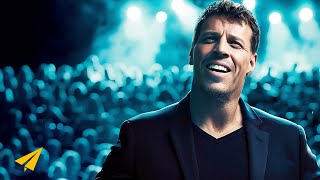
In this 34‑minute motivational presentation, Tony Robbins outlines a framework for achieving lasting personal and business transformation. He argues that true fulfillment comes from raising one’s personal standards rather than chasing fleeting goals. By converting "shoulds" into "musts" and aligning identity with those standards, individuals create an internal certainty that drives consistent action without relying on willpower. Robbins illustrates how identity shapes behavior through metaphors such as the conditioned elephant and personal anecdotes about quitting smoking, fitness, and wealth. He stresses the importance of resourcefulness, leverage, and an exit strategy in business, citing Sam Walton’s frugal expansion and Michael Ovitz’s missed exit as case studies. He introduces practical tools: value‑added marketing (VAM), the RPM planning system (Result‑Purpose‑Massive‑action), incantations (embodied affirmations), and the brain’s reticular activating system (RAS) that filters focus. Throughout, he emphasizes that progress—not change—is the true source of happiness, and that rituals, not willpower, sustain long‑term results. The talk concludes with a call to identify a specific life area, write its current state, pinpoint limiting rituals, define a vivid vision, and create new rituals to achieve it.
Chapters
You say, "I'm gonna find the way, I'm gonna make the way." What is it that's gonna truly fulfill you? Things, getting things is not gonna make you happy. You want clients for life, not just customers. They want you to supply them more information. He never thought through an exit strategy and he got almost nothing for it. There's a resource that people believe is missing. But failure comes from all the little things. Activity without high levels of purpose is the drain of your fortune. So use your body and your voice. He's an American motivational speaker, personal finance instructor, and self-help author. He became well known from his infomercials and self-help books. In 2013, Forbes estimated his net worth to be $480 million. He's Tony Robbins, and here are his top 10 rules for success. Ultimately, if you're gonna have lasting change in anything, you're really talking about just raising your standards. I mean, I always tell people, if you want to know how to change your life, I give it to you in 3 words, boring as it sounds. Raise your standards. Now what does that mean? Corny as it sounds, raise your standards. Well, thank you for the breakthrough thought, Tony. I'm glad I wasted my time watching this little email with you. But think about it. Lasting change is different than a goal. You don't always get your goals, but you always get your standards. Maybe it'll help you to think about it this way. I try to explain standards to people with a different set of words. Think of it as everybody in life gets their musts. They don't get their shoulds. Like, think about it. Most people have a list of shoulds, don't they? Don't you have a list of the shoulds, things you should do, you should follow through on? I should lose some weight. I should work out more. I should make more calls. I should respond more rapidly to my email, whatever. You know, I should get into the office earlier. I should be, you know, more confident. Whatever your should list is, people love to have their should list be met, but it's kind of like New Year's resolutions. If it does, it's really exciting, but if it doesn't, which is most of the time, eh, it's a little disappointing, but you kind of know it's not gonna happen. But when you decide something is a must for you, an absolute must, when you cut off any possible, you just say, "I'm gonna find the way, or I'm gonna make the way," human beings, when they resolve things, when they make a real resolution inside themselves, which is they raise the standard and they make it a must, they find the way. Think about it in your own life. Haven't you had some area of your life where You raised your standard and your life has never been the same? Maybe at one time in your life you smoked cigarettes or you did something and you did it for years and you kept trying to change it, trying to change it and kept telling yourself, "I should." And then one day something happened. Something just clicked you over. Something took you over that kind of tipping point. And inside yourself you said, "No more." And it was a very, very different experience, wasn't it? Something inside of you shifted and what was a should became a must and you've never gone back. Is there an area like that in your life you can think of? Again, did you ever smoke cigarettes? Did you ever eat a certain way, drink a certain form of alcohol and then finally say, "No more," and you just don't go back? And notice this, it doesn't really take any willpower anymore because somewhere when we make this click, when we make something a must, we attach ourselves to it. It becomes part of our identity. And one thing I've learned in the last, gosh, 33 years of working with people from now over 100 countries, 4 million people, is human beings absolutely follow through on who they believe they are. If you said to me, "Well, I'm really going to work hard to stop smoking, but, you know, I've been a smoker my whole life and I'm, you know, I am a smoker," I know your days are numbered. You're going to be back smoking cigarettes again because we all act consistent with who we believe we are. I tell people the strongest force in the whole human personality is this need to stay consistent with how we define ourselves. If you define yourself as somebody who is really conservative, you're not gonna be crazy and act nuts unless you're really drunk or something, and then you can say it's the alcohol when it's really just you finally getting permission to be yourself. The alcohol's your excuse. If you're a really crazy person, you act crazy, outrageous, playful. You don't act conservative because that's not who you are. Very often people say, "Well, I can't do that. I'm not that kind of person." And I always say to people, "Really? When did you define yourself?" I mean, really, how many years ago did you come up with what you could and couldn't do in your life? How many years ago? Most people, if they really look at how they're living their life today, it's based on a set of standards, a set of beliefs that they made choices about 10, 20, 30 or more years ago. I mean, very often we made decisions in our youth or very young about what to believe, about what we were capable of, about who we are as a person, and that becomes the glass ceiling, if you will, that controls us. There's a corny metaphor, but it's true. I remember one time I was with my family at the circus, and there was a person there, and they had this big giant elephant. And you look at this elephant, and they take this little rope, put it around the elephant's neck, and they drive this stake into the ground. And I mean, you look at this, and you know that elephant could rip down the entire tent with almost no effort. And yet the elephant doesn't struggle, doesn't try. Why? Because the elephant's conditioned. And they take that elephant and condition the elephant when it's a baby elephant. That's how they train 'em. When it's a little baby elephant and it doesn't have the power yet, they put a big rope around it and they drive this huge stake in the ground and the elephant fights and fights and fights. And one day, finally, that elephant decides, "I'm not capable of pulling this out." And once that becomes the definition of an identity of anyone, an elephant in this case, they don't even try anymore. It's just who I am, that's how it is. That's just the way it is in my life. I'd like to ask you to take a look at any place you've got a limitation and ask yourself, when did I decide to accept that limitation? And you may not even see it as a limitation. You might see it as just, that's who I am. But so often in our lives, we've adapted to be a certain way so that we don't fail or so that people will like us or respect us, but it's not necessarily who we are. Joy comes when you're spontaneous. It's really hard to be truly happy when you're not being yourself. And most of us have no clue who we are. And so a big part of my work, if you've ever been to an event, you know, is to get people to do things spontaneously without thinking, 'cause that's when the real you shows up. That's when the energy comes alive. And when you do that, when you start to connect to your true nature, suddenly there's energy available for you to set a higher standard for what you want in your life. That's what this is really all about. And when I talk about standards, when I talk about, you know, shoulds versus musts, think about your own life. I know there have been areas in your life where some point in time you just shifted and you raised the standard and your life changed because whatever people have their identity attached to, they live. We live who we believe we are. That's just how it works. It's just kind of like, I'll give you an example. Look at your physical body. Your physical body today is an absolute reflection of only one thing, not your goals, not your desires, but your standards. The identity you have for yourself. If your standard is you're an athlete, then there's a certain amount of strength, a muscle tone, an energy that's available in your body on a regular basis because that's who you are. And so you do whatever's necessary to maintain that identity. Again, the strongest force in the human personality is this need to stay consistent with how we define ourselves. 'Cause If you don't know who you are, you wouldn't know how to act. Once you lock in on that identity, your brain finds a way to keep you there. If you say, you know, "Man, I'm overweight, I've always been overweight, I'm big-boned," and that's the story you've got, then you're gonna always find a way to get back there. That's your settling point. That's your identity. That's where things lock in. If you see somebody who's in really great shape, you ask them, "Do you work out?" You know the answer. "Yes." "How often?" And they'll tell you 3 times, 4 times, 5 times a week, whatever. In a seminar, I'll ask people, "Who here works out?" "at least 5 days a week, and I'm stand-up." And you look around that room and you know that they work out 5 times a week 'cause you can see their body. You don't just get a result without some kind of action, without some form of ritual, ritual meaning actions you do consistently. Now, do you think those people that are out there working out 5 days a week, do they have more time than you do? Or I have, or anybody else? Of course not. Is their life less busy? Of course not. It's just a must for them. They must work out that way and they've made that turn and their life changed. So I'm not saying you have to work out 5 days a week. I'm just saying whatever you really want, wants don't get met consistently, standards do. Whatever you identify, this is who I am and so it's not so much about changing your identity as it is expanding it. You know, deciding that instead of your goals to lose 10 pounds, which is not compelling, what if your vision was to get back to my fighting weight? You know, this year, this month, this next 90 days, I'm gonna transform my body. I'm gonna take on a new challenge. I'm gonna find some technique or strategy, there's a million of them, that can reframe myself where I'm gonna feel younger, stronger, more vibrant than ever before. Here's my reasons. Because I want the energy to really make my life work. Because it's tough out there and I wanna be stronger than I've ever been before. I wanna go in front of the mirror and if I'm naked, not, you know, wanna laugh. I wanna look there and take a good look and go, "Yeah, I'm proud of whatever I see there." Whatever it takes. Something's gonna make you laugh, smile, something that's gonna tease yourself, but something's gonna move you to another level. If you identify yourself in a new way and you own that every day, and that becomes the standard of how you live, you'll find the way to make that standard real. Money's the same way. Think about it. It doesn't matter what's happening, quote unquote, in the marketplace. People that make money find a way to make money no matter what, don't they? I mean, Most people's standard is to pay their bills. So that's what most people find a way to do, even when economic times get tough. Most people, if that's their absolute standard, they find a way. Some people's standard is pay their bills most of the time, and so most of the time they do. Some people's standard is not just to pay their bills, but to take care of their family and maybe even some of their friends, and they find a way. In fact, you know, some people may be in a family where they don't have enough money, they barely have money to pay their bills, They work their guts out and then somebody, their mother, their father, somebody else, their sister gets ill and there's not enough money to take care of it. Nobody else has money in the family. They don't either, but they find a way to get that money to take care of their mother or father, don't they? And pay their bills. They never could do it before. Why? The situation made them raise their own standard. And not everybody does that. Somebody else in the family might have money and still not take care of their mother. It all comes down to the inner game, my friends. Changing your life is a change in the inner game. The outside world you can't control, but you have absolute control over this one if you learn the dynamics of what shapes you. And identity is one of those simple, clear, fundamental basics that if you start to shift it, everything else will shift in your life as well. Some people, by the way, have to have more than enough money to do what they want, when they want, where they want, with whomever they want, contribute the way they want. And if that's their must, they find a way. I know that sounds overly simplistic, but it's true. Somebody once said, "You can take all the money in the world out of the hands of everybody, out of all the wealthy people in the world who are really successful, give it to other people, it wouldn't take too long, those people would have it back in their hands." It's not because they're manipulative, it's because they have a standard. Some are manipulative, don't get me wrong, but they've got a standard of what they're going to find a way to make happen. I'm just simply saying to you, take those 3 magic words and live them: raise your standard. Michael Gerber, the guy that wrote The E-Myth, you know, talks about why so many businesses, young businesses fail. And one of the things he says is most people are not really entrepreneurs, but they think that's what they should be. They think that's the sexy thing, that's the most attractive thing, that's the best answer. And what I say to you is you got to separate the vehicle from the outcome. What is it that's going to truly fulfill you? What is it that's going to give you that extraordinary life? What's gonna make things magnificent on your terms? Not somebody else's terms. Not your father, your mother, your background. What is that really? Separate the vehicle, 'cause there's many ways to get that vehicle. But I'm saying sometimes you gotta reevaluate what's gonna really make you fulfilled. What is your gift? Are you an artist? Are you the talent that can produce something no one else produces as a skill or a product or a service or some impact? Are you incredibly good at management? You really know how to manage or lead people? Are you an extraordinary entrepreneur that has— can take that gigantic gut load of risk and can create the vision and attract the talent that you need and the managers and leaders? You may have all 3 abilities, but which one really fulfills you the most is going to be the critical question. Because we tend to want to do them all, especially in a room like this because you're all overachievers, right? Me too. And you say, "Well, I can do all these." Yes, you can, but what will it do to your quality of life? See, again, the secret's gonna be this: what is an extraordinary life on your terms today? Things, getting things is not gonna make you happy. That's good news in a tough economy. It's a good reminder. You know, it doesn't matter what you get. Doesn't matter whether it be money or opportunity. All those things might excite you for the moment. You know, even a relationship, as magnificent as it may be, might be exciting for a while, but if you don't keep growing, that relationship isn't gonna stay exciting. So the secret to real happiness is progress. Progress equals happiness, and if we can make progress on a regular basis, we feel alive, and that's why at the beginning of the year we get this thing like, "Okay, I can have this fresh start. I could really do what my soul desires. I could expand, I could grow, I could improve, I could change, or maybe better than change, I could progress." See, Think about that. Progress has an aliveness to it, doesn't it? You don't have to work at changing. People say all the time now, "Well, I'm working on changing." Don't worry about it. You don't have to work on changing. Change is automatic. Your body's gonna change whether you want it or not as the years go by. No matter how hard you work, there's gonna be some changes going on there. The economy's gonna change no matter what you want it to do. The weather's gonna change. Relationships are gonna change. Everything in life is always changing. We don't have to work on change. Change is automatic, but progress is not. So if you want to make real progress, then you really got to look at your life in a different way. You got to say, I got to take control of this process and not just hope it's going to work out like people do who make a resolution. Treat people at the end of the relationship like it's the beginning and there won't be an end. And that's not just your intimate relationship. What if your customers— what if you fell in love with your customers, with your clients? More than your product, more than your company, if your entire life is about meeting their needs, if you would do what for your customers and clients? You would do what? Anything. If you love your customers and clients, you'd do anything. Guess what? They're gonna love you. But most people love their customers and clients as long as they buy from them, do what they want, respond to them. And when they don't, they go, "That's the end." You want clients for life, not just customers? Fall in love with them. It's a different focus, isn't it? It's a different meaning, and that creates a different life because you make decisions differently from that place. What does it take to create world-class marketing? What is the unique selling proposition? What is what we call value-added marketing, VAM? Today, most people are sick and tired of advertising because where is it? Everywhere. In fact, I got a question for you. How many of you in this room do not even see banner ads anymore. Literally, it's there, but you don't perceive it. Like, there's— like, your brain literally washes it out. Raise your hand if that's true. Keep your hands nice and high and look around the room right now, and you'll see 98% of the people wash it out. So don't buy them unless you're going to create something really unique. It's a total waste of your money and your time in the world we're in today. Today, what creates marketing is when you don't just market, but You add value to people. You do something. You teach them. You give them an insight. You give something valuable that costs them nothing, and then they look to you as an expert. They look to you as a person that adds value. They want, they want you to supply them more information, more experience, more products, more services. If you've made this whole business about meeting your needs, you can run a successful business, but it'll be a job. 'Cause you'll never be able to sell it. 'Cause if it's just meeting your needs, it's not a system. It demands your attention, your connection. It's giving what you want, but ultimately it's not gonna give somebody else what they want, so you can't sell it. If you can't sell your business, if you don't have an exit strategy, you have a job. I don't care how successful the business is. That doesn't mean you have to sell the business, but one of the most important decisions you make in business is ultimately, If I was going to sell this, if I chose to, I have to know who would I sell this to so that I have long-term value, not just in income along the way. I have this critical mass here. I get a multiple of my business. And most people don't have a clear exit strategy. They think, "I'll come up with that someday." You got to start with that end in mind. That's got to be part of your focus if you're going to be successful in your business. I can remember a gentleman who built CAA in Hollywood. It was the largest, most successful agency. Michael Ovitz, remember that name? He put together Nike and Coca-Cola and these billion-dollar deals. And eventually, Mike Ovitz went to go sell that business. He never thought through an exit strategy, and he got almost nothing for it. Because the laws prevented him from selling it to a studio. He had to sell it to some of his employees for pennies on its real value. Now, Mike found a way to make money later on in another place off of Disney, but the bottom line is the guy didn't have an exit strategy. He was brilliant, made lots of money, in the end didn't get the value. Whenever people fail to achieve their goals, 99.9% of the time, you ask them why, they'll tell you it's because of a lack of resources. That's what all these things are. I didn't have the support, right? I didn't have the money. We didn't have the time. We didn't have this, we didn't have that. There's a resource that people believe is missing. And that resource belief structure then keeps people from ever being able to really lead. Because what leaders do is they find a way to maximize whatever resources they have, as little as they may be. And they don't believe in limited resources. I'll give you an example. Let's take a business example to start with. In 1974, a guy named Sam Walton had built his little company up. He came up with an idea. He started with $20,000 in, I think, 1962, if I remember right. But by 1974, within 12 years, he had 78 stores. And you know how he did it? In the middle of the night, he'd drive across the border, and he'd go and study other people's stores. He'd buy everything as cheap as he could in the middle of the night. He'd go to other people's stores, Whatever was working, he figured out. Success leaves clues. He came back and did it in his store. Whatever was working in any store, in any competitor, anywhere he could do it, he did it. So he figured out how to maximize the little resources he had, his $20,000, built 78 stores, and if you read any of the people following him, the company had gone public in that year, they were all saying, "This is it. He's maximized his resources." I mean, he only has so much money, there's only so many cities that are going to appeal to this discounting mentality. Right? This is it. This is all he can do. And the word on Wall Street was sell. Now what's interesting is, at that time, you look at Sears and Kmart, and they were gargantuan companies, weren't they? 20, 30, 40, 50 times, 100 times his size or more, probably. And at that time, they were the leaders, and they knew what was going to happen. But did things change? Yes or no? Yes. Did he suddenly get mass amounts of capital? No. Here's what they didn't understand. Sam Walton now, or the Walton organization, Walmart, is the most successful retailing operation on Earth. And when you talk about Bill Gates being the richest man in the world, that's only true because Sam's fortune is divided up amongst a bunch of different family members. You put them together, they dwarf Bill Gates. Sam Walton did this. How did he do it? What people underestimated is that this guy could go to 4,400 stores, do $250 billion, Where's Kmart today? And they've been shrinking. All of them have been shrinking. And he's the dominant force on Earth. Here's the thing he understood. Resources are interesting, but the ultimate resources are the feelings of emotion that make you resourceful. Think of it this way. Resourcefulness is the ultimate resource. What do I mean? What are the emotions that make all this possible? What's the fuel? That takes an idea from being in your head where you intellectually know what to do. How many of you had an idea, for example, was a great idea, you're excited about it, and then you didn't do anything, one day there you saw it on the shelf, you saw it somewhere else, someone stole your idea. How many of you had this happen? Say, "I." The only difference between you and that person was not that they had more resources, they were more resourceful. Success and failure are not giant events. They don't just show up. You don't just suddenly become successful or suddenly have this cataclysmic event that makes you fail. It may look that way, But failure comes from all the little things. It's failure to make the call. It's failure to check the books. It's failure to say, "I'm sorry." It's failure to push yourself to do things physically that you don't want to do. And all those little failures day after day come together until one day some cataclysmic event happens and you blame that. That event happened because you missed all the little stuff. Do you agree with me? And success, by the way, is not some overnight event. It's all these little things. Success is having a vision. Success is making it compelling. Success is really seeing it and feeling it every day with strong enough reasons. Success is feeling the sense that I'm here to grow and I'm here to give something to the world more than just myself. All the little stuff. That's where success comes from. In business, it comes from delivering more than anybody could imagine. All those little things add up. People go, "Wow." That's who I want to do business with. It's true in any area of your life. Leverage is critical. You know, I get so much done because I don't just get it done. I know the outcome, I know the purpose, and I look for leverage. Leverage is different than delegation. What's the problem with delegation? Delegation is you have all that needs to be done, so you give it to someone else and you tell them what needs to be done, and when they don't do it, you're pissed off. Leverage says I can move the biggest boulder in the world with a little bit of effort if I got something I can do it with, but I'm still part of it. So leverage is, if I'm going to leverage something here with Tom, I'm going to make sure Tom understands the what? The outcome. I want to make sure Tom understands the purpose, the why, and the action. But I might say to Tom, if you can get this done without this action or better action, go for it, baby. And I want to talk to you on this date, and we got to promise that we're going to check in before it's needed so there's no surprises. And if you're having problems, Tom, come back to me because we're partners on this. That I call leverage. And you know what I do when I have no time? There is time. I just got to leverage it. Now, say, say, I don't want to leverage it too, you know. Shane over here, right? I got all the stuff he wants to do, he can't leverage it. But Shane's answer was hire somebody. Then he thinks about what it's going to take and goes, $125,000. I can't do that now. He's getting caught up in one way to get the outcome. Leverage. He goes through his list and goes, "What if I got someone to do 20% of this stuff? I could spend $20,000 to get that much freedom. I could pay for it times 10. Hmm." If I'm really productive, my productivity should enhance the world, not only my clients and customers, but it should provide jobs for other people. If there's anything you hate to do, it's because you're either ineffective at it or you don't think it's very important, but it is urgent. So you need to hire somebody for those things. And ideally, somebody who loves that job. You're never going to grow when your time is eaten up for activities that aren't that important. Activity without high levels of purpose is the drain of your fortune. Do it now. If you can't get it all now, do a part of it now. Leverage is power. Leverage is ultimate power. Here's what I've created for my life and anyone I know has succeeded. I'm a 17-year-old kid from Azusa, California with no real education other than self-education, with no background, with parents that did their best, all of them, with no money, but I did one thing. I loved people and I had an enormous demand I made upon myself and I sculpted my mind and my emotions to get me to do whatever it would take to achieve. And to contribute. But to do that, I did it by using my body and changing my focus. I did it by putting myself in a peak physiology and using what I call incantations. Can you train yourself to believe something? Yes or no? Absolutely. How many of you have ever made the fatal mistake of going to Disneyland or Disney World, and while you're there, made the fatal mistake of going to a ride called "It's a Small World After All"? What happens for about a week after you're out of that damn place? You're still singing this thing in your head in 24 languages, right? Well, let me tell you something. How many of you have things when you want to go achieve them and this part of your voice goes, "Oh, it's not going to happen," or, "Forget it"? How many got a voice that sometimes interrupts that good pattern? Say, "I." [Speaker:AUDIENCE] I. What you want to do is train a new one. So starting when I was 17, I started doing incantations. Not affirmations. Affirmation, you go, "I'm happy, I'm happy, I'm happy, I'm happy, I'm happy." What's the problem? You haven't changed your what? Your what? Physiology. If you don't change your physiology, you won't get anything. So an incantation is not only you speak it, but you embody what you're saying with all the intensity you can. And you do it with enough repetitions that it sticks in your head. Like "It's a Small World," now the conversation in your head is always the same and it gives you what you want. So use your body and your voice. 17 years ago, I started doing things. I was working for Jim Rohn, this speaker. I was 17 years old. I had long hair, minestrone soup acne on my face. I was trying to call on Bear Stearns type of people and convince them why they should go to this man's seminar and be more successful. I was driving a 1968 Volkswagen that I had earned at $40 a week as a janitor. The only way I did it was park far from the building and then go in. I love people and I believe, but I put myself in state and I was able to influence people that were far more successful than I was at the time. I would do something that I still do backstage and have done for 23 years because I don't hope I'm going to be in a good state. I demand it. So I do an incantation using my whole body. I'd say, "I now command my subconscious mind to direct me in helping as many people as possible live today to better their lives by giving me the strength, the emotion, the persuasion, the humor, the brevity, whatever it takes to show these people and get these people to change their lives." Now! I would do that, literally driving in my Volkswagen to a meeting in LA on the freeway for 40 minutes. People were looking at me. I'm screaming at the top of my lungs. They're going, "I know he's a serial killer. I know he is." By the time I entered that room, when two people meet, if there's rapport, the person who's most certain will always influence the other person. I was totally certain, and they were trying to get revved up to certainty. Do you agree with this? Yes or no? I'd do another one because I was poor. I changed my mindset. I kept doing things, but I never got beyond it. I'd say, "God's wealth is circulating in my life. His wealth flows to me in avalanches of abundance. All my needs, desires, and goals are met instantaneously by infinite intelligence, for I am one with God and God is everything." I would imagine the abundance in my life and I would feel so grateful. A year later, I went from making $38,000 a year to making $1 million a year in one year. Thank you so much for watching. I made this video because Subash Limbu and my cameraman Jason asked me to. So if there's a famous entrepreneur that you want me to profile next, leave it in the comments below and I'll see what I can do. I'd also love to know which of Tony Robbins' top 10 rules was the most impactful on you. Leave it in the comments and I'll join in the discussion. Thank you so much for watching. Continue to believe, and I'll see you soon. There's a man named Ken Blanchard who wrote those books called the One Minute Manager books. And he said to me very early in my life, he said, Tony, he said, a business will always consume whatever's available. And he said, I see you're coming out with your first book. I was 24. It was Unlimited Power. And he goes, you're coming out with this book. I think it's gonna be a big success. Do not put that money in your business. Take that money and put it into a separate investment account that nobody else touches. He said, "I'm telling you, the business will get all the benefit of all the media, of all the things that come to it, but the actual dollars of that should stay out." He said the same thing when I had an infomercial. He said, "Take that money and put it aside." Well, it was some of the best advice I ever got in my entire life because I put it aside and there were times that money was needed, but I was like putting it in a chapel. It was like putting it where it was sacred money and it was not gonna be touched. If someone came along and said, "You have no money for your business, but guess what? Obama just raised the taxes 20% more for your business." You'd scream, you'd yell, you'd be upset, and you'd pay it. So why not put your family first? Why not have a portion of what you own, or what you earn I should say, for yours to keep? It doesn't go to Kate Spade, it doesn't go to Wall Street, it goes to your family. And the way you do that is you tax yourself. It's a wealth tax. You go, that's my freedom fund, and that comes off the top. And the secret is automate it so you don't see it. That's really the most important. Very often you're getting what you're asking for, you're just not aware of how general you're asking. Clarity is power. The more clear you are about exactly what it is you want, the more your brain knows how to get there. Your brain is a servo mechanism. It's like a bomb. Those bombs, those missiles, they have a servo mechanism. So if the target moves, it knows what the target is, it follows it. Your brain, when you condition it, knows exactly what to go for and it'll find a way to get there. Did you ever buy a certain outfit or a certain car and suddenly see that car outfit everywhere? How many of you ever had that experience? Say, "Aye." How come that car outfit's everywhere? It always was everywhere, but now you notice it. And the reason is because there's a part of your brain called the reticular activating system, the RAS. That part of your brain determines what you notice and what you don't notice. Your brain spends most of its time trying to make sure you don't notice because you'll go crazy if you notice everything. But when you decide what's most important to you, your brain goes after it. Everyone I know who's successful builds what I call an RPM plan. An RPM is built on the metaphor That the way to get from where you are to where do you want to go to the fastest is you got to build power like in a car, RPMs. And the R stands for they know the result they're after. They know what they want precisely. If you don't know exactly what you want or you let yourself get beyond that into something general, you're not going to achieve it. Clarity is power. You got to know the specific result you're after. What do you want? If you can't answer that question right now in your personal life, in your body, in your relationships, in your finances, in and your spirituality, then you're not gonna be as fulfilled as you wanna be. Here's my assignment for you if you want one. If you wanna go from conversation to some action, here's a simple thing to do. What's an area in your life right now that you really wanna improve? What's an area that's important to improve? If your body's great, how about your career? Career's great, how about your relationships? Intimate one especially, or your kids, or your relationship with your creator, spiritual side of your life, or is it your finances? Figure an area that really matters. Decide on that area. Number 1, write down what your life is like in that area right now, specifically as possible. So you might say, "Well, I'm 13.5 pounds overweight." You know, whatever the weight is, whatever the situation is. Or, "My body fat's like this," or, "I wake up exhausted in the morning." And you write the truth of where you are right now so you're real clear. Or, "I'm not in a relationship. I say I want a relationship, but I—" I'm not in one and I don't seem to find them. All the good ones seem to be gone is my belief, you know, and I really do want one, but I don't have it. Whatever your definition. Or I'm in a relationship and God, I wish I wasn't in a relationship. I'm planning my escape. Wherever you are. Or I have a wonderful relationship, we love each other, but there just isn't enough passion. Just write the truth of where you are. The area you want to change, but write how it is. And then the second step is, this is where you got to be really honest with yourself. What are the rituals that have put me there? Because whatever results you're getting, even if you don't like the results, there's some rituals that are keeping you in that place. There's some rituals of what you eat or don't eat, how you move or don't move, how you sleep or don't sleep. There's some rituals in the lack of variety or spice or energy or focus in an area. There's something you're doing and it's usually not one thing. It's a bunch of little things. That you kind of do consistently whenever you think about getting in a relationship, whenever you think about working out, whenever you think about money, you get yourself in a state of overwhelm. You start thinking about all the things you can't control. Just write down all the rituals you have. And then here's the third step. What do you want? What's your vision? And be really specific. I want to be my fighting weight. I want to be the strongest I've ever felt. I want to be— I'm going to turn my— whatever it is, be specific. And then last step, number 4, what are the rituals that will get you there? What would you need to do differently each morning if you're gonna be that kind of energy, that kind of strength? How would you have to— how often would you work out? What days would you work out? What time? A ritual is something you do consistently, usually at a specific time so it becomes automatic. Let me tell you something. Willpower doesn't last, but rituals can last a lifetime. I bet you have some rituals in your life right now you've been doing for years, even though some of them don't serve you. I'm just saying wake yourself up. If you want a new year and a new life, you don't need to start on January 1st. Start today. Start with this little video and just begin to see what happens and see how easy it is to just do a few little rituals. Don't do them all. Just do 2 or 3 new things. You know what happens? You'll get momentum because once you discipline yourself in one area of your life, you feel yourself doing it in other areas as well. I always say something that my original teacher taught me. I always remind people, there's always 2 pains in life. Is it the pain of discipline or is it the pain of regret? And discipline weighs ounces, as my friend Jim Rohn taught me. Regret weighs tons. You don't want to have regret. So right now, what do you want to change? What's it really like? What are the rituals that got you there? That'll take a little homework. If you're not sure, ask the people around you. They'll tell you what your rituals are. What do I really want in depth? What are the rituals that'll get me there? And then get yourself to start a few of those actions and lock them in place.
More from Evan




How the Biggest Mistake in History Created A Trillion-Dollar Empire | Sergey Brin



9 Machiavelli Principles That Force People To Respect You | Machiavellian Philosophy



The First 10 Words That Instantly Ruin A Sales Conversation | Vanessa Van Edwards